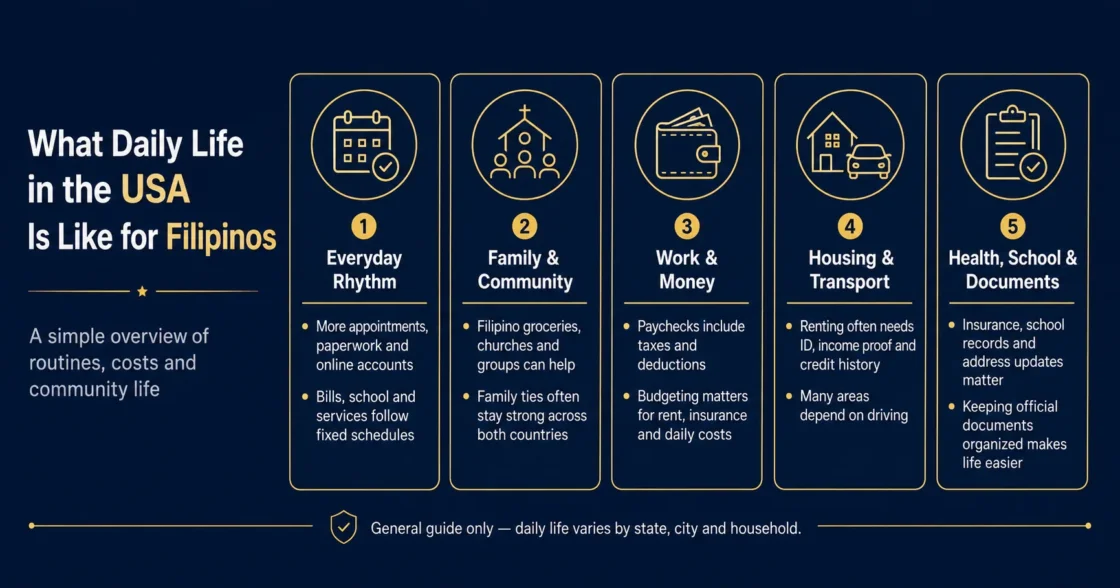
Daily life in the United States can feel familiar in some ways and very different in others for Filipinos. English is widely used, Filipino communities are visible in many major states, and many households keep close family ties across both countries. The bigger adjustment usually comes from the practical rhythm of American life: driving, appointments, paperwork, insurance, rent, taxes, school rules, and the cost of services that may have been handled more informally in the Philippines.
Why this matters →
For Filipino newcomers, daily life in the USA is easier to manage when cultural comfort and official responsibilities are understood together.
How Everyday Life Usually Feels
The main adjustment is not only cultural; it is also practical, financial, and schedule-based.
Many Filipinos arrive in the U.S. with strong English ability, family support, and a good understanding of American media and workplace culture. That can make the first stage less intimidating. Still, everyday life often feels more structured than expected. Appointments must be booked ahead, bills arrive on fixed cycles, documents are checked carefully, and many services depend on online accounts.
In the Philippines, a person may rely more on relatives, local contacts, walk-in offices, and neighborhood familiarity. In the U.S., daily tasks often require proof of identity, proof of address, a debit or credit card, a phone number, and a working email address. These small requirements shape ordinary life more than many newcomers expect.
Tip: A stable phone number, email address, mailing address, and folder for official documents can prevent many first-year problems.
Community and Family Life
Filipino social life in the U.S. often stays close to family, church, food, and community events.
For many Filipinos, daily life becomes easier when there is a nearby Filipino community. In areas with larger Filipino populations, it may be easy to find Filipino groceries, remittance services, churches with Filipino members, cultural associations, Filipino restaurants, and community events. In smaller towns, Filipino life may be quieter and more family-centered, with social connection happening through work, school, church, or online groups.
Family expectations can also change. Some households live with extended family, while others adjust to more independent living because of distance, work schedules, or housing costs. Childcare, elder care, transportation, and household chores may feel different because hired help is usually expensive in the U.S. Many families handle more tasks themselves, from cooking and laundry to school pickup and home maintenance.
Work and Money Routines
Work life is often formal, time-tracked, and closely tied to taxes, benefits, and documentation.
Filipinos in the U.S. work across many fields, including health care, education, hospitality, business services, retail, technology, public service, and caregiving. The workday depends heavily on the job and state, but punctuality, written policies, timekeeping, and payroll records are usually taken seriously.
Pay is often quoted hourly or annually before taxes. The amount deposited into a bank account can be lower than expected because of federal tax withholding, state tax in many states, Social Security and Medicare payroll taxes, insurance deductions, retirement contributions, and other benefits. For newcomers, the first paystub is often the clearest lesson in how U.S. income works.
Important: U.S. tax rules depend on immigration status, tax residency, income type, and time spent in the country. Nonresident aliens may need to file a U.S. tax return if they have U.S. income or work-related tax obligations, and resident aliens may be taxed differently.[b]
Housing, Rent, and Commuting
Where a Filipino household lives often affects cost, transportation, school access, and community support.
Housing is one of the biggest parts of daily life in the U.S. Rent can vary sharply between states, cities, and neighborhoods. Many landlords ask for proof of income, identification, a credit check, references, and a security deposit. New arrivals without U.S. credit history may need a co-signer, a larger deposit where allowed, or a landlord willing to review foreign documents and employment letters.
Commuting also changes the routine. In some cities, public transit is usable for work and school. In many suburbs and smaller cities, driving is almost necessary. Grocery shopping, doctor visits, school activities, church, and work may all require a car. This can be a major adjustment for Filipinos used to jeepneys, tricycles, buses, taxis, or more walkable local errands.
| Daily Area | What Filipinos Often Notice | What Helps |
|---|---|---|
| Renting | Credit history and income proof matter. | Prepare IDs, paystubs, bank records, and references. |
| Transportation | Many places are car-dependent. | Check commute time before choosing housing. |
| Bills | Utilities, internet, phone, and insurance are separate costs. | Track due dates and set reminders. |
| Appointments | Walk-ins are not always available. | Book early and keep confirmation emails. |
Driving and State Rules
Driver licensing is handled by states, so requirements can differ by location.
A Filipino moving to the U.S. should treat driving as a state-level matter. Each state has its own motor vehicle agency, testing process, proof-of-residency rules, Real ID process, vehicle registration steps, and insurance requirements. A license rule that applies in California may not apply in Texas, Florida, New York, Hawaii, or Nevada.
For daily life, the driver’s license often becomes more than permission to drive. It is also a common photo ID for banks, leases, domestic travel screening, age verification, and many routine services. Those who do not drive may still be able to apply for a state ID, depending on state rules.
Tip: Before moving to a new state, check that state’s motor vehicle office for license transfer, written test, road test, insurance, and vehicle registration rules.[c]
Food, Groceries, and Filipino Comfort
Food is one of the easiest ways Filipino households keep home close.
In cities with large Filipino communities, it is often possible to find rice varieties, patis, bagoong, calamansi products, frozen longganisa, tocino, bangus, ube, pan de sal, banana ketchup, and Filipino snacks. Asian supermarkets may also carry ingredients used across Filipino cooking, even when a dedicated Filipino store is not nearby.
Eating out can be more expensive than expected, especially after tax and tip. Many households cook at home more often, pack lunch for work or school, and buy groceries in larger weekly trips. Potlucks, birthdays, church gatherings, and family visits remain part of Filipino social life, but schedules may be tighter because weekends are often used for errands, children’s activities, overtime work, or long drives.
Healthcare and Insurance
Healthcare access is tied closely to insurance, eligibility, networks, and appointment systems.
Healthcare is one of the biggest adjustments for Filipinos in the U.S. A clinic visit, urgent care visit, emergency room visit, lab test, or prescription can cost much more without insurance. Many people get health insurance through an employer. Others may use the Health Insurance Marketplace if eligible, while some qualify for Medicaid or CHIP depending on state rules, income, age, household status, and immigration category.
Lawfully present immigrants may be eligible for Marketplace coverage and may qualify for savings based on income. Medicaid and CHIP eligibility can be more limited and often depends on state rules and immigration category.[d]
Practical note: Keep insurance cards, pharmacy details, doctor names, vaccination records, and emergency contacts in one place. U.S. medical offices often ask for this information before the appointment begins.
Children, Schools, and Language
School routines may feel familiar in purpose but different in paperwork, communication, and parent involvement.
Public school enrollment is usually based on residence, age, and district rules. Schools commonly ask for proof of address, immunization records, birth records, prior school records, and parent or guardian identification. Families should contact the local school district for the exact list because requirements vary.
Federal civil rights guidance states that public elementary and secondary schools may not bar a child from enrollment based on the child’s or parent’s citizenship or immigration status.[e] For Filipino families, the daily adjustment often involves school portals, email updates, parent-teacher conferences, school buses, packed lunches, after-school programs, and activity fees.
Many Filipino children adapt quickly to English-speaking classrooms, especially if they already studied English in the Philippines. Still, parents may need time to understand grading systems, special education services, school calendars, sports rules, and how to request help from teachers or counselors.
Documents That Shape Daily Life
A smoother daily routine often depends on keeping identity, work, tax, and address records organized.
Newcomers often discover that the same documents are requested repeatedly. A passport, visa page, I-94 record when applicable, green card or Employment Authorization Document when applicable, Social Security card, lease, utility bill, school records, marriage certificate, birth certificate, and vaccination records may all be needed at different times.
In general, only noncitizens with permission to work from the Department of Homeland Security can get a Social Security number. Some applicants can request an SSN while applying for work authorization or lawful permanent residence through USCIS processes, while others may need to work directly with Social Security.[f]
Important: Most non-U.S. citizens in the United States must report a change of address to USCIS within 10 days of moving, with limited exceptions. USPS mail forwarding does not replace USCIS address reporting when that rule applies.[g]
Mail, Banking, and Online Accounts
Much of U.S. daily life runs through mail, banking apps, and online identity checks.
Mail is still important in the U.S. Government notices, bank cards, insurance letters, school mail, tax forms, and medical bills may arrive by postal mail. When a household moves, USPS change-of-address forwarding can help reroute mail, but it does not update every sender automatically. Banks, employers, schools, USCIS when applicable, insurance companies, doctors, and state agencies may need separate address updates.
USPS says standard mail forwarding may begin within a few business days, but it is best to allow up to two weeks, and the service has limits by mail type and time period.[h]
Banking can also feel different. A checking account, debit card, credit card, direct deposit, and online bill pay are common parts of daily life. Building U.S. credit history takes time. Paying bills on time, keeping balances low, and avoiding missed payments can matter later for apartments, car loans, phone plans, and other services.
Social Life, Identity, and Belonging
Many Filipinos balance adaptation with keeping language, faith, food, family customs, and Filipino identity alive.
Daily life in the U.S. does not require leaving Filipino identity behind. Many households continue speaking Tagalog, Cebuano, Ilocano, Hiligaynon, Waray, Kapampangan, or another Philippine language at home. Children may grow up switching between Filipino family culture and American school culture. This can be a strength, but it may also need patience across generations.
Some adults feel homesickness most strongly during holidays, family milestones, illness, or the first winter in a colder state. Others feel pressure from remittances, expectations from relatives in the Philippines, or comparison with other migrants. A healthier adjustment usually comes from realistic planning: stable work, manageable bills, community connection, and enough rest.
First Month Priorities
The first month is easier when urgent practical tasks are handled before less urgent plans.
Suggested first-month list:
- Secure a reliable mailing address and keep proof of address.
- Set up a U.S. phone number and email access for official accounts.
- Organize passport, visa, immigration, school, medical, and tax documents.
- Open a bank account if eligible and arrange direct deposit when employed.
- Check health insurance options before medical needs become urgent.
- Review state driver’s license or state ID requirements.
- Register children for school through the local district if applicable.
- Track rent, utilities, phone, insurance, and debt payment due dates.
- Update addresses with official agencies when required.
- Locate nearby Filipino groceries, community groups, clinics, schools, and transit routes.
What Newcomers Should Recheck Over Time
Daily life becomes more stable when rules, addresses, insurance, and documents stay current.
Life in the U.S. can become more predictable after the first year. The routines become clearer: paydays, tax season, school calendars, annual insurance enrollment, car registration, lease renewal, medical checkups, and travel planning. For Filipinos, the strongest adjustment is often learning when something is casual and when it is official. A neighbor’s advice may be helpful, but immigration, tax, school, insurance, and driver licensing matters should still be checked with the correct agency.
Rules for immigration status, health coverage, taxes, state IDs, school enrollment, and public benefits can change. Before making a major decision, Filipino households should recheck the latest official source or ask a qualified professional when the matter affects legal status, money, health coverage, or family records.
Sources
- [a] Pew Research Center, facts about Filipinos in the U.S. Used for Filipino population size, geography, English proficiency, and community context. Pew is a long-running nonpartisan research organization that publishes methodology-based demographic analysis.
- [b] Internal Revenue Service, nonresident alien tax information. Used for general tax filing context for nonresident aliens. The IRS is the U.S. federal tax authority.
- [c] USAGov, state motor vehicle services. Used for state-level driver’s license, vehicle registration, and Real ID direction. USAGov is an official U.S. government information portal.
- [d] HealthCare.gov, health coverage for lawfully present immigrants. Used for Marketplace, Medicaid, CHIP, and immigration-status coverage context. HealthCare.gov is the official federal Marketplace information site.
- [e] U.S. Department of Education, equal rights to public education regardless of immigration or citizenship status. Used for public school access context. The Department of Education is the federal agency responsible for education policy guidance and civil rights resources.
- [f] Social Security Administration, Social Security numbers for noncitizens. Used for SSN eligibility context. SSA is the official federal agency that issues Social Security numbers.
- [g] U.S. Citizenship and Immigration Services, change of address guidance. Used for the 10-day address reporting rule. USCIS is the federal agency that administers many immigration benefits and related address updates.
- [h] U.S. Postal Service, standard mail forwarding and change of address. Used for mail forwarding timing and limits. USPS is the official national postal service of the United States.