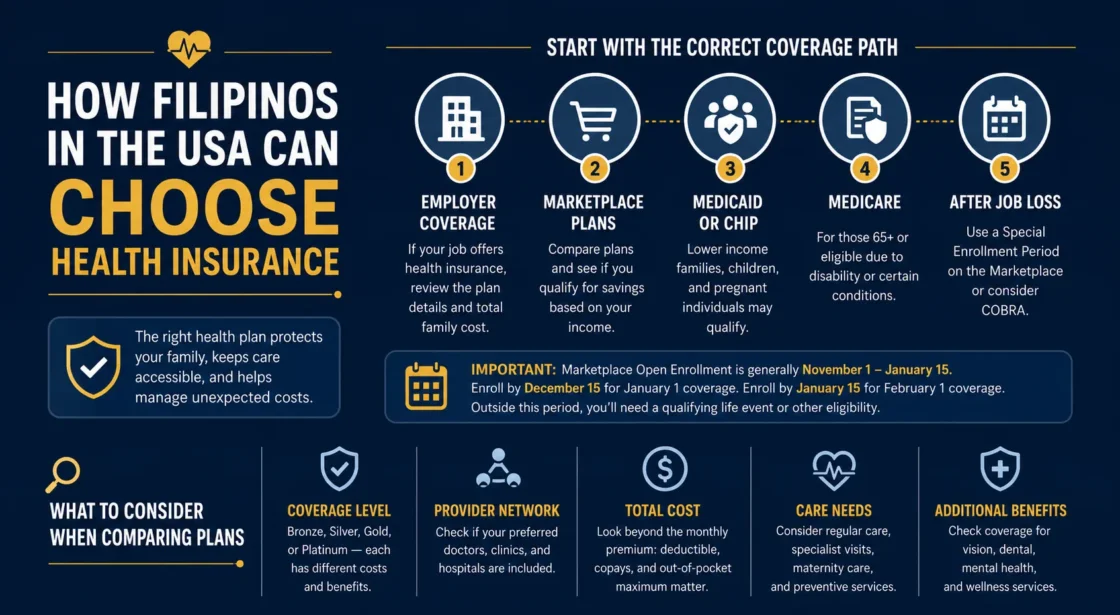
Choosing health insurance in the United States requires more than comparing the monthly premium. Filipino workers, students, new immigrants, families with children, and older adults should match coverage to immigration status, household income, job benefits, state rules, preferred doctors, prescriptions, and expected care needs.
Why this matters →
For Filipino households in the U.S., the right health plan can protect family finances while keeping access to regular care, prescriptions, children’s services, and emergency treatment within reach.
2027 Open Enrollment: For coverage through HealthCare.gov, Open Enrollment starts November 1, 2026. Enroll or change plans by December 15, 2026 for coverage that starts January 1, 2027. Open Enrollment ends January 15, 2027; enrollment from December 16 through January 15 generally starts February 1.[b]
Federal vs. state Marketplace: These dates apply to HealthCare.gov. States that operate their own Marketplace can use different enrollment deadlines, so applicants should check the official Marketplace for their state before relying on the federal dates.[n]
Required Information Before Comparing Plans:
- Current ZIP code and state of residence
- Immigration or citizenship status for each person applying
- Estimated household income for the full calendar year
- Employer health insurance offer, if available
- Names of doctors, clinics, hospitals, and pharmacies the household wants to keep
- Current prescriptions, dosage, and refill frequency
- Expected medical needs, such as pregnancy care, diabetes care, specialist visits, therapy, or children’s checkups
- Social Security numbers or immigration document details when requested by the official application system
Start With The Correct Coverage Path
The first decision is not the plan name; it is the system where the household is allowed to enroll.
Most Filipino residents in the U.S. will compare health insurance through one of five paths: employer coverage, the Health Insurance Marketplace, Medicaid or CHIP, Medicare, or temporary continuation coverage after job loss. Marketplace eligibility generally requires living in the U.S., being a U.S. citizen or national, or being lawfully present, and not being incarcerated.[a]
| Situation | Most Relevant Coverage Path | What To Check First |
|---|---|---|
| Full-time employee with benefits | Employer health insurance | Premium share, deductible, family cost, provider network, and whether the plan meets Marketplace affordability rules |
| Self-employed, contractor, recently arrived, or no job-based plan | Marketplace plan | Eligibility, premium tax credit, Silver plan savings, doctors, and prescriptions |
| Lower income household, child, or pregnant applicant | Medicaid or CHIP | State rules, income limits, immigration status rules, and whether enrollment is open year-round |
| Age 65 or older, or eligible due to disability or certain conditions | Medicare | Part A, Part B, drug coverage, Medicare Advantage, and Medigap needs |
| Recently lost job-based health coverage | Marketplace Special Enrollment Period or COBRA | 60-day Marketplace window, COBRA cost, and when new coverage starts |
IMPORTANT NOTICE: Outside the applicable Marketplace Open Enrollment period, enrollment usually requires a qualifying life event or another Special Enrollment Period. Medicaid and CHIP applications can be made throughout the year. Applicants using a state-based Marketplace should follow that state’s published enrollment calendar rather than assuming every HealthCare.gov deadline applies.[b][n]
Step 1: Confirm Immigration And Residency Eligibility
Health coverage rules can change depending on legal status, state, and program type.
Many Filipinos in the U.S. are citizens, green card holders, work visa holders, student visa holders, permanent residents, or family-based immigrants. For Marketplace coverage, lawfully present immigrants may qualify for private plans and may also qualify for lower costs based on income.[c]
Common immigration categories that may be relevant for Marketplace eligibility include lawful permanent residents, valid nonimmigrant visa holders, certain employment authorization document holders, refugees, asylees, and several humanitarian categories. Status rules should be checked directly through the official eligibility tool before applying.
IMPORTANT NOTICE: Immigration status rules for health coverage are detailed and can change. A person who cannot enroll for personal coverage may still be able to apply on behalf of eligible family members, such as a U.S. citizen child or lawfully present spouse.
Step 2: Check Employer Coverage Before Buying A Marketplace Plan
A job-based offer can affect whether Marketplace savings are available.
If an employer offers health insurance, the employee should review the employee-only cost, family cost, deductible, out-of-pocket limit, covered clinics, and prescription list before choosing another plan. For 2027 coverage, HealthCare.gov states that job-based coverage is considered affordable when the applicable share of the lowest-cost employer plan is less than 10.22% of household income and the plan meets the minimum value standard.[o]
The affordability calculation is not identical for everyone in the family. For the employee, it is based on the premium for self-only coverage. For household members offered coverage through the employee’s job, affordability is based on the premium needed to cover the household members offered that coverage. This means an employee may be ineligible for Marketplace savings while a spouse or children may still qualify if family coverage is not affordable.[o]
Tip: Before declining employer coverage, request the Summary of Benefits and Coverage and the employer’s plan cost for employee-only and family enrollment.
Step 3: Compare Total Yearly Cost, Not Only The Premium
A low monthly premium can still become expensive when care is needed.
Health plans should be compared using the full yearly cost: monthly premium, deductible, copayments, coinsurance, prescription cost, and the out-of-pocket maximum. Marketplace metal categories describe how costs are generally split between the plan and the member; they do not measure quality of care.[e]
| Plan Category | Usually Fits | Watch Carefully |
|---|---|---|
| Bronze | People who use little medical care and want lower monthly premiums | Higher deductible and higher cost when care is needed |
| Silver | Households that may qualify for cost-sharing reductions | Savings on deductibles and copays apply only when eligible members choose a Silver plan |
| Gold | People with regular doctor visits, chronic care, pregnancy needs, or planned procedures | Higher monthly premium than many Bronze or Silver plans |
| Platinum | People who expect higher medical use and want lower cost when receiving care | Often the highest premium and not available everywhere |
Practical Note: A Filipino family with children, regular prescriptions, or a preferred pediatrician may benefit more from a plan with a higher monthly premium but lower care costs, especially if the family uses medical services throughout the year.
Step 4: Review Premium Tax Credits And Silver Plan Savings
Financial help can change which plan is the most sensible choice.
The Premium Tax Credit can lower the monthly cost of a qualified Marketplace plan for eligible households. The IRS states that eligibility depends on factors such as Marketplace enrollment, household income, tax filing status, not being claimed as another person’s dependent, and not being eligible for certain other coverage such as affordable employer coverage, Medicaid, Medicare, CHIP, or TRICARE.[f]
Cost-sharing reductions are separate savings that can lower deductibles, copayments, and coinsurance for eligible Marketplace applicants, but they generally apply only when the eligible person chooses a Silver plan.[g]
ATTENTION: Advance premium tax credits are based on estimated yearly household income. If income changes during the year, the Marketplace application should be updated so the tax credit is not too high or too low at tax filing time.
Step 5: Check Doctors, Hospitals, Pharmacies, And Language Support
Network details often decide whether a plan works in daily life.
Marketplace plan types can affect where care is covered. HMO and EPO plans usually limit coverage to network providers except in emergencies. PPO and POS plans may offer more out-of-network flexibility, but often with higher cost or referral rules.[h]
Filipino households should check the following before selecting a plan:
- Whether the family’s primary care doctor is in network
- Whether preferred hospitals and urgent care clinics are in network
- Whether Filipino, Tagalog-speaking, Ilocano-speaking, Cebuano-speaking, or culturally familiar providers are available when important to the household
- Whether prescriptions are on the plan formulary
- Whether nearby pharmacies are preferred pharmacies under the plan
- Whether referrals are required for specialists
- Whether telehealth visits are covered
- Whether care outside the local area is covered for students, traveling workers, or family members who split time between states
Tip: A doctor’s office may accept an insurance company but not every plan sold by that company. The exact plan name should be confirmed with both the insurer and the provider’s billing office.
Step 6: Consider Medicaid And CHIP For Children And Pregnant Applicants
Some families qualify for free or lower-cost coverage through state programs instead of private plans.
Medicaid and CHIP rules vary by state. Medicaid.gov states that some states provide Medicaid or CHIP coverage to lawfully residing children and pregnant women, including certain people within their first five years of having specific legal status.[i]
For Filipino families with U.S.-born children, mixed immigration statuses, pregnancy, or lower income, Medicaid or CHIP should be checked before assuming a private plan is the only option. Medicaid and CHIP applications can generally be submitted at any time of year through the Marketplace or the state program.
Procedure Note: A Marketplace application may route eligible household members to Medicaid or CHIP while allowing other household members to compare private plans. Different family members can receive different types of coverage.
Step 7: Choose Medicare Carefully For Older Adults
Filipino seniors and older immigrants should review Medicare choices separately from family Marketplace plans.
Medicare is generally for people age 65 or older, with earlier eligibility for some people with disabilities, End-Stage Renal Disease, or ALS. Medicare includes Part A for hospital insurance, Part B for medical insurance, Part D for drug coverage, and the option to choose Original Medicare or Medicare Advantage.[j]
For older Filipino adults, the choice often depends on doctor access, prescription needs, travel pattern, specialist care, and whether a Medicare Advantage network is acceptable. Original Medicare may offer wider provider access, while Medicare Advantage may combine medical and drug coverage through a private plan with its own network and rules.
IMPORTANT NOTICE: Medicare enrollment periods and late enrollment penalties can affect long-term costs. Older adults approaching age 65 should check official Medicare timing before delaying Part B or drug coverage.
Step 8: Compare Marketplace Coverage And COBRA After Job Loss
Losing job-based coverage usually opens more than one option.
After losing job-based health insurance, a person may be able to enroll in a Marketplace plan through a Special Enrollment Period or continue the job-based plan through COBRA. HealthCare.gov states that a Marketplace application generally must be submitted within 60 days of losing job-based coverage for that Special Enrollment Period.[k]
COBRA can allow workers and families to temporarily keep job-based health benefits after certain job or life events, but the cost is often higher because the former employee may pay the full premium plus an administrative charge.[l]
| Option | Best For | Possible Drawback |
|---|---|---|
| Marketplace Plan | People who may qualify for premium tax credits or want a new plan after job loss | Provider network and deductible may differ from the old employer plan |
| COBRA | People who need to keep the same doctors, treatment schedule, or current plan during a transition | Monthly premium can be much higher without employer contribution |
Step 9: Review Preventive Care And Family Needs
The plan should support routine care, not only emergencies.
Most Marketplace health plans must cover certain preventive services at no cost when provided by an in-network medical provider, though coverage details can vary by service and plan rules.[m]
Filipino households should review preventive and family care needs before enrolling:
- Annual physicals and preventive screenings
- Vaccines and child wellness visits
- Pregnancy and postpartum care
- Diabetes, blood pressure, cholesterol, or asthma management
- Mental health visits and therapy coverage
- Dental and vision needs, especially for children
- Prescription refills and mail-order pharmacy options
- Emergency care access near home, work, school, and relatives
Before Enrolling
A final review can prevent avoidable coverage problems after the plan starts.
Before submitting an application or accepting an employer plan, each household should confirm the plan year, monthly premium after any subsidy, deductible, out-of-pocket maximum, provider network, prescription coverage, referral rules, and cancellation rules. The selected plan should match the household’s real medical use, not only the lowest displayed price.
Enrollment Review List:
- Confirm every covered person’s name and date of birth
- Check that the address and ZIP code are correct
- Confirm income estimate for the full calendar year
- Review whether any employer offer was reported correctly
- Search each doctor and hospital by exact plan name
- Check every regular medication in the plan’s drug list
- Save eligibility notices, plan documents, and payment confirmation
- Pay the first premium by the insurer’s deadline so coverage can begin
Health insurance rules, enrollment windows, premiums, subsidies, immigration eligibility, and state program rules can change. Before applying, renewing, or changing coverage, the household should recheck the official Marketplace, Medicare, Medicaid, IRS, employer, or state insurance source that applies to its situation.
Sources
- [a] HealthCare.gov, Marketplace eligibility requirements for U.S. residents, citizens, nationals, and lawfully present non-citizens. This source is relevant to the coverage path section and is reliable because it is the official federal Marketplace website.
- [b] HealthCare.gov, Marketplace enrollment dates and deadlines. Used for the November 1 start, December 15 January-1 coverage deadline, January 15 Open Enrollment end date, and February 1 coverage timing for later enrollments. (Official federal Marketplace resource.)
- [c] HealthCare.gov, health coverage for lawfully present immigrants. This source supports the immigration eligibility section and is reliable because it is maintained by the federal Marketplace.
- [d] HealthCare.gov, job-based coverage and Marketplace savings rules. This source supports the employer coverage section and is reliable because it explains official Marketplace treatment of employer coverage.
- [e] HealthCare.gov, Bronze, Silver, Gold, and Platinum plan categories. This source supports the total yearly cost comparison and is reliable because it is the official Marketplace explanation of plan categories.
- [f] Internal Revenue Service, Premium Tax Credit questions and answers. This source supports the tax credit section and is reliable because it is the U.S. federal tax authority.
- [g] HealthCare.gov, cost-sharing reductions and Silver plan savings. This source supports the out-of-pocket savings section and is reliable because it is the official federal Marketplace resource.
- [h] HealthCare.gov, HMO, PPO, EPO, and POS plan network types. This source supports the provider network section and is reliable because it explains official Marketplace plan type definitions.
- [i] Medicaid.gov, Medicaid and CHIP coverage for lawfully residing children and pregnant women. This source supports the Medicaid/CHIP section and is reliable because it is the official federal Medicaid program site.
- [j] Medicare.gov, parts of Medicare and coverage options. This source supports the Medicare section and is reliable because it is the official U.S. Medicare website.
- [k] HealthCare.gov, options after losing job-based health insurance. This source supports the Marketplace Special Enrollment Period section and is reliable because it is an official federal Marketplace page.
- [l] U.S. Department of Labor, COBRA continuation coverage. This source supports the COBRA section and is reliable because it is the federal agency responsible for employee benefit information.
- [m] HealthCare.gov, preventive health services. This source supports the preventive care section and is reliable because it is an official Marketplace coverage page.
- [n] Centers for Medicare & Medicaid Services — Marketplace Open Enrollment national reporting. Used for the distinction between HealthCare.gov and state-based Exchanges and the fact that state-based Marketplace enrollment deadlines can vary. (Official CMS source.)
- [o] HealthCare.gov — Affordable Coverage. Used for the 2027 employer-plan affordability threshold of 10.22% and the separate affordability treatment for employees and household members. (Official federal Marketplace resource.)