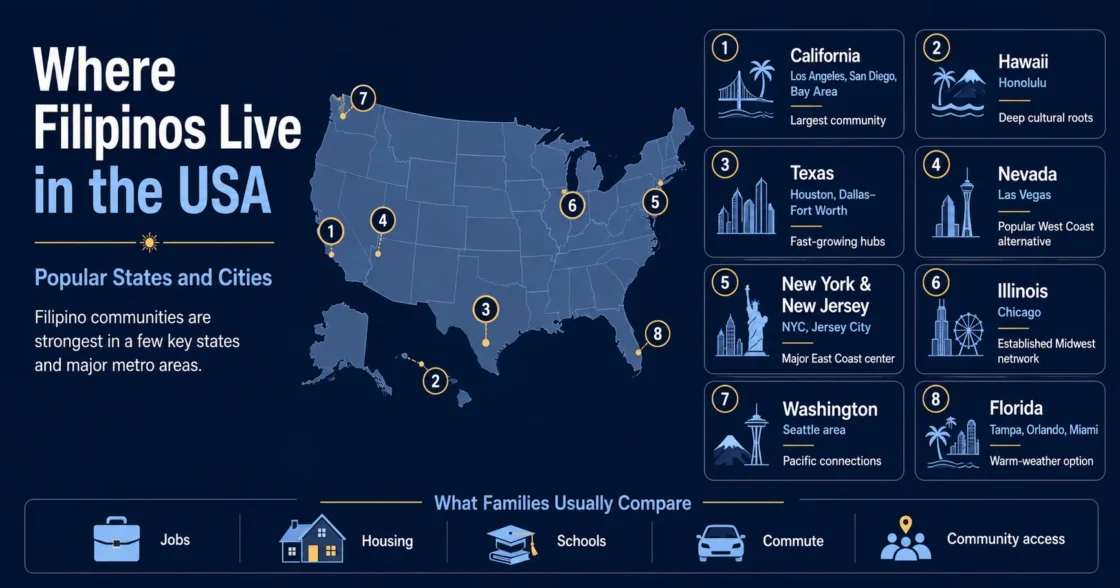
Filipinos in the United States are not spread evenly across the country. The largest communities are concentrated in California, Hawaii, Texas, Florida, Nevada, Illinois, New York, Washington, New Jersey, and parts of Virginia and Maryland. For families choosing where to live, the best state is usually not just the one with the highest Filipino population; it is the place that fits work, housing cost, schools, commute patterns, health care access, and access to Filipino churches, groceries, services, and community networks.
Why this matters →
For Filipino families, location can shape daily support, job access, cultural connection, and how easy it feels to build a stable life in the United States.
Data Note: U.S. population estimates may count “Filipino” in different ways. Some sources count all people who identify as Filipino alone or in combination with another race or origin, while others focus only on immigrants born in the Philippines. These two groups overlap, but they are not the same.
Where Most Filipinos Live in the United States
The largest Filipino communities are found in states with long migration history, strong job markets, military ties, and established family networks.
An estimated 4.2 million people in the United States identified as Filipino alone or in combination with other races or Asian origins in 2023, according to Pew Research Center’s analysis of American Community Survey data.[a] The same profile places California far ahead of every other state, with about 1.6 million Filipinos, or roughly 38% of the U.S. Filipino population.
Several other states have large and visible Filipino communities, even when their totals are much smaller than California’s. Hawaii, Texas, Florida, and Nevada are among the next largest state-level destinations for Filipino Americans. For immigrants born in the Philippines, Migration Policy Institute data also shows a strong concentration in California, followed by Hawaii, Texas, Nevada, and Illinois.[b]
| State | Why Filipinos Often Choose It | Best Fit For |
|---|---|---|
| California | Largest Filipino population, long-established communities, strong health care and service sectors, many Filipino businesses and churches | Families who want the widest Filipino network and can manage higher housing costs |
| Hawaii | Deep Filipino presence, strong cultural familiarity, large Ilocano and Tagalog-speaking communities | Families seeking close community ties and island life, with careful budgeting |
| Texas | Growing metro areas, health care jobs, lower housing costs than many coastal cities, family migration growth | Families prioritizing space, jobs, and newer suburban communities |
| Florida | Health care, hospitality, military and retiree communities, warm climate | Health care workers, retirees, and families preferring warm weather |
| Nevada | Large Las Vegas-area community, service jobs, hospitality, health care, and West Coast proximity | Workers tied to hospitality, health care, and lower-cost alternatives to California |
| Illinois | Chicago-area jobs, hospitals, universities, and older Midwest Filipino networks | Families seeking a large metro area outside the West Coast |
| New York and New Jersey | Large metro economy, health care, finance, education, and dense immigrant communities | Workers who need access to the New York metro job market |
| Washington | Seattle-area tech, health care, military ties, and Pacific connections | Professionals and families seeking West Coast access outside California |
Tip: A large Filipino population can make daily life easier, but housing cost and commute time should be checked before choosing a city.
Popular Metro Areas and Cities
Most Filipino communities are built around metro areas, not just state borders.
The largest Filipino populations are found in major metropolitan regions. Pew Research Center lists the Los Angeles, San Francisco, and New York metro areas among the largest Filipino population centers in the country.[a] For Filipino immigrants specifically, the greater Los Angeles, San Francisco, and New York areas together account for a large share of the U.S. Filipino immigrant population, while Honolulu has one of the strongest Filipino-born population shares among major metro areas.[b]
Los Angeles and Southern California
Southern California remains one of the most familiar settlement regions for Filipinos. Los Angeles County and nearby areas offer Filipino restaurants, grocery stores, churches, medical workers’ networks, community events, and services in Tagalog and other Philippine languages. Many families also consider cities in Los Angeles County, Orange County, Riverside County, and San Bernardino County because they offer different balances of job access and housing cost.
San Diego
San Diego has a long Filipino presence connected to the U.S. Navy, health care, education, and family migration. The area can be attractive for families who want a strong Filipino community in a coastal city, though housing costs can be high.
San Francisco Bay Area
The Bay Area has deep Filipino roots, especially in Daly City, South San Francisco, Vallejo, Union City, and nearby communities. The region offers strong job access in health care, technology, public services, and education, but it is also one of the most expensive housing markets in the country.
Honolulu and Other Parts of Hawaii
Hawaii is culturally familiar for many Filipinos because Filipino communities have been part of local life for generations. The state has strong Ilocano, Tagalog, and other Philippine language communities. Housing, groceries, and inter-island travel can be costly, so family support and job stability matter before relocating.
Las Vegas
Las Vegas has become a major Filipino population center, especially for families moving from California or entering hospitality, health care, business services, and public-sector work. Compared with many California cities, housing may be more reachable, though wages, school districts, and heat should be reviewed carefully.
Houston and Dallas-Fort Worth
Texas has growing Filipino communities in Houston, Dallas-Fort Worth, San Antonio, and Austin. Health care, engineering, energy, education, and service industries attract many Filipino professionals and families. Suburban living is common, so transportation and commute distance are practical concerns.
New York City, Northern New Jersey, and Long Island
The New York metro area offers one of the largest Filipino communities outside the West Coast. Queens, Jersey City, Bergen County, Long Island, and nearby areas are common reference points. The region is attractive for health care, finance, education, and service work, but housing and transit costs vary widely by neighborhood.
Chicago
Chicago and its suburbs have older Filipino networks tied to hospitals, universities, churches, and professional associations. It may suit families who want a large city with Midwest access, though winter weather and property tax differences should be part of the decision.
Before Choosing a State or City:
- Check whether the area has job openings in the household’s main profession.
- Compare rent, transportation, utilities, and health insurance costs.
- Review school districts if children will attend public school.
- Look for nearby Filipino groceries, churches, community centers, and services.
- Confirm whether public transportation is realistic or a car is needed.
- Check state income tax, sales tax, and local cost differences.
- Consider weather, commute time, and distance from relatives.
Why California Has the Largest Filipino Population
California’s role comes from history, geography, employment, and family migration patterns.
California has been a major destination for Filipinos because of Pacific migration routes, military and naval ties, agricultural and service-sector history, health care employment, and family-based migration. Once a large community is established, new arrivals often choose the same region because housing leads, job referrals, church communities, and family support are easier to find.
California also offers the widest range of Filipino community institutions. In many cities, Filipino residents can find Tagalog-speaking professionals, Filipino food businesses, cultural organizations, Filipino American student associations, and community events. This can reduce the feeling of isolation for newcomers, especially older relatives or newly arrived family members.
Important: A strong Filipino community does not automatically mean a city is affordable. Parts of California, Hawaii, New York, New Jersey, and Washington can have high rent, high home prices, or long commutes. Housing cost should be checked with current local listings before a move.
States With Strong Filipino Community Life
Some states stand out because Filipino culture is visible in daily life, not only in population charts.
California
California offers the broadest Filipino community infrastructure in the country. Daly City, Los Angeles-area communities, San Diego, Vallejo, Union City, and parts of Orange County are often associated with Filipino American life. The main tradeoff is cost, especially in coastal counties.
Hawaii
Hawaii has one of the most visible Filipino communities in everyday life. Filipino languages, foods, churches, and family networks are familiar across the islands. The main tradeoff is the high cost of living and limited housing supply in many areas.
Nevada
Nevada, especially the Las Vegas area, attracts Filipino families looking for a large community with easier access to the West Coast. It may appeal to workers in hospitality, health care, logistics, business services, and public agencies.
Texas
Texas is popular for families seeking larger homes, growing job markets, and suburban communities. Houston and Dallas-Fort Worth are often the main choices, while Austin and San Antonio may appeal to workers in technology, education, government, military, and medical fields.
New York and New Jersey
The New York-New Jersey area is strong for Filipino workers in health care, education, caregiving, finance, restaurants, and professional services. It also offers dense community networks, but rent and transportation planning are important.
How Filipino Settlement Patterns Differ by Need
The best location depends on the household’s reason for moving.
| Need | States or Areas Often Considered | What to Check First |
|---|---|---|
| Strong Filipino community | California, Hawaii, Nevada, New York-New Jersey, Illinois | Community access, rent, commute, and proximity to relatives |
| Health care jobs | California, Texas, Florida, New York, New Jersey, Illinois, Washington | Licensing, pay range, hospital networks, and commute |
| Lower housing cost than coastal California | Texas, Nevada, Arizona, parts of Florida, parts of Illinois | Salary differences, car costs, utilities, and school zones |
| Retirement or warm weather | Florida, Nevada, California inland areas, Hawaii where affordable | Health care access, insurance, housing, and family support |
| Public transit access | New York City, parts of New Jersey, San Francisco Bay Area, Chicago, Honolulu | Actual commute route, monthly transit cost, and safety after work hours |
What Newcomers Should Know Before Moving Near a Filipino Community
A good move balances cultural comfort with practical stability.
Living near other Filipinos can help with church life, food access, language comfort, child care referrals, elder support, and trusted local recommendations. It can also make the first months in the United States feel more manageable for a newly arrived spouse, parent, student, or worker.
Still, community size should not be the only measure. A city with a smaller Filipino population may be a better fit if it offers steady employment, lower rent, better schools, shorter commutes, or stronger support from relatives already living nearby.
Tip: When comparing two cities, use a monthly household budget instead of only comparing rent. Car payments, insurance, fuel, health coverage, child care, and taxes can change the real cost of living.
Understanding Filipino Population Numbers
Population estimates are useful, but the definition behind each number matters.
The Census Bureau’s American Community Survey publishes estimates for Asian groups, including Filipino alone or in any combination, through detailed tables such as B02018.[c] These estimates are not the same as a direct count of every Filipino person living in a city. They are survey-based estimates and may include margins of error, especially in smaller places.
For local planning, it is helpful to separate three ideas:
- Filipino American population: People who identify as Filipino, including U.S.-born and foreign-born residents.
- Filipino immigrant population: People born in the Philippines who now live in the United States.
- Filipino community presence: The practical visibility of Filipino life, such as stores, churches, schools, services, family networks, and events.
Useful Context: A smaller city can still feel very connected if Filipino families are concentrated in certain neighborhoods, churches, schools, or professional networks. A larger metro area may have more Filipinos overall but feel spread out across long distances.
Choosing Between a Large Filipino Hub and a Smaller Community
Both options can work well when the household’s priorities are clear.
A large Filipino hub can be useful for families who want cultural familiarity, language access, Filipino food, community events, and referral networks. It can also help seniors and newly arrived relatives adjust more easily.
A smaller community may be better when the goal is lower housing cost, less traffic, stronger school options, or a specific job opportunity. Filipino families in smaller cities often build support through churches, school communities, professional groups, and regional gatherings rather than dense neighborhood clusters.
- Choose a large hub when family support, cultural comfort, and Filipino services are the top priorities.
- Choose a smaller city when affordability, school fit, and job stability matter more than community size.
- Choose a suburb carefully by checking commute time, school zoning, public transportation, and access to Filipino groceries or services.
Sources
- [a] Pew Research Center, Facts about Filipinos in the U.S. — Used for 2023 Filipino population estimates, state distribution, metro-area population references, nativity, and language context. Pew is a long-running nonpartisan research organization that publishes methodology and data notes.
- [b] Migration Policy Institute, Filipino Immigrants in the United States — Used for Filipino immigrant settlement patterns by state, county, and metro area. MPI is a policy research institute that bases its profiles on Census Bureau ACS data and publishes source notes.
- [c] U.S. Census Bureau, ACS Table B02018: Asian Alone or in Any Combination by Selected Groups — Used for the definition and official ACS table structure for Filipino alone or in any combination estimates. The Census Bureau is the official U.S. federal statistical agency for ACS data.