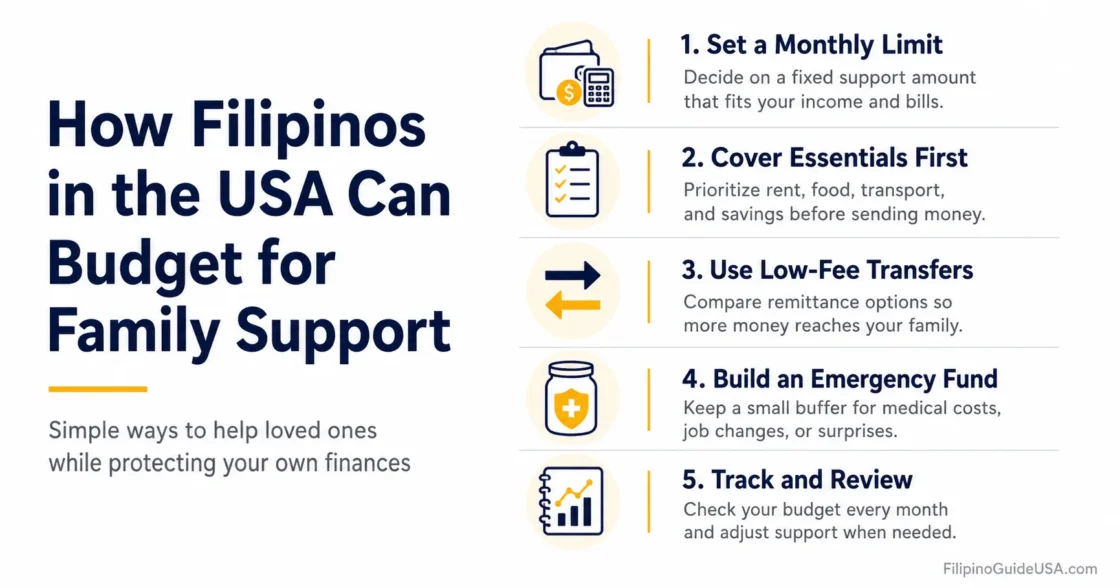
Family support is part of financial life for many Filipinos in the United States. It may cover groceries in the Philippines, a parent’s medicine, a sibling’s tuition, an emergency hospital bill, or help for relatives settling into U.S. life. The safest budget is not based on guilt, habit, or whatever amount is requested first. It starts with the sender’s U.S. obligations, then sets a clear support amount that the family can understand and plan around.
Why this matters →
Family support works best when it protects loved ones without putting the sender’s rent, insurance, savings, immigration plans, or tax responsibilities at risk.
Before Setting the Support Amount: Prepare one month of U.S. income details, fixed bills, debt payments, savings goals, regular family needs, expected remittance fees, and a list of emergency situations that would justify extra help.
Start With The U.S. Household Budget
The support amount should be calculated after U.S. living costs are protected, not before.
A Filipino worker or family in the U.S. may earn in dollars, but U.S. expenses are also in dollars. Rent, utilities, transportation, insurance, childcare, debt payments, and food must be counted before deciding how much can be sent or given to relatives. Consumer.gov recommends making a monthly plan, tracking daily spending, and reviewing the plan at the end of each month so the next budget is more accurate.[b]
For workers with hourly pay, overtime, seasonal work, tips, or gig income, the safest method is to use a conservative monthly income number. A household should not base regular family support on its best month. A better number is the lower average of the last three to six months after taxes and payroll deductions.
| Budget Area | What To Include | Why It Matters For Family Support |
|---|---|---|
| Fixed U.S. Bills | Rent or mortgage, utilities, phone, internet, insurance, car payment, minimum debt payments | These bills usually have due dates and penalties, so they should be funded before remittances. |
| Variable Living Costs | Groceries, gas, transit, medicine, school expenses, clothing, household items | Underestimating these costs often causes credit card use after sending money. |
| Savings And Buffer | Emergency fund, car repair fund, medical deductible, immigration or travel fund | A sender with no buffer may need to borrow during the next emergency. |
| Family Support | Regular padala, U.S.-based family help, school support, medical support, special requests | Keeping this as a separate line makes the amount visible and easier to control. |
Tip: Treat family support as a planned budget category, not as whatever remains after emotional decisions.
Set A Support Ceiling Before Requests Arrive
A support ceiling gives the family a clear limit before pressure, emergencies, or last-minute requests appear.
A practical support ceiling can be calculated with a simple rule:
Monthly take-home income − essential U.S. expenses − debt payments − savings target = maximum possible family support.
The final support amount may be lower than the maximum. For example, if $500 remains after essential expenses and savings, the regular support amount does not need to be $500. The household may choose $250 or $300 and keep the rest for irregular costs such as car registration, winter heating, school supplies, or medical copays.
For many Filipino families, the difficult part is not the math. It is explaining the boundary. A clear monthly amount helps relatives in the Philippines plan their own spending instead of assuming that extra dollars can always be sent.
| Type Of Support | Recommended Budget Treatment | Example Boundary |
|---|---|---|
| Regular Household Help | Set one fixed monthly amount. | “This amount is for food, utilities, and basic household needs.” |
| Education Support | Pay by term, semester, or school billing cycle when possible. | “Tuition support is separate from daily spending money.” |
| Medical Support | Request a bill, prescription, or hospital estimate before sending extra money. | “Medical help is reviewed case by case.” |
| Emergency Requests | Use an emergency fund only for defined urgent needs. | “Emergency help is not available for non-urgent purchases.” |
| Long-Term Goals | Separate from monthly padala. | “House repair, business capital, and migration expenses need a separate plan.” |
Separate Regular Padala From Emergency Help
Regular support and emergency support should not come from the same mental account.
The Consumer Financial Protection Bureau explains that the right emergency savings amount depends on a household’s situation and past unexpected expenses. It also notes that even small, consistent contributions can help create more financial security.[c]
For Filipinos supporting relatives, this means the U.S. household should have two separate plans:
Regular support: The monthly amount sent for known family needs.
Emergency support: A separate reserve for urgent medical, safety, housing, or family crisis needs.
Practical Boundary: An emergency fund should not be treated as a second monthly remittance account. If emergency money is used, the next budget should include a plan to rebuild it before increasing regular support.
A household that sends the same amount every month but has no emergency reserve may feel generous in the short term and trapped later. A better approach is to send a stable monthly amount and build a separate reserve for true emergencies.
Make Remittances Transparent, Not Just Frequent
The amount received in pesos matters more than the amount sent in dollars.
Remittances are a major financial link between overseas Filipinos and families in the Philippines. Bangko Sentral ng Pilipinas data show overseas Filipino cash remittances of $35.63 billion in 2025, with the United States listed as a large source country.[a] This does not mean every household should send more. It means remittance decisions should be planned carefully because they are often part of regular family survival, education, and healthcare spending.
Before sending money, compare the total cost, not only the advertised fee. The CFPB says remittance transfer providers must provide information such as fees, taxes, exchange rate, expected amount delivered, availability date, cancellation rights, error steps, and complaint instructions.[d] The World Bank’s Remittance Prices Worldwide database also tracks remittance costs and reported a global average cost of 6.36 percent of the amount sent in its highlighted Q3 2025 data.[e]
| Before Sending | Question To Ask | Why It Protects The Budget |
|---|---|---|
| Fee | How many dollars are charged for this transfer? | A low transfer amount can become expensive if the fee is high. |
| Exchange Rate | What peso rate will be used? | A weaker rate can reduce what the family receives even when the fee looks low. |
| Recipient Amount | How many pesos should the family receive? | This is the number the family can actually budget. |
| Delivery Method | Will it go to a bank account, wallet, cash pickup, or door-to-door service? | Some methods may be faster but cost more or create pickup delays. |
| Timing | When will the money be available? | Late delivery can affect rent, tuition, medicine, or bill due dates in the Philippines. |
DANGER: Do not send money only because a transfer app shows “no fee.” The exchange rate, receiving method, and amount delivered can still change the real cost. Keep receipts and check the final peso amount before making the same provider a monthly habit.
Build A Shared Budget With The Receiving Family
The sender’s budget and the receiving household’s budget need to match each other.
A common problem is that the sender budgets in dollars while the family spends in pesos without a shared monthly plan. This can cause repeated extra requests even when the sender believes the monthly amount is enough.
The receiving family should know what the support is meant to cover. A simple written plan can separate basic needs from optional spending. It does not need to be formal. A shared note, spreadsheet, or messaging app list can be enough.
| Receiving Household Category | What To Track | Planning Note |
|---|---|---|
| Food And Household Basics | Rice, groceries, cooking gas, drinking water, toiletries | This should be the first line if the support is for daily needs. |
| Utilities | Electricity, water, internet, phone load | Ask for due dates so money is not requested at the last minute. |
| Health | Maintenance medicine, checkups, lab tests, hospital bills | Regular medicine should be planned separately from emergency treatment. |
| Education | Tuition, uniforms, projects, transportation, exam fees | School expenses often come in waves, so they need advance notice. |
| Debt | Loans, credit cards, informal borrowing, payment dates | Debt payments should be visible so remittances do not silently disappear. |
| Local Savings | Small emergency cash, medicine reserve, school reserve | Even a small local buffer can reduce urgent requests to the U.S. sender. |
Tip: When a family says the monthly amount is not enough, ask for categories and due dates before increasing the regular remittance.
Handle Tax And Recordkeeping Carefully
Family support is personal financial help, but U.S. tax rules can still matter for larger amounts or dependent claims.
Money sent to relatives is usually a personal gift or support payment, not a business expense. The IRS states that gifts generally cannot be deducted on a federal income tax return unless they are deductible charitable contributions. The IRS gift tax FAQ also lists the annual gift exclusion amount for 2026 as $19,000 per donee.[f]
Supporting a relative financially does not automatically mean the person can be claimed as a dependent. IRS dependent rules generally require a dependent to be a U.S. citizen, U.S. resident alien, U.S. national, or a resident of Canada or Mexico, along with other tests.[g] Many relatives living in the Philippines will not meet that general residency rule, even if the sender provides more than half of their support.
IMPORTANT WARNING: Large family gifts, repeated support transfers, and dependent claims should be reviewed with a qualified tax professional when the amounts are high or the household plans to claim tax benefits. Rules can change by tax year, filing status, residency, and relationship.
Recordkeeping does not need to be complicated. Keep transfer receipts, dates, recipient names, amounts sent, amount received, and the reason for support. This helps the sender review the budget, answer bank questions if needed, and prepare for tax conversations when support becomes large.
Protect The Sender’s Long-Term Stability
A family support plan should not quietly replace savings, insurance, retirement, or debt repayment.
Many Filipino households carry responsibility in two directions: building life in the U.S. while helping family in the Philippines. The budget should protect both sides. Sending money while ignoring U.S. credit card balances, car insurance, health insurance, or retirement savings may create a future burden for the sender and the family.
A safer support plan leaves room for:
Emergency savings for the U.S. household.
Debt reduction so interest does not grow faster than income.
Insurance and medical costs that prevent a small problem from becoming a larger one.
Retirement savings so family members are not later asked to support the sender.
Immigration, travel, or document costs if the household is planning future petitions, visits, or family reunification.
Practical Rule: If regular support can only continue by using credit cards, skipping insurance, delaying rent, or stopping emergency savings completely, the amount is higher than the household can safely sustain.
Use A Monthly Review Instead Of A Yearly Reset
Small monthly reviews prevent family support from drifting beyond the household’s real capacity.
A monthly review can be simple and direct. The sender should compare planned support with actual transfers, note any extra requests, check whether savings still happened, and decide whether the next month needs a change.
Review U.S. take-home income. Use actual deposited income, not gross salary.
Check fixed bills and debt payments. Confirm that no payment was delayed because of family support.
Compare planned support with actual support. List every transfer, cash gift, bill payment, or U.S.-based family expense.
Identify repeat extra requests. If the same need appears every month, it may belong in the regular budget or require a family discussion.
Rebuild emergency savings after use. Extra support should not permanently drain the sender’s safety reserve.
Update the family agreement. If income, rent, health costs, or exchange rates change, the support amount may need to change too.
The most workable family support plan is clear, repeatable, and honest about limits. It helps relatives plan around a reliable amount while allowing the sender to stay financially stable in the United States. Financial, tax, remittance, and recordkeeping rules can change, so official sources should be checked again before relying on any amount, deadline, or tax-year figure.
Sources
[a] Bangko Sentral ng Pilipinas, Overseas Filipino Cash Remittances by Country and Source — used for official remittance totals and U.S. source figures. This source is reliable because it is the Philippine central bank’s official statistical table.
[b] Consumer.gov, Making a Budget — used for monthly budgeting steps and spending review guidance. This source is reliable because Consumer.gov is a U.S. government consumer education site.
[c] Consumer Financial Protection Bureau, An Essential Guide to Building an Emergency Fund — used for emergency savings planning. This source is reliable because the CFPB is a U.S. federal consumer finance agency.
[d] Consumer Financial Protection Bureau, Remittance Transfer Rights — used for required remittance disclosures, cancellation rights, and receipt information. This source is reliable because it explains U.S. federal consumer protections for money transfers.
[e] World Bank, Remittance Prices Worldwide — used for global remittance cost context. This source is reliable because it is a World Bank database tracking remittance prices across corridors.
[f] Internal Revenue Service, Frequently Asked Questions on Gift Taxes — used for gift deductibility and the 2026 annual gift exclusion figure. This source is reliable because it is the official U.S. tax authority.
[g] Internal Revenue Service, Dependents — used for general dependent eligibility rules. This source is reliable because it is the official IRS page for dependent tax rules.