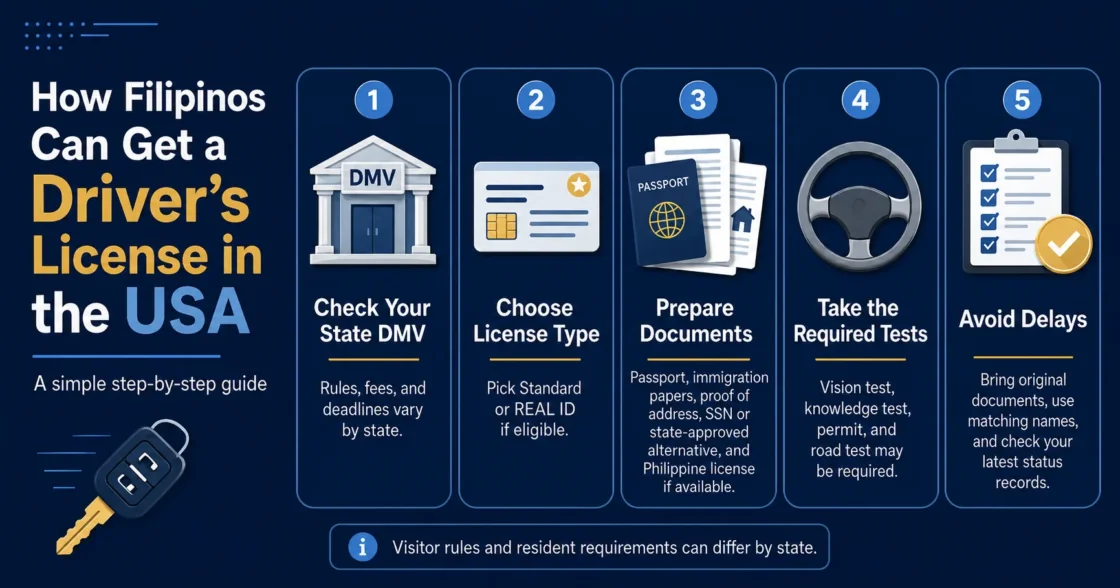
Getting a U.S. driver’s license is usually handled by the state where a person lives, not by one national licensing office. For Filipinos arriving as immigrants, workers, students, spouses, permanent residents, or long-term visitors, the correct path depends on residence, immigration documents, Social Security number status, and whether the license also needs to work as a REAL ID for domestic travel.
Why this matters →
A driver’s license can affect daily life in the U.S., from commuting and school drop-offs to banking, housing, and airport identification.
Required Documents: Most DMV offices require original documents, not photocopies. Exact rules vary by state, but applicants should usually prepare:
- Valid Philippine passport or other accepted identity document
- U.S. immigration document, such as a Permanent Resident Card, visa record, Form I-94, EAD, Form I-20, DS-2019, I-797 approval notice, or other status document that applies to the case
- Proof of local state residence, usually two documents showing name and address
- Social Security number, if issued, or the state-approved alternative if no SSN is available
- Valid Philippine driver’s license, if the applicant already has one
- International Driving Permit or certified translation if required by the state or rental company
- Appointment confirmation, completed application, and payment method accepted by the DMV
Who Can Apply for a U.S. Driver’s License
This section explains why the answer depends on state residence and license type.
U.S. citizenship is not automatically required for a state driver’s license. State motor vehicle agencies set licensing rules, and non-citizens may be able to apply if they meet that state’s identity, residence, testing, and document requirements. USA.gov notes that driving rules for non-citizens depend on the state being visited or lived in, and travelers may need an International Driving Permit along with a home-country license in some places.[a]
The first question is not “Can a Filipino apply?” but “Is the person a visitor or a resident of a U.S. state?” Visitors may be allowed to drive temporarily with a valid Philippine license, while residents usually need to apply for a state license after the state’s allowed period.
Important Notice: A Philippine driver’s license or International Driving Permit is not a substitute for a state driver’s license once a person becomes a resident under that state’s rules. Residence deadlines are state-specific and should be checked before driving regularly.
Step 1: Check The DMV Rules In The State Of Residence
The application starts with the state DMV, not a federal agency.
Each state has its own agency name. It may be called DMV, MVA, RMV, DPS, DDS, or Secretary of State. The state website should be used before scheduling an appointment because document lists, fees, testing rules, and name-matching requirements can differ.
For Tourists And Short-Term Visitors
Filipino tourists should check the DMV rules for every state where they plan to drive. Some states accept a valid foreign license for visitors, while others may expect an International Driving Permit or English translation. Car rental companies may also set their own document requirements.
For New Residents, Workers, Students, And Family Immigrants
Longer-term residents usually need a state license. This includes many green card holders, employment visa holders, international students, exchange visitors, spouses, dependents, and people who have moved to a state for work, school, or family reasons.
Tip: Search the official state DMV site for “new resident driver license,” “non-citizen driver license,” or “foreign license” before making an appointment.
Step 2: Decide Between A Standard License And REAL ID
A license for driving and a license for federal identification are not always the same.
A standard state driver’s license allows legal driving when issued validly by the state. A REAL ID-compliant license meets federal identification standards for certain federal uses. TSA states that, as of May 7, 2025, non-REAL ID state licenses and IDs are no longer accepted as valid airport checkpoint identification unless the traveler has another acceptable ID, such as a passport.[b]
Attention: A standard license may let a person drive but may not be accepted for boarding domestic flights or entering certain federal facilities. A Philippine passport, U.S. passport, Permanent Resident Card, or other TSA-accepted ID may still be used when applicable.
For many Filipino immigrants and temporary residents, applying for REAL ID can be useful, but it may require proof of lawful presence and stricter document review. If the applicant only needs permission to drive, a standard license may be enough where the state offers it.
Step 3: Prepare Identity, Immigration, SSN, And Address Documents
Most application delays happen because documents do not match or are incomplete.
| Document Area | What It Usually Proves | Common Examples |
|---|---|---|
| Identity | Full legal name and date of birth | Passport, green card, EAD, or other state-accepted identity record |
| Lawful Presence Or Eligibility | Immigration status or state license eligibility | I-94, visa-related document, I-20, DS-2019, I-797, Permanent Resident Card, or EAD |
| Social Security | SSN record or approved alternative | SSN card, W-2, pay record, SSA ineligibility letter, or state-specific affidavit |
| State Residence | Local address in the licensing state | Lease, utility bill, bank statement, school record, insurance bill, or official mail |
The Social Security Administration explains that some non-citizens may request a Social Security number if they work, attend school, or have another valid reason allowed by SSA rules.[c] If no SSN is available, the DMV may require a state-approved alternative, such as an SSA letter or signed declaration, depending on state law.
Document Note: Names should match across passport, immigration records, SSN records, lease, school records, and DMV forms. If a married name, middle name, or suffix appears differently, bring the official name-change document requested by the state.
Step 4: Expect Immigration Document Verification
Some applicants may need extra time because DMV systems verify immigration records.
Many licensing agencies use federal verification tools when a non-citizen applies for a license or ID. USCIS explains that SAVE allows registered government agencies to verify immigration status for public benefits and licenses, but the licensing agency still decides whether the applicant qualifies.[d]
If the DMV cannot verify a record immediately, the application may be paused while additional verification is completed. This does not always mean denial. It often means the DMV needs the newest immigration document, an updated I-94, a corrected name record, or time for a recent USCIS approval to appear in the system.
Important Notice: Applicants with a pending extension, recent visa change, OPT/STEM OPT update, H-1B transfer, green card approval, or new EAD should bring the newest document available. A license may be delayed if the DMV cannot verify current status.
Step 5: Apply For A Permit Or First License
Most states use a permit, knowledge test, vision screening, and road test path.
The usual process starts with an application, document review, vision screening, and knowledge test based on the state driver’s handbook. Virginia DMV, for example, describes the application process as driver training where required, proper documents and fee, and relevant tests.[e]
- Complete the online or paper driver’s license application required by the state.
- Schedule an appointment if the DMV office requires one.
- Bring original identity, immigration, SSN, and address documents.
- Take the vision screening.
- Take the written or computer-based knowledge test.
- Receive a learner permit if required.
- Practice driving under the state’s permit restrictions.
- Schedule and pass the road test.
- Receive a temporary license or receipt if issued, then wait for the card by mail.
Tip: Study only the official state driver’s handbook. Road signs, school bus rules, right-of-way rules, and parking rules can differ from Philippine driving habits.
Step 6: Use The Philippine License Correctly
A Philippine license can help in some situations, but it does not create a national conversion right.
A valid Philippine driver’s license may help prove prior driving experience or allow temporary visitor driving where state law permits. It may also help with some state testing or learner permit rules, but the United States does not have one national rule that automatically converts a Philippine license into a U.S. license.
The Automobile Association Philippines lists the United States among countries where a Philippine International Driving Permit may be accepted and notes that local driving laws at the destination should still be checked.[f] The IDP is best understood as a translation and supporting document, not a standalone license.
Practical Note: A Filipino visitor should carry the valid Philippine driver’s license together with the IDP when required. Carrying only the IDP is not enough because the permit supports the home license.
State Examples That Often Affect Filipino Applicants
These examples show why checking the exact state rule matters.
| State Example | What Filipino Applicants Should Notice |
|---|---|
| New York | New York says a person can drive with a valid foreign license unless they become a New York resident, and non-citizens can apply for certain license or ID types depending on eligibility.[g] |
| Florida | Florida lists document requirements for non-immigrants applying in person, including primary identification and DHS-related documents for a REAL ID-compliant license or ID.[h] |
| California | California states that non-U.S. citizens who can prove current legal presence may be eligible for a REAL ID driver’s license or ID, with temporary legal status cards tied to the legal presence document date.[i] |
| Virginia | Virginia explains that a valid foreign license may help meet some licensing requirements, but applicants from non-reciprocal countries still need required testing.[j] |
Common Reasons Applications Are Delayed
Small document issues can create extra DMV trips.
- The passport name does not match the SSN, lease, school record, or immigration record.
- The applicant brings photocopies when the DMV requires originals.
- The address proof is too old or does not show the applicant’s full name.
- The I-94, I-20, DS-2019, I-797, or EAD is not the newest version.
- The applicant chooses REAL ID but cannot provide the stricter document set.
- The state requires a certified translation or IDP for a non-English foreign license.
- The applicant arrives without an appointment where appointments are required.
- The road test vehicle lacks valid registration, insurance, or inspection where required.
Before Going To The DMV:
- Confirm the exact license type: standard, REAL ID, permit, or state-specific driving privilege card.
- Print or save the official DMV document checklist for the state.
- Use the same full legal name on all forms.
- Bring the valid Philippine license if already licensed in the Philippines.
- Bring two address proofs if the state requires them.
- Check whether a knowledge test appointment and a road test appointment are separate.
- Keep copies for personal records, but bring originals to the DMV.
Frequently Asked Questions
These answers address the questions Filipino applicants commonly face before visiting a DMV office.
Can A Filipino Tourist Drive In The U.S. With A Philippine License?
Often yes for a limited visitor period, but the rule depends on the state. Some states or rental companies may expect an International Driving Permit or certified translation. A tourist should check each state where driving will happen.
Can A Philippine License Be Exchanged Directly For A U.S. License?
There is no single nationwide Philippine-to-U.S. license exchange. Some states have reciprocity with certain countries, but applicants with Philippine licenses should expect to take at least the state knowledge test and road test unless the specific DMV says otherwise.
Is A Social Security Number Always Required?
No single answer applies nationwide. Some applicants must provide an SSN if one has been issued. Others may use a state-approved alternative, such as an SSA ineligibility letter or state affidavit, if the state allows it.
Does A REAL ID Prove U.S. Citizenship?
No. A REAL ID-compliant license is a federally accepted form of identification for certain uses, but it is not the same as proof of U.S. citizenship. Non-citizens with qualifying documents may be eligible for REAL ID in many states.
Can A Student Or Temporary Worker Get A License?
Many students and temporary workers can apply if they meet state document and residence rules. The license expiration date may be tied to the immigration document expiration date in some states.
What If The DMV Says Immigration Verification Is Pending?
The applicant should ask for the verification case information, confirm that the DMV entered the latest document numbers correctly, and return with updated documents if USCIS or school records changed. The DMV, not the applicant, completes the license decision after verification returns.
When To Recheck Official Rules
Driver licensing rules can change, especially for non-citizen applicants and REAL ID use.
Rules should be checked again before applying, renewing, moving to another state, changing immigration status, or relying on a license for domestic air travel. State DMV pages, TSA identification rules, SSA guidance, and USCIS verification information should be treated as the controlling sources for current requirements.
Verification Note: Driver’s license rules, REAL ID requirements, accepted documents, fees, and appointment systems can change. Before visiting a DMV office, the applicant should confirm the latest requirements on the official state DMV website and any relevant federal source.
Sources
- [a] USA.gov, “Driving in the U.S. if you are not a citizen” – used for state-based non-citizen driving and IDP guidance. USA.gov is the official U.S. government public information portal.
- [b] Transportation Security Administration, “Acceptable Identification at the TSA Checkpoint” – used for REAL ID airport identification rules. TSA is the federal agency responsible for airport checkpoint identification rules.
- [c] Social Security Administration, “Request a Social Security number” – used for SSN eligibility and first-time SSN application context. SSA is the federal agency that issues Social Security numbers.
- [d] USCIS SAVE Case Check, “About the SAVE Program” – used for immigration status verification context. USCIS is the federal agency that administers SAVE.
- [e] Virginia Department of Motor Vehicles, “Apply for a Driver’s License” – used as an official example of application steps and testing. Virginia DMV is a state licensing authority.
- [f] Automobile Association Philippines, “International Driving Permit” – used for Philippine IDP requirements and destination acceptance notes. AAP is the Philippine automobile association that issues Philippine International Driving Permits.
- [g] New York DMV, “Drivers from Other Countries” – used for foreign license, resident, non-citizen, and New York licensing information. New York DMV is the official licensing agency for New York State.
- [h] Florida Highway Safety and Motor Vehicles, “Non-Immigrant” – used for Florida non-immigrant document examples. FLHSMV is Florida’s official driver licensing agency.
- [i] California DMV, “REAL ID Info: Non-U.S. Citizens” – used for California REAL ID eligibility and temporary legal status card information. California DMV is the official licensing agency for California.
- [j] Virginia Department of Motor Vehicles, “Exchange a Foreign Driver’s License” – used for foreign license exchange and testing examples. Virginia DMV is a state licensing authority.