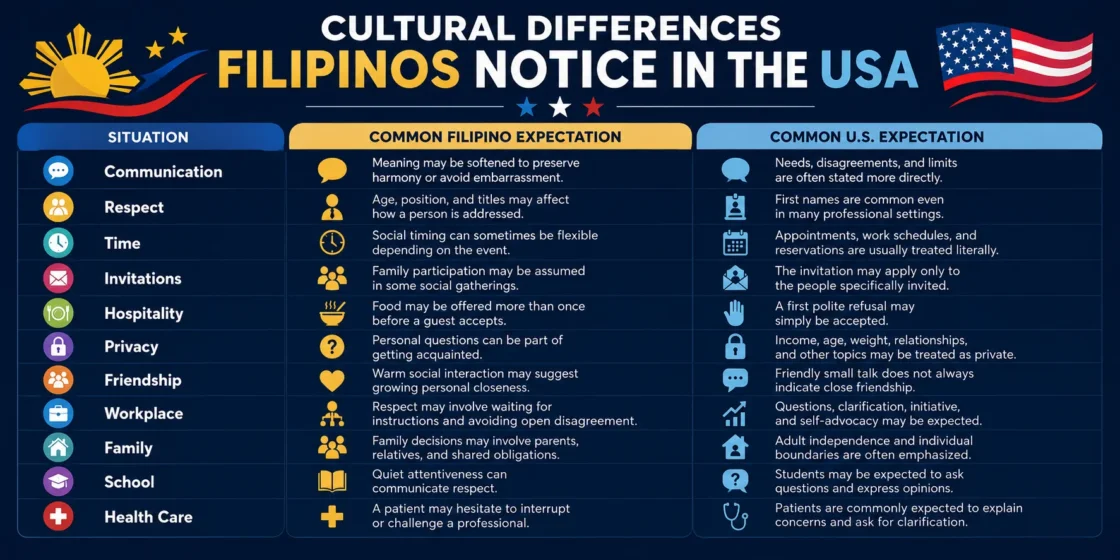
Life in the United States can feel familiar to many Filipinos long before it feels fully predictable. English is widely used in the Philippines, American entertainment is familiar, and the two countries have long-standing historical and social ties. Yet everyday interactions can operate by different unwritten rules. A polite indirect answer may be understood literally, a supervisor may expect questions instead of quiet agreement, and a casual invitation may have narrower boundaries than a Filipino guest expects.
Why this matters →
Many uncomfortable moments are not caused by poor English or bad manners; they happen because the same words, silences, gestures, and social expectations can carry different meanings in Filipino and U.S. settings.
Cultural Differences Filipinos Commonly Notice in the USA
The differences are often most visible in ordinary conversations, workplaces, family relationships, appointments, invitations, and friendships.
| Situation | Common Filipino Expectation | Common U.S. Expectation |
|---|---|---|
| Communication | Meaning may be softened to preserve harmony or avoid embarrassment. | Needs, disagreements, and limits are often stated more directly. |
| Respect | Age, position, and titles may affect how a person is addressed. | First names are common even in many professional settings. |
| Time | Social timing can sometimes be flexible depending on the event. | Appointments, work schedules, and reservations are usually treated literally. |
| Invitations | Family participation may be assumed in some social gatherings. | The invitation may apply only to the people specifically invited. |
| Hospitality | Food may be offered more than once before a guest accepts. | A first polite refusal may simply be accepted. |
| Privacy | Personal questions can be part of getting acquainted. | Income, age, weight, relationships, and other topics may be treated as private. |
| Friendship | Warm social interaction may suggest growing personal closeness. | Friendly small talk does not always indicate close friendship. |
| Workplace | Respect may involve waiting for instructions and avoiding open disagreement. | Questions, clarification, initiative, and self-advocacy may be expected. |
| Family | Family decisions may involve parents, relatives, and shared obligations. | Adult independence and individual boundaries are often emphasized. |
| School | Quiet attentiveness can communicate respect. | Students may be expected to ask questions and express opinions. |
| Health Care | A patient may hesitate to interrupt or challenge a professional. | Patients are commonly expected to explain concerns and ask for clarification. |
These are tendencies rather than rules. Filipino families differ by region, generation, language, religion, socioeconomic background, and personal experience. U.S. behavior also varies widely by age, state, city, workplace, family, and community. The goal is therefore not to assign one personality to either country, but to recognize situations where expectations frequently differ.
English fluency and cultural fluency are different: Pew Research Center reports that 85% of Filipinos in the United States ages 5 and older are proficient in English. Strong English ability can make daily life easier, but it does not automatically reveal the social meaning behind phrases, tone, silence, invitations, boundaries, or workplace expectations.[a]
Direct Communication Can Feel Blunt at First
One of the most noticeable differences is not what people say, but how much of the intended meaning is expected to be stated openly.
Filipino communication often gives considerable attention to the relationship between the people speaking. A refusal may be softened. Disagreement may be expressed indirectly. Someone may leave part of the message unstated because the other person is expected to notice the context, tone, or discomfort.
Many U.S. environments place more weight on explicit communication. A person who says, “I can’t do that,” “I disagree,” or “I’m not available” is not necessarily angry. The statement may simply be intended to make the situation clear. University guidance for international students commonly describes U.S. communication as relatively direct while also noting informality, punctuality, privacy, personal space, and open expression of opinions as recurring social expectations.[b]
Indirect Answers Can Be Interpreted Literally
Several perfectly polite phrases can create misunderstandings when the speaker and listener assign different meanings to them.
| Phrase | What the Filipino Speaker May Mean | What the Listener May Understand |
|---|---|---|
| “Maybe.” | Probably no, but a direct refusal feels uncomfortable. | There is still a realistic possibility. |
| “I’ll try.” | It may not be possible. | It will probably be done. |
| “It’s okay.” | There is a problem, but complaining feels uncomfortable. | Nothing needs to be fixed. |
| “It might be difficult.” | This cannot realistically be completed. | The task is difficult but still possible. |
| Silence after a suggestion | Discomfort, hesitation, or respectful disagreement. | No objection. |
Tip: When the outcome matters, clarity is safer than relying on hints. “I won’t be able to work Saturday” communicates more accurately than “Saturday may be difficult for me.”
Hiya and Pakikisama Can Shape How Someone Speaks Up
Some familiar Filipino values can influence how disagreement, embarrassment, gratitude, and group harmony are handled.
Terms such as hiya, pakikisama, utang na loob, and kapwa are sometimes reduced to simple English labels, but their social meanings are more nuanced. Research involving Filipino Americans has treated hiya in relation to dignity or shame, utang na loob in relation to gratitude or solidarity, and pakikisama in relation to companionship and harmonious relationships. The findings also show that these values should not automatically be classified as either helpful or harmful; their effects can depend on context.[c]
Harmony Can Sometimes Hide Necessary Disagreement
Someone who places high value on keeping a group comfortable may hesitate to correct a coworker, disagree with an older relative, return an incorrect order, question a teacher, or tell a supervisor that a deadline is unrealistic.
In many U.S. situations, however, the other person may not infer the hidden concern. Silence can be interpreted as agreement. A polite “yes” can be treated as acceptance. Waiting for someone to notice discomfort may therefore allow a small misunderstanding to become a larger one.
A useful adjustment: Respect does not need to disappear when communication becomes clearer. “I understand the request, but I see a problem with the deadline” preserves courtesy while stating the concern directly.
Respect Often Looks Less Formal in the United States
Informal language can coexist with clear differences in authority and responsibility.
First Names Are Common
A Filipino newcomer may initially feel uncomfortable calling an older person, professor, manager, physician, or senior colleague by a first name. In many U.S. workplaces and social settings, the person may specifically introduce himself or herself by first name and expect others to use it.
If a manager says, “Please call me David,” doing so is usually not an act of disrespect. It also does not erase the professional relationship. The manager still has the responsibilities and authority associated with the position.
Questions Do Not Automatically Challenge Authority
Respect for teachers, supervisors, physicians, and older adults can lead some Filipinos to avoid questioning them. In U.S. environments, asking for clarification is often interpreted differently.
Statements such as these are generally more useful than remaining uncertain:
- “Could you explain what you mean by that?”
- “Which part should be completed first?”
- “Can I confirm the deadline?”
- “I understood the first step, but I need clarification on the second.”
The distinction is between respectful questioning and hostile confrontation. The first is routine in many workplaces, classrooms, medical settings, and customer-service interactions.
Time Is Often Treated More Literally
The meaning of “8:00” depends on the setting, but formal schedules usually leave less room for interpretation.
The familiar stereotype of “Filipino time” is too broad to explain real situations. A family party, a medical appointment, a work shift, and a job interview do not operate under the same expectations.
In the United States, scheduled commitments often mean:
- A work shift at 8:00 a.m.: the employee may be expected to be ready to work at 8:00, not entering the building at that time.
- A medical appointment: late arrival can reduce the available appointment time or lead to rescheduling, depending on the provider.
- A restaurant reservation: the table may not be held indefinitely.
- A class or meeting: entering after the scheduled start may be noticed even if the delay is short.
- A casual gathering: the expectation may be more flexible, especially when the host has not set a formal start.
Tip: When timing matters, the safest question is specific: “Do you want everyone there at 6:00, or is that the time the event starts?”
Invitations Often Have More Defined Boundaries
An invitation can be warm while still applying only to a specific person, date, or type of gathering.
RSVP Usually Requires a Real Answer
When an invitation asks for an RSVP, the host generally needs to know whether the invited person will attend. Leaving the answer uncertain can affect seating, food, tickets, reservations, or other planning.
A clear response is preferable:
- “Yes, I’ll be there.”
- “Thank you for inviting me, but I can’t attend.”
- “I need to check my schedule. Can I confirm by Friday?”
Family Members May Not Automatically Be Included
In a family-centered social environment, it may feel natural to assume that a spouse, children, relative, or visiting family member can come along. U.S. invitations are often more specific.
If the invitation is unclear, asking is normal: “Is this adults only?” or “Would it be okay to bring my husband?” prevents an awkward situation for both the guest and host.
Unannounced Visits Are Less Common in Many Households
Stopping by a relative’s or friend’s home without advance notice can be normal in some Filipino families. Many Americans prefer a message or call first, even with people they know well. Privacy, work schedules, children’s activities, and personal routines can make spontaneous visits less convenient.
Hospitality Can Follow Different Social Rules
Food remains a strong way of showing care in both cultures, but the offer-and-refusal pattern can differ.
“No, Thank You” May End the Offer
In some Filipino households, a guest may initially decline food out of politeness and accept after the host offers again. An American host may interpret the first refusal literally and stop asking.
Someone who actually wants the food does not need to wait for repeated encouragement. “Yes, thank you” is enough.
“Help Yourself” Usually Means Exactly That
If food is placed on a table and the host says, “Help yourself,” guests may be expected to serve themselves rather than wait for the host to prepare a plate.
Potluck Is a Shared-Food Arrangement
When a gathering is described as a potluck, guests usually bring food to share. The host may coordinate dishes so that everyone does not arrive with the same type of food. Asking, “What should I bring?” is entirely appropriate.
Dietary Needs Are Often Discussed Openly
Food allergies, vegetarian or vegan diets, religious dietary rules, and other restrictions are commonly mentioned before meals or events. Informing a host about an actual restriction is not usually considered demanding when done politely and early enough for planning.
Personal Questions Can Become Private Much Earlier
Questions intended as friendly conversation in one culture may feel intrusive in another.
A Filipino acquaintance may ask personal questions as a way of learning about someone’s life. In many U.S. social situations, the acceptable depth of a question depends heavily on how well the people know each other.
Topics that can feel too personal early in a relationship include:
- salary or household income,
- age,
- weight or changes in appearance,
- why someone is unmarried,
- when a couple plans to have children,
- the price of a person’s house,
- religious beliefs,
- medical conditions,
- immigration status,
- political preferences.
This does not mean Americans never discuss these subjects. Close friends and relatives often do. The difference is that relationship depth and permission tend to matter more.
Personal Space and Physical Contact Are More Explicit
Comfort with distance, touching, hugging, and other physical gestures varies from person to person.
Americans may maintain more physical distance during conversation than some newcomers expect. Touching a person’s arm, shoulder, or back can be friendly in one relationship and uncomfortable in another.
Hugging is also context-dependent. Some friends hug whenever they meet. Others rarely do. A person’s friendliness does not automatically imply comfort with physical contact.
The most reliable approach is to notice the other person’s behavior and avoid assuming that one person’s preference represents the whole country.
“How Are You?” May Be a Greeting Rather Than a Full Question
Some English phrases have a social function that is different from their literal wording.
At a store, workplace, hallway, or elevator, someone may say, “How are you?” while continuing to move. In that context, a short response such as “Good, thanks. How are you?” is common.
That does not mean Americans never want an honest answer. Context changes the meaning. A close friend who sits down privately and asks, “How are you doing?” may genuinely be inviting a longer conversation.
Other phrases can also be less literal than they first appear. “See you around” may simply mean goodbye. “We should get coffee sometime” can express friendliness without creating an actual appointment. A real plan usually becomes more specific: a day, time, and place are chosen.
Friendly Does Not Automatically Mean Close Friendship
Warm conversation and personal friendship can develop at different speeds.
Cashiers, neighbors, coworkers, parents at school, and strangers waiting in line may engage in casual conversation. Smiling, joking, and small talk are common social behaviors and do not always indicate a desire for a closer relationship.
Adult friendships can also be highly scheduled. Two people may genuinely like one another and still plan dinner two or three weeks ahead because of work, family responsibilities, children’s schedules, or other commitments.
For someone accustomed to more spontaneous social contact, this can initially feel distant. The scheduling itself should not automatically be interpreted as rejection.
The U.S. Workplace May Feel Casual but Expect More Self-Advocacy
First-name communication and relaxed clothing do not necessarily mean that expectations are vague.
Silence Can Be Interpreted as Understanding
A supervisor may explain a task and finish with, “Any questions?” An employee who remains silent out of respect may believe that asking would make the employee appear unprepared. The supervisor may instead assume that the instructions were completely understood.
Workplace translation: When a manager says, “Let me know if you need anything,” it can be reasonable to ask for clarification before a problem becomes difficult to fix. Waiting silently until the deadline is usually less helpful than raising a specific question early.
Explaining an Accomplishment Is Not Automatically Bragging
Humility is valuable, but some U.S. workplace processes require employees to describe what they personally completed. Performance reviews, interviews, promotion discussions, project updates, and résumés may ask for individual contributions.
There is a difference between exaggerating and accurately documenting work. “The team completed the project, and I managed the scheduling and client reporting” gives credit to the group while making the person’s own responsibility clear.
Initiative May Be Expected
Some workplaces provide detailed instructions; others expect employees to identify the next reasonable step, raise problems, or propose a solution. A person accustomed to waiting for explicit direction may initially find this uncomfortable.
When authority is unclear, a middle approach works well: “The next step appears to be contacting the vendor. Would you like me to proceed?”
A Friendly Supervisor Is Still a Supervisor
Jokes, first-name communication, casual conversation, or lunch with the team do not remove professional boundaries. Attendance, deadlines, confidentiality, performance expectations, and workplace rules still apply.
Saying No Can Require Less Explanation
A short refusal is often considered sufficient when it is polite and clear.
Filipinos who are accustomed to maintaining harmony may feel pressure to provide a long explanation when declining a favor or invitation. In many U.S. interactions, a simple response can be enough:
- “I’m sorry, I can’t cover that shift.”
- “I won’t be available that weekend.”
- “Thank you, but I’ll pass.”
- “I can’t lend money right now.”
- “That arrangement won’t work for me.”
The same principle works in reverse. A coworker or friend who says no may be declining the request, not rejecting the relationship.
Family Independence Can Create Deeper Differences
The contrast may become more noticeable when decisions involve parents, teenagers, adult children, partners, privacy, and money.
Filipino family life often gives considerable weight to family cohesion, parental authority, shared responsibility, and maintaining relationships. U.S.-raised children may encounter stronger expectations around personal choice, privacy, independence, and openly discussing disagreements.
Research involving Filipino families in the United States has described family closeness as both an important source of support and, in some circumstances, a source of tension for young people. Studies have also documented differences in how respect, disagreement, autonomy, and family communication can be understood across generations.[d]
Disagreement Does Not Always Mean Disrespect
A Filipino parent may hear an adolescent’s direct disagreement as disrespectful. A U.S.-raised child may view the same conversation as ordinary self-expression. Both can be responding according to different expectations about what respectful communication sounds like.
This is especially visible around:
- dating,
- career choices,
- college decisions,
- moving out,
- household responsibilities,
- privacy,
- financial support for relatives,
- how much parents should participate in adult children’s decisions.
Neither family closeness nor independence requires rejecting the other. Many Filipino American households develop their own combination of shared responsibility and personal boundaries.
School Participation May Look Different
Quiet attention is not always the only behavior teachers use to evaluate engagement.
A student may have learned that listening quietly, avoiding interruption, and following the teacher’s directions demonstrate respect. Many U.S. classrooms also value those behaviors, but participation can include asking questions, contributing an opinion, discussing different interpretations, and respectfully disagreeing.
A student who does not understand an assignment should not assume that requesting clarification will offend the teacher. Similarly, parents are generally expected to contact the school when instructions, academic expectations, schedules, or student needs are unclear.
The communication can remain respectful while still being specific: “Could you explain which part of the assignment needs revision?” is more useful than remaining silent and guessing.
Health Care Often Requires Patients to Speak More Explicitly
Medical visits work better when symptoms, concerns, questions, and uncertainty are stated rather than implied.
Respect for professionals can make some patients reluctant to interrupt a physician, request another explanation, or admit that instructions were not understood. Relational comfort can matter as well. Research on Filipino patients in the United States found that understandable communication, tone, body language, cultural familiarity, and pakikisama influenced trust and experiences with health care. The study also found that navigating the U.S. health system itself can be difficult for some Filipino patients.[e]
During a medical appointment, it is appropriate to say:
- “I don’t understand that term.”
- “Could you explain the instructions again?”
- “I have another symptom I haven’t mentioned yet.”
- “What should I do if this gets worse?”
- “Can you write that down for me?”
A polite “yes” given only to keep the conversation moving can create confusion if the patient actually does not understand the instructions.
Tip: When a health professional asks whether there are questions, the question can be taken literally. Asking for clarification is part of communicating about care.
Splitting Costs Does Not Automatically Mean a Lack of Generosity
Friendship and financial obligation are often kept more separate than some newcomers expect.
Friends may request separate checks at a restaurant, reimburse each other for tickets, divide vacation costs, or send an exact share of an expense through a payment app. These practices do not necessarily indicate weak friendship.
Likewise, paying for someone’s coffee or giving a ride does not always create a long-term social obligation. This can feel different where utang na loob gives gratitude and reciprocity a deeper relational meaning.
Practices vary widely. Some American families regularly take turns paying for meals, and many Filipino American groups maintain familiar Filipino patterns of generosity. The important distinction is that financial arrangements should not be assumed from nationality alone.
Where a Filipino Lives Can Change the Experience
Cultural adjustment in a large Filipino community can feel very different from adjustment in a place with few Filipino residents.
The Filipino presence in the United States is substantial. U.S. Census Bureau population estimates for 2024 counted approximately 5.0 million people of Filipino descent when people identifying as Filipino alone or in combination with other groups were included.[f]
Filipino restaurants, churches, grocery stores, professional networks, community organizations, cultural events, and extended-family networks are easier to find in some areas than others. A newcomer surrounded by a large Filipino community may continue familiar social patterns while gradually learning U.S. norms. Someone living where few Filipinos are present may encounter cultural differences more often and have fewer familiar reference points.
This is one reason two Filipinos can move to the United States and describe very different adjustment experiences.
Not Every Uncomfortable Experience Is a Cultural Difference
Understanding cultural variation should not require accepting behavior that crosses clear personal or professional boundaries.
It is useful to distinguish different social styles from inappropriate behavior.
| Cultural Difference | What It Does Not Automatically Justify |
|---|---|
| Direct communication | Humiliation, intimidation, or repeated personal insults |
| Casual workplace communication | Ignoring professional boundaries |
| Friendly conversation | Assuming unwanted physical contact is welcome |
| Different views of privacy | Pressuring someone to disclose information they do not want to share |
| Different communication styles | Mocking a person’s accent, language ability, or background |
Useful distinction: A cultural difference explains why two people may interpret an interaction differently. It does not require either person to ignore reasonable personal boundaries.
Keep the Filipino Value, Adjust the Translation When Needed
Successful adjustment does not require abandoning Filipino identity or copying every American social habit.
Many Filipino values remain useful in the United States. The practical challenge is recognizing when a familiar expression of those values may be interpreted differently.
| Filipino Value or Habit | What Can Remain | What May Need a Different Expression in the USA |
|---|---|---|
| Respect for elders and authority | Courtesy, consideration, and appropriate manners | Asking respectful questions does not automatically show disrespect. |
| Pakikisama | Cooperation and attention to relationships | Important disagreement may need to be stated instead of hidden. |
| Hiya | Awareness of dignity, propriety, and how behavior affects others | Embarrassment should not prevent necessary questions or corrections. |
| Utang na loob | Gratitude and reciprocity | Not every small favor is understood as creating an ongoing obligation. |
| Hospitality | Generosity toward guests | A guest’s first “no, thank you” may be intended as a final answer. |
| Family closeness | Support, shared responsibility, and connection | Adult relatives may expect stronger privacy or decision-making boundaries. |
| Humility | Giving others credit and avoiding arrogance | Work, school, and professional situations may require clearly describing personal achievements. |
The most useful adjustment is often not changing the value itself. It is changing how the value is communicated. Respect can remain while questions become clearer. Family loyalty can remain while privacy is acknowledged. Humility can remain while achievements are described accurately. Pakikisama can remain while an important disagreement is spoken aloud.
For many Filipinos, adapting to the United States eventually becomes less about memorizing “American rules” and more about recognizing which situations require explicit communication. Once that distinction becomes familiar, interactions that initially seemed cold, overly direct, informal, or distant often become easier to interpret without giving up the Filipino values that continue to shape family and community life.
Common Questions About Filipino and American Cultural Differences
Is It Rude to Call an Older American by Their First Name?
Not necessarily. If the person introduces himself or herself by first name or specifically asks others to use it, following that preference is normally appropriate. More formal titles may still be used in settings where the institution or individual expects them.
Why Do Americans Ask “How Are You?” Without Waiting for a Long Answer?
In brief public interactions, “How are you?” can function as a greeting. A short response is normal. In a private conversation with a friend, the same words may invite a much more detailed answer.
Is Saying No Directly Considered Rude in the United States?
A polite and clear refusal is generally acceptable. The tone and wording matter. “I can’t attend, but thank you for inviting me” is direct without being unfriendly.
Should Guests Bring Food When Invited to an American Home?
It depends on the event. A potluck normally involves shared food, while a dinner invitation may not require guests to bring anything. Asking the host what would be helpful is acceptable when the invitation is unclear.
Why Are American Coworkers Friendly but Not Always Close Friends?
Professional friendliness and private friendship can remain separate. Coworkers may have warm relationships at work while keeping family life and personal time more private.
Does American Individualism Mean Families Are Not Close?
No. Many U.S. families are very close. Independence usually refers more to expectations around personal decisions, privacy, finances, housing, or adult responsibility than to an absence of affection or family support.
Does Adapting Mean Giving Up Filipino Culture?
No. Cultural adjustment can simply mean learning how behavior is interpreted in another environment. Many Filipino Americans combine Filipino family values, social traditions, food, language, community life, and identity with communication habits learned through life in the United States.
Sources
- Pew Research Center — Filipinos: Data on Asian Americans — Provides U.S. Filipino demographic, language, immigration, and geographic data used to explain why English proficiency and cultural familiarity should not be treated as the same thing. (Pew Research Center is a long-established nonpartisan research organization that publishes documented demographic analysis.)
- Texas Tech University — Guide to American Culture for International Students — Supports the discussion of direct communication, first-name informality, punctuality, privacy, personal space, and everyday social expectations in U.S. settings. (Texas Tech University is a public research university and the material is published through its international student services.)
- PubMed — Scale Validation of Filipino Cultural Values and Its Associations With Depressive Symptoms and Substance Use in Filipino Americans — Supports the treatment of hiya, utang na loob, pakikisama, and related Filipino cultural values as nuanced concepts rather than simple stereotypes. (PubMed is maintained by the U.S. National Library of Medicine and indexes peer-reviewed biomedical and behavioral research.)
- PubMed Central — Voices of the Filipino Community Describing the Importance of Family in Understanding Adolescent Behavioral Health Needs — Supports the section on Filipino American family cohesion, intergenerational communication, parental expectations, and the role of family relationships in adolescent experiences. (PubMed Central is the U.S. National Library of Medicine’s full-text research archive.)
- PubMed — Pakikisama: Filipino Patient Perspectives on Health Care Access and Utilization — Supports the discussion of communication, trust, cultural familiarity, family navigation, and pakikisama in Filipino experiences with U.S. health care. (PubMed is maintained by the U.S. National Library of Medicine; the cited study was published in the Journal of the American Board of Family Medicine.)
- U.S. Census Bureau — Asian American and Pacific Islander Heritage Month: May 2026 — Provides the 2024 population estimate of approximately 5.0 million people of Filipino descent in the United States when Filipino alone-or-in-combination identification is counted. (The U.S. Census Bureau is the federal statistical agency responsible for official U.S. population data.)