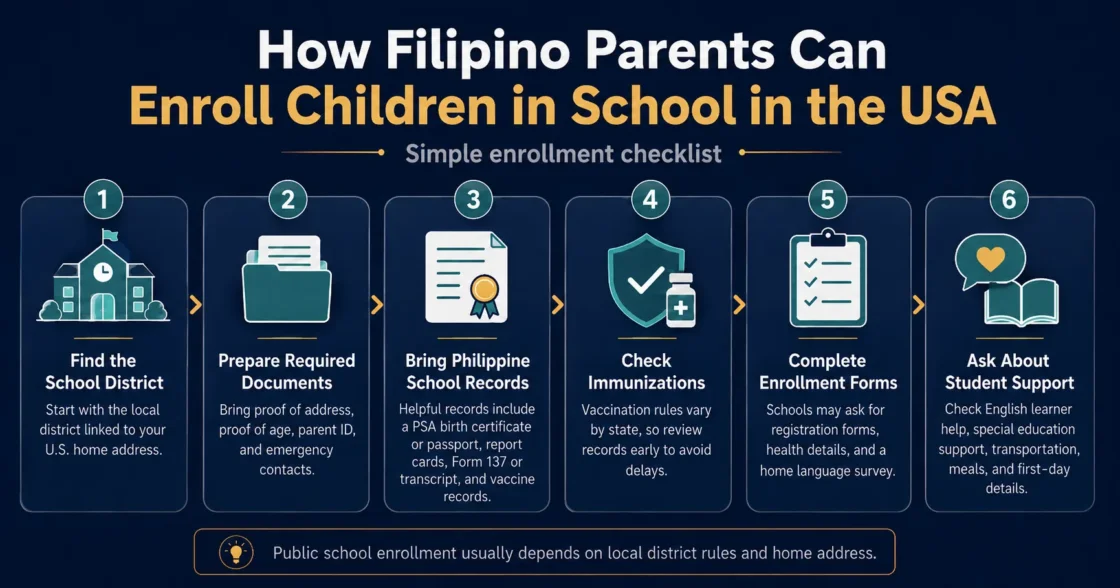
For Filipino parents moving to the United States, school enrollment usually starts with the local school district, not a national education office. Public school rules are set mainly by state and local districts, so the exact forms, deadlines, grade placement, and immunization rules can vary by address. The process is usually manageable when parents prepare proof of residence, proof of age, immunization records, and any previous school documents before contacting the assigned school.
Why this matters →
Filipino families can avoid delays when they understand which records U.S. schools may request, which documents are optional, and which student rights apply regardless of immigration or citizenship status.
Required Documents: Most school districts ask for proof of address, proof of the child’s age, immunization records, parent or guardian identification, emergency contact details, and previous school records if available.
Helpful Philippine Records: Bring the child’s PSA birth certificate or passport, report cards, Form 137 or school transcript if available, vaccination records, and any English translation if the document is not easy for the school to read.
Local Rule: The assigned school is usually based on the family’s U.S. home address, so the first practical step is finding the correct school district for that address.
How School Enrollment Works in the USA
This section explains the basic structure Filipino parents will meet when enrolling a child in a U.S. school.
In the United States, children usually attend a public school connected to the family’s residential address. The local school district sets the enrollment process, school calendar, required forms, and deadline for submitting records. Some areas have neighborhood schools, while others use school zones, district placement offices, magnet schools, charter schools, or transfer applications.
Public elementary and secondary schools cannot deny enrollment only because a child or parent is not a U.S. citizen. The U.S. Department of Education states that citizenship or immigration status cannot be used to bar students from public school access.[a]
Tip: Search the name of the city or county plus “school district enrollment” to find the correct local enrollment page.
Step 1: Find the Correct School District
A child’s U.S. address usually decides where the family should begin the registration process.
Parents should first confirm the school district connected to their home address. District websites often provide a “school locator,” “attendance zone,” or “boundary map” tool. In apartment buildings, the school office may ask for the full unit number because school boundaries can change by street or building.
If the family is still staying with relatives, in temporary housing, or has not signed a lease yet, the district enrollment office should be contacted directly. Districts may have procedures for families in temporary living situations, and a child should not be left out of school simply because the family’s housing documents are incomplete.
Step 2: Prepare Proof of Residence
Schools use residence documents to confirm that the child belongs in that district or school zone.
Common proof of residence may include a lease, mortgage statement, utility bill, property tax bill, official mail, or a notarized residency affidavit from the person hosting the family. The exact list depends on the district.
Document Note: If the parent’s name is not on the lease or utility bill, the district may allow an affidavit or a form signed by the homeowner, tenant, or relative living at the address.
Parents should avoid using an address where the child does not actually live. School districts treat residence verification seriously, and using the wrong address can lead to removal from the school or other local consequences.
Step 3: Bring Proof of the Child’s Age and Identity
Schools need to confirm the child’s age so they can place the student in the correct grade level.
For Filipino children, a Philippine birth certificate, passport, visa page, or previous school record may help confirm age and identity. A school may request proof of age, but it should not discourage enrollment only because the document shows a foreign place of birth.
| Document Type | How It Helps | Notes for Filipino Parents |
|---|---|---|
| PSA birth certificate | Confirms full name and date of birth | Bring the original and a clear copy if available |
| Philippine passport | Confirms identity and birth date | Useful if the birth certificate is not yet available |
| Previous school record | Shows grade history and completed school year | May help with grade placement, especially for older students |
| Translation | Helps school staff read non-English records | Ask the district whether a certified translation is required |
Step 4: Submit Immunization Records
Vaccination rules are one of the most common reasons school enrollment is delayed.
U.S. school vaccination requirements are set by state and local law. CDC explains that state laws establish vaccination requirements for school children, and these rules often apply to public schools, private schools, and child care settings.[b]
Parents should bring the child’s vaccination booklet, clinic records, or physician record from the Philippines. If the record uses vaccine names or date formats unfamiliar to the U.S. school, the district nurse or local health department may review it and identify missing doses.
Important Warning: Do not wait until the first day of school to check immunization records. Some states allow temporary or conditional attendance while vaccines are being completed, but the rules and deadlines vary by state.
Step 5: Provide Previous School Records
Academic records help the school decide grade placement, courses, and support needs.
For younger children, the school may place the child mainly by age. For middle school and high school students, previous report cards, transcripts, course descriptions, and proof of completed grade levels can matter more. High schools may review credits before deciding whether a student should be placed in grade 9, 10, 11, or 12.
Filipino parents should prepare copies of recent report cards, Form 137 if available, certificates of completion, and any records for honors classes, advanced math, science, English, or special programs. If the child is entering high school, ask whether the district requires a transcript evaluation.
Step 6: Complete the District Enrollment Forms
The enrollment packet collects family contact details, health information, and school services information.
Most districts now offer online registration. Parents may still need to visit the school or enrollment center to verify documents. Common forms include parent or guardian information, home language survey, emergency contacts, medical information, transportation request, technology agreement, and release of records from the previous school.
The home language survey is important for many Filipino families. If Tagalog, Cebuano, Ilocano, Hiligaynon, Waray, Kapampangan, or another Philippine language is spoken at home, parents should answer honestly. This does not harm the child’s enrollment. It helps the school decide whether English language screening or support is needed.
Step 7: Ask About English Learner Support
Children who are still building academic English may qualify for language support at school.
Students whose primary language is not English may need language support to participate meaningfully in school. The U.S. Department of Education states that schools and districts must take steps to address language barriers for English learner students and must communicate important school information to limited English proficient parents in a language they can understand.[c]
Parents can ask the school about English as a Second Language, English Learner services, bilingual support, interpreter access, and translated notices. A child who speaks conversational English may still need help with academic vocabulary, writing, science terms, or U.S. classroom expectations.
Tip: If a parent needs an interpreter for a school meeting, the request should be made before the meeting date so the school has time to arrange support.
Step 8: Discuss Special Education or Learning Support
Parents should tell the school if the child has an existing diagnosis, therapy history, or learning concern.
If a child has a disability, developmental delay, speech concern, autism diagnosis, ADHD diagnosis, hearing or vision issue, or prior school support plan, parents should bring records and ask how to request an evaluation. Under IDEA, eligible children with disabilities in the United States can receive a free appropriate public education with special education and related services.[d]
For children age three or older, USA.gov directs families to contact the local elementary school or school district to request a special education evaluation. It also notes that a child can be evaluated even if the child does not attend public school.[e]
Parent Action: If the child had therapy, an IEP-like plan, medical notes, or school accommodations in the Philippines, bring copies and ask the U.S. school how to start the review process.
Step 9: Understand Visa and Immigration Status Issues
Most children living with parents in the United States are treated differently from children coming only to study on an F-1 visa.
For regular public school enrollment, schools cannot use a child’s or parent’s citizenship or immigration status to block access to public education. Families should still answer school forms truthfully, but a school should not require a Social Security number or immigration document in a way that prevents a child from enrolling.
A separate rule applies when a child is coming to the United States specifically as an F-1 international student. The U.S. Department of State states that F-1 students cannot receive visas to attend public elementary school, and F-1 attendance at public high school is limited to twelve months with payment of the full, unsubsidized per-student cost.[f]
Important Warning: A child living in the United States as a dependent of a parent’s visa may have different school rules from a child applying for an F-1 visa to attend school. Families should confirm the child’s visa category before making school plans.
Public School, Private School, Charter School, and Homeschool Options
The right option depends on address, budget, admission rules, and the child’s needs.
Public schools are usually tuition-free for children who live in the district. Private schools charge tuition and set their own admissions process. Charter schools are public schools but may use a separate application or lottery system. Homeschool rules are set by each state, and parents must follow state reporting or instruction requirements where they live.
| School Option | How Enrollment Usually Works | What Parents Should Check |
|---|---|---|
| Public neighborhood school | Based mainly on home address | District boundaries, required documents, start date |
| Charter school | Application or lottery may be required | Deadlines, transportation, grade availability |
| Private school | School decides admission and tuition | Accreditation, tuition, visa rules if applicable |
| Homeschool | Parent follows state homeschool law | State notice rules, testing rules, recordkeeping |
Common Enrollment Problems and What to Do
Most issues can be handled by contacting the district enrollment office early and asking for the correct alternative document.
No Lease or Utility Bill Yet
Ask whether the district accepts a residency affidavit, hotel or shelter letter, employer housing letter, or written statement from the person hosting the family. Do not guess; each district has its own accepted documents.
No Complete Vaccination Record
Contact the school nurse, local health department, or pediatric clinic. The child may need vaccine review, catch-up doses, or a state-specific form. Keep copies of every vaccine document submitted.
Philippine Records Are Delayed
Ask the previous school in the Philippines for digital copies while waiting for originals. The U.S. school may begin placement using available records, parent statements, and later verification, depending on local policy.
Child Is Placed in the Wrong Grade
Request a meeting with the counselor, registrar, or school administrator. Bring the child’s transcript, report cards, course descriptions, and any proof of completed grade level. For high school students, ask how credits were evaluated.
Questions Filipino Parents Often Ask
These answers address practical concerns that often come up during the first U.S. school registration.
Can a Child Enroll Without a Social Security Number?
In many districts, a Social Security number may be requested but should not be required in a way that blocks enrollment. Parents can ask for the district’s alternative student identification process.
Can a School Ask About Immigration Status?
A public school should not use citizenship or immigration status to deny a child access to school. If a form seems to request unnecessary immigration information, parents can ask why it is needed and whether the field is optional.
Can a Child Start School in the Middle of the Year?
Yes, children who move into a district during the school year are usually enrolled after documents are reviewed. The school may need time to assign classes, review immunization records, and set up language or learning support.
Will Philippine Grade Levels Match U.S. Grade Levels Exactly?
Not always. U.S. schools may use age, completed schooling, transcripts, credits, English level, and district policy. High school placement is often more detailed because graduation credits matter.
Should Parents Translate Philippine School Records?
If the record is in English, translation is usually not needed. If any record is in another language or contains unclear abbreviations, ask the district whether a certified translation is required.
Before the First Day of School
After enrollment is accepted, a few final steps help the child start with fewer surprises.
- Confirm the official start date and school hours.
- Ask about bus eligibility, pickup location, or parent drop-off rules.
- Request the school supply list.
- Set up the parent portal account if the school uses one.
- Ask how absences, late arrivals, and early pickups are reported.
- Confirm lunch payment, free or reduced-price meal forms, or cafeteria account setup.
- Tell the school about allergies, medication, asthma, vision needs, hearing needs, or health restrictions.
- Ask who to contact for English learner services, counseling, or special education questions.
Verification Note: U.S. school enrollment rules can change by state, district, visa category, and school year. Parents should confirm the latest requirements with the local school district, state education agency, or the relevant U.S. government source before relying on any document list or deadline.
Sources
- U.S. Department of Education: Equal Rights to Public Education Regardless of Immigration/Citizenship Status — Used for public school access rights regardless of citizenship or immigration status. This is reliable because it is an official U.S. Department of Education civil rights resource.
- CDC: State Vaccination Requirements — Used for the explanation that state laws establish school vaccination requirements. This is reliable because CDC is the federal public health agency responsible for vaccine guidance and public health information.
- U.S. Department of Education: Equal Education Opportunities for English Learners — Used for English learner support and communication rights for parents with limited English proficiency. This is reliable because it is an official U.S. Department of Education civil rights page.
- U.S. Department of Education IDEA: About IDEA — Used for the free appropriate public education and special education explanation. This is reliable because it is the official IDEA information site maintained by the U.S. Department of Education.
- USA.gov: Early Intervention and Special Education Services for Children — Used for how families can request evaluation through local schools or districts. This is reliable because USA.gov is the official U.S. government portal for public services information.
- U.S. Department of State: Foreign Students in Public Schools — Used for F-1 public elementary and public high school restrictions. This is reliable because it is an official U.S. Department of State visa information page.