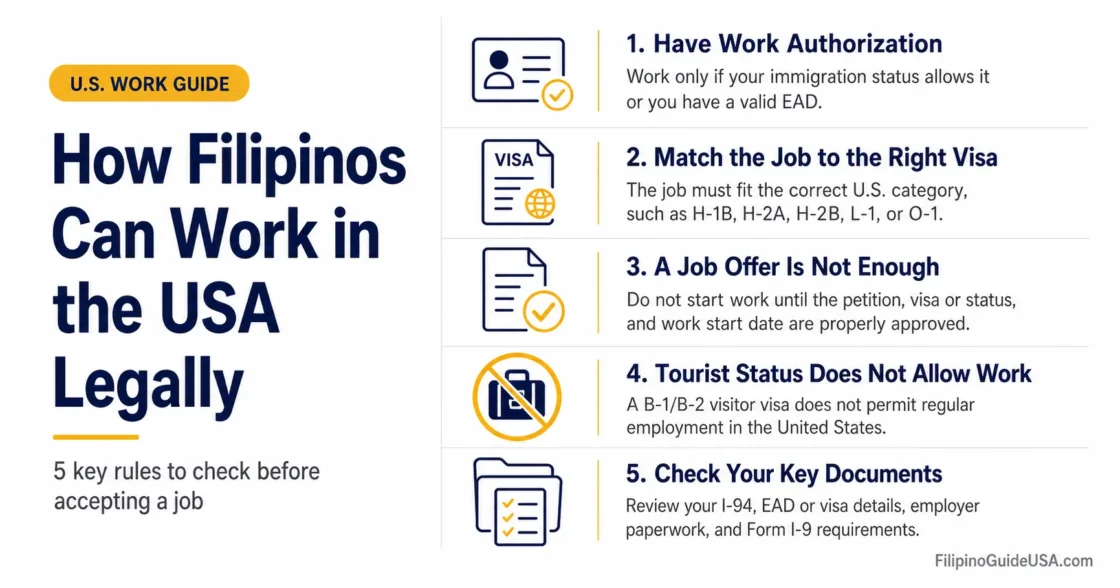
Filipinos can work in the United States legally only when their immigration status allows work, or when they have a separate work permit from U.S. immigration authorities. A job offer, a visitor visa, a Social Security number, or a relative in the U.S. does not automatically give permission to work. The safe starting point is simple: match the job to the correct U.S. visa or work authorization before accepting employment, traveling, or starting payroll.[a]
What Legal Work Means in the United States
Legal work means you are allowed to perform services in the U.S. under your current immigration category, or you have an Employment Authorization Document, often called an EAD or work permit.[b] For many Filipino workers, the authorization is tied to a specific employer, a specific visa category, or a specific time period.
This is where many people get confused. A U.S. visa in your passport lets you ask for entry at a port of entry, but it does not always mean you can work for any employer. Your allowed activity depends on your visa category, your I-94 admission record, and any work authorization document you hold.
| Situation | Can You Work? | What to Confirm First |
|---|---|---|
| Lawful permanent resident | Yes | Green card validity and employer I-9 documents |
| Temporary worker visa such as H, L, O, P, Q, or R | Usually yes, within the visa terms | Employer, job role, petition approval, visa category, and I-94 |
| Approved EAD | Yes, while valid | EAD category, start date, expiration date, and any limits tied to status |
| F-1 student | Only in limited situations | On-campus rules, CPT, OPT, STEM OPT, and school authorization |
| B-1/B-2 visitor visa | No regular employment | Visitor status does not permit accepting employment in the U.S.[c] |
| Pending petition or pending EAD | Not by itself | Actual approval and work start date, not just a receipt notice |
Main Legal Paths Filipinos Usually Consider
There is no single “Filipino work visa.” Filipino citizens use the same U.S. employment categories as other foreign nationals, unless a program has country-specific eligibility rules. The right path depends on the job, the employer, your education, your work history, and whether the plan is temporary or permanent.
Employer-Petitioned Temporary Work
For many temporary U.S. work categories, the process starts with a U.S. employer filing a petition with U.S. Citizenship and Immigration Services. The worker usually cannot apply for these visas alone without the employer’s role. The U.S. Department of State explains that most temporary worker visa applicants need an approved petition before applying for the visa at a U.S. embassy or consulate.[a]
Common temporary work categories include:
H-1B: Often used for specialty occupations that normally require a bachelor’s degree or equivalent in a related field. The employer usually handles the petition side, and the job must match the visa requirements. The Department of Labor also has a Labor Condition Application process for H-1B employers.[f]
H-2B: Used for certain temporary non-agricultural jobs, often seasonal or peak-load work. This is employer-driven and involves U.S. labor certification steps before USCIS petitioning.[g]
H-2A: Used for temporary or seasonal agricultural work. The employer must follow a separate agricultural labor certification process.[h]
L-1: Used for intracompany transfers, usually when a worker employed abroad moves to a related U.S. office as a manager, executive, or specialized knowledge employee.
O-1: Used for people with a strong record of ability or achievement in fields such as science, business, education, arts, or athletics.
R-1, P, and Q: Used for narrower work situations such as religious work, certain performers or athletes, and cultural exchange roles.
A job advertisement saying “visa sponsorship available” is not the same as an approved petition. Before relying on a job offer, ask which visa category the employer plans to use, who will file the petition, what documents are needed, and whether the job can legally begin only after approval.
Employment-Based Green Card
A green card allows permanent residence and broad work authorization in the United States. Employment-based green card categories include workers with extraordinary ability, advanced degree professionals, skilled workers, professionals, certain special immigrants, and investors, depending on the category. Many employment-based cases require an employer sponsor, a labor certification, or both, while a few categories allow self-petitioning in limited cases.[i]
This path is common in long-term hiring, especially when a U.S. employer wants to keep a worker beyond temporary visa limits. It is not usually a fast route. Visa availability, priority dates, document review, and consular or adjustment processing can affect timing.
Student-Related Work
Filipinos studying in the U.S. on F-1 status should treat work rules carefully. USCIS states that F-1 students may not work off campus during the first academic year, though on-campus employment may be allowed under certain conditions.[j] Later, work may be possible through Curricular Practical Training, Optional Practical Training, or STEM OPT if the student qualifies and receives the required authorization.
OPT is not just a casual job option. It must be connected to the student’s field of study, and the timing matters. A student should coordinate with the school’s Designated School Official before accepting any work, internship, freelance role, or paid training connected to F-1 status.[k]
Work Authorization Based on Another Status
Some people can work because of a separate EAD category. This may apply to certain adjustment of status applicants, some spouses of temporary workers, some humanitarian categories, and other specific groups. For example, certain H-4 dependent spouses of H-1B workers may apply for employment authorization if the principal H-1B worker meets the listed USCIS conditions.[l]
The rule is not “all spouses can work.” A dependent spouse should check the exact visa category, I-94 status, EAD eligibility, and whether work is allowed only after receiving the physical EAD card or an updated status document.
If You Are Applying From the Philippines
A Filipino worker applying from the Philippines usually deals with two sides of the process: U.S. immigration requirements and Philippine overseas employment documentation. These are separate. Approval on one side does not automatically finish the other side.
Confirm the correct U.S. category. The job must match a legal U.S. work route. A caregiver job, nurse job, IT job, seasonal job, cruise-related job, or company transfer may fall under different rules.
Check who files first. For many temporary work visas, the U.S. employer starts by filing with USCIS after any required labor steps. For many immigrant employment cases, the employer may need Department of Labor certification before an immigrant petition.
Wait for petition approval when required. A job offer letter alone is not enough for most petition-based work visas. The visa interview usually requires petition information such as a receipt number or approval notice.
Prepare for the U.S. visa process. The worker normally completes the DS-160 for a temporary visa, pays the required visa fee, schedules the interview, and brings documents requested by the U.S. embassy or consulate.
Review Philippine-side requirements. Filipino workers leaving for overseas employment may need to use Department of Migrant Workers online services, especially when direct hire or overseas employment records are involved.[m]
Do not buy tickets too early. A petition approval does not guarantee visa issuance, and a visa does not guarantee final admission at the U.S. port of entry.
For direct-hire situations, do not rely only on what an employer or recruiter says. Ask for the exact U.S. petition category, written job terms, employer contact information, and the Philippine documentation path before paying anything or resigning from current work.
If You Are Already in the United States
If you are already in the U.S., the first document to check is your I-94. CBP’s I-94 record shows your admission class and, in many cases, the date until which you were admitted.[n] Your visa stamp may still be valid, but your I-94 controls your current authorized stay after entry.
Before starting any job, check:
Your current immigration status and I-94 admission class
Whether your status allows work by itself or only after EAD approval
Whether your work is limited to one employer
The start and expiration date of any EAD
Whether a pending change of status, extension, or EAD renewal gives you permission to keep working
Whether the employer can complete Form I-9 using acceptable documents
Every U.S. employer must verify the identity and work authorization of each new employee using Form I-9.[d] An employer who says “cash is fine” or “we do not need papers” is not solving the worker’s immigration problem. That can put the worker at risk.
Social Security Number and Payroll
A Social Security number is used for wages, tax reporting, and identity records, but it is not a work permit. The Social Security Administration says that, in general, only noncitizens with permission to work from the Department of Homeland Security can get a Social Security number.[e]
This matters because some workers think that getting an SSN means they can accept any job. It does not. The employer still needs valid work authorization documents, and the worker must stay within the limits of their immigration category.
Documents to Review Before Accepting a U.S. Job
Before accepting a job tied to U.S. immigration, keep a clean document folder. This helps you compare what the employer promised with what was actually filed.
Written job offer: job title, location, wage, work schedule, start date, and employer name
Petition documents: receipt notice, approval notice, or petition category if the employer is sponsoring you
Visa documents: DS-160 confirmation, appointment confirmation, and visa category
Admission record: I-94 after entering the United States
EAD, if needed: card category, validity dates, and any renewal receipt rules that may apply
Philippine-side documents: DMW account records, direct-hire processing documents, or other overseas employment documents when required
Fee records: receipts for official payments only; USCIS filing fees should be checked through the official fee tools because amounts can change.[o]
Work Situations That Often Cause Confusion
Working on a Tourist Visa
A B-1/B-2 visitor visa is not a normal work visa. The U.S. Department of State lists employment as an activity that cannot be done on a visitor visa, and it also states that a person on a visitor visa is not permitted to accept employment or work in the United States.[c]
Visiting family, attending a meeting, or joining a short business consultation is different from working for pay in the U.S. A Filipino visitor who receives a job offer while in the U.S. should not begin work unless the status is changed or the person receives the correct work authorization.
Remote Work, Freelance Jobs, and Side Income
Remote work can be tricky because the worker is physically inside the United States even if the client or company is abroad. Do not assume that online work, freelance tasks, content work, virtual assistance, or paid consulting is allowed just because payment comes from outside the U.S. If your status does not clearly allow employment, get advice from a qualified immigration attorney or, for students, your school’s international office before doing paid work.
Pending EAD or Pending Change of Status
A receipt notice is proof that an application was received. It is not always proof that work is allowed. Some renewal situations have special rules, but many first-time applicants must wait until the EAD is approved and valid before starting work.
Helping in a Family Business
Helping a relative’s store, restaurant, care business, office, or online shop may still count as work, even if the payment is informal or delayed. The safer question is not “Will I be paid today?” but “Does my current U.S. status allow this activity?”
How to Keep the Process Safe
Many Filipino workers are careful because overseas work is tied to family savings, remittances, and long-term plans. That caution is useful. Legal work should leave a clear paper trail: real employer, real job, correct visa category, official receipts, and written terms.
Be careful with anyone promising a “guaranteed U.S. work visa.” Visa issuance and admission are never guaranteed.
Do not submit fake education records, job history, marriage records, or employment letters.
Do not start work because a recruiter says “everyone does it.”
Compare the job title and employer name on your documents with the job you are actually asked to do.
Keep your own copies of contracts, pay records, visa notices, I-94 records, and DMW documents.
Use official fee pages rather than screenshots or forwarded messages when checking government fees.
Temporary workers also have rights in the United States. The U.S. Department of State provides rights and protections information for temporary workers, including H-1B, H-2A, and H-2B applicants.[p] USCIS also warns applicants to use authorized legal help and avoid immigration scams.[q]
Common Questions About Filipinos Working Legally in the USA
Can a Filipino Work in the U.S. With a Tourist Visa?
No. A B-1/B-2 visitor visa does not allow regular employment in the United States. A visitor who receives a job offer must use a proper work route before starting the job.
Is a U.S. Job Offer Enough to Start Working?
No. A job offer is only one part of the process. For many work categories, the employer must file a petition, the worker must receive the correct visa or status, and the worker must be authorized to start work.
Can Filipinos Apply for a U.S. Work Visa Without an Employer?
Most temporary worker visas require a U.S. employer or petitioner. Some permanent categories and special cases may allow self-petitioning, but those are limited and evidence-heavy. The correct path depends on the worker’s qualifications and the category.
Can an F-1 Filipino Student Work While Studying?
Sometimes, but only under student work rules. On-campus work, CPT, OPT, and STEM OPT each have conditions. A student should not accept paid work before the school or USCIS authorization is clear.
Does a Social Security Number Mean I Can Work Anywhere?
No. An SSN is not the same as work authorization. The worker still needs a status or document that allows employment, and the employer must complete Form I-9.
Do Filipinos Need Philippine Documents Before Leaving for a U.S. Job?
Often, yes. A Filipino worker leaving the Philippines for overseas employment may need to follow Department of Migrant Workers procedures, especially in direct-hire situations. This is separate from the U.S. visa process.
Before Relying on Any Requirement
U.S. immigration rules, visa fees, petition procedures, visa interview rules, DMW processing steps, and work authorization policies can change. Before filing, paying, traveling, or starting work, check the official U.S. and Philippine sources linked below, and use qualified legal help for case-specific questions.
Sources
[a] U.S. Department of State, Temporary Worker Visas — used for the rule that foreign citizens need the correct visa for U.S. work and that many temporary worker categories require an approved petition. (Official U.S. government visa authority.) ↩
[b] U.S. Citizenship and Immigration Services, Form I-765 — used for Employment Authorization Document and work permit information. (Official USCIS form page.) ↩
[c] U.S. Department of State, Visitor Visa — used for the rule that employment is not permitted on a visitor visa. (Official U.S. government visa page.) ↩
[d] U.S. Citizenship and Immigration Services, Form I-9 — used for employer verification of identity and employment authorization. (Official USCIS employment eligibility page.) ↩
[e] Social Security Administration, Social Security Number for Noncitizens — used for the point that most noncitizens need DHS work permission to get an SSN. (Official SSA public guidance.) ↩
[f] U.S. Department of Labor FLAG, Labor Condition Application — used for H-1B employer labor filing context. (Official Department of Labor foreign labor certification portal.) ↩
[g] U.S. Department of Labor FLAG, H-2B Temporary Labor Certification — used for temporary non-agricultural worker process context. (Official Department of Labor program page.) ↩
[h] U.S. Department of Labor FLAG, H-2A Temporary Certification for Agriculture Workers — used for temporary agricultural worker process context. (Official Department of Labor program page.) ↩
[i] U.S. Citizenship and Immigration Services, Permanent Workers — used for employment-based immigrant categories and permanent worker overview. (Official USCIS employment immigration page.) ↩
[j] U.S. Citizenship and Immigration Services, Students and Employment — used for F-1 student work limits. (Official USCIS student employment page.) ↩
[k] U.S. Immigration and Customs Enforcement, SEVP Practical Training — used for CPT and OPT context for F-1 students. (Official SEVP/ICE student guidance.) ↩
[l] U.S. Citizenship and Immigration Services, Employment Authorization for Certain H-4 Dependent Spouses — used for H-4 spouse EAD eligibility context. (Official USCIS category page.) ↩
[m] Department of Migrant Workers, Online Services — used for Philippine-side overseas employment service context. (Official Philippine government migrant worker portal.) ↩
[n] U.S. Customs and Border Protection, I-94 — used for admission record and stay information. (Official CBP travel record page.) ↩
[o] U.S. Citizenship and Immigration Services, Fee Calculator — used for checking current USCIS filing fees. (Official USCIS fee tool.) ↩
[p] U.S. Department of State, Your Rights and Protections — used for temporary worker rights and protection information. (Official U.S. government rights resource.) ↩
[q] U.S. Citizenship and Immigration Services, Avoid Scams — used for warning readers to use authorized immigration help and avoid scams. (Official USCIS fraud-prevention page.) ↩