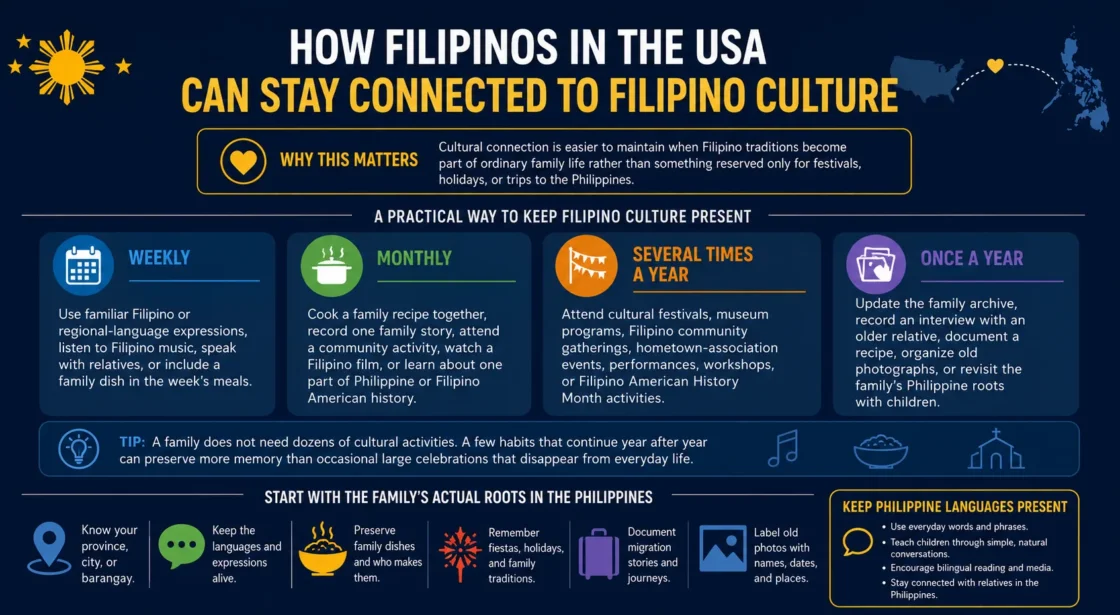
Filipinos living in the United States can stay connected to Filipino culture by keeping family languages present, preserving stories from older relatives, cooking family-specific dishes, learning both Philippine and Filipino American history, participating in community life, and maintaining relationships with relatives in the Philippines. These connections do not require living near a large Filipino neighborhood or following every tradition practiced by previous generations.
The community is also much larger and more varied than a single cultural model suggests. U.S. Census Bureau data for 2024 estimate about 5.0 million people of Filipino descent in the United States when people reporting Filipino alone or in combination with other detailed Asian groups or races are included.[a] Families within that population may trace their roots to different Philippine provinces, speak different languages, follow different religious traditions, and have very different migration histories.
Why this matters →
Cultural connection is easier to maintain when Filipino traditions become part of ordinary family life rather than something reserved only for festivals, holidays, or trips to the Philippines.
A Practical Way to Keep Filipino Culture Present
Small practices repeated throughout the year are often easier to sustain than trying to recreate every tradition at once.
| Frequency | Ways to Stay Connected |
|---|---|
| Weekly | Use familiar Filipino or regional-language expressions, listen to Filipino music, speak with relatives, or include a family dish in the week’s meals. |
| Monthly | Cook a family recipe together, record one family story, attend a community activity, watch a Filipino film, or learn about one part of Philippine or Filipino American history. |
| Several Times a Year | Attend cultural festivals, museum programs, Filipino community gatherings, hometown-association events, performances, workshops, or Filipino American History Month activities. |
| Once a Year | Update the family archive, record an interview with an older relative, document a recipe, organize old photographs, or revisit the family’s Philippine roots with children. |
Tip: A family does not need dozens of cultural activities. A few habits that continue year after year can preserve more memory than occasional large celebrations that disappear from everyday life.
Start With the Family’s Actual Roots in the Philippines
A personal connection to a province, city, language, and family history usually carries more meaning than a generic list of Filipino customs.
Filipino culture should not be treated as if every family has the same traditions. A household with roots in Cebu may preserve different food, vocabulary, music, celebrations, and family stories than one connected to Ilocos, Pampanga, Bicol, Negros, Panay, Leyte, or another part of the Philippines.
One useful starting point is identifying what was actually practiced in the family before trying to adopt additional traditions. Parents and grandparents can often provide details that are difficult to reconstruct later: the barangay where someone grew up, the language spoken at home, a hometown fiesta, a dish associated with a particular relative, or the story of who first moved to the United States.
Create a Family Culture Record:
Write down the province, municipality, city, or barangay connected to parents and grandparents.
Record the languages and expressions older relatives use.
List family dishes and identify who usually prepares them.
Document fiestas, Christmas customs, birthdays, remembrance practices, and other traditions the family actually observes.
Add migration stories, including when relatives moved to the United States and where they first settled.
Label older photographs with names, approximate dates, locations, and relationships while relatives can still identify them.
This approach also avoids reducing Filipino identity to the traditions that happen to be most visible in American popular culture. A family’s own history may contain traditions that are far more specific.
Keep Philippine Languages Present in Everyday Life
Language connection can be maintained at many levels; fluency does not have to be the starting point.
Some Filipino households in the United States primarily use English. Others continue using Filipino/Tagalog, Cebuano, Ilocano, Hiligaynon, Waray, Kapampangan, Pangasinan, or another Philippine language. Families may also switch naturally between languages depending on the speaker and situation.
When children do not speak the family’s Philippine language fluently, culture does not need to become an all-or-nothing language test. Recognition and regular exposure can come first.
Use Words That Already Belong to Family Life
Keep familiar greetings and expressions in regular use.
Use family terms such as Lolo, Lola, Tito, and Tita where those terms are part of the household.
Keep Filipino dish names rather than replacing them with generic English descriptions.
Teach children common numbers, foods, family relationships, and household expressions.
Ask grandparents to send short voice messages that children can replay.
Use songs and karaoke to make pronunciation and vocabulary familiar without turning every interaction into a lesson.
Build Language Gradually
A realistic progression may look like hearing → recognizing → using familiar words → forming sentences → reading or writing. Different members of the same family may stop at different points.
Language note: Filipino culture should not be presented as Tagalog-only. Families can preserve the Philippine language connected to their own region while also learning Filipino or another language that is useful to them.
Turn Family Stories Into Cultural Memory
Personal memories can explain culture in ways that dates, definitions, and general descriptions cannot.
Older relatives often hold details about daily life in the Philippines that younger generations have never heard. These may include school routines, childhood games, neighborhood relationships, market days, provincial travel, farming, work, courtship, religious observances, recipes, migration, or the first years after arriving in America.
Those stories do not require a formal oral-history project. One useful question during an ordinary family call can produce information worth preserving.
One Call, One Question: Ask an older relative one specific question during a regular conversation. Examples include: “What did your family usually cook at Christmas?”, “What was your school like?”, “What language did your parents speak to you?”, “What did your neighborhood look like?”, or “What do you remember about your first year in the United States?”
With permission, audio or video recordings can preserve pronunciation, humor, expressions, and emotion that a written family tree cannot capture.
Use Filipino Food to Preserve Family History
Food becomes a stronger cultural connection when the family also preserves who made it, where it came from, and when it was served.
Cooking adobo, pancit, sinigang, lumpia, kare-kare, bibingka, or another Filipino dish can keep familiar tastes in the household, but the most personal value often comes from documenting the family version.
Two families may prepare a dish differently because of province, household preference, available ingredients, or recipes passed between generations. Instead of deciding which version is the “correct” one, families can record what makes their own version recognizable.
Write Down More Than Ingredients
A useful family recipe can include:
The relative associated with the recipe.
The province or community connected to it, when known.
Ingredients and approximate measurements.
Substitutions commonly used in the United States.
How the family knows when the dish is finished.
Whether it is associated with birthdays, Christmas, fiestas, ordinary meals, or another occasion.
Filipino and Asian grocery stores can also become places for younger family members to discover vegetables, sauces, snacks, breads, frozen foods, and ingredients they may not encounter in mainstream supermarkets. Explaining what an ingredient is used for usually creates a stronger connection than simply placing it in the shopping cart.
Build Filipino Traditions Into the American Year
A cultural calendar helps traditions survive busy school schedules, work calendars, and long distances between relatives.
| Period | Possible Cultural Connection |
|---|---|
| May | Look for Asian American, Native Hawaiian, and Pacific Islander heritage programs that include Filipino history, arts, food, or community stories. |
| June | Philippine Independence Day programs, local cultural festivals, community performances, and family discussions about Philippine history. |
| October | Filipino American History Month activities, family migration stories, Filipino American books, museum resources, and local historical programs. |
| December | Parol-making, Filipino Christmas food, family gatherings, gift traditions, and Simbang Gabi for Catholic families who observe it. |
| Family Dates | Hometown fiestas, migration anniversaries, birthdays, memorial dates, and other occasions connected to the family’s own history. |
October Is Filipino American History Month
October is formally observed by the Filipino American National Historical Society as Filipino American History Month. FANHS first introduced the observance in 1992, and the U.S. Congress recognized the month in 2009. October was selected in part because the first recorded Filipino presence in the continental United States dates to October 18, 1587, in what is now Morro Bay, California.[b]
The month can be used for more than festival attendance. Families can explore migration history, Filipino American labor history, community institutions, writers, artists, veterans, local neighborhoods, and their own relatives’ experiences in the United States.
Learn Filipino American History Alongside Philippine History
Families living in the United States inherit a story that crosses both countries.
Learning Philippine history helps explain the homeland, languages, regions, colonial experiences, national events, and traditions that shaped earlier generations. Filipino American history answers another set of questions: When did Filipinos begin settling in different parts of the United States? Why did communities develop in Hawaii, California, Alaska, Louisiana, Washington, and other areas? How did work, immigration policy, military service, education, and family migration shape those communities?
For example, Filipino farmworkers were already central to labor organizing before the better-known later stages of the farmworker movement. On September 8, 1965, predominantly Filipino workers affiliated with the Agricultural Workers Organizing Committee initiated strikes against grape growers in the Delano area of California. Filipino and Mexican workers later joined forces in the movement that developed into the United Farm Workers.[e]
Knowing stories such as these can help U.S.-born Filipinos understand that their heritage in America is not merely an extension of events taking place elsewhere. Filipino communities have their own long history inside the United States.
Explore Filipino American History Through Museums and Archives
Historical collections can make migration and community history tangible for adults and children.
The Smithsonian’s National Museum of American History currently hosts How Can You Forget Me: Filipino American Stories, an exhibition centered on Filipino migrants in Stockton, California. Personal belongings preserved in steamer trunks help tell the story of the community that developed in Stockton’s Little Manila from the early twentieth century. Smithsonian information lists the exhibition as remaining on view through November 2027.[c]
A family does not need to live near Washington, D.C., to begin exploring archival material. The Library of Congress maintains a Filipino-American materials resource guide covering photographs, diaries, newspapers, books, special collections, and other physical and electronic resources available through its collections.[d]
Local libraries, universities, state historical societies, museums, and public archives may also hold material about Filipino communities in their region. Searches are often more productive when using a city, state, family surname, organization name, occupation, or specific migration period rather than searching only for “Filipino culture.”
Find Community Even Without a Filipino Neighborhood
Cultural participation is possible in both large Filipino population centers and smaller American communities.
Filipino community life in the United States may develop through cultural organizations, provincial or hometown associations, university groups, dance organizations, arts programs, Filipino-owned businesses, sports groups, religious communities, professional associations, and local festivals.
Not every activity will suit every household. Religious events, for example, may be meaningful to some Filipino families and irrelevant to others. Provincial organizations may be especially useful for families seeking traditions connected to a particular Philippine region.
Participate Rather Than Only Attend
Community connection usually becomes stronger when people have a role instead of remaining spectators. Depending on the local organization, participation might include:
Volunteering at a Filipino festival.
Joining a cultural or historical organization.
Helping children participate in a dance, music, language, or arts program.
Attending a Filipino American history presentation.
Learning parol-making, traditional crafts, cooking, or another practice from community members.
Supporting community events that give elders opportunities to share their experiences.
Joining hometown or provincial gatherings when the family’s roots match the group.
Social media groups can help locate events, but online membership alone does not have to be the final destination. A local gathering, class, volunteer role, performance, or recurring community activity creates opportunities for relationships to develop over time.
Keep Filipino Music, Film, Books, and Art in Normal Life
Culture remains easier to recognize when Filipino creative work appears throughout the year rather than only during heritage celebrations.
Families can explore cultural media in three directions.
What Older Generations Remember
Ask parents and grandparents about the music, singers, movies, radio programs, television shows, books, comics, or performers they knew while growing up. Family karaoke favorites can be part of this record too.
What Is Being Created in the Philippines Now
Contemporary Filipino cinema, OPM, P-pop, literature, television, podcasts, independent creators, visual arts, and regional-language media show younger generations that Philippine culture continues to evolve. Cultural connection does not have to stop with the media familiar to grandparents.
What Filipino Americans Are Creating in the United States
Filipino American writers, musicians, filmmakers, historians, chefs, artists, and performers reflect experiences shaped by both Philippine heritage and American life. Their work can be especially relatable for U.S.-born children and adults who do not see their experience fully represented by media produced only in the Philippines.
Help Children Develop Their Own Filipino American Identity
Children raised in the United States may connect to heritage differently from parents or grandparents who grew up in the Philippines.
A child does not need to reproduce a parent’s childhood in order to develop a connection to Filipino culture. The American school environment, friends, language use, mixed-family background, distance from relatives, and exposure to the Philippines can all shape how identity develops.
Make Culture Something Children Can Do
Let children help prepare a family dish instead of only eating it.
Show them the Philippine town or province connected to their grandparents.
Ask them to help label old family photographs.
Teach the meaning of family terms and expressions they hear.
Let them interview grandparents.
Make a parol or participate in another family tradition together.
Read age-appropriate Filipino and Filipino American books.
Attend museums, cultural festivals, history programs, music, or dance events when available.
Avoid Turning Heritage Into a Test
Language ability, birthplace, food preferences, surname, or knowledge of particular customs should not become a scorecard for deciding whether someone is sufficiently Filipino. That approach can make younger relatives avoid the very culture adults hope they will explore.
Questions usually work better than correction. A teenager who becomes interested in a grandparent’s migration story, a regional dish, Filipino American history, music, or a few words of a family language already has a path that can be developed further.
Keep Relatives in the Philippines Part of Family Life
Modern communication makes it possible for relatives across the Pacific to take part in cultural transmission directly.
Regular calls with grandparents, cousins, aunts, uncles, and other relatives can do more than maintain relationships. They can expose children to accents, languages, humor, family stories, local celebrations, food, and everyday life that may not be visible through tourism or social media.
Families can make these calls more interactive by:
Cooking the same family recipe while on a video call.
Asking relatives to explain old photographs.
Having grandparents teach a few words or expressions.
Showing children the family neighborhood through a video call.
Exchanging birthday and holiday messages.
Talking about how local traditions differ between generations or regions.
This is especially useful for children who cannot visit the Philippines regularly. Familiarity can develop gradually even across long distances.
Create a Digital Family Archive Before Details Disappear
Family records are easier to preserve when information is collected while relatives can still explain what it means.
A digital archive does not need special software. A clearly organized folder stored in a reliable location can preserve material that might otherwise be scattered across phones, messaging apps, old albums, and relatives’ homes.
| Folder | What to Preserve |
|---|---|
| Family Origins | Province, city, municipality, barangay, family names, and family tree information. |
| Photographs | Scanned photographs with names, approximate dates, places, and context. |
| Recipes | Ingredients, preparation notes, family variations, and the person associated with each dish. |
| Language | Expressions, sayings, voice recordings, songs, pronunciation, and regional vocabulary. |
| Migration to the USA | Stories, photographs, travel records, first U.S. residence, work history, and memories from early years in America. |
| Celebrations | Christmas, fiestas, birthdays, weddings, family reunions, remembrance customs, and other household traditions. |
| Recorded Stories | Audio or video interviews with parents, grandparents, and other relatives. |
Tip: A photograph without names or context can become difficult to identify within one generation. Adding a short caption now can preserve information that may otherwise be impossible to recover later.
Stay Connected to the Philippines Without Depending on Social Media
Online platforms can help maintain contact, but cultural knowledge can come from a wider range of sources.
Families interested in contemporary Philippines can follow music, film, literature, sports, arts, regional media, documentaries, and reputable reporting. Historical claims circulating through short videos or social posts deserve more caution because an appealing story may be incomplete or inaccurate.
For history, older migration records, labor history, or questions about Filipino communities in the United States, museum collections, universities, government archives, libraries, and established historical organizations provide a better starting point.
This balance also prevents cultural connection from becoming passive scrolling. Learning a recipe from a relative, reading a family document, attending an event, speaking the family language, visiting an exhibit, or preserving an oral history creates something that remains after the screen is closed.
Support Places Where Filipino Culture Is Being Created
Restaurants and stores are only part of the cultural ecosystem.
Filipino culture in the United States is also carried by bakeries, bookstores, artists, filmmakers, authors, musicians, craftspeople, cultural groups, museums, festivals, educators, dance organizations, and community programs.
Supporting these spaces may mean buying a book, attending a performance, visiting an exhibition, taking a workshop, ordering food from a regional Filipino restaurant, donating to a cultural organization, or simply bringing children to an event where Filipino culture is visible in public life.
For families whose regional culture is less commonly represented, asking community organizers about regional artists, dishes, languages, and hometown groups can uncover connections beyond the traditions most frequently presented at large festivals.
If There Is No Filipino Community Nearby
Geography changes the method of connection, but it does not remove the possibility.
A Filipino family living far from a major Filipino population center can divide cultural activities into three levels.
At Home
Preserve family recipes.
Use familiar Philippine-language words and expressions.
Build the family archive.
Listen to Filipino music and explore Filipino film or literature.
Observe family-specific traditions.
Online and Across Distance
Maintain regular contact with relatives in the Philippines.
Use digital museum and library resources.
Participate in reputable cultural or educational programs available online.
Watch performances, interviews, and history programs from trusted institutions.
Periodically
Travel to regional Filipino festivals or community events.
Visit museums or historical locations with Filipino American collections.
Spend time in areas with Filipino restaurants, stores, cultural centers, and community organizations when practical.
This model makes cultural continuity possible without assuming that every Filipino household lives near Los Angeles, the San Francisco Bay Area, Honolulu, Las Vegas, New York, or another large Filipino community.
Different Generations May Reconnect in Different Ways
The best entry point often depends on where a person grew up and what was already preserved at home.
| Situation | Useful Ways to Connect |
|---|---|
| Recently Arrived From the Philippines | Community relationships, familiar food, Philippine media, language use, local Filipino groups, and regular contact with relatives. |
| Long-Time Filipino Immigrant | Preserving family traditions, recording migration memories, maintaining language, community participation, and teaching younger relatives. |
| 1.5 Generation | Rebuilding language skills, family history, childhood memories, Filipino American history, and reconnecting with relatives or hometown roots. |
| U.S.-Born Filipino American | Family-origin research, Filipino American history, relatives, arts, food, community organizations, and Philippine cultural learning. |
| Child in a Mixed Filipino Family | Family stories, grandparents, food, celebrations, accessible language learning, family photographs, and Filipino American books and events. |
| Far From a Filipino Community | Home traditions, family archive work, digital resources, relatives, media, and occasional regional cultural trips. |
Filipino Culture Can Change Without Disappearing
Traditions often adapt when families move between countries and generations.
A recipe may use an ingredient that is easier to find in an American supermarket. A Christmas gathering may move to a weekend because of work schedules. English may become the main household language while Filipino expressions remain. A mixed Filipino family may combine customs from two or more backgrounds. Children may develop traditions that their grandparents never practiced.
Change alone does not determine whether a cultural practice has been lost. A more useful question is whether the family still understands where the practice came from, what it means to them, and whether someone in the next generation knows how to continue it.
That makes cultural continuity less about reproducing one fixed version of Filipino life and more about preserving memory, relationships, knowledge, and practices in forms that can realistically remain part of life in the United States.
Common Questions About Staying Connected to Filipino Culture
Do Filipinos in the USA Need to Speak Tagalog to Stay Connected to Their Culture?
No. Language can provide a strong cultural connection, but Tagalog is not the only Philippine language and fluency is not the only measure of cultural knowledge. Family history, regional roots, food, relatives, community participation, music, arts, and Filipino American history can all maintain cultural connection. Families that want to rebuild language skills can begin with regular exposure and useful household vocabulary.
How Can Filipino Parents Teach Culture to Children Born in the United States?
Children generally have more opportunities to connect when culture becomes something they participate in. Cooking with relatives, hearing family stories, learning where grandparents grew up, using familiar words, attending community activities, exploring Filipino American history, and preserving photographs can all be incorporated into ordinary family life.
What If Someone Did Not Grow Up With Filipino Culture?
A practical starting point is the person’s own family. Identify Philippine hometowns, relatives, languages, migration stories, photographs, and recipes first. From there, explore Philippine history, Filipino American history, community organizations, arts, literature, film, music, and language according to personal interest.
What If There Are No Filipino Organizations Nearby?
Home-based traditions, conversations with relatives, digital museum and library collections, Filipino media, family archives, and occasional travel to regional events can maintain connection. A nearby Filipino neighborhood is helpful but not required.
Is Filipino American Culture Different From Culture in the Philippines?
It can be. Filipino American communities share many connections with the Philippines, but generations of migration and life in the United States have also created experiences, institutions, histories, art, food practices, and community traditions shaped by American conditions. Both can belong to the same family’s cultural story.
Is October Filipino Heritage Month?
The established national observance led by FANHS is called Filipino American History Month. It takes place in October and focuses specifically on the history, experiences, and contributions of Filipinos in the United States.
Sources
[a] U.S. Census Bureau — Asian American and Pacific Islander Heritage Month: May 2026. Used for the 2024 U.S. population estimate for people reporting Filipino alone or in combination. (U.S. federal statistical agency.)
[b] Filipino American National Historical Society — October Is Filipino American History Month. Used for the origin of the October observance, the 1587 recorded presence, and congressional recognition. (National historical organization devoted to documenting Filipino American history.)
[c] Smithsonian Institution — Smithsonian Asian Pacific American Center Fact Sheet. Used for current information about the How Can You Forget Me: Filipino American Stories exhibition and its scheduled run through November 2027. (Smithsonian institutional source.)
[d] Library of Congress — Filipino-American Materials: A Resource Guide. Used for information about Library of Congress collections and research materials related to Filipino American history. (U.S. national library and archival institution.)
[e] Library of Congress — United Farm Workers Organizing Committee Recognized by AFL-CIO. Used for the documented role of predominantly Filipino Agricultural Workers Organizing Committee members in beginning the 1965 Delano grape strikes. (U.S. national library research resource.)