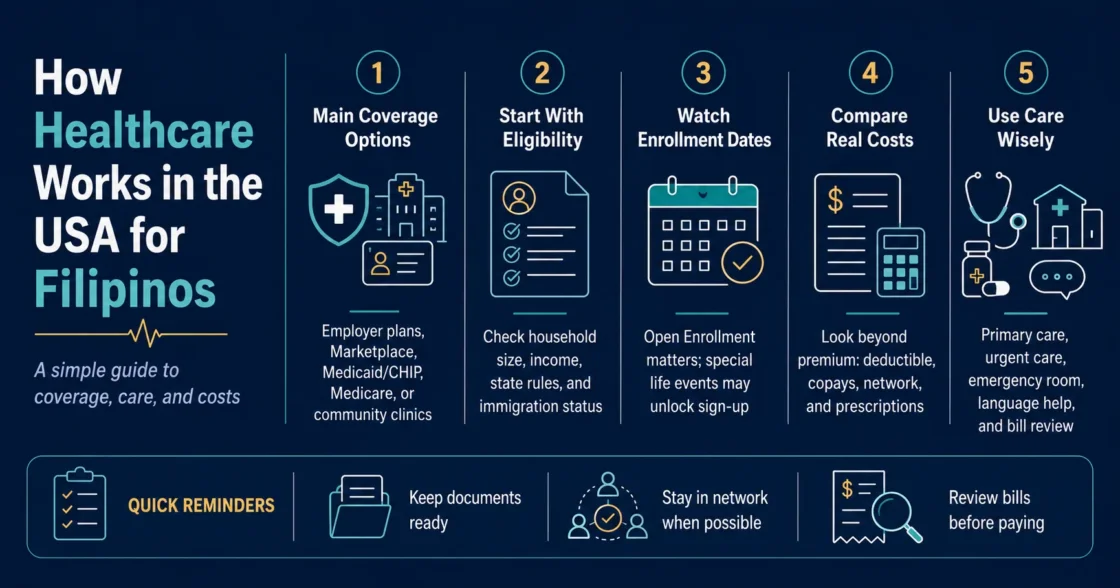
Health care in the United States works through insurance networks, enrollment windows, state rules, and provider billing systems. For Filipinos living in the U.S. or preparing to move, the safest starting point is to identify the correct coverage path before a medical need becomes urgent.
Why this matters →
Medical care in the U.S. can be costly without coverage, and choosing the wrong path can delay care, increase bills, or leave a family member uninsured.
Required Documents: Most health insurance applications ask for identity, household, income, address, and immigration-related information when applicable.
- Full legal names and dates of birth for each household member applying
- U.S. address and contact information
- Social Security numbers, if issued
- Immigration document details for non-citizens applying for coverage
- Recent income information, such as pay stubs, employer letter, tax return, or estimated yearly income
- Employer coverage offer details, if a job offers health insurance
- Current insurance cards, if anyone is already covered
- Proof of a life event, such as moving, loss of job-based coverage, marriage, birth, or adoption, when applying outside the normal enrollment period
The Main Ways To Get Health Coverage
This section explains the common coverage paths and which households usually use each one.
Most Filipinos in the U.S. get health coverage through one of five routes: an employer plan, the Health Insurance Marketplace, Medicaid or CHIP, Medicare, or care options for people without insurance. Eligibility depends on job benefits, state of residence, age, income, immigration status, and household size.
| Coverage Path | Who It Usually Fits | What To Check First |
|---|---|---|
| Employer Health Insurance | Employees and eligible family members when a U.S. employer offers coverage | Premium, deductible, provider network, dependent cost, and enrollment deadline |
| Marketplace Plan | U.S. citizens, U.S. nationals, and many lawfully present immigrants who do not have suitable job-based coverage | Eligibility, income estimate, premium tax credit, providers, and prescription coverage |
| Medicaid Or CHIP | Low-income adults, children, pregnant people, some seniors, and people with disabilities, depending on state rules | State eligibility rules, income limits, age, pregnancy status, and immigration category |
| Medicare | People age 65 or older, and some younger people with disability, ESRD, or ALS | Enrollment period, work history, Part A, Part B, drug coverage, and possible penalties |
| Community Clinics Or Self-Pay Care | People without insurance, short-term visitors, or those waiting for coverage | Sliding fee options, local clinic rules, payment plans, and emergency coverage rights |
IMPORTANT WARNING: A person who is not eligible for a Marketplace plan may still have other care options, but undocumented immigrants cannot enroll in Marketplace coverage for themselves. They may apply on behalf of documented family members who are eligible.[a]
Step 1: Identify Household And Immigration Status
Coverage decisions usually start with who is applying, where they live, and which status category applies.
A household should first list each person who needs coverage. One family may have mixed eligibility: a U.S. citizen child, a green card holder parent, a worker on a nonimmigrant visa, and a visiting relative may each have different options.
For Marketplace coverage, U.S. citizens, U.S. nationals, and lawfully present immigrants may apply if they meet the program rules. Lawfully present status can include lawful permanent residents, certain humanitarian statuses, valid nonimmigrant visa holders, and other listed categories, depending on the current federal rule.
Medicaid and CHIP rules are more state-specific. Many qualified non-citizens must meet a five-year waiting period before full Medicaid or CHIP eligibility, but there are exceptions for groups such as refugees and asylees. Some lawfully present immigrants who are still in a waiting period may still be able to use Marketplace coverage if otherwise eligible.[b]
Note: Children and pregnant people may have more options than adults in the same household. Some states cover lawfully residing children or pregnant people in Medicaid or CHIP without the usual five-year waiting period.[c]
Step 2: Check The Enrollment Window
The right plan may not be available every month unless a person qualifies for an exception.
Marketplace Open Enrollment usually runs from November 1 through January 15. Medicaid and CHIP applications can be submitted at any time of year. Outside Open Enrollment, Marketplace coverage usually requires a Special Enrollment Period based on a qualifying event.[d]
Common events include moving, losing other coverage, getting married, having a baby, adopting a child, or gaining eligible immigration status. Many Special Enrollment Periods allow enrollment during a limited window, often 60 days before or after the event, depending on the event type.[e]
DEADLINE WARNING: A family moving from the Philippines or from one U.S. state to another should not wait until someone gets sick to check coverage. Missing the enrollment window can mean waiting until the next Open Enrollment unless another qualifying event applies.
Step 3: Compare The Real Cost Of A Plan
The cheapest monthly premium is not always the lowest-cost choice after doctor visits and prescriptions are included.
Health insurance costs usually include more than the monthly premium. A plan may also have a deductible, copayments, coinsurance, and an out-of-pocket limit. A low premium can be useful for a healthy person who rarely visits doctors, but it can be expensive for a family with regular prescriptions, diabetes care, pregnancy care, therapy, or specialist visits.
Marketplace plans must cover categories known as essential health benefits, including emergency care, hospitalization, pregnancy and newborn care, prescription drugs, mental health care, lab services, preventive care, pediatric services, and more. Exact covered services can still vary by state and plan.[f]
Tip: Before selecting a plan, search for the family doctor, OB-GYN, pediatrician, preferred hospital, and main prescriptions in the plan tools.
For many Filipino families, provider access matters as much as price. A plan that does not include a nearby hospital, Filipino-speaking provider, preferred pediatrician, or needed specialist can create travel and scheduling problems later.
Step 4: Know The Difference Between Care Settings
Choosing the correct place for care can reduce delay, confusion, and avoidable bills.
A primary care provider is usually the regular doctor for checkups, ongoing health needs, lab follow-ups, referrals, and chronic conditions. Urgent care is generally used for non-life-threatening problems that cannot wait for a regular appointment. Emergency rooms are for severe symptoms, serious injury, chest pain, trouble breathing, stroke symptoms, severe allergic reaction, heavy bleeding, or other urgent medical danger.
Preventive care is often one of the most useful parts of U.S. insurance. Many plans, including Marketplace plans, must cover certain preventive services without copayment or coinsurance when delivered by an in-network provider, though coverage details can vary.[g]
Care Note: Annual checkups, vaccines, blood pressure screening, diabetes screening, pregnancy care, and pediatric visits should be scheduled before a problem becomes urgent. Preventive care is easier to use when the provider is in network.
Step 5: Use Language Help When Needed
Patients with limited English can ask for communication support in many health settings.
Filipino families may speak English, Filipino, Tagalog, Cebuano, Ilocano, Hiligaynon, or another language at home. In health care, even fluent English speakers may need help with medical terms, consent forms, insurance letters, or discharge instructions.
Many health programs and providers that receive federal financial assistance must take reasonable steps to provide language access services for people with limited English proficiency. HHS notes that language help may apply in settings such as pharmacies, emergency rooms, insurance applications, doctor visits, and nursing homes.[h]
Tip: Ask for a qualified medical interpreter before signing consent forms, discussing surgery, reviewing a new diagnosis, or changing medication.
Medicaid, CHIP, And Medicare For Filipino Households
Public programs can be helpful, but eligibility must be checked by state and personal situation.
Medicaid And CHIP
Medicaid and CHIP are not the same as Marketplace plans. Medicaid is a state-administered public coverage program for eligible low-income people and certain other groups. CHIP covers eligible children in families whose income is too high for Medicaid but still within the state’s CHIP limits.
For a Filipino family, this can matter most when there are U.S. citizen children, pregnant household members, lower income, disability, or a recent job loss. A Marketplace application may also screen for Medicaid or CHIP eligibility.
Medicare
Medicare is mainly for people age 65 or older. Some younger people may qualify due to disability, End-Stage Renal Disease, or ALS. Some people are enrolled automatically, while others must actively sign up based on Social Security timing and personal situation.[i]
Medicare does not work like a family plan. Each eligible person has individual choices. A Filipino senior living with adult children may still need to compare Original Medicare, Medicare Advantage, Part D drug coverage, and possible supplemental coverage based on doctors, prescriptions, travel, and monthly cost.
IMPORTANT WARNING: Medicare enrollment delays can lead to penalties in some situations. Anyone approaching age 65 should check enrollment timing before the birthday month, especially if still working, covered through a spouse, or newly arrived in the United States.
Options When A Person Has No Insurance
Uninsured patients still have care options, but costs and eligibility should be checked before treatment whenever possible.
People without insurance may use community health centers, public hospital clinics, charity care programs, self-pay discounts, or payment plans. Federally supported health centers may use a sliding fee discount program based on ability to pay, with discounts tied to income levels under federal program rules.[j]
Short-term visitors from the Philippines should not assume regular U.S. health insurance rules apply to them. Travel medical insurance, visitor insurance, or private self-pay arrangements may be needed, especially for older parents visiting for several months.
Tip: For a visiting parent, compare visitor medical coverage before the flight and keep medication names, diagnoses, and doctor letters available in English.
Medical Bills And Surprise Billing Rights
A bill should be reviewed before payment, especially after emergency care or out-of-network treatment.
After care, a patient may receive an Explanation of Benefits from the insurer and a bill from the provider. These are not always the same document. The insurer document explains what was billed, what the plan allowed, what the plan paid, and what the patient may owe.
The No Surprises Act protects many people with private insurance from certain unexpected out-of-network bills, including most emergency services and some non-emergency care from out-of-network providers at in-network facilities. It also gives uninsured or self-pay patients certain rights related to good faith estimates.[k]
Billing Note: If a bill seems wrong, request an itemized bill, compare it with the insurer’s explanation, confirm whether the provider was in network, and ask the billing office about financial assistance or appeal options.
Public Charge Concerns And Health Coverage
Many families avoid benefits because of fear, but the rule is narrower than many rumors suggest.
USCIS materials state that certain health-related benefits, including CHIP, Medicaid except long-term institutional care, Health Insurance Marketplace coverage, and Marketplace financial assistance, are not treated as public charge benefits in the way many families fear. Long-term institutional care at government expense is treated differently and should be reviewed carefully in immigration-sensitive situations.[l]
IMPORTANT WARNING: Immigration situations can be fact-specific. A person with a pending green card case, prior public benefits questions, or long-term care concerns should verify the current USCIS rule and seek qualified legal help when needed.
Common Mistakes To Avoid
Most expensive problems come from timing, network, documents, or misunderstood bills.
- Waiting until after arrival in the U.S. to check insurance options
- Choosing a plan only by monthly premium
- Using an out-of-network doctor without checking the plan directory
- Assuming dental and adult vision are included in every medical plan
- Forgetting to add a spouse or child during the employer enrollment window
- Missing a Special Enrollment Period after moving or losing coverage
- Ignoring letters from the Marketplace, Medicaid office, insurer, or employer benefits office
- Paying a large hospital bill without asking for an itemized bill or financial assistance review
- Using relatives as interpreters for serious medical decisions instead of asking for qualified language help
- Assuming one rule applies in every state
Before Applying Or Choosing A Plan
A short review can prevent many coverage and billing problems.
Checklist: Review these items before submitting an application or accepting a plan.
- Confirm who in the household needs coverage.
- Check whether an employer plan is available and whether dependents can be added.
- Estimate yearly household income carefully.
- Confirm immigration document details for applicants who are not U.S. citizens.
- Search the provider network for doctors, hospitals, and specialists.
- Check the prescription drug list for regular medicines.
- Compare deductible, copayments, coinsurance, and out-of-pocket limit.
- Save enrollment confirmations, plan cards, and payment receipts.
- Report major changes in income, address, household size, or coverage access when required.
Verification Note: Health insurance rules, premiums, enrollment dates, income limits, immigration eligibility, and state programs can change. Before applying, review the current official federal or state page and the plan documents for the coverage year.
Sources
- HealthCare.gov: Health coverage for immigrants — Used for Marketplace eligibility categories and the rule that undocumented immigrants cannot enroll for their own Marketplace coverage. (Official U.S. federal Marketplace source.)
- HealthCare.gov: Coverage for lawfully present immigrants — Used for lawfully present immigrant coverage, Marketplace savings, Medicaid/CHIP waiting period notes, and public charge language on health coverage. (Official U.S. federal Marketplace source.)
- Medicaid.gov: Medicaid and CHIP coverage of lawfully residing children and pregnant women — Used for state options covering lawfully residing children and pregnant people. (Official CMS Medicaid source.)
- HealthCare.gov: Open Enrollment Period — Used for Marketplace Open Enrollment dates and the note that Medicaid and CHIP can be applied for any time of year. (Official U.S. federal Marketplace glossary.)
- HealthCare.gov: Special Enrollment Period — Used for qualifying life events and the usual 60-day Marketplace Special Enrollment Period timing. (Official U.S. federal Marketplace glossary.)
- HealthCare.gov: What Marketplace health insurance plans cover — Used for essential health benefit categories. (Official U.S. federal Marketplace source.)
- HealthCare.gov: Preventive health services — Used for preventive care coverage rules and in-network cost notes. (Official U.S. federal Marketplace source.)
- HHS.gov: Limited English Proficiency — Used for language access rights in health programs and health care settings. (Official U.S. Department of Health and Human Services civil rights source.)
- Medicare.gov: Get started with Medicare — Used for Medicare eligibility basics and automatic versus active enrollment notes. (Official Medicare source managed by CMS.)
- HRSA: Sliding Fee Discount Program — Used for community health center sliding fee discount information. (Official HRSA Bureau of Primary Health Care source.)
- CMS: No Surprises Act rights against surprise medical bills — Used for surprise billing protections and good faith estimate rights. (Official Centers for Medicare & Medicaid Services fact sheet.)
- USCIS: How receiving public benefits might impact the public charge ground of inadmissibility — Used for public charge treatment of Medicaid, CHIP, Marketplace coverage, and related health benefits. (Official U.S. Citizenship and Immigration Services fact sheet.)