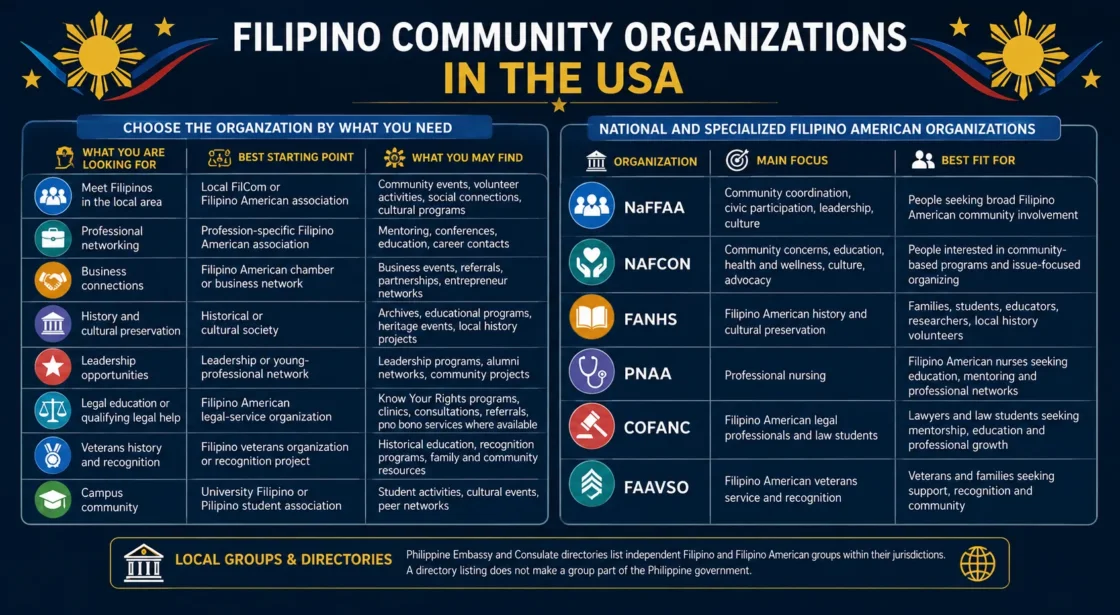
Filipino community organizations in the United States are not one single network. They include national federations, local FilCom associations, professional groups, business chambers, cultural and historical societies, legal-service organizations, leadership networks, veterans groups, campus associations, faith-based communities, and hometown or provincial organizations. Philippine Embassy and Consulate directories also list independent Filipino and Filipino American groups within their jurisdictions, but a directory listing does not make a group part of the Philippine government.[a]
Why this matters →
The right organization depends on the need: local friendship and events, career networking, business contacts, cultural connection, leadership development, legal education, veterans recognition, or broader community participation.
Choose the Organization by What You Need
Starting with the purpose is usually more useful than searching for a generic “Filipino organization” and sorting through unrelated groups.
| What You Are Looking For | Best Starting Point | What You May Find |
|---|---|---|
| Meet Filipinos in the local area | Local FilCom or Filipino American association | Community events, volunteer activities, social connections, cultural programs |
| Professional networking | Profession-specific Filipino American association | Mentoring, conferences, education, career contacts |
| Business connections | Filipino American chamber or business network | Business events, referrals, partnerships, entrepreneur networks |
| History and cultural preservation | Historical or cultural society | Archives, educational programs, heritage events, local history projects |
| Leadership opportunities | Leadership or young-professional network | Leadership programs, alumni networks, community projects |
| Legal education or qualifying legal help | Filipino American legal-service organization | Know Your Rights programs, clinics, consultations, referrals, pro bono services where available |
| Veterans history and recognition | Filipino veterans organization or recognition project | Historical education, recognition programs, family and community resources |
| Campus community | University Filipino or Pilipino student association | Student activities, cultural events, peer networks |
National and Specialized Filipino American Organizations
The organizations below have different missions, so they should not be treated as interchangeable or ranked as though they provide the same service.
| Organization | Main Focus | Best Fit For |
|---|---|---|
| NaFFAA | Community coordination, civic participation, leadership, culture | People seeking broad Filipino American community involvement |
| NAFCON | Community concerns, education, health and wellness, culture, advocacy | People interested in community-based programs and issue-focused organizing |
| FANHS | Filipino American history and cultural preservation | Families, students, educators, researchers, local history volunteers |
| PNAA | Professional nursing | Filipino American nurses seeking education, mentoring and professional networks |
| COFACC | Business and chamber networking | Entrepreneurs, business owners and professionals |
| FALDEF | Legal education, clinics, pro bono services and civil-rights work | People seeking Filipino-focused legal education or possible qualifying assistance |
| FYLPRO | Leadership development and diaspora connections | Emerging Filipino leaders and professionals |
| FilVetREP | Filipino World War II veterans recognition and education | Veterans, descendants, educators and history-focused community members |
National Federation of Filipino American Associations (NaFFAA)
NaFFAA is a national affiliation of Filipino American institutions, organizations and individuals. Its work centers on civic participation, national advocacy, leadership development and Filipino culture, with regional structures that connect communities across the United States and U.S. territories.[b]
It is a practical starting point for someone looking for broad community involvement rather than a profession-specific organization. A person interested only in nursing, business, legal help or historical research may get more direct value from a specialized group.
National Alliance for Filipino Concerns (NAFCON)
NAFCON describes itself as a national alliance of Filipino organizations, institutions and individuals. Its programs bring communities together through culture and heritage, education, health and wellness, and advocacy.[c]
This makes it different from a social club or a single local association. Its structure is better suited to people interested in community programs, shared concerns and organized participation across multiple locations.
Filipino American National Historical Society (FANHS)
FANHS focuses on identifying, preserving and sharing Filipino American history. Its national office and National Pinoy Archives are in Seattle, its national museum is in Stockton, California, and the organization reports more than 40 chapters across the United States.[d]
FANHS is especially relevant for families tracing local Filipino American history, students, educators, researchers, heritage volunteers and people seeking cultural programs rooted in documented community history rather than general social networking.
Philippine Nurses Association of America (PNAA)
PNAA is a professional nursing organization established in 1979. Its current organizational profile reports 55 chapters and more than 5,000 members, with activities that include mentoring, leadership development, education, conferences and professional advocacy related to nursing and health care.[e]
A PNAA chapter is therefore different from a general Filipino community association. Its primary value is professional connection and development within nursing.
Coalition of Filipino American Chambers of Commerce (COFACC)
COFACC is a national association of independently operating Filipino American chambers of commerce. It was incorporated in 2018 as a 501(c)(6) organization and was formed by Filipino American business entrepreneurs and professionals representing chambers in Southern California.[f]
For business owners and entrepreneurs, a Filipino American chamber can be more relevant than a general cultural organization because the focus is on business relationships, local commerce, professional contacts and economic activity.
Filipino American Legal Defense and Education Fund (FALDEF)
FALDEF provides Filipino-focused legal education and services that include Know Your Rights workshops, legal clinics, consultations and pro bono services. Its programs address legal needs affecting Filipinos and Filipino Americans across the country.[g]
Legal-service note: A community legal organization is not the same as automatically having a lawyer assigned to a case. Service availability, eligibility, capacity and the type of legal problem can affect whether direct representation is available.
Filipino Young Leaders Program (FYLPRO)
FYLPRO is a leadership network created to develop next-generation Filipino leaders in the diaspora and strengthen connections with the Philippines. Its work is oriented toward leadership, professional experience, collaboration and community projects rather than ordinary local social membership.[h]
Filipino Veterans Recognition and Education Project (FilVetREP)
FilVetREP is a national, community-based initiative focused on recognition and public education related to Filipino and Filipino American World War II soldiers. Its mission includes historical research, education and preservation of the veterans’ legacy.[i]
It is most relevant to veterans, descendants, educators and people interested in Filipino military history. It should not be confused with the U.S. Department of Veterans Affairs or another government benefits agency.
Local FilCom Organizations and Hometown Associations
For day-to-day community life, a local organization may be more useful than a national network.
The term FilCom is commonly used for Filipino Community organizations. These groups can be citywide, countywide, regional or centered on a specific shared background. Some are formal nonprofits, while others are membership associations, cultural groups, church-connected communities or volunteer-led organizations.
Local Filipino organizations commonly include:
- City or regional Filipino American associations that organize cultural events, volunteer activities and community gatherings.
- Hometown and provincial associations built around ties to a Philippine province, city, municipality, language group or region.
- Cultural societies focused on dance, music, food traditions, language, heritage and Filipino American History Month activities.
- Professional associations for nurses, physicians, engineers, attorneys, educators, accountants and other occupations.
- Business chambers and entrepreneur groups that connect Filipino-owned businesses and professionals.
- Student associations based at colleges and universities.
- Faith-based Filipino communities connected with parishes, ministries or other religious institutions.
- Veterans and military-family groups focused on fellowship, recognition, history or veteran-related community information.
Hometown and Provincial Groups Serve a Different Role
A Filipino organization does not always represent the entire Filipino population of a city. Some associations are organized around a shared place of origin in the Philippines, such as an Ilocano, Bicolano, Cebuano, Visayan or province-based community. Activities may include reunions, cultural celebrations, scholarships, charitable projects or support for a hometown in the Philippines.
These groups can be useful for maintaining regional identity and family connections, but their membership rules and activities vary widely. A person looking for broad citywide networking may prefer a general FilCom association, while someone seeking a community tied to a particular Philippine region may prefer a hometown organization.
Use Embassy and Consulate Directories to Find Nearby Groups
Philippine government community directories can provide a more organized starting point than relying only on general web searches or social media.
The Philippine Embassy in Washington maintains public directories for Filipino community organizations and businesses within its jurisdiction and directs people outside that area to the Philippine Consulate that serves their location.[a] Some Philippine Consulates in the United States maintain their own FilCom or Filipino American community directories.
Why Consular Jurisdiction Matters
The nearest well-known city is not always the correct place to search. Philippine consular coverage is organized by jurisdiction, and a consulate may serve several states or only a portion of a large state. The New York Consulate, for example, maintains a Filipino Community Directory for organizations in the U.S. Northeast.[j]
The Chicago Consulate’s directory covers Filipino community organizations within its Midwest jurisdiction, not only organizations located inside Chicago.[k] This makes a state-and-jurisdiction search more reliable than using only a city name.
Directory listing does not mean government endorsement: Philippine Embassy and Consulate directories state that listed organizations remain separate and independent from the diplomatic post. Inclusion does not mean the Embassy or Consulate endorses the organization’s programs, events or fundraising activities.
How Filipino Organizations Differ by Purpose
Two groups serving the same city may have very different membership rules, activities and reasons for existing.
Cultural and Historical Organizations
These groups preserve Filipino or Filipino American culture through archives, oral histories, exhibits, heritage celebrations, language activities, dance, music and educational programs. A historical society is a better choice for research and preservation work than a chamber of commerce or professional association.
Professional Associations
Professional organizations combine Filipino community identity with career development. Membership may be tied to a profession, credentials, student status or chapter rules. Their activities can include continuing education, conferences, mentorship and professional leadership.
Business and Entrepreneur Networks
Filipino American chambers and business groups are designed for commercial and professional connection. They may offer networking events, business referrals, educational programs and opportunities to meet other entrepreneurs. Membership may be structured around individuals, companies or local chamber affiliates.
Student and Young-Professional Groups
University Filipino associations are usually campus-based and may require student affiliation for formal membership. Leadership networks such as FYLPRO operate differently: participation can be application-based and oriented toward professional, civic or community leadership.
Faith-Based Filipino Communities
Filipino parish groups, ministries and other faith communities can provide social connection, cultural events and volunteer opportunities. They are religious communities rather than consular offices or government service providers, so they should not be relied on for official passport, immigration or public-benefit decisions.
Veterans and Military-Family Organizations
These groups may focus on fellowship, historical recognition, family connections, commemorations or information sharing. A community veterans group can help people connect with others who share a service background, but federal veterans benefits remain the responsibility of the appropriate U.S. government agency.
Membership, Chapters and Participation
Joining can mean anything from formal dues-paying membership to attending one public event.
| Participation Type | What It Usually Means |
|---|---|
| Member | Formal membership under the organization’s rules; dues may apply. |
| Chapter Member | Membership in a local or regional branch of a larger organization. |
| Volunteer | Helping with events or programs without necessarily becoming a formal member. |
| Event Participant | Attending activities that are open to members, guests or the public. |
| Professional Member | Membership may depend on occupation, licensing, education or professional status. |
| Program Applicant | Applying for a particular fellowship, leadership program, scholarship or cohort rather than joining the whole organization. |
Membership terms should always be checked with the organization itself. A national group and its local chapter may have different dues, application procedures, event access and contact methods.
Before Joining, Donating or Sharing Personal Information
A few checks can separate an active, transparent organization from an outdated listing or an unclear fundraising request.
What to check:
- Look for recent events, current officers or other signs that the organization is active.
- Confirm that the group actually serves the city, county, state or professional field needed.
- Read membership requirements before paying dues.
- Confirm who controls a fundraiser and what the money is intended to support.
- Use a payment method and contact channel clearly associated with the organization.
- Be cautious about sending passport copies, Social Security numbers or other sensitive records unless there is a clear and legitimate reason.
- If the organization claims U.S. tax-exempt status, verify that claim through the IRS rather than relying only on a logo or statement on social media.
The IRS Tax Exempt Organization Search allows the public to review tax-exempt status, selected filings and whether an organization is listed as eligible to receive tax-deductible charitable contributions.[l] This is useful when a group describes itself as a nonprofit or asks for a charitable donation.
Nonprofit does not always mean the same thing: Filipino community organizations can have different legal and tax structures. IRS status should be checked by the organization’s legal name or EIN when donation deductibility or tax-exempt status matters.
Community Organization, Consulate or U.S. Government Agency?
Many problems are easier to solve once the correct type of institution is identified.
| Need | Community Organization | Philippine Embassy or Consulate | U.S. Government Agency |
|---|---|---|---|
| Local social or cultural connection | Often the right place | May support community activities | Usually not applicable |
| Philippine passport or consular document | Cannot issue it | Correct authority | Not the issuing authority |
| U.S. immigration status or immigration decision | May offer education or referrals | Cannot decide U.S. immigration status | Correct authority depends on the matter |
| Professional networking | Yes, if profession-focused | Not its main role | Usually not applicable |
| Business networking | Yes, through chambers or business groups | May support community or trade programs | Agency role depends on the business issue |
| Legal education | Some specialized groups provide it | May provide consular information or referrals | Agency information depends on the legal issue |
When a Filipino Community Group Is Not the Right Resource
A Filipino organization can connect people with community knowledge, referrals and support, but it does not replace the government authority responsible for an official decision. A community group is generally not the final authority for:
- Issuing or renewing a Philippine passport.
- Deciding a U.S. visa, immigration status or citizenship case.
- Determining Social Security eligibility or benefits.
- Processing federal or state tax returns and tax disputes.
- Issuing a professional license.
- Handling police, fire or medical emergencies.
- Making a binding court decision.
Specialized organizations may still provide education, referrals or other assistance, but the official process remains with the relevant government body or licensed professional.
Questions to Ask Before Choosing an Organization
A short screening process can help identify whether a group matches the actual need.
- Does the organization serve the local area? Check the city, county, state or consular jurisdiction.
- Is it a general community group or a specialized association? A professional or legal organization may have narrower eligibility.
- Can individuals join? Some networks primarily connect organizations, chambers or chapters.
- Is membership required for events? Public activities may be open even when formal membership is not.
- Are dues required? Check the current membership terms directly with the group.
- Is there an active local chapter? A national organization may not have a chapter in every state.
- Are current leaders and contact details identifiable? Outdated directories can continue to appear in search results.
- Does the organization actually provide the needed service? Cultural, professional, legal and business organizations have different roles.
- If money is involved, can the organization be independently verified? Check legal name, nonprofit claims and fundraising details.
Tip: Search by both purpose and location. “Filipino nurses association in [state]” or “Filipino cultural organization in [city]” will usually produce more relevant results than “Filipino organization near me.”
Common Questions About Filipino Community Organizations in the USA
Is There One Official Filipino Organization for the Entire United States?
No. The United States has multiple national networks, specialized associations and independent local organizations. Philippine diplomatic posts may maintain directories, but the listed groups remain separate from the Embassy or Consulate.
Are Filipino Community Organizations Part of the Philippine Government?
Usually not. A Filipino American association, chamber, professional society, cultural group or hometown organization is generally an independent entity. Government affiliation should never be assumed from a consular-directory listing.
Does a Consulate Listing Mean the Organization Is Endorsed?
No. Philippine Embassy and Consulate directory notices state that inclusion does not imply endorsement of the organization’s programs, events or fundraising activities.
Does Someone Have to Be a Philippine Citizen to Join?
Not necessarily. Eligibility is set by each organization. Many Filipino American cultural and community groups include U.S.-born Filipino Americans and other community participants, while professional, student, chapter or program-based organizations may have their own requirements.
Are There Filipino Organizations Specifically for Professionals?
Yes. Nursing, medicine, law, engineering, education, accounting, business and other fields can have Filipino American professional networks. Profession-specific groups are usually a better fit for career development than a general social association.
Can a Filipino Organization Help With an Immigration or Legal Problem?
Some specialized legal organizations provide education, clinics, consultations or qualifying pro bono services. General community groups may provide referrals, but they are not U.S. immigration authorities and should not be treated as substitutes for licensed legal advice when individual representation is needed.
How Can Someone Tell Whether a Local Group Is Still Active?
Look for recent activities, current leadership information, working contact details, updated membership instructions and a current chapter or directory entry. If the organization claims tax-exempt status, IRS records can provide an additional verification point.
Sources
Philippine Embassy in Washington, D.C. — Filipino Community & Business Directories — Explains the public FilCom directory system, jurisdiction routing and non-endorsement notice. (Official Philippine government source.)
National Federation of Filipino American Associations — About — Describes NaFFAA’s national role, mission areas and community structure. (Official organization profile; primary source for its mission and structure.)
National Alliance for Filipino Concerns — About — Describes NAFCON’s alliance model and work in culture, education, health and community concerns. (Official organization profile; primary source for its mission.)
Filipino American National Historical Society — About FANHS — Documents FANHS history, archives, museum and chapter network. (Official historical society source and primary record of its organizational structure.)
Philippine Nurses Association of America — About PNAA — Provides PNAA’s chapter count, membership profile and professional mission. (Official professional association source.)
Coalition of Filipino American Chambers of Commerce — Who We Are — Explains COFACC’s chamber model, organizational status and business focus. (Official chamber coalition source.)
Filipino American Legal Defense and Education Fund — Programs and Services — Describes legal education, clinics, consultations and pro bono services. (Official legal-service organization source.)
Filipino Young Leaders Program — About — Explains FYLPRO’s leadership mission and diaspora focus. (Official organization profile; primary source for program purpose.)
Filipino Veterans Recognition and Education Project — Our Mission — Describes FilVetREP’s veterans recognition, research and educational work. (Official project source; primary record of its mission.)
Philippine Consulate General in New York — Filipino Community Directory — Shows the Consulate’s public directory for Filipino American organizations in the U.S. Northeast. (Official Philippine government source.)
Philippine Consulate General in Chicago — Filipino Community Directory — Shows the Midwest FilCom directory, consular jurisdiction and non-endorsement notice. (Official Philippine government source.)
Internal Revenue Service — Tax Exempt Organization Search — Allows verification of tax-exempt status, filings and eligibility for tax-deductible charitable contributions. (Official U.S. government tax authority.)