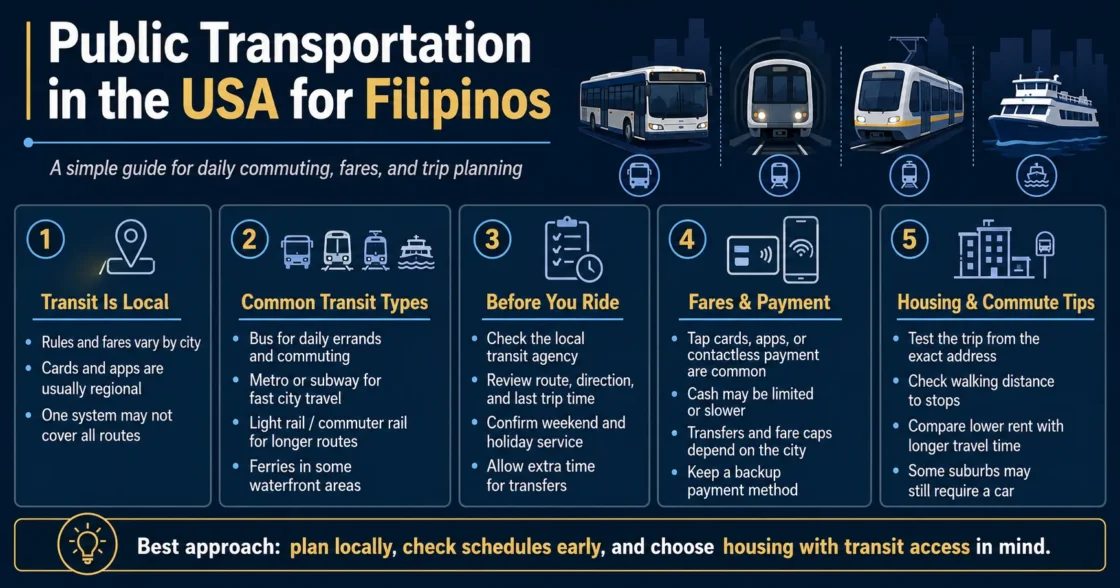
Public transportation in the United States can feel familiar in some ways and very different in others. For Filipinos arriving for work, school, family migration, caregiving, travel nursing, or a first long stay, the main point is simple: transportation rules are local. A bus card that works in Los Angeles may not work in Chicago, and a train pass in New York may not apply to commuter rail outside the city.
Why this matters →
A clear understanding of U.S. public transportation can help Filipino newcomers choose housing, manage commuting costs, and avoid missed appointments during the first months in America.
Before Riding: Check the local transit agency, route map, fare method, transfer rules, last-trip time, and whether the route runs on weekends or holidays.
How Public Transportation Works in the USA
Public transportation is usually managed by local or regional agencies, not by one national system.
The United States has many types of public transportation, including buses, subways, light rail, commuter rail, trolleys, ferries, and paratransit services. The Federal Transit Administration supports public transportation systems across the country, but each city or region usually controls its own routes, fares, cards, apps, and schedules.[a]
| Transit Type | Common Use | What Filipino Riders Should Check |
|---|---|---|
| City Bus | Daily commuting, errands, school, clinics, groceries | Exact route, transfer rules, cash policy, late-night service |
| Subway or Metro Rail | Fast travel inside large cities | Fare gates, tap cards, direction of train, service changes |
| Light Rail or Streetcar | City corridors, downtown areas, airport links in some places | Proof-of-payment rules and station ticket machines |
| Commuter Rail | Suburbs to city centers | Peak and off-peak fares, zones, paper or mobile ticket rules |
| Ferry | Waterfront cities and island connections | Weather delays, separate fares, limited evening trips |
| Paratransit | Accessible rides for eligible people with disabilities | Eligibility application, advance booking, service area limits |
What Filipino Newcomers Should Consider Before Choosing Housing
In many U.S. cities, transportation access can affect rent, work options, and daily stress.
Before signing a lease, it is safer to test the commute at the same time of day the trip will actually happen. A 25-minute trip on Sunday afternoon may become a 70-minute trip on a weekday morning. This matters for healthcare workers, hotel employees, airport workers, students, caregivers, and service workers whose shifts may start early or end late.
- Check the walking distance from the home to the nearest bus stop or station.
- Confirm whether the route runs early enough for morning shifts and late enough for evening shifts.
- Look at weekend schedules, because some U.S. bus routes reduce service on Saturday and Sunday.
- Compare the cost of rent savings against extra transportation time.
- Check whether groceries, Filipino stores, pharmacies, clinics, and schools are reachable without a car.
- Ask whether winter weather, hills, poor sidewalks, or limited street lighting will make the walk difficult.
Tip: When comparing apartments, search the route from the exact address, not only the city name or neighborhood name.
How To Plan A Public Transit Trip
A reliable trip starts with the correct local agency, not with a general U.S. travel assumption.
Step 1: Identify The Local Transit Agency
Search for the city or county name plus “transit,” “metro,” “bus,” or “transportation authority.” In some areas, the city bus, regional train, airport rail, and suburban bus may be operated by different agencies.
Step 2: Use A Map App, Then Confirm With The Agency
Google Maps, Apple Maps, and Transit-style apps are useful for route planning, but the official transit agency site or app is usually the better source for service alerts, fare rules, station closures, and holiday schedules.
Step 3: Check Direction, Stop Name, And Platform
Many U.S. routes use direction labels such as “Northbound,” “Southbound,” “Downtown,” “Uptown,” “Inbound,” or “Outbound.” A rider can be on the correct route number but on the wrong side of the street. For trains, the platform direction matters.
Step 4: Plan Transfers With Extra Time
Transfers are common. Some agencies allow free transfers for a limited time when the same card or device is used. Others may charge separately. New riders should allow extra time for the first trip, especially when going to work, a medical appointment, immigration-related appointment, school enrollment, or airport travel.
Important Notice: Do not assume that one payment covers every vehicle in the area. Local buses, express buses, commuter trains, ferries, and airport trains may have separate fares or special rules.
Paying Fares And Using Transit Cards
Most large systems use tap cards, mobile wallets, agency apps, or contactless bank cards.
Payment methods vary by region. New York’s OMNY system allows riders to use a contactless credit or debit card, smart device, wearable, prepaid card, or OMNY card on supported services.[b] Los Angeles Metro accepts TAP, credit or debit card options, mobile wallet options, and cash on buses, with fare caps when eligible payment methods are used.[c]
| Area | Common Fare System | Useful Note |
|---|---|---|
| New York City | OMNY | Use the same card or device for transfers and fare-cap tracking where available. |
| Los Angeles County | TAP / contactless options | Fare capping applies only when eligible tap payment methods are used. |
| Chicago | Ventra | CTA and Pace riders can use Ventra cards, tickets, value, passes, and supported contactless payment options.[d] |
| San Francisco Bay Area | Clipper / MuniMobile / cash in some cases | Muni accepts several payment methods, and fare rules differ for cable cars, passes, and discount programs.[e] |
Cash Is Not Always The Best Option
Some buses still accept cash, but exact change may be required and transfers may not be included. Rail systems often require a card, app, or station ticket purchase before boarding. A stored-value transit card is usually easier for daily commuting.
Foreign Cards May Not Always Work Smoothly
Some Philippine-issued cards may work, especially if they support international contactless payment, but this is not guaranteed. New arrivals should keep a backup payment method, such as a local debit card, transit card, small cash, or the agency’s official app.
Tip: When using a contactless card or mobile wallet, tap the same card or same device each time. Switching between a physical card and the phone wallet version can affect transfers or fare caps in some systems.
City Patterns Filipino Riders Often Notice
Transit quality depends heavily on the metro area, neighborhood, and time of day.
In dense cities such as New York, Boston, Washington, D.C., Chicago, San Francisco, and parts of Seattle, public transportation can be practical for daily life. In spread-out areas such as many suburbs of Los Angeles, Texas, Florida, Arizona, and parts of the Midwest, transit may work for selected corridors but still require rideshare, biking, carpooling, or a personal car for some errands.
- New York and nearby New Jersey: Strong subway, bus, commuter rail, and regional connections, but fares and agencies can differ by route.
- Los Angeles: Useful Metro rail and bus corridors, but distance between home, work, and groceries matters a lot.
- Bay Area: Multiple systems may be involved, including Muni, BART, Caltrain, AC Transit, and ferries.
- Chicago: CTA trains and buses are useful inside the city, with commuter rail serving many suburbs.
- Washington, D.C. Area: Metro rail, buses, and regional commuter services can help, but suburban trips may require careful planning.
- Hawaii: Bus service can be useful in urban Honolulu, but island geography and tourist traffic can affect travel time.
Airport, Intercity, And Long-Distance Travel
Airport trips and city-to-city travel often use different systems from daily city transit.
Many airports have train, bus, shuttle, or rail links, but not all airport transit is included in regular city fare. Some airport trains or express buses charge separate fares. For long-distance travel, Amtrak allows riders to search schedules by station or route and create trip-specific timetables for available train and connecting bus options.[f]
For Filipino travelers visiting relatives in another state, city-to-city buses and trains may be cheaper than flying for shorter routes, but travel time can be much longer. Always check baggage rules, station location, refund policy, and arrival time before booking.
Practical Note: A “train station” or “bus station” may not be near the airport or the final home address. Check the last mile from the station to the destination before buying a ticket.
Accessibility, Seniors, Students, And Discount Fares
Many agencies offer reduced fares, but eligibility rules and applications are local.
Discount programs may exist for seniors, people with disabilities, students, low-income riders, veterans, or Medicare card holders, depending on the city. Some programs require an application, proof of age, school enrollment, disability documentation, residence, or a specific local card.
Under ADA-related transit rules, complementary paratransit is intended for eligible people whose disabilities prevent them from using regular fixed-route bus or rail service. The Federal Transit Administration explains that paratransit service is generally tied to the fixed-route system’s service area, days, and hours, rather than being an unlimited door-to-door service everywhere.[g]
Important Notice: A disability diagnosis alone may not automatically qualify a rider for paratransit. Local agencies usually review functional ability to use regular transit and may require an application or assessment.
Safety, Etiquette, And Daily Riding Habits
Most routine transit problems can be reduced with planning, awareness, and correct fare use.
- Keep the fare card or ticket until the trip is fully finished, especially on proof-of-payment systems.
- Stand behind platform safety lines and do not rush closing doors.
- Let passengers exit before boarding.
- Use headphones for calls, videos, and music.
- Move bags away from seats when the vehicle is crowded.
- Check service alerts before late-night or weekend trips.
- Save the agency’s customer service number and lost-and-found page.
- During winter, allow more time for buses and trains because weather can affect service.
Tip: For late shifts, check the return trip before accepting a route. A bus may run to work in the afternoon but stop running before the shift ends.
Public Transportation Vs Driving In The USA
The better choice depends on city density, job location, family needs, and budget.
Public transportation can save money on parking, fuel, insurance, and car maintenance. It can also reduce stress in cities where parking is expensive or traffic is heavy. Driving may still be necessary in suburbs, smaller cities, rural areas, or jobs with changing worksites.
| Situation | Public Transportation May Work Well If | A Car May Be Needed If |
|---|---|---|
| Daily Work Commute | The route is direct, frequent, and reliable during shift hours. | The job starts very early, ends late, or changes location often. |
| Family With Children | School, daycare, groceries, and clinic visits are near transit. | Multiple children need different drop-offs across long distances. |
| New Arrival Without U.S. License | Housing is near a strong route and the workplace is transit-accessible. | The area has limited bus service or no safe walking path to stops. |
| Student Life | The campus has student passes, shuttles, or nearby rail and bus lines. | Housing is far from campus and weekend service is weak. |
Questions Filipinos Commonly Ask
These answers cover common first-month concerns for riders adjusting to U.S. transit systems.
Can A Filipino Tourist Use Public Transportation In The USA?
Yes. Tourists can usually use buses, trains, subways, and airport transit if they pay the correct fare. A passport is not normally needed for ordinary city transit, but it may be needed for some discount programs, intercity travel, hotel check-in, or identity verification in other contexts.
Is Public Transportation Safe For Daily Commuting?
Many people use public transportation daily. Safety varies by city, route, station, and time of day. New riders should choose well-lit stops, check late-night schedules, avoid empty train cars when possible, and follow official service alerts.
Can A Newcomer Live In The USA Without A Car?
Yes, in some cities and neighborhoods. It is more realistic in areas with frequent buses, rail, walkable streets, and nearby groceries. In car-dependent suburbs, living without a car can be difficult and may increase rideshare costs.
Do Children Need Their Own Fare?
Rules vary by agency. Some systems allow young children to ride free with a paying adult, while older children may need a regular or reduced fare. Always check the local agency’s child fare rule before traveling.
What Happens If A Rider Forgets To Pay?
Fare enforcement rules vary. A rider may receive a warning, fine, citation, or be required to leave the system. On proof-of-payment rail, inspectors may check tickets after boarding, so the rider should keep proof of payment until the trip ends.
Are There Filipino Language Services On Transit Systems?
Some agencies provide multilingual customer service, but Tagalog or other Philippine languages may not always be available. Riders who need help can ask for language assistance, use official apps, or bring a trusted interpreter for complex fare or accessibility applications.
Sources
- [a] U.S. Department of Transportation, Federal Transit Administration overview: used for the national description of public transportation systems and FTA’s role. This is reliable because it is an official U.S. government transportation source.
- [b] OMNY official FAQ: used for New York contactless fare payment methods and supported services. This is reliable because OMNY is the official fare payment system for MTA-supported transit services.
- [c] LA Metro fares page: used for Los Angeles fare payment options and fare-cap context. This is reliable because it is the official fare page of the Los Angeles County Metropolitan Transportation Authority.
- [d] Chicago Transit Authority Ventra page: used for Chicago fare system details. This is reliable because it is published by the official Chicago Transit Authority.
- [e] San Francisco Municipal Transportation Agency Muni fares page: used for San Francisco payment methods and fare categories. This is reliable because it is the official SFMTA fare information page.
- [f] Amtrak schedules and timetables page: used for long-distance train planning and station-to-station schedule checking. This is reliable because it is Amtrak’s official schedule tool.
- [g] Federal Transit Administration ADA frequently asked questions: used for paratransit service limits and eligibility context. This is reliable because it is an official FTA civil rights and ADA guidance source.