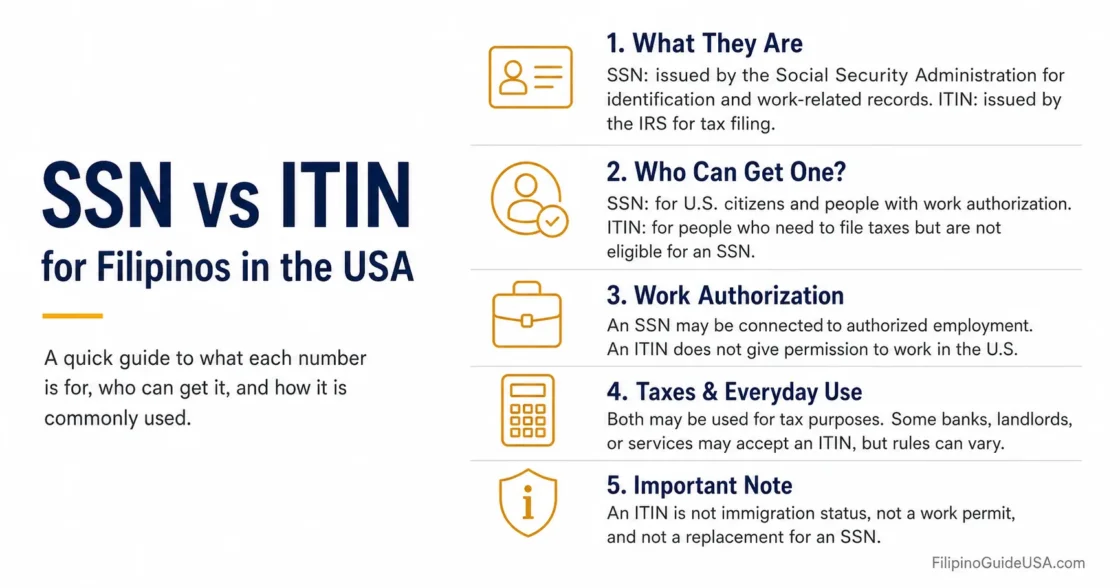
Filipinos in the United States often encounter two different identification numbers in tax, work, banking, school, and family paperwork: the Social Security Number, usually called an SSN, and the Individual Taxpayer Identification Number, usually called an ITIN. They look similar because both have nine digits, but they are not interchangeable.
An SSN is issued by the Social Security Administration and is generally tied to U.S. work authorization, tax records, and Social Security earnings. An ITIN is issued by the Internal Revenue Service for federal tax purposes when a person is not eligible for an SSN but has a valid U.S. tax reason.
Why this matters →
Choosing the wrong number can delay tax filing, employment onboarding, dependent claims, refunds, or immigration-related paperwork for Filipino families in the United States.
Prerequisites: Before deciding between an SSN and an ITIN, confirm these points first.
- Current U.S. immigration status or visa classification.
- Whether the person is authorized to work in the United States by the Department of Homeland Security.
- Whether there is a federal tax filing reason, such as filing a U.S. tax return, being listed as a spouse or dependent, or claiming an allowable tax benefit.
- Whether the person already has an SSN or has become eligible for one.
- Whether the number is needed for employment, tax filing, dependent paperwork, school records, banking, or state-level forms.
The Main Difference Between an SSN and an ITIN
This section separates the two numbers by issuing agency, purpose, eligibility, and limits.
For most Filipino applicants, the decision starts with one question: Is the person eligible for an SSN? In general, noncitizens need permission to work from the Department of Homeland Security to get an SSN.[a] If the person is not eligible for an SSN but has a federal tax reason, an ITIN may be the correct number.
| Category | SSN | ITIN |
|---|---|---|
| Issued By | Social Security Administration | Internal Revenue Service |
| Main Purpose | Employment, wage reporting, federal tax filing, Social Security earnings, and certain benefit records | Federal tax processing for people who are not eligible for an SSN |
| Who Usually Needs It | U.S. citizens, green card holders, and noncitizens with U.S. work authorization | Resident or nonresident aliens, spouses, or dependents who need a taxpayer identification number but cannot get an SSN |
| Work Authorization | Connected to lawful work-authorized status for noncitizens | Does not authorize legal work in the United States |
| Tax Use | Used on U.S. federal and state tax returns when the person has one | Used on a U.S. federal tax return only when the person is not eligible for an SSN |
| Expiration | Does not expire, although a person may need to update name or citizenship status with SSA | Can expire if not used on a federal tax return for three consecutive tax years |
Important Notice: An ITIN is for federal tax purposes only. It does not provide immigration status, does not authorize legal work in the United States, does not qualify a person for Social Security benefits, and does not qualify a person for the Earned Income Tax Credit.[b]
Which Number Fits Common Filipino Situations?
These examples show how the SSN and ITIN decision usually applies to Filipino workers, students, spouses, dependents, and taxpayers.
| Filipino Applicant Situation | Usually Correct Number | Reason |
|---|---|---|
| Filipino green card holder living in the United States | SSN | A lawful permanent resident is generally eligible for an SSN and should use it for employment and taxes. |
| Filipino employee with DHS work authorization, such as an approved work permit | SSN | Employment-authorized noncitizens generally apply for an SSN rather than an ITIN. |
| Filipino F-1 or M-1 student with authorized employment | SSN | A student with approved employment may need an SSN for wage reporting and payroll. |
| Filipino spouse listed on a U.S. tax return but not eligible for an SSN | ITIN | A spouse who cannot get an SSN may need an ITIN for federal tax filing. |
| Filipino dependent listed on a U.S. taxpayer’s return but not eligible for an SSN | ITIN, if allowed for that tax purpose | Some dependent-related tax benefits may allow an ITIN, while others require an SSN. |
| Filipino tourist with no U.S. work authorization and no federal tax filing reason | Neither | A visitor normally does not apply for either number unless a specific federal tax or official reason exists. |
| Filipino abroad with U.S.-source income, such as certain rental or investment income | ITIN, if not eligible for an SSN | A nonresident alien who must file a U.S. federal tax return may need an ITIN. |
Tip: A Philippine SSS number, Philippine TIN, UMID, PhilHealth number, or Pag-IBIG number cannot replace a U.S. SSN or ITIN on U.S. federal forms.
When a Filipino Should Use an SSN
An SSN is the right path when the person is eligible for one, especially for work-authorized status in the United States.
A Filipino should use or apply for an SSN if they are a U.S. citizen, lawful permanent resident, naturalized citizen, or a noncitizen with DHS work authorization. The IRS also states that an individual who is eligible for an SSN should use Form SS-5 to get an SSN rather than applying for an ITIN.[c]
Step 1: Confirm SSN Eligibility
Eligibility is usually based on U.S. citizenship, lawful permanent residence, or work-authorized noncitizen status. For a noncitizen, the person should review the immigration document that shows current status or work authorization.
Step 2: Prepare Identity and Status Documents
SSA may ask noncitizens to show current U.S. immigration documents, such as a Permanent Resident Card, an Arrival/Departure Record with an unexpired foreign passport, or an Employment Authorization Document. Some students and exchange visitors may need documents such as Form I-20 or DS-2019, depending on status.[d]
Step 3: Apply Through the Correct Channel
Some applicants can request an SSN while applying for work authorization or lawful permanent residence. SSA explains that applicants using Form I-765 or Form I-485 may request an SSN card through those applications if the required section is completed.[e]
Step 4: Use the SSN Consistently
Once issued, the SSN should be used for payroll, tax returns, W-2 wage reporting, and other official records that require a taxpayer identification number. Name changes after marriage, naturalization, or court order should be updated with SSA so that tax and employment records match.
Procedure Note: Filipinos who receive a green card, work permit, or naturalization certificate should keep the SSN card separate from the passport and immigration documents. The number is often needed, but the physical card should not be carried daily unless required for a specific appointment.
When an ITIN Is the Right Path
An ITIN is for federal tax processing when the person cannot get an SSN but has a valid U.S. tax reason.
An ITIN may be needed by a Filipino who is not eligible for an SSN but must file a U.S. federal tax return, claim an allowable tax benefit, report U.S.-source income, or be listed as a spouse or dependent for an allowed tax purpose. IRS guidance lists several ITIN applicant categories, including nonresident aliens filing a U.S. federal tax return, resident aliens filing a U.S. federal tax return, and dependents or spouses of certain U.S. taxpayers or visa holders.
Step 1: Confirm That an SSN Is Not Available
An ITIN should not be used as a backup choice when a person is actually eligible for an SSN. If the person has become work-authorized, received a green card, or otherwise qualifies for an SSN, the SSN path should be checked first.
Step 2: Identify the Federal Tax Reason
The IRS generally requires a federal tax purpose for an ITIN. A return with all zero entries may not show a federal tax purpose, and an ITIN application normally belongs with a tax return unless an IRS-listed exception applies.
Step 3: Prepare Form W-7 and Tax Documents
An ITIN application package generally includes Form W-7, a U.S. federal income tax return such as Form 1040 or Form 1040-NR unless an exception applies, and supporting documents proving foreign status and identity.[f]
Step 4: Choose How to Apply
Applicants may apply by mail or in person. In-person options may include an IRS Taxpayer Assistance Center with ITIN services, a VITA site with ITIN services, or an IRS-authorized Certifying Acceptance Agent. Some options can authenticate most supporting documents and return them at the appointment.
Step 5: Wait for IRS Processing
The IRS states that applicants should allow seven weeks for an ITIN application status notice, and processing can take nine to eleven weeks during tax season or when applying from overseas.
Attention: Do not submit original Philippine passports or civil documents by mail unless the IRS instructions require it and there is no safer available option. Many applicants prefer an IRS Taxpayer Assistance Center or Certifying Acceptance Agent when available because documents may be reviewed without mailing originals.
Required Documents for SSN and ITIN Applications
The documents depend on the person’s status, age, tax reason, and whether the application is for a new number, renewal, or record update.
| Application Type | Common Documents | Important Notes |
|---|---|---|
| SSN for a Filipino green card holder | Passport, Permanent Resident Card or immigrant visa document, proof of identity, and other SSA-requested records | SSA may require original or certified documents. Photocopies are usually not enough. |
| SSN for a Filipino with work authorization | Passport, I-94 if applicable, Employment Authorization Document, and identity documents | The immigration document must show current lawful work-authorized status. |
| SSN for a Filipino student or exchange visitor | Passport, I-94, I-20 or DS-2019, and employment authorization evidence when required | School or sponsor documentation may be needed depending on status and employment type. |
| ITIN for a Filipino taxpayer | Form W-7, federal tax return unless an exception applies, and documents proving foreign status and identity | Each family member applying for an ITIN needs their own Form W-7. |
| ITIN for a Filipino spouse or dependent | Form W-7, supporting identity and foreign-status documents, and tax return documents tied to the claimed tax benefit | Dependent documentation rules can be stricter, especially for proof of residency. |
Tax Benefits and Dependent Issues
Some tax benefits accept an ITIN in limited situations, while others require an SSN.
Filipino families should be careful when listing a spouse or child on a U.S. tax return. An ITIN can allow certain tax filing steps, but it does not unlock every credit. For example, the IRS states that a child with an ITIN cannot be claimed for the Child Tax Credit; the child must have an SSN to be a qualifying child for the Child Tax Credit or Additional Child Tax Credit.[g]
Important Notice: Tax credit rules change and depend on filing status, residency, due dates, and the identification number assigned before filing deadlines. Filipino taxpayers with mixed SSN and ITIN households should verify the current tax year rules before filing.
What Happens If a Filipino With an ITIN Later Gets an SSN?
A person should not keep using an ITIN after becoming eligible for and receiving an SSN.
Some Filipinos first receive an ITIN because they are not work-authorized or are listed on a tax return as a spouse or dependent. Later, they may receive an EAD, green card, or other status that makes them eligible for an SSN. Once an SSN is issued, the SSN should be used for tax purposes going forward.
The IRS instructs people who receive an SSN after having an ITIN to stop using the ITIN and notify the IRS so tax records can be combined under the SSN. This matters because wages, withholding, and refund records may not connect correctly if the old ITIN continues to be used.
Tip: After marriage, adjustment of status, naturalization, or legal name change, the name on SSA records, tax returns, payroll records, and bank records should match as closely as possible.
Common Mistakes to Avoid
These errors often cause delays for Filipino applicants and families preparing U.S. forms.
- Applying for an ITIN even though the person is eligible for an SSN.
- Using an ITIN on employment forms as if it were proof of work authorization.
- Listing a Philippine SSS number or Philippine TIN on a U.S. form that asks for an SSN or ITIN.
- Mailing original identity documents without checking whether an in-person document review option is available.
- Using an expired ITIN on a federal tax return without checking renewal rules.
- Assuming every dependent tax benefit works the same way for SSNs and ITINs.
- Continuing to use an ITIN after receiving an SSN.
SSN or ITIN Decision Path
This simple decision order helps prevent the most common filing and application mistakes.
- Check SSN eligibility first. If the person is a U.S. citizen, green card holder, or DHS-authorized worker, the SSN route usually comes first.
- If not SSN-eligible, check for a federal tax purpose. An ITIN is not issued just because a person wants an identification number.
- Match the number to the form. Employment forms normally require SSN-related work eligibility, while federal tax returns may use an ITIN only when allowed.
- Review dependent rules separately. A spouse or child may need a different number than the main taxpayer.
- Update records after status changes. When a person receives an SSN after previously using an ITIN, the IRS should be notified so tax records can be merged.
Verification Note: SSN, ITIN, tax credit, immigration, and document rules can change. Before applying or filing, applicants should recheck the current SSA and IRS pages linked below or consult a qualified tax or immigration professional for case-specific advice.
Sources
The following sources are official government pages used to verify eligibility, forms, document rules, and tax limits.
- [a] Social Security Administration: “If I am not a U.S. citizen, can I get a Social Security number?” — Used for noncitizen SSN eligibility. This is reliable because it is an official SSA public guidance page.
- [b] Internal Revenue Service: Individual Taxpayer Identification Number (ITIN) — Used for ITIN purpose, limits, eligibility categories, and what an ITIN does not do. This is reliable because it is the IRS page for ITIN rules.
- [c] Internal Revenue Service: U.S. Taxpayer Identification Number Requirement — Used for the rule that a person eligible for an SSN should use the SSN route and a person not eligible may apply for an ITIN. This is reliable because it is official IRS international taxpayer guidance.
- [d] Social Security Administration: Learn What Documents You Will Need to Get a Social Security Card — Used for SSA identity, immigration status, and document examples. This is reliable because it is an official SSA document checklist page.
- [e] Social Security Administration: Apply for Your Social Security Number While Applying for Your Work Permit and/or Lawful Permanent Residency — Used for requesting an SSN through Form I-765 or Form I-485. This is reliable because it is official SSA guidance connected to USCIS application workflows.
- [f] Internal Revenue Service: How to Apply for an ITIN — Used for Form W-7, tax return attachment, supporting documents, application methods, and processing time. This is reliable because it is the IRS application page for ITIN applicants.
- [g] Internal Revenue Service: Child Tax Credit FAQ on ITIN and SSN — Used for the rule that a child with an ITIN cannot be claimed for the Child Tax Credit. This is reliable because it is an IRS FAQ focused on this exact tax credit question.