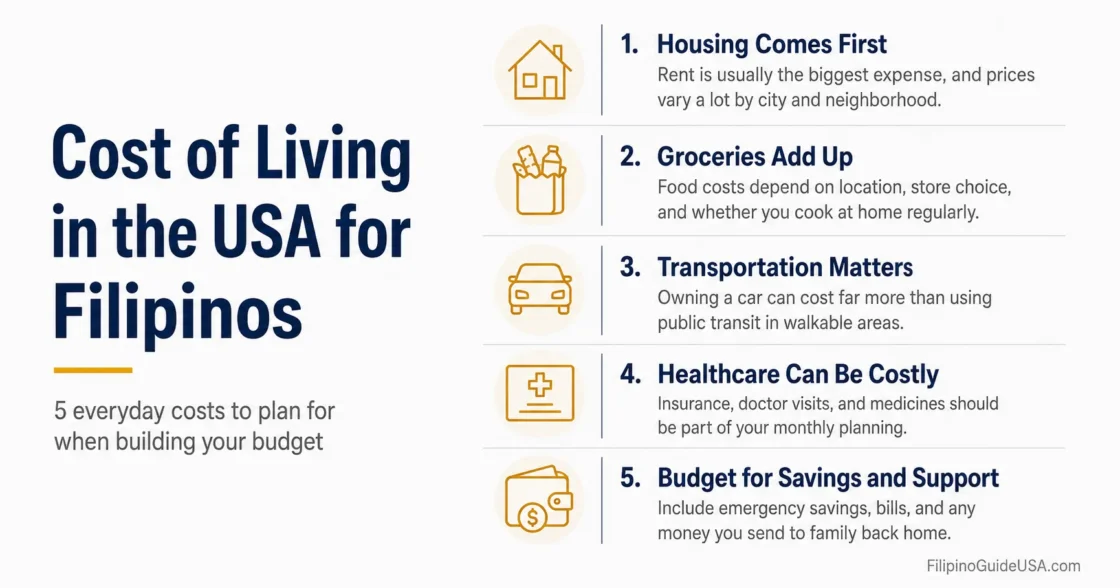
Living in the United States can feel very different from budgeting in the Philippines because several expenses are billed separately: rent, utilities, health insurance, car insurance, phone service, taxes, childcare, and remittances. For Filipino workers, students, new immigrants, and families, the safest way to estimate the cost of living is not to use one national number, but to build a monthly budget around the state, city, household size, job benefits, and family obligations.
Why this matters →
For Filipinos in the United States, the real monthly budget must cover American living costs while also leaving room for savings, emergencies, and possible support for family in the Philippines.
Budget Note: U.S. government spending data shows that housing, transportation, food, and healthcare take the largest share of household expenses, but the order can change depending on whether a person lives in a car-dependent suburb, a high-rent city, a shared apartment, or employer-provided housing.
Monthly Budget Range for Filipinos Living in the USA
This section gives realistic planning ranges without treating the United States as one uniform market.
A Filipino newcomer living alone in a shared apartment may spend much less than a family renting a two-bedroom home, paying for daycare, and keeping two cars. As a planning baseline, the U.S. Bureau of Labor Statistics reported average annual consumer-unit spending of $78,535 in 2024, with housing at 33.4% of total expenditures, transportation at 17.0%, food at 12.9%, and healthcare at 7.9%.[a]
| Household Situation | Practical Monthly Planning Range | What Usually Changes the Number |
|---|---|---|
| Single adult sharing housing | $1,900–$3,200 before savings and remittances | City, roommates, public transit access, employer health insurance, car ownership |
| Single adult renting alone | $2,700–$4,800 before savings and remittances | Rent, utilities, car payment, insurance, healthcare premium, debt payments |
| Couple without children | $4,000–$7,000 before long-term savings | One income or two incomes, housing size, health plan, transportation needs |
| Family with children | $5,500–$10,000+ depending heavily on childcare and housing | Childcare, school district, health coverage, number of cars, state taxes |
Tip: A budget that looks comfortable in a small city may fail in New York, San Francisco, Los Angeles, Seattle, Boston, Honolulu, or parts of New Jersey and Washington, D.C.
Housing Is Usually the Largest Expense
Rent often decides whether a U.S. salary feels enough or stretched.
Housing costs vary sharply by county and metro area. The U.S. Census Bureau reported that renters paid a national median of $1,413 per month in 2020–2024 ACS estimates, but this national figure can be far below rents in major coastal cities and above rents in smaller inland communities.[b]
| Housing Choice | Budget Effect | Best For |
|---|---|---|
| Room in a shared apartment | Usually the lowest rent option | New arrivals, students, single workers, temporary relocation |
| Studio or one-bedroom apartment | More privacy but higher rent and utilities | Workers with stable income and no need for school-district planning |
| Two-bedroom rental | Much higher in cities with strong job markets | Couples, small families, remote workers needing space |
| Suburban rental home | May lower rent per square foot but often adds car costs | Families prioritizing space, school access, and parking |
Important: Many U.S. rentals require the first month’s rent, a security deposit, application fees, and proof of income before move-in. A newcomer without U.S. credit history may also need a higher deposit, a co-signer, or additional documentation.
Food and Groceries
Food costs depend on whether meals are cooked at home, bought outside, or built around imported Filipino ingredients.
Cooking at home is usually the strongest way to control food costs in the United States. USDA food plan data gives a useful baseline: in a recent monthly cost report, the Thrifty Food Plan listed monthly food-at-home costs of $249.30 for a female age 20–50 and $312.80 for a male age 20–50, before restaurant meals or location-specific price differences.[c]
Filipino households may spend more than the lowest food plan when they regularly buy seafood, rice in bulk, imported condiments, specialty meats, tropical fruit, or Filipino bakery items. The cost difference is usually manageable when these items are bought from Asian supermarkets, warehouse clubs, or community grocery stores rather than small convenience shops.
- Rice, eggs, chicken, frozen vegetables, beans, noodles, and bulk pantry items help stabilize weekly spending.
- Filipino groceries are usually cheaper in metro areas with larger Filipino or Asian communities.
- Eating out frequently can raise monthly costs faster than grocery inflation because tips, delivery fees, taxes, and service charges add up.
- Large family gatherings should be planned as a separate monthly or occasional budget line, not hidden inside regular groceries.
Transportation: Car or Public Transit
Transportation costs can change the entire budget because many U.S. areas are built around car use.
In some U.S. cities, public transit can reduce monthly expenses. In many suburbs and smaller cities, a car is not optional for work, school drop-off, groceries, and medical appointments. Federal transportation data shows that rural households spent more on transportation than urban households in 2024, and transportation took a larger share of rural household income.[d]
| Transportation Setup | Common Monthly Costs to Include | Budget Risk |
|---|---|---|
| Public transit only | Transit pass, occasional rideshare, walking or biking needs | Limited job access outside transit routes |
| Used car paid in cash | Insurance, gas, registration, maintenance, repairs | Unexpected repair bills |
| Financed car | Loan payment, insurance, gas, parking, repairs | High insurance for new drivers or limited credit history |
| Two-car family | Two insurance policies, fuel, maintenance, parking, loan payments if financed | Can quietly become the second-largest household expense |
Tip: Before choosing cheaper rent far from work, compare the rent savings with gas, insurance, parking, tolls, commute time, and possible second-car needs.
Healthcare and Insurance
Healthcare is one of the expenses that can surprise Filipino newcomers because insurance does not always mean care is free.
Many full-time workers receive health insurance through an employer, but employees may still pay premiums, deductibles, co-pays, co-insurance, and out-of-network costs. KFF reported that average annual employer-sponsored health insurance premiums in 2024 were $8,951 for single coverage and $25,572 for family coverage, with covered workers contributing an average of $1,368 for single coverage and $6,296 for family coverage.[e]
Key Point: Do not compare job offers by salary only. A lower salary with strong employer health insurance may leave more usable income than a higher salary with expensive premiums, high deductibles, or no family coverage.
For people using the Health Insurance Marketplace, Open Enrollment usually runs from November 1 to January 15. Enrolling by December 15 can allow coverage to start January 1, while enrolling by January 15 can allow coverage to start February 1, if the first premium is paid.[f]
Taxes, Paychecks, and Take-Home Pay
A U.S. salary should be judged by net pay, not only the job offer amount.
Filipino workers new to the United States often focus on the annual salary, but the amount deposited into a bank account is lower after federal income tax withholding, Social Security, Medicare, possible state income tax, benefit deductions, retirement contributions, and insurance premiums. The IRS explains that employees complete Form W-4 so employers can withhold the correct federal income tax from pay, and the form should be reviewed when personal or financial circumstances change.[g]
| Paycheck Item | What It Means | Why It Matters for Budgeting |
|---|---|---|
| Gross pay | Total pay before deductions | Useful for job comparison, but not the amount available for rent |
| Federal and state withholding | Estimated income tax taken from pay | Can vary by state, filing status, income, and W-4 entries |
| FICA payroll taxes | Social Security and Medicare deductions | Applies to most wage income |
| Benefits deductions | Health insurance, dental, vision, retirement, and other elected benefits | Can make two similar salaries feel very different |
| Net pay | Amount actually received | Use this number for rent, food, savings, and remittances |
Remittances and Family Support
Money sent to the Philippines should be planned as a budget category, not treated as leftover cash.
Many Filipinos in the United States send regular support to parents, children, siblings, or extended family in the Philippines. This can be manageable when it is treated like a fixed monthly line item. It becomes risky when it is sent from money needed for rent, insurance, taxes, or emergency savings.
When sending money internationally, remittance providers may charge transfer fees and use different exchange rates. The Consumer Financial Protection Bureau maintains resources on the federal remittance transfer rule, which covers disclosures and protections for many international money transfers from the United States.[h]
Practical Remittance Rule: Set a monthly remittance amount after rent, utilities, food, insurance, transportation, debt payments, and emergency savings are accounted for. If family support must change, it is better to adjust early than to rely on credit cards or payday-style borrowing.
Banking, Credit History, and Upfront Costs
A stable U.S. budget becomes easier once banking, direct deposit, and credit records are organized.
Opening a U.S. bank account can help with direct deposit, rent payments, bill payment, debit card use, savings, and financial records. The FDIC notes that a bank account can keep money safe, provide quick access to funds, and help avoid some check-cashing and bill-payment fees.[i]
- Keep a checking account for bills and everyday spending.
- Keep a separate savings account for emergencies, immigration expenses, car repairs, medical costs, or travel to the Philippines.
- Use credit carefully; U.S. credit history affects apartment applications, car loans, credit cards, and sometimes insurance pricing.
- Avoid carrying credit card balances for normal living costs unless there is a clear repayment plan.
Before Signing a Lease or Accepting a Job Offer:
- Estimate monthly take-home pay, not just annual salary.
- Check rent, utilities, deposit, parking, and renter’s insurance.
- Ask whether health insurance is employer-paid, employee-paid, or shared.
- Estimate transportation based on the actual commute.
- Set a fixed remittance amount and emergency savings target.
- Confirm whether childcare, school transportation, or after-school care is needed.
Childcare and Family Costs
For families with young children, childcare can change the budget more than groceries or phone bills.
Childcare costs vary by state, county, child age, care type, and provider availability. The U.S. Department of Labor describes the National Database of Childcare Prices as a federal source for childcare price data by provider type, child age, and county characteristics.[j]
Filipino families should also account for school supplies, school clothes, lunch costs, activity fees, transportation, after-school programs, and occasional childcare during school breaks. Living near relatives can reduce childcare pressure, but it should not be assumed unless the arrangement is stable, safe, and clearly agreed upon.
Lower-Cost and Higher-Cost Living Patterns
A person can earn the same salary in two states and feel very different financially.
| Budget Pattern | Usually Lower Cost | Usually Higher Cost |
|---|---|---|
| Housing | Roommates, smaller cities, suburbs with reasonable commute | Major coastal cities, luxury apartments, short-term rentals |
| Food | Cooking at home, bulk rice, Asian markets, packed lunch | Delivery apps, daily takeout, specialty imports, frequent restaurant meals |
| Transportation | Public transit, one used car, living near work | Two financed cars, long commute, high insurance, paid parking |
| Healthcare | Strong employer plan, preventive care in-network | No employer coverage, high deductible, out-of-network care |
| Family Support | Fixed remittance schedule | Unplanned emergency transfers from credit cards |
Sample Monthly Budget Structure
A clear budget should separate survival expenses, family obligations, and future stability.
| Budget Category | What to Include | Planning Advice |
|---|---|---|
| Housing | Rent, utilities, internet, renter’s insurance, parking | Keep this realistic before choosing a city or apartment size |
| Food | Groceries, Filipino ingredients, work lunches, occasional dining out | Separate groceries from restaurants to see where money goes |
| Transportation | Transit pass, gas, insurance, maintenance, loan payment, registration | A car can be affordable to buy but expensive to keep |
| Healthcare | Premiums, prescriptions, co-pays, deductible savings | Read the plan details before assuming coverage is enough |
| Family and Remittance | Regular support, emergency help, school fees in the Philippines, transfer fees | Use a fixed amount where possible |
| Savings | Emergency fund, retirement, travel, immigration paperwork, car repair reserve | Treat savings as a bill, not as leftover money |
Where Filipinos Can Often Reduce Costs
The best savings usually come from large recurring bills, not tiny one-time cuts.
- Choose housing after comparing commute costs, not before.
- Share housing during the first months if privacy needs and safety allow it.
- Buy Filipino pantry staples in bulk when storage space is available.
- Use in-network healthcare providers whenever possible.
- Compare phone plans after confirming coverage in the actual neighborhood.
- Review car insurance quotes before buying a vehicle.
- Keep remittance fees and exchange rates visible instead of sending only by habit.
- Build a starter emergency fund before upgrading housing, car, or lifestyle.
Important: A U.S. emergency fund should be kept in dollars and accessible quickly. Medical co-pays, car repairs, job gaps, apartment deposits, and urgent family travel can happen before a newcomer has built strong credit or local support.
Frequently Asked Questions
These answers address common money questions for Filipinos planning a U.S. move.
Is the USA Expensive for Filipinos?
Yes, compared with most daily living costs in the Philippines, the United States is usually much more expensive, especially for rent, healthcare, car ownership, childcare, and eating out. However, U.S. wages may also be higher, so the better question is whether net income after taxes and benefits can cover the chosen city’s living costs.
How Much Should a Filipino Newcomer Save Before Moving to the USA?
A safer target is enough to cover the first month’s rent, security deposit, basic furniture, utilities setup, transportation, food, phone service, health coverage gap, and at least one to three months of essential expenses. The exact amount depends on the city, whether housing is already arranged, and whether family support is available.
Is It Cheaper to Live Near a Filipino Community?
It can be cheaper for groceries, community support, shared housing leads, cultural familiarity, and access to Filipino services. However, some areas with large Filipino communities are in expensive metro regions, so rent and commute costs still need careful checking.
Should Remittances Be Sent Every Month?
Monthly remittances can work well when they are planned. Problems arise when support is sent before essential U.S. bills are paid or when emergency transfers are funded with high-interest debt.
What Is the Biggest Cost Mistake New Arrivals Make?
The most common mistake is comparing salary to Philippine prices instead of calculating U.S. take-home pay, rent, health insurance, transportation, taxes, and deposits in the specific city where the person will live.
Sources
- [a] U.S. Bureau of Labor Statistics, Consumer Expenditures 2024 — used for national household spending categories and shares. This is a federal statistical source.
- [b] U.S. Census Bureau, rental cost analysis from ACS estimates — used for national median renter cost context. This is an official U.S. government population and housing data source.
- [c] USDA Food and Nutrition Service, monthly cost of food reports — used for food-at-home planning baselines. This is an official federal nutrition and food-cost source.
- [d] Bureau of Transportation Statistics, transportation spending by household type — used for transportation cost context. This is an official U.S. transportation data source.
- [e] KFF Employer Health Benefits Survey 2024 — used for employer-sponsored health insurance premium and worker contribution figures. KFF is a long-established health policy research organization with published methodology.
- [f] HealthCare.gov, Marketplace dates and deadlines — used for Open Enrollment timing. This is the official federal Marketplace information source.
- [g] Internal Revenue Service, Form W-4 information — used for paycheck withholding context. This is the official U.S. federal tax agency source.
- [h] Consumer Financial Protection Bureau, remittance transfer rule resources — used for remittance disclosure and protection context. This is an official U.S. consumer finance regulator source.
- [i] Federal Deposit Insurance Corporation, Get Banked — used for bank account benefits and safety context. This is an official U.S. banking regulator source.
- [j] U.S. Department of Labor Women’s Bureau, National Database of Childcare Prices — used for childcare price data context. This is an official federal labor data source.