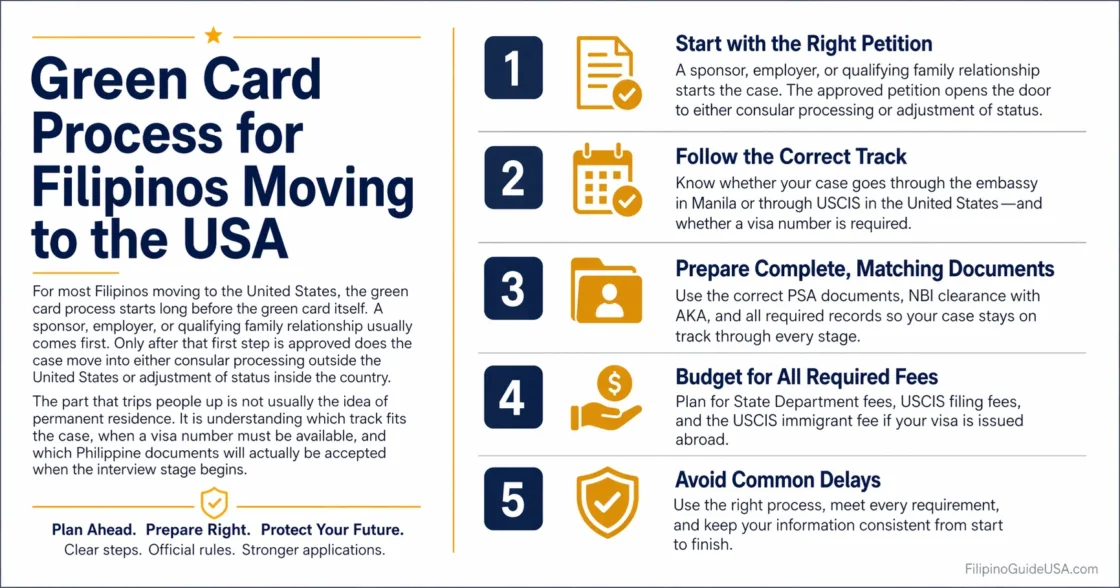
For most Filipinos moving to the United States, the green card process starts long before the green card itself. A sponsor, employer, or qualifying family relationship usually comes first. Only after that first step is approved does the case move into either consular processing outside the United States or adjustment of status inside the country.
The part that trips people up is not usually the idea of permanent residence. It is understanding which track fits the case, when a visa number must be available, and which Philippine documents will actually be accepted when the interview stage begins.
How The Process Usually Starts
A green card case usually has two layers. First, someone files the underlying petition or immigrant case. After that, the beneficiary either applies for an immigrant visa abroad or files Form I-485 in the United States if that option is available.[a]
For family cases, the first filing is often Form I-130. For employment cases, the first filing is often Form I-140, and some categories also require a labor certification before the petition is filed.[b]
| Situation | What Usually Happens First | Where The Case Usually Continues |
|---|---|---|
Spouse, parent, or minor child of a U.S. citizen living in the Philippines | Family petition is filed and approved | NVC processing, medical exam, and immigrant visa interview in Manila |
Spouse or child of a green card holder | Family petition is filed, then the case waits for visa availability if needed | NVC or USCIS, depending on where the beneficiary is and whether a visa number is current |
Employer-sponsored case for a worker abroad | Employment petition is filed after any required labor step | Consular processing after approval and visa availability |
Beneficiary already in the United States and eligible to file there | Petition and green card filing may be separate or, in some cases, filed together | USCIS adjustment of status process |
Family-Based Cases for Filipinos
Family sponsorship is the route many Filipino families use, but not all family cases move at the same speed. The first question is whether the case falls into an immediate relative category or a preference category.
Immediate Relative Cases
A spouse of a U.S. citizen, an unmarried child under 21 of a U.S. citizen, and a parent of a U.S. citizen who is at least 21 years old are treated as immediate relatives. These categories are not subject to annual numerical limits, so they do not wait for a visa number in the same way preference categories do.[c]
Preference Cases
If the petitioner is a lawful permanent resident rather than a U.S. citizen, or if the relationship falls into another family preference category, the case may have to wait until the priority date becomes current under the Visa Bulletin. That waiting step matters before the beneficiary can move forward to the final green card stage.[d]
One detail many families miss is what happens if the petitioner naturalizes while the case is pending. For a spouse or minor child, the National Visa Center can upgrade the category after proof of U.S. citizenship is submitted. In a spouse case, minor children who had been included as derivatives may need separate petitions after that upgrade, so this is worth checking early instead of near the interview date.[e]
2026 Public Charge Bond Pilot: The Department of State began using a Public Charge Bond procedure for selected immigrant visa applications on August 5, 2026. It is not a standard green card fee or a bond every immigrant must post. The procedure can become relevant after an INA 212(a)(4) public-charge finding when a consular officer tells the applicant that the bond route is available.[o] For family cases and the distinction between Form I-864, the public-charge determination, and a Public Charge Bond, see Family-Based Immigration to the USA for Filipinos.
Employment-Based Cases
For Filipinos moving through work, the first stage is usually handled by the U.S. employer or its immigration counsel. Some employment categories require a labor certification first, while others do not. After the petition is approved, the case still has to move through visa availability and final processing before permanent residence is issued.[f]
This is why an approved job-related petition does not always mean a person can move right away. The final step depends on whether the case will finish at a U.S. consulate abroad or through adjustment of status inside the United States, and whether a visa number is available at that time.
If You Will Finish the Case From the Philippines
If the beneficiary is living in the Philippines and is not eligible to file inside the United States, the case usually moves through consular processing. After the petition is approved, the National Visa Center handles the fee, document, and online application stage before the interview is scheduled.
Wait for the NVC stage to open. After approval, the case is transferred for immigrant visa pre-processing.
Pay the required fees. The NVC Welcome Letter leads to CEAC, where required fees are paid before the online application becomes available.
Complete Form DS-260. Each immigrating family member must complete a DS-260, and the confirmation page should be printed and brought to the interview.[g]
Collect civil documents. For Philippine cases, that usually means PSA-issued civil documents and the NBI police certificate where required. If there were corrections, annulments, name changes, or court actions affecting the record, the State Department’s Philippines reciprocity page says the document should be requested with a CDLI endorsement so the amendment appears on the record.[h]
Prepare for Manila-specific interview steps. The Embassy’s Manila instructions say immigrant visa applicants must complete the medical exam with St. Luke’s Medical Center Extension Clinic before the interview, and the post also requires a valid Philippine NBI Clearance with an AKA that includes maiden names, birth-certificate names, aliases, nicknames, and variant spellings that appear on other documents.[i]
That last point is easy to underestimate. A case can be delayed not because the relationship or job is weak, but because the civil record trail does not match across the PSA document, passport, marriage record, and NBI clearance.
If You Are Already in the United States
Some Filipinos do not finish the process in Manila because they are already lawfully in the United States and qualify to adjust status with USCIS. In that situation, Form I-485 is the filing that asks USCIS to grant permanent residence inside the country.
When Adjustment of Status May Be Possible
If you are physically present in the United States and an immigrant visa is immediately available, concurrent filing may be possible in some cases. USCIS specifically notes that immediate relatives can always concurrently file Form I-485 with the underlying Form I-130, while other categories depend on visa availability at the time of filing.[j]
If your case has already reached the NVC stage but you now plan to adjust status with USCIS instead, the State Department says you should notify NVC of that plan and not submit NVC fee payments for adjustment-of-status processing.[k]
What Usually Goes Into the USCIS Filing
For applicants who must submit Form I-693, USCIS requires that medical report to be filed together with Form I-485 rather than later in the case. That rule matters because a missing required medical filing can lead to rejection or delay.[l]
Before filing inside the United States, it is worth checking two things very carefully: whether your category is allowed to file now, and whether your current status and entry history support adjustment of status. Filing inside the country is not just the Manila process moved to a different office. It is a different legal track.
Costs to Plan For
Government fees change, so the safest way to budget is to separate State Department fees from USCIS fees.
The State Department lists the immigrant visa application processing fee for immediate relative and family preference cases at $325 per person.
It lists the immigrant visa application processing fee for employment-based cases at $345 per person.
It lists the Affidavit of Support review fee, when reviewed domestically, at $120.
Separate USCIS filing fees may also apply for forms such as I-130, I-140, or I-485 depending on your route, so those should be checked on the current USCIS fee pages before you send anything.[m]
For people who receive an immigrant visa abroad, USCIS also requires the separate immigrant fee to process the visa packet and produce the physical green card, unless an exemption applies.[n]
Public Charge Bond Is Not a Standard Fee: Do not add a Public Charge Bond to the normal green card budget unless a consular officer specifically instructs the applicant that the bond procedure applies. Under the 2026 pilot, the bond amount is set case by case for selected immigrant visa applicants rather than charged as a fixed fee to everyone.[o]
What Often Slows Cases Down
Using the wrong track. Some people assume every approved petition ends in a Manila interview, while others assume they can always switch to I-485 inside the United States. That is not always true.
Missing Philippine document details. PSA records with corrections, late annotations, or court changes may need the right endorsed version.
Name mismatches. A maiden name, nickname, or alternate spelling that appears on one document but not the others can become a document problem at the NBI or interview stage.
Treating petition approval as the finish line. Petition approval only moves the case into the next stage. It does not by itself grant permanent residence.
Ignoring visa-number rules. Preference categories may still have to wait even after the petition is approved.
Paying or uploading the wrong items after a case changes direction. This can happen when a petitioner naturalizes or when the beneficiary shifts from consular processing to adjustment of status.
What You Should Have Ready Before You Move Forward
Your exact immigration category
The name of the petitioner or employer who starts the case
Proof of the qualifying relationship or job offer
Current passport biographic page
PSA civil records that match your other documents
NBI clearance and any other required police certificates
Marriage, divorce, annulment, or death records if those apply
Financial sponsorship documents for family-based cases
A clear decision on whether the case will finish through Manila or through USCIS inside the United States
Before you file, pay fees, post any bond, or book travel, check the current USCIS page, the State Department page for your visa category, and the Manila post instructions one more time. Fees, form editions, interview steps, public-charge procedures, and document rules can change.
Sources
[a] How to Apply for a Green Card — used for the basic structure of petition first, then the permanent residence application step. (Official USCIS green card process page.)
[b] Immigrant Visa Process: Step 1 Submit a Petition — used for the family I-130 and employment I-140 starting point. (Official U.S. Department of State immigrant visa process page.)
[c] U.S. Visas Glossary — used for the definition of immediate relatives and the rule that these cases are not numerically limited. (Official State Department reference glossary.)
[d] Visa Availability and Priority Dates — used for the point that preference cases may need a current priority date before the final green card step. (Official USCIS visa-number availability page.)
[e] Immigrant Visas Processing: General FAQs — used for category upgrades after naturalization and the note that some children may need separate petitions. (Official State Department NVC guidance.)
[f] Employment-Based Immigrant Visas — used for the employment-based process and the note that some categories require labor certification before the petition stage. (Official State Department employment-based immigrant visa page.)
[g] Step 6 Complete Online Visa Application — used for the DS-260 filing step and the rule to print and bring the confirmation page to the interview. (Official State Department immigrant visa process page.)
[h] Philippines: Reciprocity and Civil Documents by Country — used for PSA and NBI document requirements and the CDLI endorsement point for amended civil records. (Official State Department Philippines civil document page.)
[i] U.S. Embassy Manila, Philippines – MNL — used for Manila-specific medical and police-certificate instructions, including SLEC and the NBI AKA requirement. (Official Manila immigrant visa instruction page.)
[j] Concurrent Filing of Form I-485 — used for the point that some applicants in the United States may file the petition and I-485 together when allowed. (Official USCIS concurrent filing page.)
[k] Immigrant Visas Processing: General FAQs — used for the instruction not to pay NVC fees when the case will be handled through adjustment of status with USCIS. (Official State Department NVC guidance.)
[l] USCIS Now Requires Report of Immigration Medical Examination and Vaccination Record to Be Submitted — used for the rule that required I-693 medical forms must be submitted with Form I-485. (Official USCIS policy alert.)
[m] Fees for Visa Services — used for the State Department immigrant visa and Affidavit of Support fee amounts cited in the budgeting section. (Official State Department fee page.)
[n] USCIS Immigrant Fee — used for the separate USCIS immigrant fee that applies after an immigrant visa is issued abroad, unless exempt. (Official USCIS immigrant fee page.)
[o] U.S. Department of State – Public Charge Bonds for Immigrant Visa Applicants — used for the August 5, 2026 pilot, selected-case limitation, INA 212(a)(4) context, consular notification rule, and case-specific bond amount. (Official State Department visa-policy notice.)