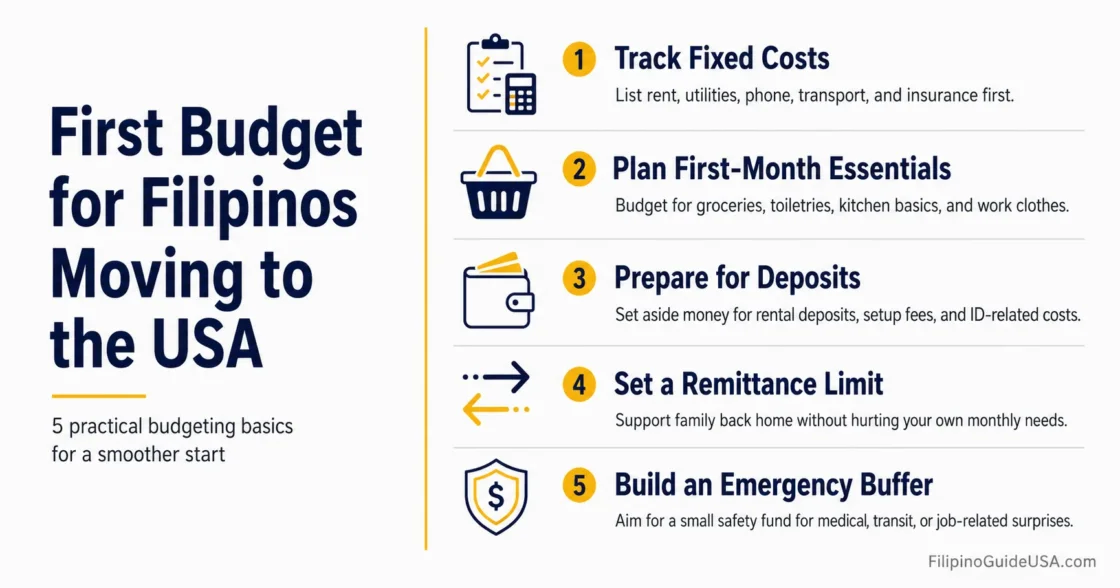
Moving from the Philippines to the United States creates costs before daily life becomes predictable. Rent deposits, temporary lodging, local transportation, phone service, health coverage, bank setup, document fees, and family support obligations can arrive before the first full paycheck. A safer first budget is built around the first 90 days, not only the first week after arrival.
Why this matters →
A clear first budget helps Filipino newcomers protect housing, food, health coverage, and family obligations while adjusting to U.S. systems.
Budget Documents To Prepare:
- Valid passport, U.S. visa, Green Card, Employment Authorization Document, or other immigration document that applies to the person’s status.
- U.S. address, host address, hotel confirmation, or temporary housing details.
- Job offer, start date, expected pay schedule, and any employer health insurance start date.
- Recent bank statements showing available funds in Philippine pesos and U.S. dollars.
- Housing quotes, lease terms, deposit rules, application fees, and utility setup costs.
- Health insurance plan details or a plan for Marketplace, employer, student, or private coverage.
- List of Philippine obligations such as family support, loans, tuition, medicines, or regular remittances.
Build the First Budget Around the First 90 Days
This section shows which costs should be planned before depending on regular income.
The first month in the United States is rarely a normal spending month. A newcomer may pay for both Philippine obligations and U.S. setup costs at the same time. The first budget should separate arrival cash, housing money, monthly living costs, and emergency savings into different categories.
| Budget Line | What It Covers | Planning Rule |
|---|---|---|
| Arrival Cash | Airport transportation, meals, hotel, SIM card, small purchases, and backup cash. | Keep this separate from rent money so it is not spent too early. |
| Housing Start-Up | Temporary stay, first month’s rent, deposit, application fees, basic furniture, and utilities. | Price housing before choosing a city or job offer. |
| Monthly Living Costs | Groceries, transport, phone, internet, toiletries, laundry, medicines, and basic household items. | Plan for at least three months of core bills. |
| Health And Insurance | Premiums, prescriptions, urgent care, dental needs, and out-of-pocket costs. | Confirm when coverage starts before arrival or immediately after arrival. |
| Document And Immigration Costs | USCIS-related fees if applicable, photos, copies, mailing, state ID, license, and document replacements. | Check official fee pages before paying because immigration fees can change. |
| Padala And Philippine Obligations | Family support, school fees, medicine, debt payments, property costs, or savings commitments in the Philippines. | Schedule remittances after rent, food, transport, and health coverage are protected. |
Tip: A first U.S. budget works better when it protects the basics first: housing, food, transport, health, phone access, and legal documents.
Step 1: Separate Arrival Cash From Savings
This section explains how to keep travel money, rent money, and emergency money from mixing together.
Arrival cash should cover the first few days without relying on a Philippine card, delayed bank transfer, or future paycheck. This includes airport transport, meals, temporary lodging, phone activation, and a small buffer for unexpected changes.
Long-term savings should not be carried as casual spending money. Keep a record of where funds came from, how they were exchanged, and where they will be deposited. This is useful for bank setup, lease applications, and personal tracking.
Important Notice: U.S. travelers may carry more than $10,000, but amounts over $10,000 in currency or monetary instruments must be reported to U.S. Customs and Border Protection when entering or leaving the country.[a]
Step 2: Price the City Before Accepting the Lifestyle
This section helps compare U.S. locations by the costs that usually affect newcomers most.
Salary alone does not show whether a city is affordable. Rent, commuting, car insurance, public transportation, child care, and health costs can change the real value of the same paycheck. National averages can help with orientation, but local estimates are more useful for a first budget.
U.S. household spending data shows why housing and transportation deserve early attention: in 2024, housing and transportation together accounted for more than half of average U.S. household spending.[b] For city-level planning, a location tool such as the MIT Living Wage Calculator can help compare basic needs by county, metro area, state, and household type.[c]
| Cost Area | Why It Changes by Location | What to Check Before Moving |
|---|---|---|
| Housing | Rent, deposits, application fees, and utilities vary widely by city and neighborhood. | Three real rental listings, move-in deposits, lease length, and commute time. |
| Transportation | Some areas require a car; others allow commuting by bus, train, or walking. | Monthly pass, rideshare cost, car insurance, parking, and license requirements. |
| Food | Filipino groceries, Asian markets, and regular supermarkets may have different prices and access. | Nearest grocery stores, bulk rice prices, cooking setup, and meal costs near work. |
| Weather Setup | Cold states may require winter clothing, heating costs, and safer footwear. | Average winter needs, heating deposit, coat, boots, gloves, and transport delays. |
Step 3: Plan Housing Money Before Other Purchases
This section explains why housing should be funded before furniture, shopping, or large remittances.
Housing can consume a large part of the first budget because the move-in cost is often higher than one month of rent. A renter may need the first month’s rent, a security deposit, an application fee, a utility deposit, and basic household items. Newcomers without U.S. credit history may also face more questions from landlords.
Safer housing planning starts with a temporary stay, then a verified lease. A room rental with trusted relatives or community contacts can reduce early costs, but the agreement should still be clear: rent amount, bills included, house rules, move-out notice, and payment method.
Useful Note: Avoid sending rent deposits through informal payment requests before seeing the lease terms, address, landlord identity, and move-in conditions. A lower price is not helpful if the housing arrangement is unclear.
Step 4: Set Up Banking Without Assuming Everything Needs an SSN
This section covers bank access, first deposits, and Social Security Number timing.
A U.S. bank account helps with direct deposit, rent payments, bills, and safer money storage. The FDIC explains that many banks allow non-U.S. citizens to open an account, and applicants may use different forms of identification such as a foreign passport, consular ID, Social Security Number, or ITIN, depending on the bank’s policy.[d]
A Social Security Number is mainly tied to work authorization and wage reporting. The Social Security Administration states that, in general, only noncitizens with permission to work from the Department of Homeland Security can get a Social Security Number.[e] Because SSN timing can affect payroll, banking, credit checks, and background checks, the first budget should include a cash buffer for delays.
| Banking Need | Possible Requirement | Budget Impact |
|---|---|---|
| Checking Account | Passport, U.S. address, SSN or ITIN if available, and opening deposit. | May require a small first deposit and time to activate debit access. |
| Direct Deposit | Employer payroll setup and bank routing information. | First pay may be delayed, split, or issued by check. |
| Credit Card | Credit history, SSN or ITIN, income information, and identity review. | Do not depend on credit approval for rent or food. |
Step 5: Do Not Leave Health Costs Until After Arrival
This section explains why health coverage belongs in the first budget, not only in the benefits folder.
Health insurance can start through an employer, a school, a spouse, a government Marketplace plan, or another lawful coverage route. Lawfully present immigrants may qualify for Marketplace coverage and may also qualify for savings based on income and other rules.[f]
A move to the United States from a foreign country can also qualify as a Marketplace Special Enrollment Period. HealthCare.gov lists moving to the U.S. from a foreign country or U.S. territory as a qualifying change in residence, and the page notes that proof of prior coverage is not required for people moving from a foreign country.[g]
Caution: Employer health coverage may not begin on the first workday. A newcomer should confirm the exact coverage start date, premium, deductible, copay, and prescription rules before assuming medical costs are covered.
Step 6: Budget From Take-Home Pay, Not Gross Salary
This section shows why the paycheck number should be reduced before building monthly spending.
A salary offer is not the same as money available for rent and groceries. Payroll taxes, federal tax withholding, state tax where applicable, health insurance premiums, retirement contributions, union dues if any, and commuting costs can reduce take-home pay.
Tax status also matters. The IRS explains that a person who obtains a Green Card is treated as a lawful permanent resident and is generally considered a U.S. tax resident for U.S. income tax purposes; U.S. tax residents are generally taxed on worldwide income.[h] This can affect anyone who still has Philippine bank interest, business income, property income, or other foreign income after moving.
Tip: For the first three months, calculate rent and bills from expected net pay after deductions, not from the annual salary written in the job offer.
Step 7: Include Immigration And Address Costs
This section covers official costs and address duties that can be missed in early budgets.
Some immigrants entering as lawful permanent residents through consular processing may need to pay the USCIS Immigrant Fee online unless an exemption applies. The fee should be checked directly on the official USCIS page before payment because fee rules can change.[i]
Address reporting is also part of settlement planning. USCIS states that all aliens in the United States must report a change of address within 10 days, except for listed categories such as A and G visa holders and visa waiver visitors.[j] A newcomer who moves from temporary housing to a permanent address should plan this update as part of the first-month checklist.
Important Notice: Immigration fees, address duties, work authorization rules, and health coverage rules can change. Official government pages should be checked again before paying a fee, filing a form, or relying on a deadline.
Step 8: Keep Padala Separate From Survival Money
This section explains how to support family without weakening the first U.S. budget.
For many Filipino households, remittance is not optional; it may support parents, children, school fees, medicines, or debt payments in the Philippines. The safest approach is to list these obligations before moving, then decide which payments continue during the first 90 days and which can pause or shrink while the U.S. household stabilizes.
International transfers should be compared by total cost, not only the advertised fee. The Consumer Financial Protection Bureau explains that federal protections generally apply when sending more than $15 to another country through a remittance transfer provider, including required information about fees and the amount the recipient will receive.[k]
| Remittance Question | Budget-Safe Answer |
|---|---|
| Should remittance start immediately? | Only if rent, food, transport, phone access, and health coverage are already funded. |
| Should transfers be sent from emergency savings? | No. Emergency savings should stay available for housing, medical, job, or document problems. |
| Should the family know the first-month limits? | Yes. A clear temporary amount avoids pressure and protects long-term support. |
A Practical First-90-Day Budget Formula
This section turns the budget into a simple calculation that can be adjusted by city and household size.
A first budget can be written as a formula instead of a fixed number:
First 90-day budget = housing move-in cost + three months of core monthly bills + health coverage gap + document and setup costs + planned remittances + emergency reserve.
| Household Situation | Budget Focus | Common Risk |
|---|---|---|
| Single Worker Staying With Family | Transport, phone, work clothes, food contribution, documents, and savings rebuild. | Spending early savings on shopping or remittance before stable pay begins. |
| Single Worker Renting a Room | Deposit, first rent, commute, groceries, phone, insurance, and emergency fund. | Underestimating transportation and utility costs. |
| Couple or Family With Children | Larger housing deposit, school supplies, health coverage, child care, winter clothing, and transportation. | Accepting a rent amount before calculating child care, car insurance, and groceries. |
| Student or Temporary Worker | Tuition-related costs, school insurance, shared housing, public transport, and work limits. | Using possible part-time income as guaranteed monthly income. |
Common Budget Questions
This section answers common money questions Filipino newcomers ask before leaving the Philippines.
How Much Money Should a Filipino Bring When Moving to the USA?
There is no single safe amount because the answer depends on city, household size, visa or immigration status, housing plan, job start date, and health coverage. A person staying with relatives in a lower-cost city needs a different runway from a family renting independently in a high-cost metro area. The safer target is enough to cover housing setup, three months of core bills, health coverage, document costs, planned remittances, and emergency savings.
Is It Better to Bring Cash or Use a Philippine Bank Card?
A small amount of arrival cash is useful, but carrying large amounts creates reporting duties and safety concerns. Philippine cards may also face foreign transaction fees, ATM limits, fraud blocks, or exchange-rate differences. A mixed plan usually works better: small cash, accessible card funds, bank records, and a plan to open a U.S. account.
Can a Newcomer Open a U.S. Bank Account Without Being a U.S. Citizen?
Many banks allow non-U.S. citizens to open accounts, but the exact documents vary by institution. A passport, U.S. address, SSN or ITIN if available, and immigration documents may be requested. Calling the branch before visiting can prevent wasted trips.
Should Remittance Continue During the First Month?
Remittance can continue if the U.S. housing and food budget is secure. If rent, transport, health coverage, or job income is still uncertain, a smaller temporary amount may be safer. Family members in the Philippines should be told that the first months include setup costs that will not repeat every month.
What If the First Paycheck Is Delayed?
The first budget should assume a delay is possible. Payroll setup, bank verification, document review, paper checks, and pay cycle timing can all affect the first payment. A newcomer should keep enough funds for rent, food, transport, and phone service until a full paycheck is received and cleared.
Before Relying on Any Number
This section reminds readers to confirm costs and rules before making final payments.
U.S. costs and rules change by state, city, employer, school, immigration status, and household size. Rent quotes, insurance premiums, USCIS fees, tax rules, and health enrollment windows should be checked again close to the move date. A budget is safest when it uses official sources for rules and current local quotes for prices.
Sources
- U.S. Customs and Border Protection — Money and Other Monetary Instruments — Explains the reporting requirement for travelers carrying more than $10,000 into or out of the United States. (Official .gov border agency source.)
- U.S. Bureau of Labor Statistics — Housing and Transportation Spending in 2024 — Provides national household spending context for housing and transportation. (Official federal labor statistics source.)
- MIT Living Wage Calculator — Provides local cost estimates by county, metro area, state, and household type. (University research tool from MIT.)
- FDIC GetBanked — Explains basic bank account preparation, identification, deposits, and account access for non-U.S. citizens. (Official federal deposit insurance agency source.)
- Social Security Administration — Social Security Numbers for Noncitizens — Explains general SSN eligibility for noncitizens with permission to work. (Official federal Social Security source.)
- HealthCare.gov — Coverage for Lawfully Present Immigrants — Explains Marketplace coverage and possible savings for lawfully present immigrants. (Official federal health insurance Marketplace source.)
- HealthCare.gov — Special Enrollment Periods — Lists moving to the U.S. from a foreign country as a qualifying change in residence. (Official federal health insurance Marketplace source.)
- Internal Revenue Service — Tax Information for New Immigrants — Explains tax residency, Green Card tax treatment, and worldwide income rules for U.S. tax residents. (Official federal tax agency source.)
- USCIS — USCIS Immigrant Fee — Explains the immigrant fee requirement and exemptions for certain lawful permanent residents entering through consular processing. (Official immigration agency source.)
- USCIS — AR-11 Alien’s Change of Address Card — Explains the address change reporting duty and the 10-day deadline for most aliens in the United States. (Official immigration agency source.)
- Consumer Financial Protection Bureau — Remittance Transfer Rights — Explains consumer rights and disclosures for many international money transfers. (Official federal consumer finance source.)