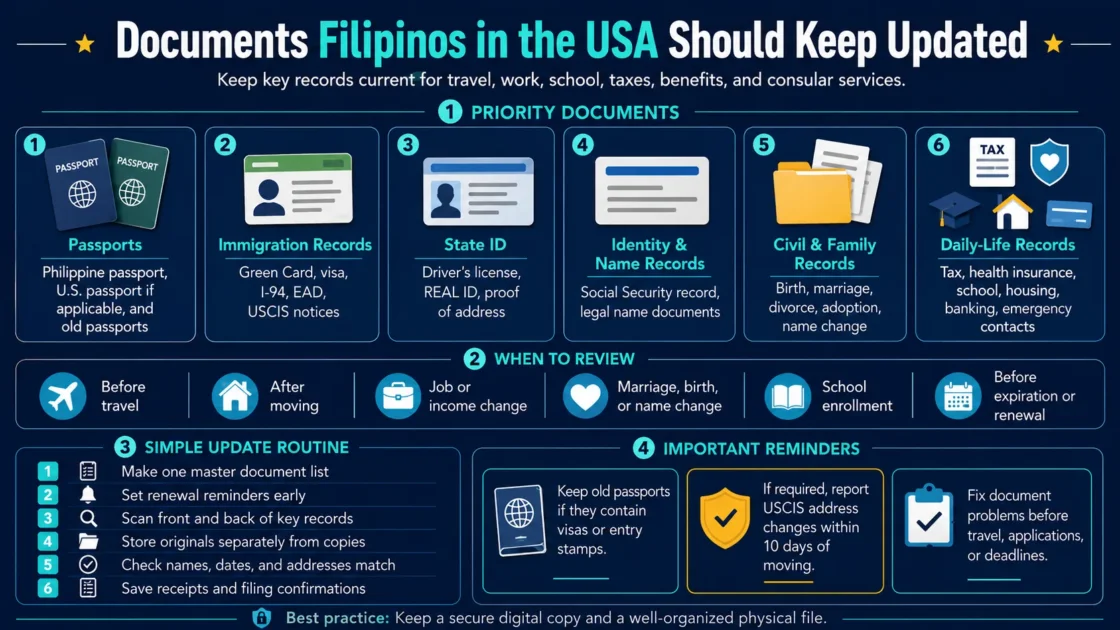
Keeping personal documents updated is one of the most practical habits for Filipinos living in the United States. A current passport, accurate immigration record, valid state ID, and organized civil records can make travel, work, school enrollment, benefits, taxes, and consular services much easier to handle.
Why this matters →
For Filipino families in the United States, one outdated document can delay travel, employment, school registration, tax filing, or a future immigration or consular transaction.
Documents To Keep Current: Review these records before travel, job changes, school enrollment, address changes, marriage, childbirth, immigration filing, or passport renewal.
- Philippine passport, U.S. passport if naturalized, and old passports with visas or entry stamps
- Green Card, visa record, Form I-94, EAD, approval notices, and other USCIS documents
- State driver’s license, state ID, REAL ID, and proof of address
- Social Security card record, ITIN documents if applicable, and legal name records
- Birth certificate, marriage certificate, divorce decree, adoption papers, and name-change orders
- Philippine civil registry records, including Report of Birth or Report of Marriage when applicable
- Tax returns, W-2, 1099, health insurance tax forms, and employment records
- School, vaccination, medical, housing, banking, and emergency contact records
Documents To Review First
Some documents affect daily life more directly than others, so they should be checked before anything urgent comes up.
| Document | When To Review It | Why It Matters |
|---|---|---|
| Passport | Before travel, renewal season, name changes, or immigration filings | Used for identity, travel, consular services, and many official applications |
| Immigration Status Document | After every entry to the U.S., before work renewal, and before moving | Helps confirm lawful status, work authorization, and address accuracy |
| State ID or Driver’s License | Before expiration, domestic flights, address changes, or vehicle-related needs | Used for banking, housing, driving, travel screening, and identity checks |
| Civil Records | After marriage, childbirth, divorce, adoption, or name correction | Needed for passports, school records, benefits, estate matters, and family petitions |
| Tax and Health Insurance Forms | Every tax season and after job, income, or insurance changes | Supports accurate filing, refund claims, health coverage records, and income proof |
Passport and Travel Records
A passport is more than a travel document; it often becomes the main identity record for consular, immigration, banking, and family transactions.
A Philippine passport should be checked well before travel plans, because renewal in the United States normally involves appointment scheduling, personal appearance, identity checks, and supporting documents through the appropriate Philippine Embassy or Consulate process.[a]
Filipinos who later become U.S. citizens should also keep their U.S. passport current. The U.S. Department of State allows eligible adults to renew a passport online or by mail, while children under 16 must apply again in person rather than renew an old child passport.[b]
Old passports should not be thrown away if they contain U.S. visa stamps, entry stamps, or past travel evidence. Even when an old passport is expired, it may help explain travel history, prior visa status, name history, or earlier immigration records.
Tip: Keep a clear scan of the passport photo page, current visa page if any, and the latest U.S. entry stamp or travel record. Store the scan in a secure location separate from the original passport.
Immigration Status Documents
Immigration records should match the person’s current status, current address, and most recent entry to the United States.
For noncitizens, the Form I-94 is one of the first records to check after entering the United States. CBP provides access to the most recent I-94 and travel history online, and the record should be reviewed for the correct name, class of admission, and admit-until date.[c]
Lawful permanent residents should track the expiration date and condition of the Green Card. USCIS uses Form I-90 for Green Card renewal or replacement when a card is expired, expiring, lost, stolen, damaged, or contains certain errors.[d]
Filipinos with work authorization should also track the expiration date on the Employment Authorization Document. USCIS generally uses Form I-765 to request, renew, or replace an EAD, depending on the person’s eligibility category.[e]
Students, exchange visitors, temporary workers, parolees, adjustment applicants, and other noncitizens may also need to keep current copies of approval notices, I-20, DS-2019, parole documents, or receipts. The exact document set depends on the person’s status and pending applications.
Important Notice: Most noncitizens required to report address changes must notify USCIS within 10 days of moving. A postal forwarding request or a change made with a school, employer, bank, or state DMV does not automatically update USCIS records.[f]
Identity, State ID, and Social Security Records
Everyday identity records should show the same legal name, date of birth, and address whenever possible.
A state driver’s license or state ID should be renewed before it expires and updated after a residential move according to state rules. For domestic air travel and access to certain federal facilities, REAL ID enforcement began on May 7, 2025, and non-compliant state IDs may not be accepted for those federal purposes unless another acceptable document is used.[g]
A Social Security card does not need to be carried every day. The Social Security Administration notes that a replacement card may be requested if the card is lost, stolen, damaged, or needed for a specific purpose, and many replacement requests can begin online.[h]
Name changes should be handled carefully. A person who changes name after marriage, divorce, naturalization, or court order should keep certified copies of the legal name-change record and update records in a sensible order: Social Security record, state ID, passport, banking, employer records, school records, insurance, and immigration or consular records when applicable.
Tip: When documents show different name formats, keep a simple name-history file with the old passport, marriage certificate, court order, naturalization record, or other document that explains the change.
Civil Registry and Family Records
Family records are often needed later for passports, school enrollment, inheritance matters, immigration petitions, and Philippine consular transactions.
Birth certificates, marriage certificates, divorce decrees, annulment records, adoption papers, custody records, and court-ordered name changes should be kept in certified form when possible. Photocopies are useful for reference, but many government offices require certified copies or originals for formal transactions.
For children born in the United States to Filipino parents, a Philippine Report of Birth may be needed for Philippine civil registry records and later passport or citizenship-related services. Philippine Embassy instructions show that Report of Birth applications may require multiple copies of parent and child records, depending on the family situation.[i]
For marriages that take place in the United States, a Report of Marriage may be needed to update Philippine civil registry records. The Philippine Embassy’s process lists civil documents, proof of citizenship, and copies that may be required depending on whether the Filipino spouse was single, divorced, annulled, or widowed.[j]
Record Note: A U.S. marriage certificate does not automatically update Philippine civil registry records. Filipino citizens should check the correct Philippine Embassy or Consulate process for the state where the event occurred.
Tax, Work, and Health Documents
Financial and employment records help with tax filing, proof of income, immigration evidence, housing applications, and health coverage records.
Tax records should be organized by year. The IRS generally advises keeping records for three years in many common situations, with longer periods applying to certain claims, losses, employment tax records, or other tax circumstances.[k]
Useful tax and work documents include filed federal and state tax returns, W-2 forms, 1099 forms, pay stubs, employer letters, business income records, bank interest statements, retirement account forms, and proof of deductible expenses when applicable.
Health insurance records should also be stored with tax documents when they affect filing. For Marketplace coverage, HealthCare.gov states that Form 1095-A is needed before filing and should be kept with tax records such as W-2 forms and other tax papers.[l]
Yearly File: Keep one folder for each tax year with tax returns, W-2 and 1099 forms, health insurance tax forms, major receipts, tuition records, childcare statements, donation records, and proof of estimated tax payments if any.
School, Housing, and Address Records
Local records often become proof of residence, family stability, school eligibility, or financial history.
Families with children should keep school enrollment letters, report cards, transcripts, vaccination records, special education documents if any, daycare records, and parent or guardian contact forms. These records can be needed after moving to another district, applying for school services, or transferring students between states.
Housing records should include a lease, mortgage statement, utility bills, renter’s insurance or homeowner’s insurance record, and move-in or move-out documents. These records can help prove address history for state ID updates, school enrollment, banking, loan applications, or future immigration evidence.
Address records should be consistent across USCIS, state DMV, employer payroll, school, bank, insurance, medical provider, and postal records. When a family moves, each office may need a separate update.
Tip: After moving, create a short address-update list and mark each office only after confirmation is received by email, letter, online account notice, or updated card.
Naturalization and Dual Citizenship Records
Citizenship records should be stored safely because they can be difficult and slow to replace.
Filipinos who become U.S. citizens should store the Certificate of Naturalization in a secure place and use certified copies or passport records when acceptable. USCIS uses Form N-565 to request a replacement Naturalization Certificate, Certificate of Citizenship, Declaration of Intention, or Repatriation Certificate.[m]
Former natural-born Filipinos who reacquire or retain Philippine citizenship should keep the Identification Certificate, Oath of Allegiance, order of approval, Philippine passport if issued, and U.S. naturalization records together. These documents may be needed for future passport renewal, property matters, family records, or travel planning.
For people with both U.S. and Philippine citizenship, the name, birth date, and place of birth should be consistent across both countries’ records. Any difference should be supported by a civil registry correction, court order, annotated record, or official certificate.
How To Keep a Document File Current
A simple document routine can prevent last-minute problems before travel, applications, or school deadlines.
- Make one master list. Write down each document name, document number if safe to record, issuing agency, expiration date, and where the original is stored.
- Set renewal reminders. Add reminders several months before passports, state IDs, EADs, travel documents, or professional licenses expire.
- Scan the front and back. Keep encrypted digital copies of identity cards, passports, approval notices, civil records, insurance cards, and tax forms.
- Separate originals from copies. Store originals in a safe location and use copies for routine reference whenever acceptable.
- Track address changes. After moving, update USCIS when required, then update DMV, employer, bank, school, insurance, health provider, and consular records if needed.
- Check names across records. Make sure passports, state ID, Social Security record, immigration documents, tax forms, and school records use the correct legal name.
- Keep proof of filing. Save receipts, confirmation pages, tracking numbers, appointment notices, and delivery proof for renewals or corrections.
Attention: Do not send original passports, civil records, or immigration documents to any office unless the official instructions specifically require originals. When mailing valuable documents, use a trackable mailing method and keep the receipt.
When a Document Is Lost, Damaged, or Incorrect
Lost or incorrect records should be handled through the issuing agency, not by creating unofficial versions or altering copies.
If an immigration document is lost, damaged, or contains an error, USCIS provides guidance on how to correct, update, or replace immigration documents depending on the document type and the problem involved.[n]
If a passport is lost, the correct process depends on whether it is a Philippine passport or a U.S. passport, whether the person is inside the United States, and whether urgent travel is involved. The loss should be handled through the relevant passport authority, and a police report or affidavit may be required depending on the rules of the issuing country.
If a civil record is incorrect, the correction should usually be made through the civil registry, court, or issuing office. For Philippine records, this may involve PSA records, embassy or consulate civil registry processes, or annotated documents. For U.S. records, the process may involve the state vital records office or a court order.
Common Questions About Document Updates
These questions cover the situations Filipino households often face after moving, changing status, or preparing for travel.
Should old passports be kept after renewal?
Yes. Old passports may contain visa stamps, entry stamps, or identity history that can help with travel history, immigration records, or future applications. They should be stored with other long-term records.
Is a Social Security card needed every day?
No. In most daily situations, the number is enough. The physical card should be stored securely and replaced only when it is lost, damaged, stolen, or required for a specific transaction.
What should be checked after entering the United States?
The passport entry stamp if any, the electronic I-94 record, visa status, admit-until date, and the spelling of the name should be checked. Any mismatch should be addressed early through the proper agency or legal support if needed.
Should Filipino parents report a U.S.-born child’s birth to Philippine authorities?
Parents should check the appropriate Philippine Embassy or Consulate process. A Report of Birth can help keep Philippine civil registry records accurate for future passport, citizenship, and family documentation needs.
What documents are useful before moving to another U.S. state?
Useful records include passports, immigration documents, state ID, Social Security record, lease or mortgage papers, utility bills, school records, vaccination records, insurance cards, tax records, and employment records.
Before Travel, Applications, or Major Life Changes
The safest time to fix a document problem is before a deadline, appointment, flight, or application date is already close.
Before international travel, check passports, visas, I-94 records, Green Cards, travel documents, children’s records, and airline name spelling. Before an immigration filing, check civil records, translations, address history, tax records, and identity documents. Before school enrollment, check proof of address, birth records, guardian records, vaccination records, and prior school documents.
For Filipino families, the best document file is not only complete; it is consistent. Names, birth dates, places of birth, addresses, and citizenship records should match across U.S. and Philippine documents as much as possible. Where they do not match, the record explaining the difference should be stored with the file.
Verification Note: Immigration, passport, consular, tax, health insurance, and state ID procedures can change. Before filing, renewing, mailing originals, or paying a fee, check the latest instructions from the official agency or the Philippine Embassy or Consulate that covers the person’s state of residence.
Sources
[a] Philippine Embassy in Washington, D.C., adult ePassport renewal page — supports the passport renewal and supporting-document section. This is reliable because it is an official Philippine government consular source.
[b] U.S. Department of State, Renew or Replace a Passport — supports the U.S. passport renewal and child passport note. This is reliable because it is the official U.S. passport authority.
[c] U.S. Customs and Border Protection, Arrival/Departure Forms I-94 and I-94W — supports the I-94 travel record section. This is reliable because CBP is the U.S. agency that issues and manages I-94 arrival and departure records.
[d] U.S. Citizenship and Immigration Services, Form I-90 — supports Green Card renewal and replacement information. This is reliable because USCIS is the agency responsible for permanent resident card applications.
[e] U.S. Citizenship and Immigration Services, Form I-765 — supports the Employment Authorization Document renewal and replacement section. This is reliable because USCIS administers EAD applications.
[f] U.S. Citizenship and Immigration Services, AR-11 Alien’s Change of Address Card — supports the USCIS address-change warning. This is reliable because it is the official USCIS address reporting page.
[g] U.S. Department of Homeland Security, REAL ID Frequently Asked Questions — supports the REAL ID enforcement and state ID section. This is reliable because DHS oversees federal REAL ID implementation.
[h] Social Security Administration, Replace Social Security Card — supports the Social Security card replacement section. This is reliable because SSA issues and manages Social Security number records.
[i] Philippine Embassy in Washington, D.C., Report of Birth application by mail — supports the section on U.S.-born children and Philippine civil registry records. This is reliable because it is an official Philippine consular source.
[j] Philippine Embassy in Washington, D.C., Report of Marriage application by mail — supports the section on marriage records and Philippine civil registry updates. This is reliable because it is an official Philippine consular source.
[k] Internal Revenue Service, How Long Should I Keep Records? — supports the tax recordkeeping section. This is reliable because the IRS is the U.S. federal tax authority.
[l] HealthCare.gov, How to Use Form 1095-A — supports the health insurance tax form section. This is reliable because HealthCare.gov is the official federal Marketplace information source.
[m] U.S. Citizenship and Immigration Services, Form N-565 — supports the replacement of naturalization and citizenship certificates section. This is reliable because USCIS issues and replaces these citizenship documents.
[n] U.S. Citizenship and Immigration Services, Immigration Documents and How to Correct, Update, or Replace Them — supports the section on lost, damaged, or incorrect immigration records. This is reliable because it is official USCIS guidance for immigration document corrections and replacements.