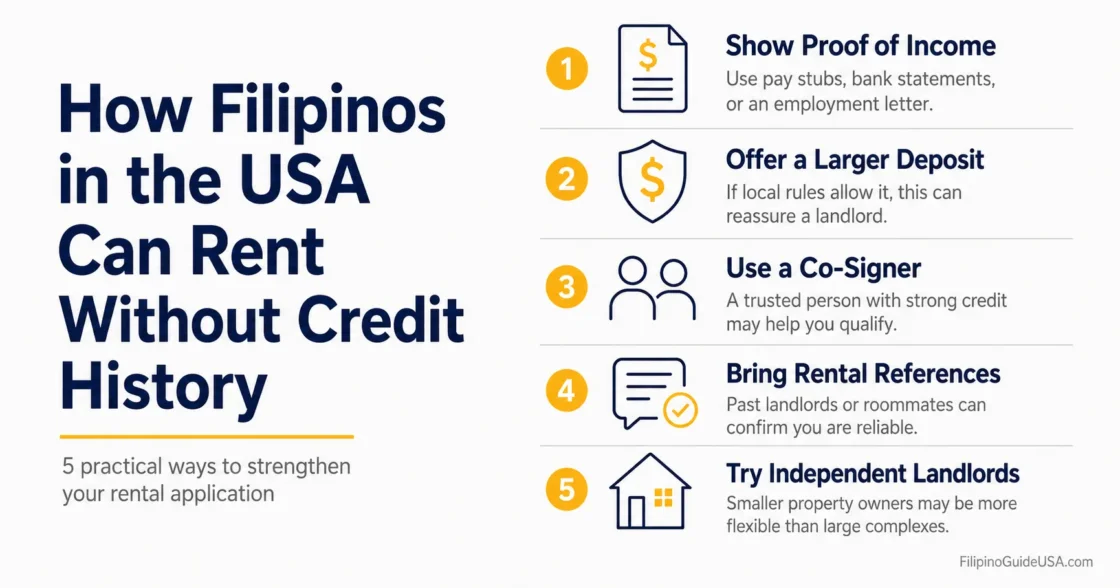
Renting in the United States can feel confusing for Filipinos who are new to the country, recently arrived for work, studying, joining family, or rebuilding financial records after relocation. A missing U.S. credit history does not automatically prevent someone from renting, but it changes the way the application must be presented. The goal is to replace a thin or blank credit file with clear proof of identity, income, savings, rental responsibility, and lawful ability to sign a lease.
Why this matters →
Many Filipino renters arrive with strong work records and responsible payment habits, but U.S. landlords usually need local documents before approving a lease.
Application Packet to Prepare:
- Passport or other government-issued photo ID
- U.S. visa, green card, Employment Authorization Document, I-94 record, or other status document if the landlord asks for proof of legal identity or stay
- Social Security number if available, or an explanation that one has not yet been issued
- Employment offer letter, contract, or current pay stubs
- Bank statements or a bank letter showing available funds
- Previous landlord reference, even if the rental was in the Philippines or another country
- Employer, school, or professional reference letter
- Contact information for a U.S.-based guarantor or co-signer, if available
- Proof of remittance obligations or family support only if it helps explain monthly budgeting; sensitive personal details do not need to be shared
Why No Credit History Creates a Rental Barrier
This section explains what landlords usually check and why a blank file is different from bad credit.
In the U.S., many landlords use tenant screening reports before approving an application. These reports may include credit report information, rental history, eviction records, and other background data. A Filipino applicant who recently moved to the U.S. may have no credit file or a very short file, even if they paid rent, loans, or bills responsibly in the Philippines.
A blank U.S. credit history is not the same as unpaid debt. It simply means the U.S. credit reporting system does not yet have enough local data to evaluate the applicant. Landlords may still approve the rental if the applicant can show reliable income, stable employment, savings, references, or a qualified guarantor.
Tip: The application should not rely on one explanation. It should give the landlord several ways to verify that rent can be paid on time.
Step 1: Ask the Landlord What They Accept Instead of Credit
This step helps avoid wasted application fees before submitting documents.
Before applying, the renter should ask the landlord or property manager whether applicants with no U.S. credit history are considered. The answer often depends on the property type. Large apartment companies may follow fixed screening rules, while smaller landlords may be more willing to review income letters, bank statements, or references.
Useful questions include:
- Does the property accept applicants with no U.S. credit file?
- Can income, savings, or an employment offer letter be reviewed instead?
- Is a U.S.-based co-signer or guarantor accepted?
- Will the application fee be charged before or after basic eligibility is reviewed?
- Will the applicant receive a copy or explanation if the application is denied because of a screening report?
Useful Procedure Note: Tenant screening reports are consumer reports. If a report contains incorrect information, the renter has rights to dispute errors under federal consumer reporting rules.[a]
Step 2: Build a Strong Proof of Income File
This step shows the landlord that rent is affordable even without a credit score.
For many no-credit applicants, income documentation carries the most weight. A landlord wants to see that rent can be paid every month after taxes and regular expenses. Filipino renters who are newly employed in the U.S. should prepare documents that show job title, salary, start date, and whether the job is full-time, part-time, contract-based, or temporary.
| Situation | Useful Document | What It Proves |
|---|---|---|
| New U.S. employee | Signed offer letter or employer verification letter | Expected income, job start date, and employer identity |
| Already working | Recent pay stubs and direct deposit records | Current earnings and payment consistency |
| Healthcare worker, caregiver, seafarer transitioning, or contract worker | Contract, agency letter, assignment letter, or work schedule | Employment arrangement and expected income flow |
| Student or trainee | Enrollment letter, stipend letter, scholarship letter, or sponsor letter | Program status and source of support |
| Self-employed applicant | Bank deposits, client contracts, tax documents if available, or business registration records | Business income and ability to cover rent |
Bank statements can help, but renters should protect privacy. It is usually enough to show the applicant’s name, bank name, recent balance, and income deposits. Sensitive transaction details that are not relevant to rent approval can be redacted before sharing.
Step 3: Use References When Credit Is Missing
This step replaces missing U.S. rental history with people who can confirm reliability.
A prior landlord reference from the Philippines can still help if it is clear, dated, and easy to verify. The letter should state the rental address, tenancy dates, whether rent was paid on time, and whether the property was kept in good condition. If the previous landlord writes in Filipino or another language, an English translation should be included.
Employer and professional references can also support the application. These should confirm stability, not personal character alone. A short letter from a supervisor, HR department, school official, or relocation coordinator is stronger than a general statement from a friend.
Tip: A reference letter should include the writer’s full name, role, phone number, email address, and relationship to the applicant.
Step 4: Consider a Co-Signer, Guarantor, or Room Rental
This step explains common approval paths when standard apartment screening is strict.
If a property requires credit history, a U.S.-based co-signer or guarantor may help. This person agrees to be financially responsible if the renter does not pay. Because this is a serious legal obligation, it should only be used when both parties understand the lease and the possible financial consequences.
For newly arrived Filipinos without a guarantor, a room rental, shared apartment, employer-arranged housing, university housing, or a short-term furnished rental may be more realistic for the first lease. After several months of on-time payments, the renter can use that local rental record to apply for a more traditional apartment.
| Option | When It Helps | Point to Check |
|---|---|---|
| Co-signer | The applicant has income but no credit file | The co-signer may be responsible for unpaid rent or lease charges |
| Guarantor service | A landlord accepts third-party lease guarantees | Fees, refund terms, and landlord acceptance should be confirmed in writing |
| Room rental | The renter needs a first U.S. address quickly | The arrangement should still have a written agreement |
| Short-term furnished rental | The renter is still waiting for documents, SSN, or job start date | Total monthly cost may be higher than a standard lease |
Step 5: Be Careful With Extra Deposits and Upfront Rent
This step helps renters avoid paying more than local law allows.
Some landlords may ask a no-credit applicant for a larger security deposit, prepaid rent, or both. This can be legal in some places and restricted in others. Security deposit rules are mainly set by state and local law, so the renter should check the rules for the city and state before offering extra money.
Warning: Do not assume that paying several months of rent upfront is always allowed or safe. State and local rules may limit deposits, prepaid rent, application fees, or how deposits must be returned. Renters can use official tenant-rights resources to find the correct complaint office or housing agency for their location.[b]
Any money paid before move-in should be documented with a receipt. The receipt should state whether the payment is an application fee, holding deposit, security deposit, first month’s rent, last month’s rent, or another charge. These labels matter because refund rules may differ.
Step 6: Handle SSN Questions Correctly
This step explains how renters can respond when an application asks for a Social Security number.
Many rental applications ask for a Social Security number because landlords use it to run credit or tenant screening checks. Some new arrivals do not have an SSN yet. According to the Social Security Administration, some noncitizens may request an SSN if they work, attend school, or have a valid nonwork reason.[c]
If the renter has no SSN yet, the applicant can ask whether the landlord accepts other identity documents, such as a passport, visa document, I-94 record, Individual Taxpayer Identification Number if applicable, employer letter, or manual review. A landlord may still choose not to proceed if its screening system requires an SSN, but the renter should avoid entering a false number or using another person’s number.
Warning: Never use a borrowed, invented, or incorrect Social Security number on a rental application. If the form cannot be completed without an SSN, ask for a manual review or a written list of acceptable alternatives.
Step 7: Know Fair Housing Protections
This step explains the difference between lawful screening and possible discrimination.
A landlord can usually apply neutral financial standards, such as income verification or tenant screening, as long as those standards are applied consistently. However, federal fair housing law prohibits housing discrimination based on national origin, along with other protected categories.[d]
For Filipino renters, this means a landlord should not reject an application because the applicant is Filipino, speaks with an accent, was born outside the U.S., has a Philippine passport, or receives part of their support from family abroad. A landlord may ask for documents needed to verify identity, income, or screening information, but the process should not be used as a cover for unequal treatment.
Warning signs may include:
- Different requirements only after the landlord learns the applicant is from the Philippines
- Refusal to accept standard documents from a lawful applicant while accepting similar documents from others
- Comments about accent, ethnicity, surname, or country of origin
- Higher fees or stricter terms that are not applied to other applicants with similar financial profiles
Step 8: Avoid Rental Scams Targeting Newcomers
This step helps renters protect money before signing a lease.
New arrivals are often under pressure to find housing quickly, especially near hospitals, care facilities, schools, transit lines, and Filipino community areas. Scammers use that pressure by posting fake listings, copying real apartment photos, or asking for deposits before allowing a viewing. The Federal Trade Commission warns that fake rental ads may promote places that are not available or do not exist.[e]
Safe rental habits include:
- View the unit in person or through a verified live video tour before paying a deposit
- Confirm that the person collecting money has authority to rent the property
- Search the address to see whether the same photos appear under different names or prices
- Avoid wire transfers, gift cards, cryptocurrency, or payment apps when the landlord refuses normal documentation
- Get the lease, receipt, and landlord contact information before paying move-in money
Tip: A listing that is far below local rent and demands fast payment before a viewing should be treated as unsafe until verified.
Step 9: Start Building U.S. Credit After Moving In
This step helps turn the first rental into a stronger record for the next application.
After securing housing, the renter should begin building a U.S. financial record. Credit scores are based on credit report information, including payment history, amounts owed, length of credit history, new credit, and types of credit used.[f]
Good first steps may include opening a U.S. bank account, paying rent and utilities on time, keeping lease receipts, and checking whether the landlord or a rent-reporting service can report rent payments to credit bureaus. A secured credit card or credit-builder product may also help, but only if payments are made on time and balances are kept manageable.
Renters should also check their credit reports as they begin building history. The Federal Trade Commission states that AnnualCreditReport.com is the authorized place to get the free credit reports provided by law.[g]
What to Say When Applying With No U.S. Credit
This section gives a clear wording sample for emails or application notes.
A short, practical explanation is better than a long personal story. The message can be adapted like this:
Hello, this applicant recently relocated to the United States and does not yet have a long U.S. credit history. The application includes proof of income, employment verification, bank documentation, identification, and rental or professional references. Please confirm whether the property can review these documents for applicants with limited U.S. credit history.
This wording keeps the focus on documents and review standards. It does not overshare family, immigration, or financial details that are not needed for rental approval.
Documents That Should Be Protected
This section explains how to share enough information without giving away unnecessary private data.
Rental applications require personal information, but not every detail has to be exposed in full. Before sending documents by email or upload portal, renters should confirm that the landlord or property manager is legitimate.
| Document | Share Carefully | Safer Practice |
|---|---|---|
| Bank statement | Full account number and unrelated transactions | Show name, bank, balance, and income deposits; redact unrelated details |
| Passport or visa page | Sending to unverified listings | Share only through a verified application process |
| Employment letter | Private HR contact details beyond what is needed | Use an official letter with a general verification phone or email |
| Reference letters | Personal addresses of references | Use professional contact information when possible |
When an Application Is Denied
This section explains what to do after a rejection without losing momentum.
A denial is not always final. The renter can ask whether the decision was based on income, credit history, tenant screening results, missing documents, or another reason. If a tenant screening report was used and the information is wrong, the applicant should request the report details and dispute the error with the reporting company.
After a denial, the next application should be adjusted. If income was unclear, add a stronger employer letter. If the landlord required U.S. rental history, add a co-signer or apply to smaller landlords. If the property required a credit score, look for properties that accept manual review for newcomers.
Procedure Reminder: Housing rules, deposit limits, application fee rules, and tenant complaint options vary by state and city. Before paying large upfront amounts or signing a lease, renters should confirm the rule for the exact location using official state, city, or federal tenant resources.
Sources
- [a] — Consumer Financial Protection Bureau, tenant background check review and dispute rights. This supports the section on tenant screening reports and error disputes. The CFPB is a U.S. federal consumer finance agency.
- [b] — USAGov, tenant rights and landlord complaint guidance. This supports the warning that rental rules and complaint offices vary by location. USAGov is the official information portal of the U.S. government.
- [c] — Social Security Administration, first-time Social Security number requests. This supports the section on when some noncitizens may request an SSN. The SSA is the federal agency that administers Social Security numbers.
- [d] — U.S. Department of Housing and Urban Development, Fair Housing Act overview. This supports the section on national origin protections in rental housing. HUD is the federal agency responsible for fair housing enforcement.
- [e] — Federal Trade Commission, rental listing scams. This supports the scam-prevention section for renters searching online. The FTC is the federal consumer protection agency.
- [f] — MyCreditUnion.gov, credit score factors. This supports the explanation of how credit scores are generally calculated. MyCreditUnion.gov is run by the National Credit Union Administration, an independent federal agency.
- [g] — Federal Trade Commission, free credit reports. This supports the section on using AnnualCreditReport.com as the authorized source for free credit reports. The FTC is a federal consumer protection authority.