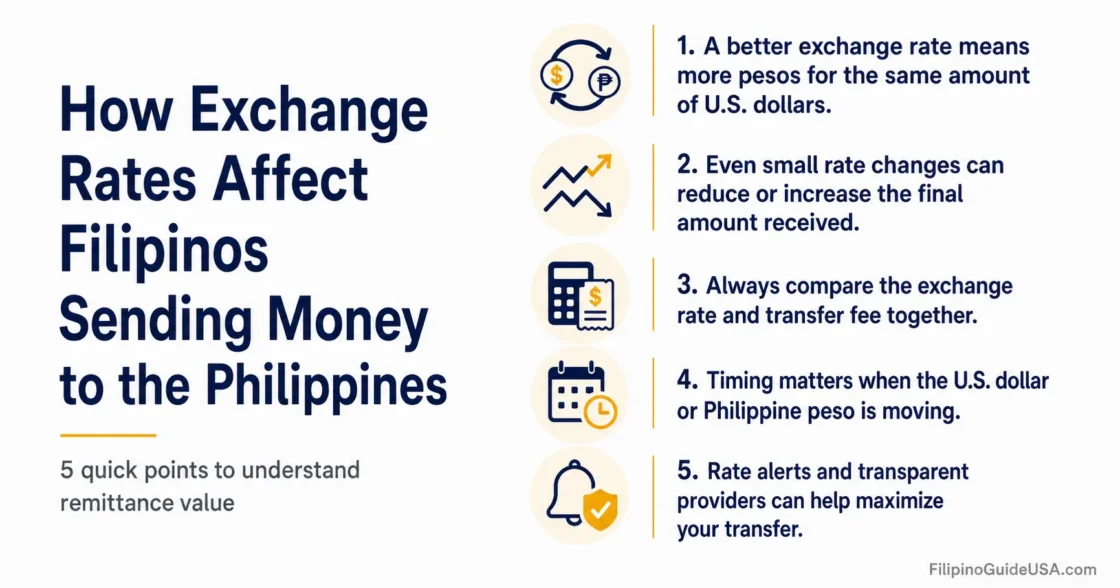
Exchange rates change the real value of every dollar a Filipino sender transfers to the Philippines. A small movement in the USD-to-PHP rate can affect groceries, tuition, rent support, medical bills, loan payments, and savings plans for a household back home. The transfer fee matters, but the exchange rate used by the provider often matters just as much because it decides how many Philippine pesos arrive after conversion.
Why this matters →
For Filipino families relying on regular support from the United States, the exchange rate can quietly change the monthly budget even when the sender sends the same dollar amount.
Before Sending Money, Check These Details:
- The exact USD amount being sent
- The provider’s PHP exchange rate, not only the transfer fee
- The total amount the recipient is expected to receive in pesos
- Whether the rate is locked before payment or only estimated
- Cash pickup, bank deposit, or mobile wallet delivery rules
- Any receiving-side charge, wallet withdrawal charge, or bank deduction
- The delivery date and the provider’s error or cancellation policy
How Exchange Rates Change The Peso Amount Received
This section explains the direct link between the dollar amount sent and the peso amount received in the Philippines.
When a Filipino sender in the United States sends money to the Philippines, the transfer usually starts in U.S. dollars and is received in Philippine pesos. The exchange rate decides how many pesos one U.S. dollar becomes.
A higher USD-to-PHP rate means each dollar converts into more pesos. A lower USD-to-PHP rate means each dollar converts into fewer pesos. The sender may still pay the same amount in dollars, but the family in the Philippines may receive a different peso amount.
| USD Sent | Provider Rate Used | Estimated PHP Before Other Deductions | Difference |
|---|---|---|---|
| $500 | ₱55 per $1 | ₱27,500 | Baseline example |
| $500 | ₱56 per $1 | ₱28,000 | ₱500 more |
| $500 | ₱54 per $1 | ₱27,000 | ₱500 less |
These examples are for explanation only. Actual rates change, and providers may use a retail rate that differs from the public market rate shown on financial websites or central bank pages.
Tip: Compare the final peso amount, not just the advertised fee. A low fee can still be expensive if the exchange rate is weaker.
The Exchange Rate Is Only One Part Of The Total Cost
This section separates the visible fee from the less obvious exchange rate margin.
Remittance costs often include two parts: the transfer fee and the exchange rate margin. The transfer fee is easy to see because it is usually shown as a dollar charge. The exchange rate margin can be less obvious because it is built into the conversion rate offered to the sender.
The World Bank’s Remittance Prices Worldwide methodology treats the exchange rate margin as a cost component because it can be part of what the sender pays even when the fee looks low.[a]
Practical Reading Of A Transfer Quote: A sender should look for three numbers before paying: the fee in dollars, the exchange rate used, and the exact peso amount expected to arrive. The peso amount is usually the clearest comparison point between providers.
Why “No Fee” Does Not Always Mean Lowest Cost
Some providers advertise no transfer fee or a promotional exchange rate. That can be useful, especially for a first transfer, but it should not be treated as the whole price. The exchange rate may include a margin, or the promotion may apply only to selected transfer types, selected amounts, or new customers.
The CFPB has warned that remittance providers may mislead consumers if they market transfers as free, no-fee, or promotional without clearly explaining limits, temporary pricing, or exchange-rate-related costs.[b]
What Happens When The Dollar Strengthens Or Weakens
This section shows how currency movement affects regular support sent to the Philippines.
When The Dollar Is Stronger Against The Peso
If the U.S. dollar strengthens against the Philippine peso, the same dollar amount can convert into more pesos. For families in the Philippines, this may help cover local expenses without the sender increasing the dollar amount.
For example, a sender who regularly sends $400 may notice that the recipient receives more pesos than last month if the provider’s rate improves. This can help with peso-based expenses such as school supplies, utility bills, groceries, and local transportation.
When The Dollar Is Weaker Against The Peso
If the U.S. dollar weakens against the Philippine peso, the same $400 may convert into fewer pesos. The sender may need to send more dollars to match the same peso target, or the recipient may need to adjust the local budget.
This is why many Filipino households think in two amounts at the same time: what the sender can afford in dollars and what the recipient needs in pesos.
How To Compare Providers Without Getting Confused
This section gives a practical method for comparing transfer quotes before payment.
Provider comparison should focus on the final amount the recipient receives, not only the sender’s fee. A provider with a $0 transfer fee may deliver fewer pesos than a provider with a small fee but a better exchange rate.
- Enter the same send amount with each provider. Use the same dollar amount, such as $200, $500, or the amount usually sent monthly.
- Choose the same delivery method. Bank deposit, cash pickup, and mobile wallet transfers can have different pricing.
- Write down the peso amount shown before payment. This is the number that matters most to the recipient.
- Check whether the rate is locked. A locked rate gives more certainty than an estimated rate.
- Review any receiving-side deductions. Some wallet or bank-related charges may reduce usable funds after arrival.
| Comparison Point | Why It Matters | What To Look For |
|---|---|---|
| Exchange rate | It controls how many pesos each dollar becomes. | The actual provider rate used for the transfer. |
| Transfer fee | It affects the sender’s total dollar cost. | Whether the fee changes by amount, payment method, or delivery method. |
| Amount received | It shows what the family in the Philippines is expected to get. | The final PHP amount before confirming payment. |
| Speed | Emergency transfers may need faster delivery. | The expected availability date and pickup or deposit timing. |
| Delivery method | Bank, wallet, and cash pickup options may carry different charges. | The method the recipient can use easily and safely. |
Important: Do not rely only on a rate shown in an advertisement, social media post, or old screenshot. Exchange rates can change quickly, and promotional rates may apply only under limited conditions.
U.S. Consumer Rights When Sending Money Abroad
This section explains the disclosures Filipino senders in the United States should expect before paying.
In the United States, many consumer remittance transfers are covered by federal protections. The CFPB explains that covered remittance transfer providers must give information such as fees, taxes, the exchange rate, certain third-party charges, and the amount expected to be delivered before and after payment.[c]
This matters for Filipino senders because the disclosure should help compare providers and confirm whether the peso amount fits the family’s need before the transfer is paid.
Information A Sender Should Save
- The receipt or confirmation number
- The exchange rate used
- The dollar amount paid
- The transfer fee and any listed taxes
- The expected peso amount
- The expected availability date
- The recipient name and delivery method
Tip: Save a screenshot or PDF of the quote before payment and the receipt after payment. This makes it easier to compare providers and report a problem if the delivered amount does not match the disclosure.
Why Public Exchange Rates May Differ From Provider Rates
This section explains why the rate seen online may not match the rate offered during a money transfer.
Public exchange rates are often reference rates, market rates, or central bank-published rates. A remittance provider may offer a different retail rate because it includes its own pricing, payment method cost, delivery network cost, or currency conversion margin.
The Bangko Sentral ng Pilipinas publishes exchange rate statistics and reference rate information for the Philippine peso, which can help readers understand the wider market context for USD-to-PHP movement.[d]
The IMF’s data standards page for the Philippines describes the country’s exchange rate arrangement as freely floating, with BSP reference exchange rate information released regularly.[e]
For personal remittances, the provider rate shown before payment is usually more practical than a public market rate because it is the rate that affects the recipient’s actual peso amount.
How Exchange Rates Affect Monthly Family Budgeting
This section connects currency movement to common Filipino household needs.
Many Filipino families plan around expected monthly support. A parent may expect a fixed peso amount for medicine, a sibling may need tuition support, or a household may depend on a regular contribution for rent and food. When exchange rates move, the same dollar transfer may no longer match the expected peso budget.
For recurring support, the household can reduce surprises by setting a peso target instead of only a dollar routine. For example, if the recipient needs ₱25,000 monthly, the sender can check how many dollars are needed at the provider’s current rate before sending.
A Simple Planning Method
- Start with the recipient’s peso need. List the amount needed for the month in PHP.
- Check the provider’s current rate. Use the rate shown inside the transfer quote.
- Include the fee. Add the transfer fee to the sender’s total cost.
- Review the final PHP amount. Confirm that the displayed amount meets the target.
- Keep a small buffer when possible. Rate changes and local deductions can affect the usable amount.
Budget Note: When a family in the Philippines depends on a fixed peso amount, planning from the recipient’s PHP need is usually clearer than sending the same USD amount every month without checking the current rate.
Why Remittances Matter For The Philippines
This section gives context for why exchange-rate effects are widely felt by Filipino households.
Money sent by overseas Filipinos is tracked closely in the Philippines because remittances are a major source of household support and foreign currency inflow. The Bangko Sentral ng Pilipinas publishes official tables on personal and cash remittances from overseas Filipinos, including remittance data by source country and worker type.[f]
For individual families, the national figures are less important than the household-level effect: the exchange rate can change what a remittance can buy in the Philippines after conversion.
Common Mistakes To Avoid
This section lists practical errors that can reduce the value of money sent to the Philippines.
- Comparing only the fee. A low fee does not always mean the recipient receives more pesos.
- Ignoring the delivery method. Mobile wallet, cash pickup, and bank deposit options may use different rates or charges.
- Trusting promotional rates without checking limits. Some offers apply only to first transfers, small amounts, or selected payment methods.
- Sending during urgency without reviewing the quote. Emergency transfers can make senders accept weaker rates without noticing.
- Forgetting local usability. The recipient may still need to withdraw cash, transfer to a bank, or pay wallet-related charges.
- Not saving receipts. Receipts help if the amount received is different from what was disclosed.
Questions Filipino Senders Often Ask
This section answers common concerns about exchange rates and remittance value.
Is It Better To Send When The Dollar Is High?
A stronger dollar against the peso can help the recipient receive more pesos, but timing the currency market perfectly is not realistic for most households. For regular family support, it is usually better to compare provider quotes and send when the money is needed rather than delay essential support.
Should The Sender Choose The Provider With The Highest Exchange Rate?
Not always. The highest exchange rate may come with a higher fee, slower delivery, or a delivery method that does not work well for the recipient. The better comparison is the final peso amount, delivery reliability, and total sender cost.
Why Did The Recipient Receive Less Than Expected?
Possible reasons include a changed or estimated exchange rate, a provider fee, a receiving-side charge, a wallet withdrawal charge, a bank deduction, or an error in the recipient details. The sender should review the receipt and contact the provider if the delivered amount does not match the disclosed amount.
Does The Public USD-to-PHP Rate Guarantee The Provider Rate?
No. Public rates can show market or reference information, while the provider’s retail rate is the rate used for the actual transfer. The sender should rely on the provider’s disclosed quote before payment.
Verification Note For Rate-Sensitive Transfers
This section explains how to keep information current before sending money.
Exchange rates, provider fees, promotional offers, delivery times, and consumer rules can change. Before sending money, the sender should check the provider’s current quote, read the disclosure before payment, and use official regulator or central bank sources when reviewing rights or exchange-rate context.
Sources
- World Bank Remittance Prices Worldwide — Methodology — Used for the explanation that transfer fees and exchange rate margins are separate parts of remittance cost. (Reliable because the World Bank is an international institution that maintains a dedicated remittance price database.) ↩
- Consumer Financial Protection Bureau — Consumer Financial Protection Circular 2024-02 — Used for the warning about no-fee, free, and promotional remittance marketing. (Reliable because the CFPB is a U.S. government consumer financial regulator.) ↩
- Consumer Financial Protection Bureau — What Is A Remittance Transfer And What Are My Rights? — Used for U.S. consumer disclosure rights on fees, exchange rates, amount delivered, cancellation, and errors. (Reliable because it is an official CFPB consumer guidance page.) ↩
- Bangko Sentral ng Pilipinas — Statistics: Exchange Rate — Used for Philippine peso exchange-rate reference context. (Reliable because it is published by the central bank of the Philippines.) ↩
- International Monetary Fund DSBB — Philippines Exchange Rates — Used for the statement on the Philippines’ freely floating exchange rate arrangement and reference exchange rate reporting. (Reliable because it is part of the IMF’s official data standards system.) ↩
- Bangko Sentral ng Pilipinas — Overseas Filipinos’ Remittances — Used for the official context that the BSP tracks personal and cash remittances from overseas Filipinos. (Reliable because it is an official Philippine central bank statistics page.) ↩