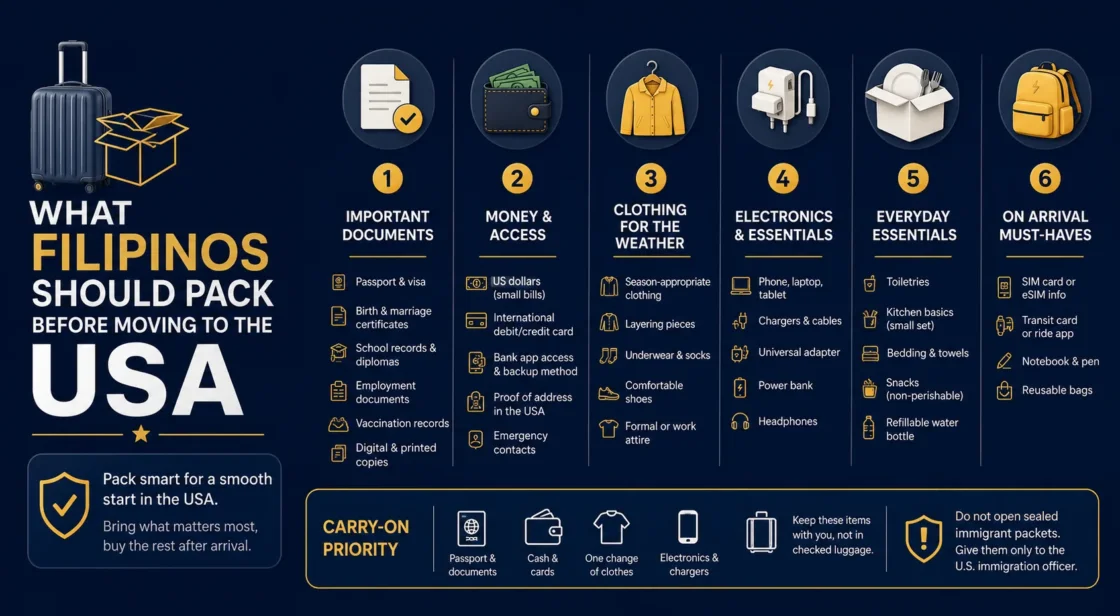
Moving from the Philippines to the United States is easier to manage when packing is treated as a paperwork, customs, climate, and first-month living task, not just a luggage task. The most useful items are the ones that help a Filipino newcomer pass airport checks smoothly, prove identity when needed, set up daily life, and avoid replacing essentials during the first few weeks.
Why this matters →
A well-planned packing list helps Filipino movers avoid airport problems, missing documents, and expensive first-month purchases in the United States.
Carry-On Priority: Keep passports, visas, sealed immigrant packets if issued, prescription medicines, cash/cards, electronics, chargers, and one change of clothes in hand-carry baggage, not in checked luggage.
Documents To Pack First
These papers should be easy to reach during travel and protected from water, bending, or luggage loss.
The most valuable “items” in the move are documents. Clothes and toiletries can be replaced in the United States, but missing papers can delay school enrollment, employment onboarding, banking, driver licensing, health insurance, or immigration follow-up.
- Philippine passport with valid U.S. visa or travel authorization
- Printed flight itinerary and U.S. address where the traveler will stay
- Visa-related documents, approval notices, or interview papers if applicable
- Sealed immigrant packet, if one was issued by the consular officer
- PSA birth certificate and, if applicable, PSA marriage certificate, CENOMAR, annulment papers, or adoption records
- School transcripts, diplomas, training certificates, and professional licenses
- Employment records, reference letters, and updated resume
- Vaccination records and medical history notes
- Prescription list, eyeglass prescription, dental records, and medical certificates where relevant
- Digital backup copies stored securely, plus printed photocopies kept separately from originals
PSA civil registry records are often needed later for identity, family, school, immigration, and consular matters, so bringing several clean copies can save time after arrival.[a]
DANGER: If a sealed immigrant packet was issued, do not open it. U.S. Department of State guidance says the packet must be opened only by the U.S. immigration official at the port of entry.[b]
Money, Cards, And First-Week Access
The first days in the United States often require payment before a local bank account is fully ready.
Filipino movers should carry a practical mix of payment options. A small amount of U.S. cash is useful for airport food, local transport, laundry, tips, or emergency purchases. A debit or credit card that works internationally is also helpful, especially for hotel holds, ride apps, online orders, or mobile phone activation.
- U.S. dollars in smaller bills
- International debit or credit card
- Philippine bank app access, OTP method, and backup authentication option
- Printed proof of temporary housing or sponsor address
- Emergency contact numbers written on paper
Important Notice: Travelers entering or leaving the United States with more than $10,000 in currency or monetary instruments must report it to U.S. Customs and Border Protection. The rule can apply to a family or group carrying a combined amount above the limit.[c]
Clothing For U.S. Weather
Packing should match the state and season, because U.S. weather can feel very different from the Philippines.
For many Filipinos, the biggest clothing adjustment is not fashion but temperature. A person moving to California, Texas, Florida, or Hawaii may need lighter clothing for much of the year. A person moving to New York, Illinois, Washington, Colorado, Minnesota, or the Northeast should prepare for colder months, especially if arriving between late fall and early spring.
| Destination Type | Useful Clothing To Pack | What To Buy Later In The USA |
|---|---|---|
| Warm or humid states | Light shirts, breathable pants, work-appropriate clothes, sandals, walking shoes | Seasonal jacket, rain gear, workplace-specific shoes |
| Four-season states | Layering shirts, jeans, socks, sweater, light jacket | Proper winter coat, insulated boots, thermal wear, gloves |
| Student or office move | Interview outfit, school clothes, semi-formal clothes, comfortable shoes | Weather-specific outerwear and local dress-code items |
Tip: Do not fill a suitcase with bulky winter items unless the exact climate is known. In cold states, buying one proper U.S.-rated winter coat after arrival is usually more practical than packing several thin jackets.
Medicines And Health Items
Health items should be packed carefully because medicines are regulated and may be checked during travel.
Pack enough personal medicine for the first weeks, but keep it in original packaging when possible. Prescription medicine should travel with the prescription, doctor’s note, or a clear medicine list showing the generic name, dosage, and purpose. This is especially useful if the medicine name in the Philippines is not the same as the U.S. brand name.
- Prescription medicines in original containers
- Doctor’s note for maintenance medication
- Eyeglasses, contact lenses, and prescription copy
- Basic first-aid items
- Health insurance papers or travel medical coverage details
- Vaccination record, especially for school, healthcare work, or child enrollment
The FDA treats many medicines and health products brought into the United States as regulated personal imports, so travelers should avoid carrying large quantities or unlabeled medicine.[d]
Food From The Philippines
Many familiar foods are allowed only if they meet U.S. agriculture and customs rules.
Filipino movers often want to bring comfort food for the first weeks. Dry, commercially packed items are usually easier to carry than fresh, homemade, meat-based, or plant-based items. The safest approach is to bring only clearly labeled, sealed, commercially packaged food and declare it when entering the United States.
- Usually safer to consider: sealed snacks, instant coffee, tea, candies, biscuits, and dry packaged goods
- Higher-risk items: meat products, fresh fruit, fresh vegetables, seeds, plants, soil, homemade food, and unlabeled products
- Items to avoid unless confirmed allowed: pork products, fresh mangoes, fresh calamansi, live plants, seeds for planting, and homemade meat dishes
DANGER: All agricultural items must be declared when entering the United States. CBP says undeclared prohibited agriculture items may be confiscated and can lead to a civil penalty.[e]
USDA APHIS also provides traveler guidance for food and agricultural products, including products carried from another country into the United States.[f]
Electronics, Chargers, And Power Adapters
Most modern electronics can work in the United States, but plugs, voltage, and batteries still need checking.
The United States commonly uses Type A and Type B plugs and 120V household power. Many phone chargers, laptop chargers, camera chargers, and tablet chargers are dual-voltage, but the label should be checked before packing. Look for an input range such as “100–240V.” If an appliance says only 220–240V, it may not work properly on standard U.S. outlets without the correct equipment.
- Phone and laptop chargers
- Type A/B plug adapter
- Power bank for travel days
- USB-C and Lightning cables as needed
- Unlocked phone or phone compatible with U.S. carriers
- External drive or secure cloud backup for documents
Important Notice: Spare lithium batteries and power banks must be carried in carry-on baggage only, according to FAA PackSafe guidance. They should not be placed in checked baggage.[g]
Toiletries And Personal Care Items
Bring enough for arrival, but avoid using luggage space for products that are easy to buy in the United States.
A small starter set is enough for most movers. Shampoo, soap, toothpaste, deodorant, lotion, razors, and basic skincare are widely available in the United States. Specialty products for hair, skin tone, or preferred Philippine brands may be worth packing if they are hard to replace locally.
- Travel-size toiletries for the flight and first few days
- Preferred skincare or haircare items that may be hard to find
- Nail clippers and grooming tools packed according to airline rules
- Feminine hygiene products for the first month if preferred brands matter
- Towel only if immediate housing will not provide one
For carry-on baggage, TSA’s 3-1-1 rule limits liquids, aerosols, gels, creams, and pastes to containers of 3.4 ounces or less, placed in one quart-sized clear bag per passenger.[h]
Items For Work, School, And Daily Setup
These items help with the first appointments, applications, and routines after arrival.
The first month may involve school registration, job onboarding, apartment applications, medical appointments, bank visits, or DMV trips. Having organized paperwork and a few practical supplies makes these tasks easier.
- Black pens and small notebook
- Folder or document envelope
- Several passport-size or 2×2 photos if already available
- Printed resume and reference list
- School records and course descriptions for students
- Professional portfolio files, if relevant
- Driver’s license from the Philippines, if the mover plans to apply for a U.S. license
Practical Note: Documents should be grouped by purpose: immigration, identity, school, work, medical, and finance. This saves time when a U.S. office asks for proof quickly.
What To Leave Behind
Leaving risky or low-value items behind can prevent customs issues and overweight baggage fees.
Not everything familiar is worth packing. Some items are restricted, some are cheaper to buy after arrival, and others take too much luggage space for little benefit.
- Fresh fruit, vegetables, plants, seeds, and soil
- Homemade meat products or unlabeled food
- Large bottles of shampoo, detergent, or liquid soap
- Heavy cookware unless culturally specific or personally valuable
- 220V-only appliances that are not worth adapting
- Too many formal clothes if the climate and workplace dress code are not yet known
- Large quantities of medicine without documentation
- Photocopies without originals, where originals are likely to be needed
Hand-Carry Packing List
The carry-on bag should cover airport checks, one overnight delay, and the first day in the United States.
- Passport, visa, and travel documents
- Sealed immigrant packet if issued
- U.S. address and contact number
- Wallet, cards, and U.S. cash
- Phone, charger, power bank, and cable
- Prescription medicines and medical documents
- One change of clothes and basic toiletries
- Light jacket or hoodie for the flight
- Copies of essential documents
- Snacks that meet airline and customs rules
Checked Baggage Packing List
Checked bags should hold replaceable items, clothing, and non-urgent household basics.
- Clothes for 10 to 14 days
- Extra shoes, sandals, and socks
- Weather-appropriate layers
- Non-liquid personal care items
- Family keepsakes in safe packaging
- Commercially packed dry food, if allowed and declared
- Extra printed document copies, separate from originals
- Small household items that are light and hard to replace emotionally
Tip: A suitcase should not depend on memory. Put a paper label inside each checked bag with the traveler’s name, email, U.S. phone number if available, and destination address.
After Arrival Items To Prepare
Some packing decisions are connected to tasks that happen soon after landing.
After arrival, many Filipino newcomers need to set up a phone plan, open a bank account, apply for a state ID or driver’s license, enroll children in school, arrange health insurance, and update immigration addresses where required. Keeping the right documents accessible makes these steps smoother.
Important Notice: Many noncitizens must report a change of address to USCIS within 10 days of moving in the United States. This requirement should be checked directly with USCIS after arrival, especially if the person has a pending case or recently entered as an immigrant.[i]
For immigrant visa holders, the USCIS Immigrant Fee may affect production of the physical Green Card, so payment status and mailing address should be reviewed before or soon after travel when applicable.[j]
Final Packing Review Before The Flight
A final review should focus on access, legality, and the first two weeks of life in the United States.
- Confirm that passport, visa, and entry documents are in the carry-on bag.
- Separate original documents from photocopies.
- Remove risky food, plants, seeds, and meat products unless clearly allowed.
- Place power banks and spare lithium batteries in carry-on baggage.
- Check liquid sizes for carry-on toiletries.
- Keep prescription medicine with labels and supporting notes.
- Weigh checked bags before leaving for the airport.
- Save digital copies of documents in a secure account that can be accessed in the United States.
Rules on immigration processing, customs, baggage security, food, medicine, and address reporting can change. Before the flight, travelers should recheck the official pages of the relevant U.S. agencies and the airline handling the trip.
Sources
- [a] Philippine Statistics Authority, Civil Registration: explains Philippine civil registry documents such as birth, marriage, death certificates, and CENOMAR. This is a reliable source because PSA is the official civil registration authority of the Philippines. ↩
- [b] U.S. Department of State, Immigrant Visa for a Spouse of a U.S. Citizen: explains sealed immigrant packet handling and immigrant visa travel notes. This is reliable because it is an official U.S. government visa information page. ↩
- [c] U.S. Customs and Border Protection, Currency and Monetary Instruments: explains the reporting rule for amounts exceeding $10,000. This is reliable because CBP enforces U.S. border reporting requirements. ↩
- [d] U.S. Food and Drug Administration, Personal Importation: explains personal baggage and regulated products such as medicine. This is reliable because FDA regulates drugs, devices, and other FDA-regulated imports. ↩
- [e] U.S. Customs and Border Protection, Bringing Food into the U.S.: explains declaration and inspection of agricultural items. This is reliable because CBP handles inspection and enforcement at U.S. ports of entry. ↩
- [f] USDA APHIS, Traveling With Food or Agricultural Products: provides traveler guidance for food and agricultural products entering the United States. This is reliable because APHIS is the U.S. agency responsible for animal and plant health safeguards. ↩
- [g] Federal Aviation Administration, PackSafe Lithium Batteries: explains lithium battery and power bank baggage rules. This is reliable because FAA regulates hazardous materials safety in air travel. ↩
- [h] Transportation Security Administration, TSA Travel Tips: explains the 3-1-1 liquids rule and airport screening notes. This is reliable because TSA manages passenger security screening in U.S. airports. ↩
- [i] U.S. Citizenship and Immigration Services, Change of Address: explains address reporting for many noncitizens. This is reliable because USCIS administers U.S. immigration benefits and related reporting. ↩
- [j] U.S. Citizenship and Immigration Services, USCIS Immigrant Fee: explains immigrant fee payment and Green Card production notes. This is reliable because it is the official USCIS fee page. ↩