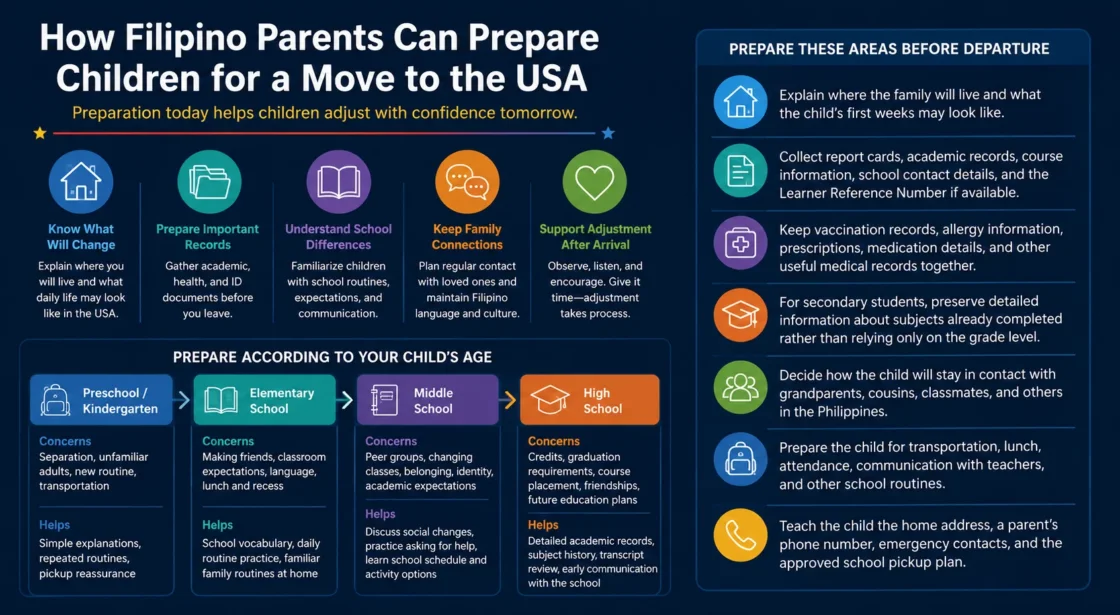
Children moving from the Philippines to the United States need preparation for more than the flight and the new address. Parents can make the transition easier by explaining what daily life will change, organizing school and health records before departure, preparing children for unfamiliar school routines, protecting continuity in family language and relationships, and watching how adjustment develops after arrival. The preparation should also match the child’s age: a six-year-old may need reassurance about who will pick them up from school, while a Grade 11 or Grade 12 student may need careful attention to transcripts, course placement, and graduation planning.
Why this matters →
A child who knows what to expect, carries a usable record of previous schooling and health information, and keeps familiar connections with Filipino family life has fewer unknowns to manage during the first weeks in the United States.
Prepare these areas before departure:
- Explain where the family will live and what the child’s first weeks may look like.
- Collect available report cards, academic records, course information, school contact details, and the child’s Learner Reference Number if available.
- Keep vaccination records, allergy information, prescriptions, medication details, and other useful medical records together.
- For secondary students, preserve detailed information about subjects already completed rather than relying only on the Philippine grade level.
- Decide how the child will stay in contact with grandparents, cousins, classmates, and other people who remain in the Philippines.
- Prepare the child for transportation, lunch, attendance, communication with teachers, and other school routines that may be unfamiliar.
- Teach the child the home address, a parent’s phone number, emergency contacts, and the approved school pickup plan.
Step 1: Prepare for the Child’s Age, Not Just the Move
The same move can create very different concerns for a young child, a middle-school student, and a teenager approaching graduation.
Parents should first identify what the move is likely to disrupt for their particular child. Younger children tend to depend heavily on familiar routines and trusted adults. Older children may be more concerned about friendships, fitting in, academic placement, sports, extracurricular activities, or whether previously completed courses will count toward graduation.
| Child’s Stage | Likely Areas of Concern | Preparation That Helps |
|---|---|---|
| Preschool or Kindergarten | Separation, unfamiliar adults, a new daily routine, transportation | Simple explanations, repeated routines, pickup reassurance, practicing basic school situations |
| Elementary School | Making friends, classroom expectations, language, lunch and recess | School vocabulary, daily routine practice, familiar family routines at home |
| Middle School | Peer groups, changing classes, belonging, identity, academic expectations | Discuss social changes, practice asking for help, learn the school’s schedule and activity options |
| High School | Credits, graduation requirements, course placement, friendships, future education plans | Detailed academic records, subject history, transcript review, early communication with the receiving school |
The U.S. Department of Education’s current Newcomer Toolkit treats welcoming, social and emotional needs, instruction, and family-school partnerships as separate parts of supporting newly arrived students.[a] That distinction is useful for parents as well: academic preparation alone does not cover the entire transition.
Step 2: Tell Children What Will Actually Change
Children usually handle specific information better than vague promises. Saying that the family is “starting a new life in America” leaves many practical questions unanswered. A child may instead be wondering where they will sleep, whether they will be placed in the same grade, how they will get to school, whether they can still speak with friends in the Philippines, or who will be waiting when school ends.
Parents should explain whatever is already known:
- the city or state where the family will live;
- who will live in the household;
- whether the child is likely to walk, ride in a car, or use a school bus;
- what the local weather is like;
- when the child is expected to start school;
- how communication with relatives and friends in the Philippines will continue;
- what belongings the child can bring;
- what parts of the family’s existing routine will remain familiar.
There is no need to invent answers that the parents do not yet have. If the school assignment or grade placement has not been decided, it is better to say that the school will review the information after enrollment than to promise a particular outcome.
Turn unknowns into specific questions: Instead of only asking whether the child is excited about moving, ask what they want to know about the new school, bedroom, weather, lunch, transportation, friends, or communication with relatives. Concrete questions often reveal concerns that a general conversation does not.
Let the Child Say Goodbye Properly
A move can separate a child from classmates, cousins, grandparents, neighbors, teachers, sports teammates, church communities, and familiar places all at once. When circumstances allow, children should have time to understand that separation and say goodbye rather than discovering during the final days that they may not see important people again for a long period.
Useful preparation can be simple: exchange contact information with close friends, take photographs, arrange a goodbye visit, save school memories, and agree on realistic times for video calls after the move. For children who are attached to grandparents or other relatives, a predictable contact schedule can provide continuity during the first months abroad.
Step 3: Build a Child Transition File Before Leaving the Philippines
School and health records are easier to organize before the family is thousands of miles away from the institutions that created them.
A separate file should be prepared for each child. Both paper copies and securely stored digital copies can be useful. Originals should be protected when an institution may require them later.
School Records to Preserve
- recent report cards;
- available certified academic records or transcript information;
- the names and contact information of previous schools;
- the child’s Learner Reference Number (LRN), if applicable;
- subjects and courses completed;
- information about grading scales when available;
- certificates that are relevant to academic placement or programs;
- records of learning support, assessments, or accommodations when applicable.
The Philippine Department of Education currently lists School Form 10 (SF10) as the Learner’s Permanent Academic Record for elementary and junior high school and, in March 2026, made a 2026 SF10 available for the Strengthened Senior High School program.[b] Parents do not need to assume that every U.S. school will request a Philippine form by the same name. The practical goal is to make the child’s previous education as clear and verifiable as possible.
Before leaving, parents can ask the Philippine school what official academic documents it can issue, certify, or later transmit if requested. This is especially useful when a student leaves during a school year or is already in senior high school.
Prepare More Detail for High School Students
A simple statement such as “the student completed Grade 11 in the Philippines” may not provide enough information for a U.S. high school to decide how previous learning fits its own graduation requirements.
For teenagers, preserve whatever reliable documentation is available for:
- each completed subject or course;
- school years and semesters attended;
- grades received;
- credits, units, or instructional information shown by the Philippine school;
- course descriptions when the school can provide them;
- graduation-related coursework already completed.
U.S. education research guidance for international transcripts describes the process as obtaining and, when needed, translating records, interpreting previous coursework against local courses, and determining which credits can be transferred.[c] For that reason, parents should not rely on a homemade chart claiming that every Philippine grade or subject has an automatic U.S. equivalent.
Attention for High School Transfers: Do not assume that a Philippine Grade 10, Grade 11, or Grade 12 placement will transfer one-for-one to a U.S. grade, course schedule, or graduation timeline. The receiving school or district may need to review age, academic history, completed coursework, credits, and local graduation requirements.
Records for Children Who Receive Learning or Therapy Support
If a child has received special education support, speech therapy, occupational therapy, psychological assessment, developmental evaluation, or classroom accommodations in the Philippines, parents should preserve the related reports rather than starting the U.S. school conversation with no history.
Useful records may include:
- evaluation reports;
- therapy summaries;
- teacher observations;
- current learning goals;
- information about assistive devices or technology;
- documents describing accommodations that have helped the child.
These records can help a U.S. school understand the child’s background. They should be treated as supporting history rather than as a guaranteed one-to-one transfer of a Philippine service plan into a U.S. school program.
Step 4: Prepare for U.S. School Placement and Classroom Routines
There is no single “American school routine.” Public education is administered through states and local school districts, and individual schools may operate differently. Preparation should therefore focus on situations the child may encounter rather than presenting television-style school stereotypes as universal rules.
Depending on the school and grade level, a child may encounter:
- a school bus or designated parent drop-off and pickup areas;
- different classrooms for different subjects;
- a homeroom or advisory period;
- lockers;
- a cafeteria and lunch account system;
- school-issued laptops or Chromebooks;
- online student and parent portals;
- attendance and tardiness procedures;
- emergency drills;
- clubs, sports, and after-school programs.
Newcomer guidance for U.S. secondary schools specifically recommends reviewing prior school records, transcripts, education history, English proficiency, previous learning, and other student needs when determining services and placement.[d] This is another reason to arrive with detailed records rather than only a final report card.
Practice the First School Day Before It Happens
A child does not need to memorize every school rule before arrival. It is more useful to rehearse a few situations in which they may need to act independently.
Tip: Practice short school situations at home. The goal is not perfect English; it is making sure the child knows what to do when something is unclear.
A child can practice how to:
- say their full name clearly;
- tell a teacher that they are new to the school;
- ask where a classroom or restroom is;
- say, “I don’t understand. Could you explain that again?”;
- ask for help if they cannot find their bus or pickup location;
- identify the adult they should contact if plans change;
- explain an allergy or other important health need in an age-appropriate way.
Do Not Buy Every School Item in Advance
School supply expectations can vary by district, school, grade, and teacher. Families may want basic supplies available, but large purchases are better made after receiving the actual school list when possible. The same applies to uniforms or dress-code assumptions: parents should check the receiving school’s rules rather than assuming that practices familiar in the Philippines will apply.
Step 5: Prepare for English Without Treating Every Filipino Child the Same
English exposure among Filipino children varies widely. One student may have completed most academic work in English, another may be more comfortable speaking Filipino or a regional language at home, and another may understand English well but have little experience using it socially with American classmates.
Parents should separate conversational English from academic and school English. A child who can comfortably watch English-language media or talk with adults may still need time to adjust to:
- unfamiliar accents;
- fast peer conversations;
- classroom discussion;
- essay expectations;
- science and mathematics terminology;
- instructions given through digital school platforms;
- humor, slang, or informal expressions used by classmates.
This adjustment should not be framed as failure. It is possible for a student to know English and still need time to understand a new educational environment.
If the School Identifies the Child as an English Learner
U.S. school districts have responsibilities to identify English learner students and provide language assistance that allows them to participate meaningfully in educational programs. Federal guidance also states that English learners should have equitable access to programs, activities, and services.[e]
A family may therefore encounter a home-language questionnaire, English proficiency screening, or discussion about language support. Parents can ask the school:
- why the child was screened;
- what the results mean;
- what type of language support is proposed;
- how the child’s academic progress will be monitored;
- how the student can participate in regular classes and activities.
Being identified for English-language support should not be described to the child as punishment or as proof that their previous schooling was inadequate.
Keep Filipino and Other Home Languages in Family Life
Parents do not need to eliminate Filipino, Tagalog, Cebuano, Ilocano, Hiligaynon, Waray, or another family language from the home simply because a child is entering an English-speaking school.
The American Academy of Pediatrics’ parent guidance on multilingual children notes that using more than one language can support connections with family, culture, and community, and advises families against restricting heritage-language exposure because of common myths about multilingual development.[f]
A family can therefore add English practice without turning the home into an English-only environment. Children can learn the language of their new school while continuing to speak with grandparents and relatives in the language that makes those relationships natural.
Home-language continuity: English does not have to replace the child’s Filipino language. Reading, storytelling, family conversations, messages to relatives, and everyday home routines can continue in the languages the family normally uses.
Do Not Turn the Child Into the Family’s Permanent Interpreter
Children sometimes learn school vocabulary and everyday U.S. English faster than adults in the household. That can make it tempting to use the child for school forms, meetings, phone calls, medical conversations, or other adult matters.
For important school communication, parents with limited English proficiency can ask what interpretation or translated communication the school provides. U.S. Department of Education civil-rights guidance states that schools must adequately communicate important school-related information to limited-English-proficient parents in languages they can understand.[g]
The child can naturally help with ordinary family life, but sensitive or complicated adult information should not automatically become the child’s responsibility.
Step 6: Organize Health Records Before School Begins
School preparation should include a health file even when the child is healthy. Records are especially useful when a new pediatrician, school nurse, camp, sports program, or other institution needs information that was previously held by providers in the Philippines.
Health information worth carrying:
- vaccination records;
- allergy information;
- current prescriptions;
- medicine names, active ingredients, and dosages;
- relevant medical summaries;
- information about asthma, diabetes, epilepsy, severe allergies, or another condition that may need attention at school;
- vision, dental, therapy, or specialist records when they are relevant to continued care.
The CDC recommends keeping a child’s vaccination record current and in a safe place and notes that school and childcare vaccination requirements differ by state.[h]
Immigration Vaccinations and School Vaccinations Are Different Requirements
Families entering through an immigrant visa process may already have provided vaccination records during the immigration medical examination. That does not mean parents should discard those records or assume that all school documentation has automatically been completed.
The U.S. Department of State lists vaccination requirements that apply to immigrant visa applicants and directs applicants to make vaccination records available to the panel physician.[i] School entry operates separately: state and local authorities set school vaccination requirements.
Important Notice: An immigration medical examination and a child’s school health requirements are not the same process. Keep the vaccination record used during immigration and check the requirements of the state and school where the child will enroll.
Plan Medication Continuity
If the child takes regular medication, the family should know more than the brand name used in the Philippines. Keeping the generic or active ingredient name, dosage, prescribing doctor’s information, and a short medical summary can make conversations with a U.S. healthcare provider easier.
Parents should also ask the receiving school about its procedure when medication must be available or administered during school hours. The rules can differ by school system, and medicine should not simply be placed in a child’s backpack without checking the school’s policy.
Step 7: Prepare Transportation, Food, Weather, and After-School Logistics
Some of the hardest parts of a child’s first week are ordinary details that adults may overlook. A student who understands the lessons but does not know where to eat lunch, where the bus leaves, or who will collect them after school can still have a difficult day.
Create a Clear Pickup and Transportation Plan
Before the first school day, the child should know:
- how they are expected to travel to school;
- where they will go at dismissal;
- who is authorized to pick them up;
- what they should do if the expected adult is not there;
- whether they attend an after-school program;
- which adult at school they can approach if they are confused.
Working parents should pay particular attention to the period between school dismissal and the end of the workday. The solution may involve a school program, childcare arrangement, bus transportation, or another trusted adult, but it should ideally be settled before the child is standing outside school wondering what happens next.
Prepare for the School Lunch Routine
A child may encounter a cafeteria, packed lunches, a school meal account, limited lunch periods, or food that is unfamiliar. Parents can explain that trying unfamiliar food is optional and that bringing familiar food may be possible when school rules allow it.
If the child has a food allergy, the allergy should be included in the health information provided through the school’s required process. Older children should also know how to describe the allergy clearly and when to seek adult help.
Prepare for the Climate Where the Family Will Actually Live
There is no single U.S. climate. A move to Minnesota requires different preparation from a move to Southern California, Texas, Florida, Washington, or Arizona.
Depending on the destination, a Filipino child may encounter:
- freezing temperatures and snow;
- dry winter air;
- very hot summers;
- rapid temperature changes;
- heavy rain or severe-weather alerts;
- different daylight hours during winter and summer.
Teach the routine that matches the destination. A child moving to a cold region may need to learn layering, gloves, boots, and coat storage. A child moving to a very hot region may need more attention to water, sun protection, and outdoor schedules.
Step 8: Give the Child a Simple Safety Routine
Children do not need to memorize a long emergency manual. They should, however, know enough basic information to get help if separated from a parent or confused during transportation.
A school-age child should know, when age-appropriate:
- their full legal name;
- the name of a parent or guardian;
- the home address;
- at least one parent’s phone number;
- an emergency contact;
- who is permitted to pick them up;
- where to go if they miss the school bus or pickup;
- that 911 is for real emergencies involving police, fire, or medical assistance.
Young children can carry an age-appropriate contact card until they reliably remember the information. Parents should also teach the child not to change transportation or leave school with someone else simply because the person says there has been a change of plan.
Step 9: Keep Filipino Family Life Familiar After Arrival
A child should not have to replace every familiar part of life on the same day. Maintaining a few predictable routines can create continuity while the child learns a new environment.
Families may choose to keep:
- Filipino or another home language in everyday conversation;
- familiar meals alongside new foods;
- regular calls with relatives in the Philippines;
- bedtime or weekend routines;
- family celebrations and traditions;
- music, television, books, and stories connected to home;
- religious or community routines that are already part of family life.
The purpose is not to isolate the child from American life. It is to avoid making adaptation depend on erasing the child’s previous life.
Filipino and American Identity Do Not Have to Compete
Children and teenagers may eventually change the way they speak, dress, socialize, or describe themselves. They may also become more aware of differences in names, accents, food, family expectations, or cultural habits.
Parents can give children room to participate in their new environment without treating every change as rejection of Filipino culture. At the same time, maintaining family language, relationships, stories, celebrations, and visits can help children keep a real connection to where they came from.
The balance will not look identical in every Filipino household. A Cebuano-speaking family, a Tagalog-speaking family, a mixed-nationality household, and a child who has already spent years in international schools may all experience the move differently.
Step 10: Manage the First 90 Days as a Transition Period
Adjustment should be observed over time rather than judged by whether the child appears happy on the first day.
| Period | What Parents Should Confirm |
|---|---|
| Before School Starts | Documents, transportation, pickup plan, sleep schedule, school start information, health requirements, emergency contacts |
| First Week | The child knows teachers, classrooms, lunch routine, transportation, login information, and where to ask for help |
| First Month | Academic placement, language support if applicable, attendance, friendships, school communication, after-school routine |
| Months Two and Three | Academic progress, social connection, clubs or activities, sleep and daily routine, continued contact with important people in the Philippines |
Do Not Make Grades the Only First-Month Measure
During the first days, more immediate questions may be useful than asking only about test scores:
- Does the child know how to get to each classroom?
- Do they know where to eat lunch?
- Have they identified an adult they can ask for help?
- Do they understand the dismissal routine?
- Can the family access the school’s communication system or parent portal?
- Does the child know what homework is expected?
- Are they beginning to recognize classmates?
Academic performance still matters, especially for older students, but a newcomer can need time to learn the mechanics of a new school before performance becomes a useful measure of adjustment.
Watch for Adjustment Patterns, Not One Bad Day
Missing friends, feeling tired, wanting familiar food, being quiet at school, or becoming frustrated with unfamiliar routines can occur during a major move. Parents should look at how the pattern changes over time rather than interpreting a difficult afternoon as proof that the move is failing.
More persistent changes deserve attention, particularly when they interfere with ordinary functioning. Examples include repeated refusal to attend school, continuing withdrawal from normal activities, major sleep or appetite changes, frequent unexplained physical complaints, or distress that does not improve. A school counselor, pediatric healthcare provider, or another qualified professional can help parents decide what type of support is appropriate.
The Department of Education’s newcomer resources specifically include social, emotional, and mental-health needs as part of supporting students who have recently arrived in the United States.[j]
What Parents Should Avoid During the Transition
Several well-intended choices can create unnecessary pressure or confusion.
- Do not wait until the final days to explain the move when the child could reasonably be included earlier.
- Do not promise a particular U.S. grade placement before the receiving school has reviewed the child’s records.
- Do not discard Philippine school documents after arrival.
- Do not assume an immigration medical examination completes school health paperwork.
- Do not assume conversational English guarantees an effortless academic transition.
- Do not force the family to become English-only simply to accelerate adjustment.
- Do not use the child as the default interpreter for complicated adult matters.
- Do not compare adjustment speed with cousins, siblings, or other Filipino children.
- Do not assume silence means everything is fine. Ask specific questions about school, transportation, lunch, teachers, classmates, and homework.
- Do not buy every school supply before seeing the actual requirements.
- Do not assume every U.S. school operates the same way.
Questions Filipino Parents Commonly Have Before the Move
Does a Child Need Fluent English Before Moving to the USA?
No. A child does not need to arrive speaking perfect English. Children who need language assistance can be identified and supported through their school system. Even children with strong English skills may need time to become comfortable with academic vocabulary, classroom participation, accents, social language, and unfamiliar school routines.
Should Parents Stop Speaking Tagalog or Another Filipino Language at Home?
No. Families can continue using the language in which parents and children communicate naturally. Maintaining Filipino, Tagalog, Cebuano, Ilocano, Hiligaynon, Waray, or another family language can preserve communication with relatives and cultural connections while the child develops English in school.
Will a Philippine Grade Automatically Transfer to the Same U.S. Grade?
Parents should not assume an automatic one-to-one transfer. Placement practices can differ by school system, and secondary schools may need to review age, academic history, transcripts, previous coursework, and local graduation requirements.
What Philippine School Records Should Parents Prepare?
Useful records include recent report cards, available official academic records, subject and course history, school contact information, LRN information when applicable, and additional detail for senior high school students. Parents should ask the Philippine school what certified records it can provide or transmit.
Are Philippine Vaccination Records Useful in the United States?
Yes. Parents should keep the child’s vaccination history available. The CDC recommends maintaining vaccination records, and schools or childcare facilities may request documentation according to state or local requirements.
What If the Family Moves in the Middle of the School Year?
Keep records showing exactly what the child completed before leaving, including the subjects, grading period, and available grades. This is especially useful for middle-school and high-school students because the receiving school may need to determine course and credit placement.
What If the Child Already Receives Learning Support or Therapy?
Bring available evaluations, progress reports, therapy summaries, and descriptions of accommodations that have helped the child. These records can give the new school a clearer picture of the child’s history and make the first discussion more informed.
How Can Parents Tell Whether the Child Is Adjusting Well?
Look beyond whether the child says the day was “fine.” Ask about transportation, lunch, teachers, classmates, homework, understanding classroom instructions, and who the child would approach for help. Over the following weeks, also watch attendance, sleep, appetite, friendships, participation, and academic progress.
Sources
- U.S. Department of Education — Newcomer Toolkit — Covers welcoming newly arrived students, social and emotional needs, instruction, and family partnerships. (Reliable because it is an official U.S. Department of Education resource reviewed in April 2026.)
- Philippine Department of Education Learner Information System — Support and School Forms — Lists SF10 as the Learner’s Permanent Academic Record and includes the 2026 Strengthened Senior High School SF10. (Reliable because it is the official DepEd Learner Information System support service.)
- Institute of Education Sciences — Finding the Right Starting Point: Obtaining, Interpreting, and Evaluating International Transcripts — Explains how international transcripts can be obtained, interpreted, and evaluated for local coursework and credit decisions. (Reliable because IES is the research and statistics arm of the U.S. Department of Education.)
- Institute of Education Sciences — Welcoming, Registering, and Supporting Newcomer Students — Addresses records, transcripts, education history, placement, English proficiency, and support for newcomer secondary students. (Reliable because the resource is published through the U.S. Department of Education’s Institute of Education Sciences.)
- U.S. Department of Education — Frequently Asked Questions on English Learner Students — Describes school-district responsibilities for identifying English learners, language assistance, access to school programs, and monitoring progress. (Reliable because it is official federal civil-rights guidance.)
- HealthyChildren.org — Young Children Learning Multiple Languages: Parent FAQs — Explains multilingual development and the value of maintaining family and heritage languages. (Reliable because HealthyChildren.org is the parent-information service of the American Academy of Pediatrics.)
- U.S. Department of Education — Equal Education Opportunities for English Learners — Explains language assistance for English learners and communication obligations toward limited-English-proficient parents. (Reliable because it is official guidance from the U.S. Department of Education.)
- Centers for Disease Control and Prevention — Keeping Track of Childhood Vaccination Records — Advises parents to preserve vaccination records and explains that school and childcare vaccination requirements differ by state. (Reliable because it is official CDC immunization guidance.)
- U.S. Department of State — Vaccinations for Immigrant Visa Applicants — Explains vaccination documentation and medical requirements in the immigrant visa process. (Reliable because it is the official U.S. Department of State visa information service.)
- National Clearinghouse for English Language Acquisition — Newcomer Toolkit — Includes dedicated resources on welcoming newcomer students and addressing social, emotional, and mental-health needs. (Reliable because NCELA is supported by the U.S. Department of Education’s Office of Elementary and Secondary Education.)