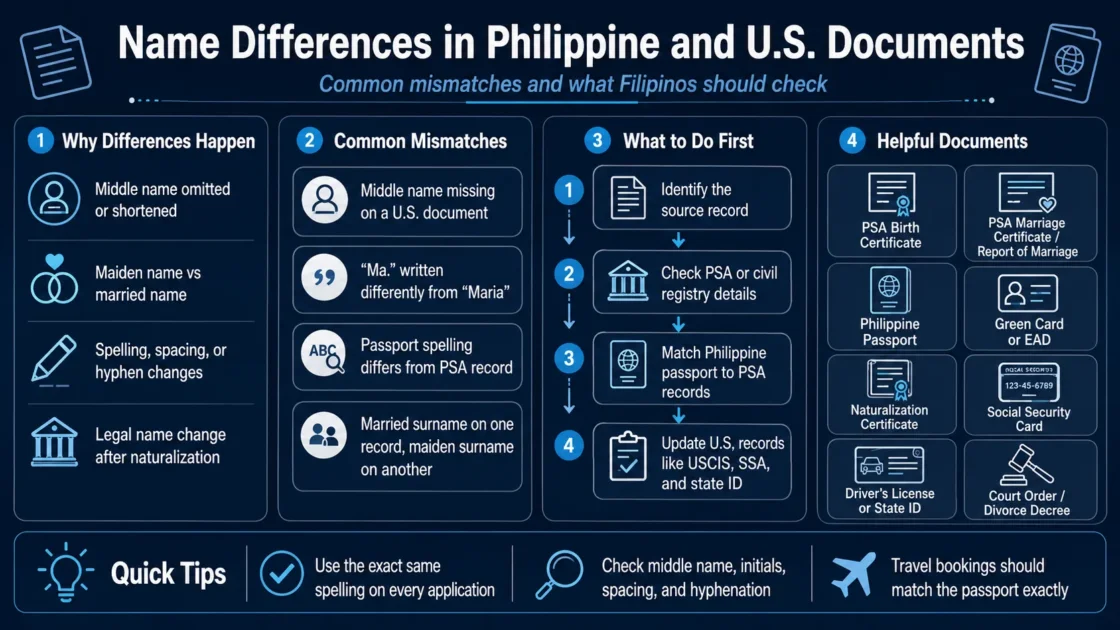
Name Differences in Philippine and U.S. Documents for Filipinos
Name differences between Philippine and U.S. documents can affect passport renewal, visa records, Social Security records, driver’s license applications, school enrollment, bank verification, insurance records, employment onboarding, and dual citizenship paperwork. For Filipinos in the United States, the problem often comes from a mix of Philippine naming customs, U.S. form formats, marriage records, PSA civil registry entries, and agency-specific rules.
Why this matters →
A small spelling, middle name, or married-name difference can delay official processing when an agency cannot clearly connect all records to the same person.
Required Documents: Before requesting a correction or update, prepare clear copies of the documents that show the full name history. Common examples include a PSA-issued birth certificate, PSA marriage certificate or Report of Marriage, current Philippine passport, U.S. passport if applicable, green card, EAD, naturalization certificate, Social Security card, driver’s license or state ID, court order, divorce decree, death certificate of spouse, and older records that show the name previously used.
Why Name Differences Happen
Most mismatches come from how Philippine names are recorded compared with how U.S. agencies format legal names.
Philippine documents commonly use first name, middle name, and surname. In many cases, the middle name is the mother’s maiden surname. U.S. systems may treat the middle name as optional, shorten it to an initial, place it in a different field, or omit it entirely. This can create a mismatch even when the person has not legally changed names.
Marriage also causes many differences. A Filipino woman may have a PSA birth certificate in her maiden name, a Philippine passport in a married-name format, a U.S. marriage certificate with a different spacing or hyphenation style, and U.S. records that use only part of the married name. Philippine passport name changes are generally tied to PSA records, and the Philippine Embassy states that the name on a Philippine passport follows PSA documents rather than non-PSA documents alone.[a]
Tip: When reviewing documents, compare the full name exactly as printed, including middle name, middle initial, suffix, spacing, hyphenation, and order of surnames.
Common Name Differences Filipinos See in the U.S.
This section separates normal formatting differences from issues that may need formal correction.
| Difference | What It Usually Means | Usual Next Step |
|---|---|---|
| Middle name missing on a U.S. document | The agency may not require or display the middle name. | Ask whether the agency needs a correction or accepts supporting ID. |
| Middle initial instead of full middle name | A U.S. form may have shortened the field. | Keep the source document showing the full name available. |
| Ma., Maria, or Mary written differently | This may be treated as a real first-name difference, not a simple nickname. | Check the PSA record and the agency record before filing updates. |
| Married surname appears on one document but maiden surname appears on another | Marriage records or name update steps may not have been completed across all agencies. | Use the marriage certificate, Report of Marriage, or court record to connect the names. |
| Birth certificate spelling is different from passport spelling | The source civil registry entry may contain a clerical error, or the passport may have copied an older record. | Review PSA correction options before applying for a new Philippine passport. |
| Naturalization certificate has a new U.S. legal name | The person may have legally changed name during or after naturalization. | Use the naturalization certificate or court order as the name-linking document for U.S. agencies. |
Step 1: Identify the Source of the Name
The correct path depends on whether the issue begins in a Philippine civil record, a Philippine passport, a U.S. immigration record, or another U.S. document.
Start by placing the documents in two groups: Philippine documents and U.S. documents. For Philippine records, the PSA birth certificate, PSA marriage certificate, Report of Birth, or Report of Marriage often controls how the Philippine passport name is handled. For U.S. records, the controlling document may be a marriage certificate, court order, naturalization certificate, U.S. passport, Social Security record, or USCIS-issued document.
A mismatch should not be corrected blindly. If the Philippine birth certificate has the accurate legal name but a U.S. form omitted the middle name, the solution may be an agency update rather than a Philippine civil registry correction. If the PSA record itself has a spelling issue, the correction may need to begin with the civil registry process.
Important Notice: Do not submit a new name to a government agency unless there is a legal document supporting that name. U.S. agencies may ask for proof that connects the old name and the new name, especially after marriage, divorce, court order, or naturalization.
Step 2: Check Whether the Philippine Record Needs Correction
If the name problem starts with a PSA record, the Philippine civil registry route may be required before other documents can be updated.
The Philippine Statistics Authority explains that Republic Act 9048, as amended, allows certain clerical or typographical errors and some first-name or nickname changes to be handled through an administrative petition rather than a court order. The petition is generally filed with the civil registry office where the record is kept, or with the Philippine Consulate Office where the record was reported if the person was born abroad.[b]
Examples that may point to a PSA-related issue include:
- A misspelled first name, middle name, or surname on the PSA birth certificate.
- A first name used in daily life that differs from the first name on the civil registry record.
- A marriage record that has not yet been reported to Philippine authorities after a U.S. marriage.
- A Philippine passport application asking for PSA documents that do not yet reflect the intended name.
- A difference between the mother’s maiden surname and the child’s middle name on a birth record.
Procedure Note: Minor spelling issues may be handled differently from changes involving surname, civil status, nationality, birth year, or other entries. If the issue is not clearly clerical, the person may need advice from the relevant civil registry office, Philippine consulate, or a qualified attorney.
Step 3: Match the Philippine Passport to the PSA Record
A Philippine passport name issue is usually reviewed against PSA-issued documents rather than informal U.S. records.
For Filipinos in the United States, a Philippine passport renewal or name update may require PSA-issued support such as an annotated birth certificate, PSA marriage certificate, Report of Marriage, annotated marriage certificate, death certificate of spouse, or court-related document depending on the reason for the name change. A U.S. marriage certificate alone may not be enough if the marriage has not been reported or recognized in the required Philippine civil registry process.
This matters for married-name formats. A person may use a married surname in the United States, but the Philippine passport office may still require PSA-based proof before printing that name in the passport. If the goal is to align the Philippine passport with the married name, the Report of Marriage and PSA marriage record should be reviewed before the passport appointment.
Tip: For a U.S. marriage involving a Filipino citizen, check the Philippine consulate with jurisdiction over the place of marriage before assuming the PSA marriage record is already available.
Step 4: Correct or Update USCIS Records When the U.S. Immigration Document Is Wrong
Green cards, EADs, travel documents, and other USCIS-issued records need a separate correction or replacement path.
If the name difference appears on a USCIS-issued document, such as a green card or Employment Authorization Document, the person should follow the USCIS correction, update, or replacement instructions for that specific document. USCIS lists supporting evidence such as a government-issued ID, a statement explaining the requested change, and documents supporting the correction or update.[c]
USCIS records should be handled carefully because immigration documents are often used as proof of lawful status, work authorization, identity, and name history. If the error was caused by a USCIS printing mistake, the process may differ from a name change caused by marriage, divorce, court order, or naturalization.
Important Notice: A mismatch in a USCIS document should not be ignored if that document is used for employment, travel, status proof, or a driver’s license application. Keep copies of the incorrect document, the corrected document request, and all supporting evidence submitted.
Step 5: Update Social Security Before Many Daily U.S. Records
The Social Security record often affects payroll, tax forms, credit checks, benefits, and state ID matching.
The Social Security Administration states that a name change is made by requesting a replacement Social Security card. Depending on the situation, the request may be started online or may require an appointment at a local office; after completion, the replacement card is mailed to the applicant.[d]
Updating the Social Security record is often a practical early step after a U.S. legal name change because many employers, payroll systems, banks, insurers, and state agencies compare records against the Social Security name. A married name used on a driver’s license but not updated with SSA can create problems during verification.
Step 6: Update U.S. Passport, Driver’s License, and REAL ID Records
U.S. identity documents usually require proof that connects the old name and new name.
For U.S. passport holders, the U.S. Department of State explains different paths for changing or correcting a passport depending on timing, legal name-change proof, data error, and whether the applicant can show a marriage certificate, divorce decree, or court order.[e]
For driver’s licenses and REAL ID cards, requirements are state-specific, but the federal REAL ID rules require identity verification. DHS explains that applicants may need documentation of name changes when the name on the lawful status document is different from the current legal name.[f]
Many states also require original or certified copies of marriage certificates, divorce decrees, or court orders when the name changed more than once. This is common for applicants whose names moved from maiden name to first married name, then to a different married name, or back to maiden name after divorce or widowhood.
Practical Order: When possible, update the legal source document first, then Social Security, then the driver’s license or state ID, then employer, bank, school, insurance, and travel accounts. For immigration-related records, follow USCIS instructions for the specific document before relying on the corrected name elsewhere.
How to Build a Name-Linking Packet
A name-linking packet helps agencies understand that all records belong to the same person.
A name-linking packet is a set of documents arranged in the order the name changed. It is especially helpful for Filipinos with Philippine maiden-name records, U.S. married-name records, and immigration documents issued at different times.
A clear packet may include:
- PSA birth certificate showing the original name.
- Current Philippine passport.
- Marriage certificate or Report of Marriage showing the move to a married name.
- Divorce decree, annulment record, death certificate of spouse, or court order if the name changed again.
- Naturalization certificate if a U.S. legal name was adopted during naturalization.
- Current Social Security card or SSA confirmation when available.
- Current driver’s license, state ID, green card, EAD, or U.S. passport.
- One written note listing the documents in chronological order.
Tip: Use the same spelling and spacing in every new application. If the legal name includes two given names, a suffix, or a hyphenated surname, copy it exactly from the controlling document.
When a Difference May Not Need Formal Correction
Some name differences are display choices, while others affect identity verification.
A missing middle initial on a bank profile, a shortened middle name on a school record, or a nickname in an online account may not require a government correction if the legal identity document is accurate. However, the same difference can matter when applying for a passport, REAL ID, immigration document, Social Security update, professional license, or federal benefit.
The safest test is simple: if the document will be used to prove identity, lawful status, travel eligibility, work authorization, tax identity, or legal name, the name should match the controlling legal record or be supported by a clear name-linking document.
Errors That Need Extra Care
Some differences are more than simple formatting issues and should be reviewed before filing new applications.
- Different first name: Ma., Maria, Mary, and Marie may not be treated as interchangeable by an agency.
- Wrong middle surname: A middle name error in a Philippine birth record may affect passport and citizenship-related paperwork.
- Changed surname without proof: A married or changed surname usually needs a marriage record, court order, divorce decree, or other official name-change document.
- Multiple name changes: Each change should be connected by documents showing the move from one name to the next.
- Naturalization name change: A new legal name from naturalization should be used consistently in U.S. records, while Philippine records may still require Philippine-specific steps.
- Passport and ticket mismatch: Airline tickets should match the passport used for travel, including order and spelling of the name.
Important Notice: Travel bookings should be made using the exact name on the passport that will be presented at check-in and border inspection. A name used socially or on another country’s document may not be accepted for the flight record.
Questions Filipinos Often Ask
These answers address common document-name situations without replacing agency-specific instructions.
Is a Missing Philippine Middle Name a Problem in the U.S.?
It depends on the agency. Some U.S. systems do not print or require a full middle name. The issue becomes more serious if the missing middle name prevents identity matching, Social Security verification, immigration document verification, or REAL ID approval.
Can a U.S. Marriage Certificate Change a Philippine Passport Name?
Not by itself in many cases. Philippine passport name changes usually rely on PSA-issued or Philippine civil registry documents. If the marriage happened in the United States, the Report of Marriage process may need to be completed with the proper Philippine consulate before PSA-based records can support the passport name.
Should the PSA Birth Certificate Be Corrected Before U.S. Records?
If the PSA birth certificate contains the root error and the Philippine passport depends on that record, correcting the PSA record first may prevent repeated mismatches. If the PSA record is accurate and the U.S. document contains the error, the U.S. agency process is usually the better starting point.
What If the Green Card and Philippine Passport Have Different Names?
The reason for the difference matters. If the green card has a USCIS error, follow USCIS correction instructions. If the name changed legally after the green card was issued, follow the replacement or update process for that document and keep the legal name-change evidence.
Can Nicknames Be Used on Official Documents?
Nicknames should not be used as legal names unless an official record legally supports that name. Banks, schools, employers, and online accounts may allow preferred names, but passports, immigration documents, Social Security records, and REAL ID documents usually require legal-name proof.
Before Submitting Any Name Correction
A final review helps avoid paying fees or mailing documents for the wrong correction path.
- Write the exact name as shown on each document.
- Mark which document is Philippine-issued and which is U.S.-issued.
- Identify the oldest record that contains the name error.
- Decide whether the issue is a spelling error, marriage-name issue, omitted middle name, legal name change, or agency data-entry mistake.
- Use official agency instructions for the exact document being corrected.
- Keep certified copies when required and avoid sending irreplaceable originals unless the agency specifically requires them.
- Save receipts, tracking numbers, appointment confirmations, and copies of all submitted forms.
Procedures, fees, appointment systems, and document rules can change. Before filing a correction, renewal, or name update, verify the latest instructions directly with the PSA, the proper Philippine embassy or consulate, USCIS, SSA, the U.S. Department of State, and the state DMV or licensing agency involved.
Sources
- Philippine Embassy in Washington, D.C. — Philippine Passport — explains that the Philippine passport name follows PSA documents and notes passport-related requirements. (Official Philippine Embassy page)
- Philippine Statistics Authority — Administrative Petition for Correction under Republic Act 9048, as Amended — explains where to file, who may file, and the basic support needed for civil registry corrections. (Official PSA government source)
- USCIS — Immigration Documents and How to Correct, Update, or Replace Them — explains correction, update, and replacement routes for USCIS-issued immigration documents. (Official U.S. immigration agency source)
- Social Security Administration — Change Name with Social Security — explains how a name change is handled through a replacement Social Security card request. (Official SSA government source)
- U.S. Department of State — Change or Correct a Passport — explains U.S. passport name change and data correction options. (Official U.S. passport authority source)
- Department of Homeland Security — REAL ID Frequently Asked Questions — explains REAL ID identity-document rules, including name-change documentation when names differ across records. (Official DHS government source)