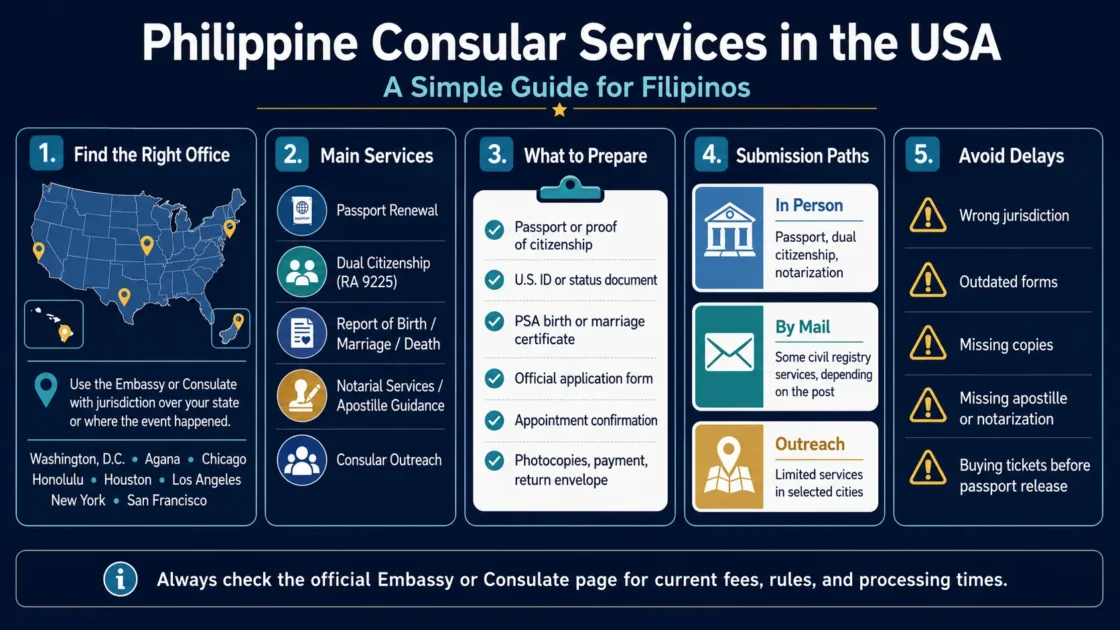
Philippine Consular Services in the USA for Filipinos
Philippine consular services in the United States help Filipino citizens, former natural-born Filipinos, dual citizens, and Filipino families complete official transactions that connect their U.S. records with Philippine government records. These services may include Philippine passport renewal, dual citizenship, civil registry reporting, notarials, apostille guidance, consular outreach, and assistance for urgent situations.
Why this matters →
Choosing the correct Philippine Embassy or Consulate before preparing documents can prevent rejected applications, missed appointments, and delayed passport or civil registry processing.
Required Documents: The exact checklist depends on the service and the consular post, but many applicants should prepare these items before booking or mailing anything:
- Valid Philippine passport, expired Philippine passport, or other proof of Philippine citizenship, if applicable
- U.S. government-issued ID, green card, visa record, certificate of naturalization, or other status document when required for the service
- Philippine Statistics Authority birth, marriage, or death certificate when the transaction involves identity, citizenship, or civil registry records
- Completed official application form from the correct Embassy or Consulate page
- Appointment confirmation for in-person services
- Photocopies required by the specific checklist
- Prepaid self-addressed mailing envelope when the service requires return by mail
- Accepted payment method listed by the consular post
Important Notice: Passport appointments through the DFA passport system are free and should be made only through the official passport appointment website. The Department of Foreign Affairs also warns applicants not to buy outbound travel tickets until the passport is actually in their possession.[b]
Step 1: Find the Correct Consular Office
Philippine consular services in the USA are handled by jurisdiction, not simply by the nearest city.
The Philippines has an Embassy in Washington, D.C. and Consulates General serving different U.S. states, territories, and assigned areas. The official Consulate Finder now includes the Philippine Consulate General in Seattle, which serves Alaska, Idaho, Montana, Oregon, and Washington. Applicants should identify the responsible post before booking an appointment or mailing original records.[a]
| Philippine Post | Consular Jurisdiction |
|---|---|
| Embassy of the Philippines in Washington, D.C. | Alabama, District of Columbia, Florida, Georgia, Kentucky, Maryland, North Carolina, South Carolina, Tennessee, Virginia, and West Virginia. The Embassy also has assigned Caribbean jurisdictions listed in the official Consulate Finder. |
| Consulate General in Agana, Guam | Guam, Commonwealth of the Northern Mariana Islands, Republic of the Marshall Islands, Federated States of Micronesia, and Republic of Palau |
| Consulate General in Chicago | Illinois, Indiana, Iowa, Kansas, Michigan, Minnesota, Missouri, Nebraska, North Dakota, Ohio, South Dakota, and Wisconsin |
| Consulate General in Honolulu | Hawaii and American Samoa |
| Consulate General in Houston | Arkansas, Louisiana, Mississippi, New Mexico, Oklahoma, and Texas |
| Consulate General in Los Angeles | Arizona; Southern Nevada (Nye, Clark, and Lincoln counties); and Southern California covering Los Angeles, San Luis Obispo, Orange, San Diego, Imperial, Riverside, San Bernardino, Ventura, Santa Barbara, and Kern counties |
| Consulate General in New York | Connecticut, Delaware, Maine, Massachusetts, New Hampshire, New Jersey, New York, Pennsylvania, Rhode Island, and Vermont |
| Consulate General in San Francisco | Colorado, Utah, Wyoming, Northern California under the Embassy’s county-based division, and Northern Nevada under its assigned city and county jurisdiction |
| Consulate General in Seattle | Alaska, Idaho, Montana, Oregon, and Washington |
Seattle Service Status: The Seattle Consulate began a soft opening of consular operations in July 2026. During the current phased opening, passport services are temporarily unavailable and visa services are not yet available. Notarial, civil registry, and dual citizenship services are available only as announced by the Consulate. Residents of Alaska, Idaho, Montana, Oregon, and Washington should check Seattle’s current service advisory before relying on older Pacific Northwest instructions from another post.[i]
Tip: A passport renewal may be based on current residence, while a Report of Birth, Report of Marriage, or Report of Death is usually tied to the location where the event occurred. California and Nevada are divided between Los Angeles and San Francisco by county or area, so applicants in those states should check the official Consulate Finder rather than choosing only by distance.
Why Jurisdiction Matters
Sending documents to the wrong consular post can lead to delays or returned applications. This is especially common with civil registry matters, because the consulate usually processes records only for births, marriages, or deaths that occurred within its assigned area. Appointment systems also differ by post, so a slot at one consulate does not normally transfer to another.
Step 2: Match the Service to the Situation
Most consular problems become easier once the applicant identifies the exact transaction needed.
| Situation | Likely Consular Service | Common Processing Path |
|---|---|---|
| A Philippine passport is expired, expiring, damaged, or needs name updates | Passport renewal or new passport application | Appointment, personal appearance, biometric capture, and mailed release |
| A former natural-born Filipino became a U.S. citizen and wants to regain Philippine citizenship | Dual citizenship under RA 9225 | Appointment, document review, oath of allegiance, and identification certificate |
| A child was born in the United States to at least one Filipino parent | Report of Birth | Civil registry filing through the consulate with jurisdiction over the place of birth |
| A Filipino citizen married in the United States | Report of Marriage | Civil registry filing, often by mail, depending on the post |
| A Special Power of Attorney or affidavit will be used in the Philippines | Consular notarization or apostille route | Personal appearance for consular notarization, or state apostille through the proper U.S. authority |
| The applicant lives far from a consulate | Consular outreach, when available | Temporary outreach mission with limited services and separate appointment rules |
Passport Services for Filipinos in the USA
Philippine passport services usually require an appointment, personal appearance, and digital capture of photo and fingerprints.
For an adult ePassport renewal, the Philippine Embassy in Washington, D.C. lists a process that includes scheduling an appointment, preparing documents, appearing at the Embassy, digital biometric data capture, and passport release by mail.[c] Other U.S. consulates follow similar principles, but applicants should use the checklist and booking link of the consular post that serves their location. Seattle is currently an exception during its soft-opening period because passport services remain temporarily unavailable there.[i]
Common Passport Renewal Requirements
- Printed passport application form from the official appointment system or consular post page
- Most recent Philippine ePassport
- Photocopy of the passport data page
- Proof of Philippine citizenship or dual citizenship documents, if the applicant has reacquired citizenship
- U.S. status document, when required by the consular post
- Prepaid return envelope with tracking, if the passport will be mailed back
Important Notice: Passport processing time, appointment availability, and return-mail instructions can vary by post. Travel should be planned only after the new passport has been received, not after an appointment has been booked.
Dual Citizenship Services Under RA 9225
Dual citizenship service is for former natural-born Filipinos who lost Philippine citizenship through foreign naturalization.
Republic Act 9225 allows former natural-born Filipinos who became naturalized citizens of another country to reacquire Philippine citizenship by taking the Oath of Allegiance before a duly authorized Philippine official. The Embassy process includes appointment booking, preparation of the application, personal appearance, oath taking, and issuance of an Identification Certificate.[d]
Important Distinction: A person born in the United States to at least one Filipino parent may already be a Filipino citizen by birth. In that situation, the usual path is a Report of Birth, not a dual citizenship petition under RA 9225.[d]
Documents Often Requested for Dual Citizenship
- Completed dual citizenship application form
- PSA or former NSO birth certificate showing birth in the Philippines, when applicable
- Foreign certificate of naturalization
- Valid U.S. passport or other foreign passport
- Old or current Philippine passport, if available
- Marriage certificate or name-change record, if the applicant’s current name differs from birth records
- Documents for qualified minor children, if they are included in the petition
Tip: Name differences should be reviewed early. Married names, middle names, spelling changes, and naturalization names often require extra proof before the consular officer can match the records.
Civil Registry Services: Birth, Marriage, and Death Records
Civil registry filings help make overseas life events part of Philippine civil records.
Philippine civil registry services in the United States include Report of Birth, Report of Marriage, Report of Death, shipment of remains, solemnization of marriage, and correction of clerical errors. The Embassy’s civil registry page states that these applications are submitted by mail for its jurisdiction.[e] Other consular posts may publish their own mailing checklist, so the correct post should be checked before sending original documents.
Report of Birth
A Report of Birth is used when a child is born abroad and at least one parent was a Filipino citizen at the time of birth. This filing helps connect the child’s overseas birth record with the Philippine civil registry system. It may also support future passport, citizenship, and identity-related transactions.
Report of Marriage
A Report of Marriage records a marriage that occurred outside the Philippines when at least one spouse is a Filipino citizen. This may matter later for passport name changes, spousal records, children’s records, inheritance matters, and other Philippine transactions.
Report of Death
A Report of Death records the death of a Filipino citizen abroad. Families may also need separate consular guidance when remains or ashes will be transported to the Philippines.
Important Notice: Civil registry applications often require original records, notarized affidavits, apostilles, and multiple photocopies. Mailing incomplete documents can cause long delays because the consular post may need to return the file or request corrections.
Notarial Services and Apostille for Philippine Use
Documents for use in the Philippines may need either consular notarization or an apostille, depending on the document type.
Philippine consular notarization is commonly used for private documents such as affidavits, Special Power of Attorney, General Power of Attorney, deeds, certifications, and similar documents intended for use in the Philippines. The Embassy states that personal appearance of all signatories is required because the consular officer verifies identity and understanding of the document.[f]
The apostille route is often used when a document is notarized locally or issued by a U.S. public authority and then authenticated by the proper state or federal competent authority. For private documents, the Embassy describes the general U.S. process as local notarization, submission to the competent authority for apostille, and use of the apostilled document in the Philippines.[g]
| Document Need | Often Used Route | Notes |
|---|---|---|
| Special Power of Attorney signed before a Philippine consular officer | Consular notarization | Personal appearance of the signatory is usually required. |
| U.S. notarized private document for use in the Philippines | State apostille | The correct Secretary of State or competent authority depends on where the document was notarized. |
| U.S. public document such as a state vital record | Apostille from the issuing state’s competent authority | Consulates generally do not replace the state apostille process for U.S. public documents. |
| Document to be used inside the United States | U.S. notarization or U.S. agency process | Philippine consular notarization is generally for documents intended for use in the Philippines. |
Tip: Before paying for notarization or apostille, ask the Philippine recipient what format they require. Banks, courts, property offices, schools, and government agencies in the Philippines may ask for different wording or document attachments.
Consular Outreach for Filipinos Far From a Consulate
Outreach missions bring limited consular services to selected cities, but they are not a full replacement for a consulate visit.
Consular outreach may help Filipinos who live far from a Philippine Embassy or Consulate. Typical outreach services may include passport processing, dual citizenship, notarials, civil registry intake, or other services announced for that specific mission. The available services, appointment release date, document pre-screening rules, and payment instructions can change for each outreach event.
Procedure Note: Outreach slots can be limited and may fill fast. Applicants should not assume that every consular service is offered at every outreach mission. The announcement for the specific city and date controls the rules.
Appointments, Mail, and Payment Rules
The same applicant may need different submission methods for different services.
Some services are appointment-based and require personal appearance, especially passport processing, dual citizenship oath taking, and consular notarization. Other services, such as civil registry filings at the Embassy in Washington, D.C., may be handled by mail only for that post. The Embassy’s appointment page also warns that appointment scheduling is free and that clients with appointments are prioritized.[h]
Before Mailing Documents
- Use the checklist from the consular post with jurisdiction.
- Confirm whether original documents are required or only photocopies are accepted.
- Check whether notarization or apostille is required before mailing.
- Use the payment method stated by the post, not a payment method from another consulate’s page.
- Include a prepaid return envelope when the checklist requires it.
- Keep tracking numbers and scanned copies of the full application packet.
When to Contact the Consulate Directly
Some situations should be checked with the consular post before an appointment is booked or documents are mailed.
- The applicant has conflicting names across Philippine, U.S., and civil registry documents.
- A Philippine passport is lost, stolen, mutilated, or expired for a long period.
- A child’s birth was reported late or the parents’ records do not match.
- A civil registry document involves divorce, annulment, adoption, legitimacy, or court orders.
- The document will be used for land, estate, banking, or court matters in the Philippines.
- The applicant needs urgent help due to serious illness, detention, death of a Filipino citizen, or loss of travel documents.
Important Notice: Philippine consulates in the United States do not issue U.S. immigration status, U.S. visas, green cards, Social Security numbers, or state driver’s licenses. Those matters belong to U.S. federal or state agencies. A Philippine consular record may support identity or citizenship, but it does not replace U.S. immigration paperwork.
Common Mistakes That Delay Consular Transactions
Many delays come from avoidable document and appointment problems.
- Booking under the wrong consular jurisdiction
- Using an outdated form saved from an old page
- Sending documents without the required apostille or notarization
- Forgetting photocopies even when originals are presented
- Using a return envelope without tracking
- Assuming passport, civil registry, and dual citizenship rules are the same at every post
- Buying tickets before the passport is released
- Using a third party to book a free official appointment
Questions Filipinos Often Ask About Consular Services
These answers cover common practical questions before contacting a consular post.
Can a Filipino renew a Philippine passport anywhere in the United States?
Applicants should use the official DFA appointment system and a post currently offering passport services that can accept their application. Service availability should be checked before booking; for example, Seattle currently lists passport services as temporarily unavailable during its soft-opening period.
Is a Report of Birth the same as dual citizenship?
No. A Report of Birth records the birth of a child born abroad to at least one Filipino parent. Dual citizenship under RA 9225 is for a former natural-born Filipino who lost Philippine citizenship through foreign naturalization and wants to reacquire it.
Can a Special Power of Attorney be notarized by a local U.S. notary instead of a Philippine consulate?
In many cases, a locally notarized document may need an apostille from the proper U.S. state or competent authority before it can be used in the Philippines. Some Philippine recipients may still prefer a consular notarization, so the receiving office in the Philippines should be consulted before choosing the route.
Do all consular services require personal appearance?
No. Passport, dual citizenship oath taking, and consular notarization commonly require personal appearance. Some civil registry services may be processed by mail, depending on the consular post and the service checklist.
Are fees the same at every Philippine consulate in the USA?
Fees and accepted payment methods can vary by service, post, and date. Applicants should use only the fee schedule published by the consular post handling the transaction.
Verification Note: Consular procedures, fees, appointment systems, mailing rules, processing timelines, jurisdiction assignments, and service availability can change. Before booking, paying, mailing originals, or making travel plans, applicants should recheck the official page of the Philippine Embassy or Consulate responsible for their case.
Sources
- Philippine Embassy in Washington, D.C. — Consulate Finder — Used for the current U.S. consular post list and jurisdiction assignments, including the Philippine Consulate General in Seattle. (Official Philippine government diplomatic source.)
- DFA Office of Consular Affairs — Passport Appointment System — Used for passport appointment warnings, free official booking, and travel-ticket caution. (Official Philippine Department of Foreign Affairs passport platform.)
- Philippine Embassy in Washington, D.C. — E-Passport Renewal — Used for passport renewal steps, appointment, document preparation, biometric capture, and mailed passport release process. (Official Philippine Embassy service page.)
- Philippine Embassy in Washington, D.C. — Dual Citizenship Application — Used for RA 9225 process and the distinction between dual citizenship petitions and Report of Birth for U.S.-born children of Filipino parents. (Official Philippine Embassy service page.)
- Philippine Embassy in Washington, D.C. — Civil Registration — Used for Report of Birth, Report of Marriage, Report of Death, and mail-based civil registry service information. (Official Philippine Embassy service page.)
- Philippine Embassy in Washington, D.C. — Consular Notarization — Used for document types eligible for notarization and the personal appearance requirement for signatories. (Official Philippine Embassy service page.)
- Philippine Embassy in Washington, D.C. — Apostille — Used for the general apostille process for documents intended for use in the Philippines. (Official Philippine Embassy service page.)
- Philippine Embassy in Washington, D.C. — Schedule an Appointment — Used for appointment reminders, free scheduling warning, and service submission notes. (Official Philippine Embassy appointment page.)
- Philippine Consulate General in Seattle — Soft Opening of Consular Services — Used for Seattle’s July 2026 opening, five-state jurisdiction, and current phased availability of passport, civil registry, notarial, and dual citizenship services. (Official Philippine Consulate General advisory.)