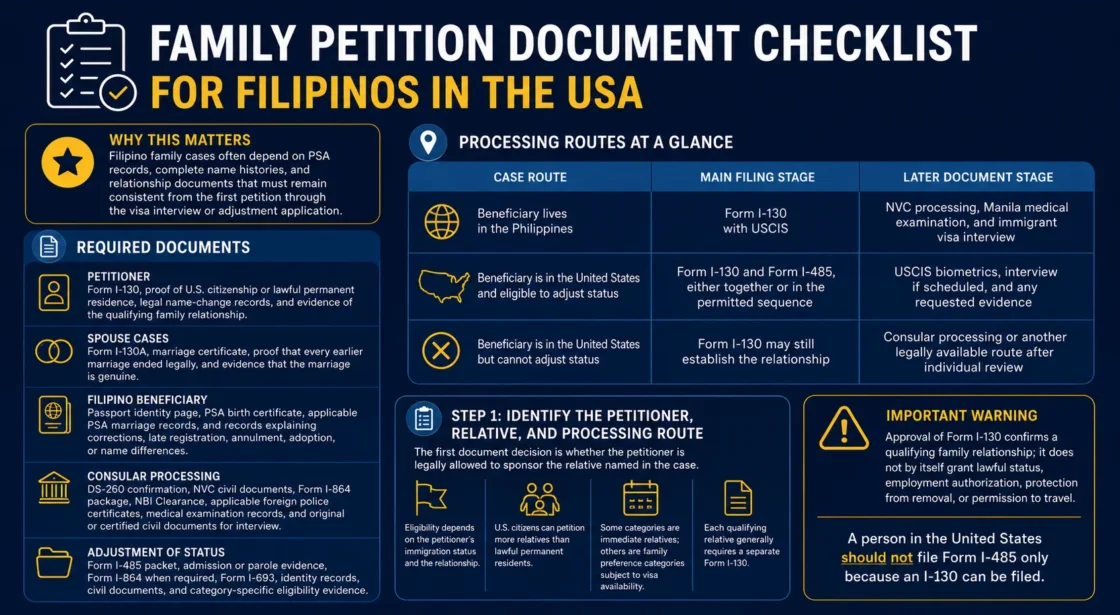
A family petition file for a Filipino relative should be organized around three facts: who is filing, which relative is being sponsored, and whether the beneficiary will complete the case in the Philippines or apply from inside the United States. Form I-130 starts most family-based cases, but the documents filed with USCIS are not the same as the civil, financial, medical, and interview records required later by the National Visa Center or the U.S. Embassy in Manila.
Why this matters →
Filipino family cases often depend on PSA records, complete name histories, and relationship documents that must remain consistent from the first petition through the visa interview or adjustment application.
Required Documents: Most files begin with the items below, but the correct packet depends on the relationship and processing route.
- Petitioner: Form I-130, proof of U.S. citizenship or lawful permanent residence, legal name-change records, and evidence of the qualifying family relationship.
- Spouse cases: Form I-130A, marriage certificate, proof that every earlier marriage ended legally, and evidence that the marriage is genuine.
- Filipino beneficiary: Passport identity page, PSA birth certificate, applicable PSA marriage records, and records explaining corrections, late registration, annulment, adoption, or name differences.
- Consular processing: DS-260 confirmation, NVC civil documents, Form I-864 package, NBI Clearance, applicable foreign police certificates, medical examination records, and original or certified civil documents for interview.
- Adjustment of status: Form I-485 packet, admission or parole evidence, Form I-864 when required, Form I-693, identity records, civil documents, and category-specific eligibility evidence.
| Case Route | Main Filing Stage | Later Document Stage |
|---|---|---|
| Beneficiary lives in the Philippines | Form I-130 with USCIS | NVC processing, Manila medical examination, and immigrant visa interview |
| Beneficiary is in the United States and eligible to adjust status | Form I-130 and Form I-485, either together or in the permitted sequence | USCIS biometrics, interview if scheduled, and any requested evidence |
| Beneficiary is in the United States but cannot adjust status | Form I-130 may still establish the relationship | Consular processing or another legally available route after individual review |
Important Warning: Approval of Form I-130 confirms a qualifying family relationship; it does not by itself grant lawful status, employment authorization, protection from removal, or permission to travel. A person in the United States should not file Form I-485 only because an I-130 can be filed.
Step 1: Identify the Petitioner, Relative, and Processing Route
The first document decision is whether the petitioner is legally allowed to sponsor the relative named in the case.
A U.S. citizen may petition for a spouse; an unmarried child under 21; a parent if the citizen is at least 21; an unmarried adult son or daughter; a married son or daughter; or a sibling if the citizen is at least 21. A lawful permanent resident may petition for a spouse, an unmarried child under 21, or an unmarried adult son or daughter. A Green Card holder cannot use Form I-130 to petition for a parent, sibling, or married son or daughter.[a]
| Petitioner | Relative | Basic Category | Document Consequence |
|---|---|---|---|
| U.S. citizen | Spouse | Immediate relative | Separate I-130 for the spouse; separate petitions may be needed for qualifying children |
| U.S. citizen age 21 or older | Parent | Immediate relative | A separate I-130 is filed for each parent |
| U.S. citizen | Unmarried child under 21 | Immediate relative | The child needs an independently qualifying petition |
| U.S. citizen | Adult or married son or daughter | Family preference | Visa availability controls when the immigrant visa or adjustment stage may proceed |
| U.S. citizen age 21 or older | Brother or sister | Family preference | The sibling’s eligible spouse and unmarried children may qualify as derivatives |
| Green Card holder | Spouse or unmarried son or daughter | Family preference | Visa availability and any derivatives must be reviewed before the next filing stage |
Immediate relatives of U.S. citizens do not have derivative beneficiaries. For example, filing an I-130 for a spouse does not automatically create an immigrant category for that spouse’s child. The U.S. citizen may need a separate petition for each child who has an independent qualifying relationship. By contrast, eligible spouses and children of some family-preference principal beneficiaries may immigrate as derivatives without separate I-130 petitions.[b]
Tip: Create a one-page case summary before collecting records. List the petitioner’s status, the beneficiary’s relationship, current country, current U.S. status if applicable, prior marriages, children, aliases, and the planned processing route.
Cases This Checklist Does Not Treat as a Standard I-130 File
A fiancé or fiancée who has not yet married the U.S. citizen normally does not fit a spousal I-130 case. Adoption cases may fall under different processes depending on the child’s country, residence, adoption history, and the petitioner’s circumstances. Widow or widower, humanitarian, removal, fraud, criminal-history, and prior deportation cases may also require a different filing analysis.
Attention: A planned marriage, engagement, church ceremony without a legally valid marriage, or informal family relationship does not replace the civil record required for the immigration category.
Step 2: Prepare the Form I-130 Core Packet
The initial USCIS packet must prove the petitioner’s status, identify both parties, and establish the claimed relationship.
Documents From the Petitioner
- Completed and signed Form I-130, Petition for Alien Relative.
- Proof of U.S. citizenship, such as an eligible U.S. birth certificate, U.S. passport, Certificate of Naturalization, or Certificate of Citizenship.
- For a lawful permanent resident petitioner, a copy of the front and back of the Permanent Resident Card or another accepted record of permanent resident status.
- Legal name-change documents when the petitioner’s current name differs from the name on the citizenship, residence, birth, or relationship record.
- Filing payment in the form and amount accepted under the current USCIS instructions.
- Relationship evidence required for the spouse, parent, child, adult son or daughter, or sibling category.
Documents From the Beneficiary
- Full legal name and every other name used, including maiden names, married names, aliases, alternate spellings, and suffixes.
- Date and place of birth, current address, prior address history requested by the form, and immigration information if the person has been in the United States.
- Copies of identity and civil records that establish the relationship.
- Legal name-change or civil-registry correction documents when the present identity record does not match the original birth record.
- For a spouse petition, completed Form I-130A, Supplemental Information for Spouse Beneficiary.
USCIS describes Form I-130 as the first step for an eligible relative to seek permanent residence. The agency’s current I-130 page also lists relationship-specific evidence and requires Form I-130A for a spouse beneficiary.[c]
Copies, Originals, and Translations
Unless the form instructions or a later notice specifically asks for an original, the mailed USCIS packet should normally contain clear, legible copies. Every foreign-language document submitted to USCIS should include the full English translation and the translator’s certification that the translation is complete, accurate, and within the translator’s competence. Keep the original document and the exact copy submitted in a permanent case file.
Document Control: Save a complete copy of every form, attachment, cover letter, delivery record, online confirmation, and payment receipt. Later NVC or interview answers should match the information filed with USCIS.
Step 3: Add the Correct Relationship Evidence
The birth or marriage certificate is the starting record, but some relationships require a full chain of documents.
Petitioning for a Filipino Spouse
Spouse File:
- Form I-130 and Form I-130A.
- PSA marriage certificate when the marriage occurred in the Philippines.
- Foreign marriage certificate when the marriage occurred elsewhere, with a certified English translation when required.
- Philippine Report of Marriage or PSA recording when available and applicable to a marriage reported through a Philippine foreign service post.
- Final divorce decree, annulment decree, declaration of nullity, or death certificate for every prior marriage of either spouse.
- Legal name-change records connecting maiden, former married, and current names.
- Evidence that the marriage was entered in good faith and continues as a real marital relationship.
Evidence of Shared Residence
- Joint lease, deed, mortgage, or property records.
- Utility, insurance, government, school, medical, or financial correspondence showing the same address.
- Records explaining periods when the spouses lived apart for work, immigration, study, caregiving, military service, or another documented reason.
Evidence of Shared Finances
- Joint bank account statements showing genuine use rather than an unused newly opened account.
- Joint tax filings when legally applicable.
- Insurance policies, retirement accounts, or employment benefits naming the other spouse.
- Joint debts, major purchases, household expenses, or money transfers consistent with the couple’s circumstances.
Evidence of Family and Daily Life
- Birth certificates of children born to the spouses.
- Travel records showing visits or trips together.
- Photographs selected across different dates, places, and family settings.
- Communication records from periods of separation.
- Wedding, family, medical, school, housing, or emergency-contact records that identify the marital relationship.
- Detailed affidavits from people with personal knowledge when formal records do not fully explain the relationship.
USCIS recognizes records such as joint property, joint tenancy, combined finances, tax returns, mortgages, utility bills, insurance, children’s birth certificates, and other evidence showing a marital partnership. A strong file is arranged by what each record proves, not by the number of pages submitted.[d]
Tip: For a long-distance marriage, use a dated relationship timeline and attach representative records from each period. Repeating dozens of nearly identical chat screenshots adds less value than showing consistent contact, visits, financial support, family involvement, and shared planning over time.
Petitioning for a Biological Child
- The child’s PSA birth certificate or the official birth certificate from the country of birth.
- The petitioner’s identity and status documents.
- Marriage certificate of the parents when it forms part of the legal parent-child relationship.
- Legitimation, acknowledgment of paternity, paternity order, custody order, or other records required by the facts of a father-child case.
- Evidence of a real parent-child relationship when the law or category requires more than the birth entry alone.
- Name-correction records when the parent’s or child’s name differs across documents.
A father’s name on a birth certificate may not resolve every case involving a child born outside marriage. The filing should be checked for the applicable rules on legitimation, acknowledgment, legal custody, and a bona fide parent-child relationship before assuming that one certificate is enough.
Petitioning for a Stepchild
- The stepchild’s birth certificate naming the biological parent.
- The marriage certificate joining the petitioner and the child’s biological parent.
- Proof that the marriage creating the step-relationship occurred before the child’s 18th birthday.
- Proof that all earlier marriages of the petitioner and biological parent ended legally.
- Identity and name-change records connecting all names in the document chain.
USCIS permits a qualifying stepparent to file Form I-130 when the marriage creating the step-relationship occurred before the child turned 18. Adoption by the stepparent is not required merely to establish the immigration step-relationship.[e]
Petitioning for an Adopted Child
An adopted-child file should not be treated as an ordinary birth-certificate case. Depending on the route, the record may include an adoption decree, declaration of finality, legal custody order, proof of joint residence, the child’s original and amended civil records, records from the National Authority for Child Care, and evidence showing when and how the adoption became final. The family-based I-130 process generally has legal-custody and joint-residence requirements that differ from Hague and orphan procedures.[f]
Important Warning: An adoption order alone does not confirm that the child fits every U.S. immigration definition. The adoption date, child’s age, custody period, residence history, country process, and prior immigration filings should be reviewed together.
Petitioning for a Filipino Mother or Father
Mother
- Petitioner’s birth certificate showing the mother’s name.
- Petitioner’s proof of U.S. citizenship.
- Proof that the U.S. citizen petitioner is at least 21.
- Name-change records connecting the mother’s maiden, married, and current names.
Father
- Petitioner’s birth certificate showing the father’s name.
- Parents’ marriage certificate when applicable.
- Legitimation, acknowledgment, paternity, support, custody, residence, or relationship records when required by the facts.
- Proof of termination of earlier marriages when needed to establish the legal relationship.
- Petitioner’s citizenship and age evidence.
Stepparent or Adoptive Parent
- For a stepparent, the petitioner’s birth certificate and the marriage certificate between the biological parent and stepparent, showing that the marriage occurred before the petitioner turned 18.
- For an adoptive parent, the adoption decree and the custody and residence evidence required for the applicable immigration definition.
Petitioning for a Brother or Sister
- Petitioner’s birth certificate.
- Beneficiary sibling’s birth certificate.
- Records showing at least one common parent.
- Petitioner’s proof of U.S. citizenship and proof that the petitioner is at least 21.
- Marriage, divorce, annulment, death, legitimation, adoption, or name-change records needed to connect half-sibling, stepsibling, or adoption-based relationships.
A sibling petition normally requires both birth certificates showing at least one shared parent. Half-sibling and adoption-based files require the additional records that establish how the relationship was legally created and maintained.[g]
Step 4: Order and Audit Philippine Civil Records
PSA records should be checked for content, annotations, security format, and consistency before they are uploaded or taken to an interview.
PSA Birth Certificate
For a person born in the Philippines, the visa record normally comes from the Philippine Statistics Authority. Check the full name, sex, date and place of birth, parents’ names, registration date, annotations, and any handwritten or difficult-to-read entries. Older records may contain Spanish text and may require an English translation.
PSA Marriage Certificate
For a marriage celebrated in the Philippines, the U.S. visa process generally expects the PSA-issued marriage certificate even when the couple also has a Local Civil Registrar copy. A marriage celebrated outside the Philippines may require the original certificate from the foreign issuing authority, a translation when needed, and the Philippine recording of the marriage when applicable.
CENOMAR and Advisory on Marriages
A Certificate of No Marriage Record reports that the PSA marriage index does not show a marriage under the searched identity. An Advisory on Marriages, sometimes referred to as CEMAR or AOM, reports marriage entries associated with the person. These are marriage-index documents, not substitutes for a marriage certificate. The required document depends on the person’s marital history and the instructions for the current processing stage.
CDLI-Endorsed Records
When a civil record has been affected by a court decision or legal instrument—such as annulment, declaration of nullity, legitimation, correction, or legal name change—the applicant should request a copy bearing the appropriate CDLI endorsement. The Department of State’s Philippines civil-document schedule warns that an unamended copy may not be valid for visa use when the legal change is not reflected.[h]
Attention: A court order kept separately from an unchanged PSA certificate may leave the civil record incomplete. Confirm that the decision was registered with the required civil registries and that the PSA copy reflects the legal event.
Late-Registered Birth Certificate
A late registration is not automatically unusable, but it may receive closer review. Preserve records created near the time of birth, including baptismal records, school enrollment records, hospital or clinic records, early identity documents, parents’ marriage record, local civil records, and other evidence that consistently identifies the person and parents. The goal is to show that the later registration matches older independent records.
PSA “No Record Available” Result
Secondary records should not replace a government birth record merely because they are easier to obtain. When PSA reports that no record is available, keep the official non-availability result and then collect the permitted secondary evidence, which may include available Local Civil Registrar, National Archives, baptismal, school, medical, or affidavit evidence. The Department of State’s Philippines schedule limits alternate birth evidence to cases where the PSA certificate indicates that no record is available.
How to Request PSA Records
PSA identifies birth, marriage, death, and CENOMAR records as civil registry documents available through its authorized channels, including online delivery options for addresses in the Philippines or abroad. Requesting rules may depend on whether the requester is the document owner, spouse, parent, adult child, guardian, authorized representative, or another person allowed under PSA privacy rules.[i]
Tip: Order records early enough to inspect them before filing. A sealed delivery envelope or fresh print date does not prove that names, annotations, and civil events are correct.
Step 5: Run a Name and Identity Consistency Audit
The same person should be identifiable across PSA, passport, NBI, USCIS, NVC, tax, and marriage records.
| Record | Full Name | Birth Details | Parents or Spouse | Issue to Resolve |
|---|---|---|---|---|
| PSA birth certificate | First, middle, surname, suffix | Date and place | Parents’ legal names | Late registration, annotation, spelling, missing suffix |
| Passport | Current travel identity | Date and place | Not always shown | Order of names, married surname, shortened birthplace |
| PSA marriage certificate | Names used at marriage | Age or birth details as recorded | Spouse and parents | Maiden name, prior marriage, annotation |
| NBI Clearance | Primary name and AKA entries | Date and place | As requested by NBI | Missing maiden name, nickname, alias, alternate spelling |
| USCIS and DS-260 forms | Legal name and all other names used | Must match supporting records | Must match the document chain | Omitted name, inconsistent transliteration, incorrect civil status |
Filipino Naming Issues Worth Checking
- Maiden surname versus married surname.
- Maternal surname used as a middle name.
- Two-part first names entered differently across systems.
- “Ma.” versus “Maria,” or another shortened first name.
- “Jr.,” “Sr.,” “II,” “III,” or another suffix omitted from one record.
- Hyphens, spaces, accents, and compound surnames.
- Nickname, baptismal name, professional name, or alias.
- A former spouse’s surname still appearing on an identity record.
- Different spellings of a parent’s name on siblings’ birth certificates.
- Different city, municipality, province, or country wording for the same birthplace.
Practical Record: Prepare a signed name-history sheet listing each name, where it appears, the dates it was used, and the document that connects it to the current identity. The sheet does not replace legal evidence, but it helps keep every form consistent.
Step 6: Prepare the NVC and Manila Visa File
After an approved petition reaches the National Visa Center, the beneficiary and petitioner move from relationship filing to visa-document processing.
Documents Commonly Prepared for NVC
- CEAC case information and fee confirmations.
- Completed DS-260 for each immigrant visa applicant.
- Valid passport biographic page for each applicant.
- Birth certificate or certified copy from the required issuing authority.
- Marriage certificate for every current marriage and records for every prior marriage.
- Final divorce decrees, annulment records, declarations of nullity, or death certificates ending prior marriages.
- Police certificates under the age, nationality, residence, and arrest-history rules that apply to the applicant.
- Court and prison records when applicable.
- Military records when applicable.
- Adoption and custody records when the visa case rests on an adopted-child relationship.
- Form I-864 and the financial records required from each sponsor.
- Certified translations when required.
The National Visa Center requires civil records from the official issuing authority, certified translations under its language rules, original or certified birth and marriage records for the later interview, termination evidence for every earlier marriage, and applicable police, court, prison, military, and adoption documents.[j]
NBI Clearance and AKA Entries
A Filipino immigrant visa applicant who must provide a Philippine police certificate should obtain the NBI Clearance specified for travel purposes. The U.S. Embassy in Manila instructs applicants to request an AKA section that includes the maiden name, birth-certificate name, aliases, nicknames, and alternate spellings appearing on civil records, even when a spelling was not used in ordinary daily life.
NBI Name Check:
- Current passport name.
- Full birth-certificate name.
- Maiden name.
- Every former married name.
- Nickname or alias disclosed on immigration forms.
- Alternate spelling found on a birth, marriage, school, court, or identity record.
- Suffixes and compound names.
Manila Pre-Interview Documents
- Interview appointment letter.
- Unexpired passport meeting the embassy’s validity instruction.
- DS-260 confirmation page.
- Original PSA birth certificate.
- Original NBI Clearance and required foreign police certificates.
- Original marriage certificate and proof ending all prior marriages.
- Form I-864 for each financial sponsor and the financial records requested by the post.
- Proof of the petitioner’s U.S. status and U.S. domicile.
- Updated relationship evidence.
- Petitioner’s original birth certificate for IR5 parent and F4 sibling cases, as directed by Manila.
- Stepchild marriage records or adoption and custody records when applicable.
Current Manila instructions also require appointment registration and a Visa Application Center appointment before the embassy interview, identify the NBI name requirements, list family-based financial and relationship records, and call for the petitioner’s original birth certificate in IR5 and F4 cases.[k]
Medical Examination in Manila
The immigrant visa medical examination is a later interview-stage requirement, not an I-130 attachment. Manila’s current instructions direct applicants to the designated panel physician and state that medical examinations from other physicians are not accepted. The applicant should follow the appointment letter and current post instructions rather than arranging an independent examination months in advance.
Important Warning: Do not open a sealed medical envelope or other sealed visa packet given for delivery to the embassy or U.S. immigration authorities. Follow the handling instruction printed on the package.
Step 7: Prepare the Affidavit of Support File
The financial sponsorship packet is separate from the evidence proving the family relationship.
Petitioner or Primary Sponsor
- Correct version of Form I-864 or another form allowed for the category.
- Proof of U.S. citizenship or lawful permanent residence.
- Proof of U.S. domicile.
- Most recent IRS tax transcript, or the tax return and supporting wage records accepted under the current instructions.
- Current employment letter and recent pay statements when needed to show present income.
- Self-employment, retirement, asset, or other income records when relied upon.
- A correct household-size calculation that includes all people required by the form instructions.
Joint Sponsor
- A separate signed Form I-864.
- Proof of U.S. citizenship or lawful permanent residence.
- Proof of U.S. domicile.
- Tax and current-income records.
- Household-size calculation for the joint sponsor’s own household and sponsorship obligations.
Household Member Income
- Form I-864A when the income of a qualifying household member is used.
- Proof of the household member’s relationship or residence as required.
- Tax and current-income records for that household member.
USCIS uses Form I-864 to show that the intending immigrant has adequate financial support, and most family-based immigrants must submit the affidavit. The petitioner generally remains a sponsor even when a joint sponsor is added.[l]
U.S. Domicile When the Petitioner Lives Abroad
A petitioner living in the Philippines or another country should prepare evidence showing an existing U.S. domicile or concrete steps to reestablish one before or with the beneficiary’s immigration. Depending on the facts, records may include U.S. tax filings, voting registration, bank or property ties, U.S. employment, a job offer, housing plans, school arrangements, shipment records, and a dated plan for returning to reside in the United States.
Attention: A joint sponsor may solve an income shortage but does not replace the petitioner’s separate domicile requirement.
Step 8: Build the Adjustment of Status Packet When the Beneficiary Is in the United States
A beneficiary already in the United States needs an eligibility review before the I-485 document checklist is used.
Questions to Resolve Before Filing
- How did the beneficiary enter the United States?
- Is there an admission, parole, passport stamp, visa record, or Form I-94?
- Is the petitioner a U.S. citizen or Green Card holder?
- Is an immigrant visa immediately available for the category?
- Has the beneficiary worked without authorization or fallen out of status?
- Is there a prior removal order, immigration-court case, denied application, unlawful-presence issue, false claim, fraud concern, or criminal record?
- Has the beneficiary ever used another name, date of birth, passport, or immigration identity?
- Is consular processing still selected on the I-130, and does USCIS or NVC need to be notified of a route change?
Immediate relatives of U.S. citizens may file Form I-485 concurrently with Form I-130 in qualifying circumstances because an immigrant visa is immediately available to that category. Family-preference applicants may file only when the applicable filing rules and visa availability permit it. Every adjustment case must also satisfy admission, admissibility, and other eligibility rules.[m]
Core Adjustment Documents
Adjustment Packet:
- Form I-485.
- Form I-130 filed concurrently, or the I-130 receipt or approval notice.
- Form I-130A in a spouse case.
- Government-issued photo identity document.
- PSA birth certificate or official birth certificate from the country of birth.
- Passport biographic page, visa page, entry stamp, and Form I-94 or other admission or parole evidence.
- Marriage certificate and records ending all earlier marriages when applicable.
- Form I-864 package when required.
- Form I-693 completed through a USCIS-designated civil surgeon.
- Required passport-style photographs.
- Certified translations.
- Category-specific and admissibility records.
USCIS lists identity, birth, entry, category, financial-support, and other eligibility documents in its Form I-485 initial-evidence checklist. The exact packet depends on the adjustment category and the applicant’s immigration history.[n]
Form I-693
Current USCIS instructions require applicants who must submit Form I-693 to file it with Form I-485. The examination must be completed by a USCIS-designated civil surgeon, and the applicant should follow the civil surgeon’s sealing and submission instructions.[o]
Important Warning: Marriage to a U.S. citizen does not erase every entry, fraud, criminal, removal, or false-claim issue. A filing that discloses a serious history without first determining the legal effect can create consequences beyond a request for more documents.
Step 9: Scan, Upload, Mail, and Preserve the Records Correctly
A valid document can still cause delay when the scan is incomplete, the pages are mislabeled, or the original cannot be produced later.
For a USCIS Mail Filing
- Use the current edition of every form.
- Check the current filing address immediately before mailing.
- Sign every required form in the accepted manner.
- Use clear photocopies unless an original is specifically requested.
- Do not send photo albums, scrapbooks, electronic media, or oversized presentation binders.
- Place certified translations directly behind the foreign-language document.
- Keep a full duplicate packet and proof of delivery.
USCIS filing guidance advises applicants to use current form editions, submit the required evidence in a processable format, and avoid unnecessary presentation materials that cannot be handled through standard intake.[p]
For CEAC Uploads
- Scan the complete document, including the back when it contains stamps, annotations, or text.
- Keep seals, serial numbers, margins, and annotations visible.
- Use a readable orientation and resolution.
- Do not combine unrelated people’s records into one unclear file.
- Label files by person, document type, and date when the portal allows.
- Upload the requested replacement when NVC rejects a document rather than assuming the original upload remains acceptable.
- Preserve the exact physical original or certified copy corresponding to the upload.
For the Visa Interview
- Bring the original or certified copy of every required civil document uploaded to CEAC.
- Bring updated versions when the embassy or NVC instruction calls for a current document.
- Keep one photocopy behind each original.
- Separate the petitioner’s documents from each applicant’s documents.
- Carry the appointment, passport, DS-260, financial, relationship, civil, police, and special-case records in labeled sections.
The Department of State places responsibility on the applicant to bring the required original or certified civil documents to the immigrant visa interview. Failure to produce them may delay the case or prevent visa issuance at that appointment.[q]
Step 10: Resolve Filipino Document Problems Before Submission
The safest time to correct a record is before the inconsistency appears across several immigration forms.
The PSA Record and Passport Do Not Match
Identify whether the difference is a harmless formatting variation, an unreported name change, a civil-registry error, or a conflict involving the person’s identity. Do not silently choose one version for USCIS and another for NVC. Use the legally correct name, disclose other names where the form asks, and attach the civil or court record connecting the versions.
The NBI Clearance Does Not Include Every Name
Compare the AKA section against the birth certificate, marriage certificates, prior married names, passport, DS-260, and all names disclosed to USCIS. Obtain the record that follows the Manila instruction rather than relying on an NBI copy that omits a maiden name or alternate spelling.
An Annulment Is Not Reflected on the PSA Record
Keep the certified court decision and declaration of finality, confirm registration with the required local civil registries and PSA, and request the properly annotated or CDLI-endorsed civil record. A plain unamended marriage certificate can create an unresolved civil-status conflict.
The Birth Was Registered Late
Collect older independent records before they are lost. Arrange them chronologically and explain any differences in spelling, age, parents’ details, or birthplace. Do not alter, recreate, or obtain a newly prepared affidavit that pretends to be an old record.
Only a Local Civil Registrar Copy Is Available
For visa processing, check the Philippines reciprocity instruction before assuming the local copy is enough. When the required PSA record does not exist, obtain the formal non-availability result and then follow the permitted secondary-evidence route.
A Marriage Occurred Outside the Philippines
Keep the original foreign marriage certificate, a certified English translation when needed, and evidence of the Philippine Report of Marriage or PSA recording when applicable. Names and dates should match the spouses’ passports, birth records, and immigration forms.
A Prior Marriage Ended Outside the Philippines
Preserve the final foreign decree, proof of finality where applicable, and any Philippine recognition or civil-registry records relevant to the person’s status. Foreign-divorce and remarriage questions can depend on citizenship, timing, forum, and Philippine law, so a standard checklist should not be used to declare the person free to marry.
The Petitioner’s Birth Certificate Is Needed for IR5 or F4
Parent and sibling cases processed in Manila should reserve the petitioner’s original birth certificate or certified copy for the interview file. The record is used to verify the parent-child or sibling chain and should be checked against the beneficiary’s PSA records before the appointment.
Family Petition Document Checklist by Stage
Use the stage columns to avoid mailing interview originals too early or waiting too long to obtain slow civil records.
| Document | I-130 Stage | NVC Stage | Manila Interview | Adjustment of Status |
|---|---|---|---|---|
| Petitioner’s citizenship or Green Card proof | Required copy | Used with financial sponsorship and case records | Copy as instructed | Included with family basis |
| Form I-130 | Required | Approved petition forms the case basis | Receipt or approval may be kept in the file | Filed, pending, or approved as permitted |
| Form I-130A | Required for spouse beneficiary | Not a substitute for DS-260 | Keep a copy for consistency | Included in spouse-based concurrent filing |
| Relationship civil record | Copy used to establish relationship | Uploaded when required | Original or certified copy | Copy with application; original preserved |
| Bona fide marriage evidence | Filed in spouse case | Updated records may be kept ready | Updated evidence may be requested | Filed and updated through interview |
| PSA birth certificate | Used when it proves the relationship | Uploaded for visa applicant | Original required under post instructions | Copy used as identity and civil evidence |
| NBI Clearance | Normally not an initial I-130 document | Uploaded when required | Original with complete AKA information | Not a standard substitute for U.S. background checks |
| Form I-864 | Not normally part of a standalone I-130 | Required in most family visa cases | Sponsor forms and updated financial records | Filed with qualifying family-based I-485 packet |
| Medical examination | Not filed | Wait for processing instructions | Completed through designated panel physician | Form I-693 through designated civil surgeon |
| DS-260 confirmation | Not applicable | Created after immigrant visa case opens | Bring confirmation page | Not used for Form I-485 |
| Passport and I-94 | Immigration history may be reported | Passport identity page uploaded | Valid passport required | Entry, admission, or parole evidence included |
Master Filing Checklist
Complete only the sections that match the petitioner, relationship, and processing route.
Before Form I-130 Is Filed
- ☐ The petitioner is permitted to sponsor this relative.
- ☐ The correct family category has been identified.
- ☐ Separate petitions have been prepared for each person who needs one.
- ☐ The planned route—consular processing or adjustment of status—has been selected accurately.
- ☐ Form I-130 is complete and signed.
- ☐ Form I-130A is included for a spouse beneficiary.
- ☐ Petitioner’s citizenship or permanent resident evidence is included.
- ☐ Primary relationship records are included.
- ☐ Every prior marriage is documented through its legal end.
- ☐ Every legal name and other name used is disclosed consistently.
- ☐ Required translations are certified.
- ☐ Copies are readable and complete.
- ☐ The current form edition, filing location, and payment method have been checked.
- ☐ A complete duplicate of the filing has been saved.
For a Spouse Petition
- ☐ PSA or foreign marriage certificate is available.
- ☐ Prior-marriage termination records exist for both spouses.
- ☐ Shared-residence evidence is organized.
- ☐ Shared-finance evidence is organized.
- ☐ Family and daily-life evidence covers more than the wedding date.
- ☐ Long-distance periods are explained through a timeline and supporting records.
- ☐ Maiden, married, and former married names match the forms and civil records.
For a Child, Parent, or Sibling Petition
- ☐ Both sides of the relationship chain are supported by civil records.
- ☐ Step-relationship dates meet the age rule.
- ☐ Father-child issues involving birth outside marriage have been reviewed.
- ☐ Adoption, custody, and joint-residence evidence is complete where applicable.
- ☐ Petitioner’s original birth certificate is reserved for an IR5 or F4 interview in Manila.
- ☐ Parent names, suffixes, and spellings have been compared across all birth certificates.
For NVC and Manila
- ☐ DS-260 is completed accurately.
- ☐ Passport identity page is current and readable.
- ☐ PSA birth and marriage records are available in the required form.
- ☐ CDLI-endorsed records have been obtained for legal changes.
- ☐ NBI Clearance lists the required AKA names.
- ☐ Required foreign police certificates have been collected.
- ☐ Court, prison, military, adoption, or custody records are included when applicable.
- ☐ Form I-864 and sponsor financial records are complete.
- ☐ U.S. domicile evidence is ready.
- ☐ Originals or certified copies match the CEAC uploads.
- ☐ VAC, medical, and interview instructions have been followed in the required order.
For Adjustment of Status
- ☐ Adjustment eligibility has been reviewed separately from I-130 eligibility.
- ☐ Passport, visa, admission stamp, and I-94 records are available.
- ☐ Visa availability permits filing when the category is numerically limited.
- ☐ Form I-485 and category-specific evidence are complete.
- ☐ Form I-864 is included when required.
- ☐ Form I-693 is completed by a designated civil surgeon and filed under current instructions.
- ☐ Prior status violations, removal proceedings, arrests, fraud concerns, and earlier filings have been disclosed accurately.
Questions Filipino Families Commonly Ask
These answers address the document decisions that most often change the filing packet.
Is an Old NSO Birth Certificate Enough?
An older NSO-issued record may still identify the person, but a current PSA copy is normally the safer record for a present visa case because the PSA is now the central issuing authority and the new copy may show annotations or later legal changes. Follow the exact USCIS, NVC, or embassy instruction for the stage.
Is CENOMAR Required for Every Spouse Petition?
No single rule makes CENOMAR an attachment to every initial I-130. It is a PSA marriage-index document and may be requested based on the person’s marital history, visa-post instruction, or case stage. It does not replace the marriage certificate for a married applicant.
Is NBI Clearance Filed With Form I-130?
NBI Clearance is normally part of the immigrant visa civil-document stage rather than the initial relationship petition. A beneficiary adjusting status in the United States does not use an NBI certificate as a substitute for the U.S. government’s own security and background process.
Should Original PSA Documents Be Mailed to USCIS?
Normally, no. Send legible copies unless the form instructions or a specific USCIS notice asks for the original. Preserve originals for later verification, NVC processing, or interview.
What Happens When the Passport and PSA Certificate Show Different Names?
The difference should be classified and documented before filing. Use legal name-change, marriage, court, or civil-registry records to connect the names, and disclose every other name where the immigration form asks. Do not erase a maiden or former married name from the history.
Does a Spouse Abroad Still Need Form I-130A?
Yes. Form I-130A is required for a spouse beneficiary even when the spouse lives outside the United States. Follow the current form instructions for the overseas spouse’s signature requirement.
Can One I-130 Cover a Spouse and All Children?
Not always. Immediate relatives do not have derivatives, so a U.S. citizen petitioning for a spouse may need separate petitions for qualifying children. Family-preference principal beneficiaries may have eligible derivative spouses or children. The category should be identified before deciding how many petitions are needed.
What Proves a Long-Distance Marriage Is Genuine?
Use a record spanning the relationship: visits, travel, communication, money transfers, shared obligations, beneficiary designations, family events, plans to live together, and evidence explaining why the couple has lived apart. Select records that show continuity and context rather than one large batch from a single week.
What If the Philippine Birth Certificate Was Registered Late?
Keep the PSA record and collect older independent evidence created near the birth or childhood. School, baptismal, medical, local civil, and early identity records may help establish consistency. Any conflict should be explained rather than hidden.
Which Birth Certificates Are Needed for a Sibling Petition?
Both the U.S. citizen petitioner’s birth certificate and the beneficiary sibling’s birth certificate are normally used to show a shared parent. Half-sibling, adoption, step-relationship, and changed-parent-name cases need the additional records connecting the family line.
What Is Needed After a Philippine Annulment?
The file may require the certified court decision, declaration of finality, proof of civil registration, an annotated or CDLI-endorsed PSA marriage record, and updated marriage-index documents. The civil record should show the legal result rather than leaving the original marriage entry unchanged.
Do Tagalog Documents Need English Translations?
For USCIS, a document not in English should have a full certified English translation. For NVC and a visa interview, follow the Department of State language rule and the specific post instruction. When only part of a record is not in English, translate the complete record rather than selected lines.
What Must Appear in the NBI AKA Section?
For Manila immigrant visa processing, compare the AKA section with the maiden name, birth-certificate name, former married names, aliases, nicknames, and alternate spellings appearing on the applicant’s documents.
Which Uploaded Documents Must Also Be Taken to the Interview?
Bring the original or certified version of the required civil documents uploaded to CEAC, plus the current Manila checklist items. A successful upload does not eliminate the interview-original requirement.
Verification Note: Immigration forms, filing locations, fees, medical procedures, document-validity rules, and embassy appointment steps can change. Check the current USCIS, Department of State, NVC, PSA, NBI, and U.S. Embassy Manila instructions again before filing, uploading records, scheduling the medical examination, or attending the interview.
Sources
- USCIS Policy Manual — General Eligibility Requirements for Family-Based Petitions — Identifies which relatives U.S. citizens and lawful permanent residents may petition for and explains immediate-relative and family-preference categories. (USCIS is the federal agency that adjudicates Form I-130.)
- USCIS Policy Manual — Family Members of the Principal Beneficiary — Explains separate petitions for immediate relatives and derivative treatment in family-preference categories. (Official USCIS adjudication guidance.)
- USCIS — Form I-130, Petition for Alien Relative — Provides the current form, filing information, I-130A requirement, and relationship evidence categories. (Official form publisher and adjudicating agency.)
- USCIS Policy Manual — Spousal Petitions — Describes marriage validity and evidence that may show a genuine marital partnership. (Official USCIS policy guidance.)
- USCIS — Immigration for Stepchildren of U.S. Citizens and Permanent Residents — Explains the marriage-before-age-18 rule for a stepchild relationship. (Official USCIS family and adoption guidance.)
- USCIS — Family-Based Petition Process for Adopted Children — Covers legal-custody, joint-residence, and family-based adoption requirements. (Official USCIS adoption authority.)
- USCIS — Bringing Siblings to Live in the United States — Lists the birth-certificate chain and additional records for sibling petitions. (Official USCIS family-petition guidance.)
- U.S. Department of State — Philippines Civil Documents — Defines PSA birth, marriage, marriage-index, CDLI, NBI, adoption, and alternate-document requirements for visa processing. (The Department of State sets immigrant visa civil-document standards.)
- Philippine Statistics Authority — Requesting Civil Registry Documents — Identifies official channels for birth, marriage, death, and CENOMAR records. (PSA is the Philippine central civil-record authority.)
- U.S. Department of State — Collect Civil Documents — Lists NVC civil, translation, police, marriage, adoption, court, prison, military, and passport requirements. (Official immigrant visa process guidance.)
- U.S. Department of State — U.S. Embassy Manila Immigrant Visa Instructions — Provides current VAC, medical, NBI AKA, family-document, financial, and interview instructions for Manila. (Official post-specific instructions.)
- USCIS — Form I-864, Affidavit of Support — Provides the current sponsorship form and purpose. (USCIS publishes and adjudicates the affidavit used in family-based cases.)
- USCIS Policy Manual — Filing Family-Based Petitions and Concurrent Adjustment — Explains when a family beneficiary may file Form I-485 with or after Form I-130. (Official USCIS adjudication policy.)
- USCIS — Form I-485 Initial Evidence Checklist — Identifies identity, entry, birth, category, financial, medical, and other adjustment records. (Official USCIS filing guidance.)
- USCIS — Form I-693, Immigration Medical Examination — States the current filing requirement and designated civil-surgeon process. (Official USCIS medical form page.)
- USCIS — Tips for Filing Forms by Mail — Covers current editions, signatures, copies, translations, and packet preparation. (Official USCIS intake guidance.)
- U.S. Department of State — Immigrant Visa Applicant Interview — Explains the requirement to bring original or certified civil documents to the interview. (Official Department of State interview guidance.)