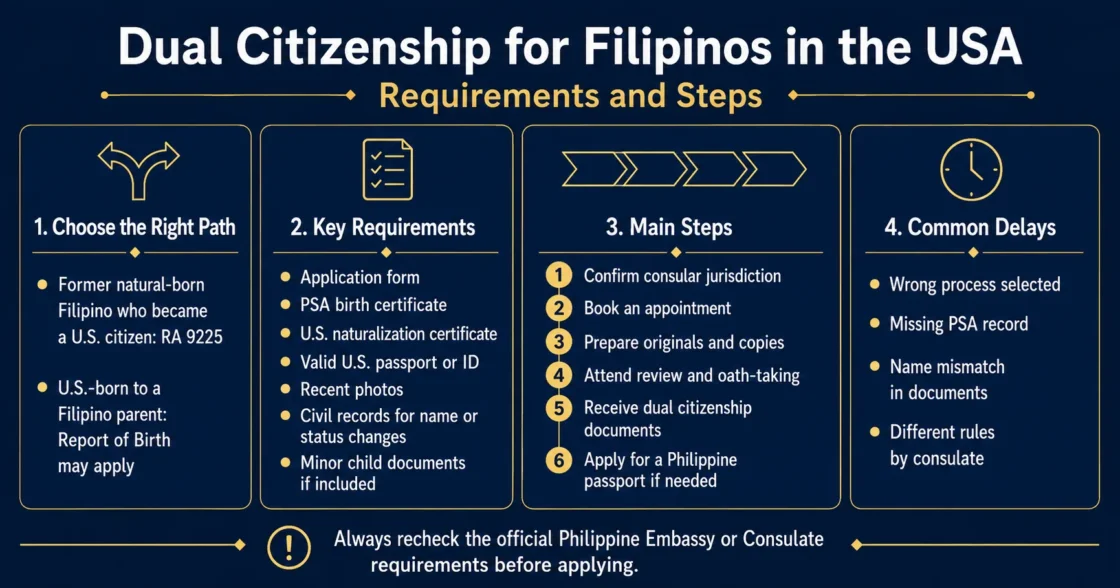
Dual citizenship for Filipinos in the USA usually means one of two different situations: a former natural-born Filipino reacquires Philippine citizenship under Republic Act No. 9225, or a person born in the United States to at least one Filipino parent is already Filipino by birth and needs birth reporting instead of RA 9225 processing. The right path depends on how Philippine citizenship was lost, kept, or acquired.
Why this matters →
Choosing the correct route helps Filipino Americans avoid rejected appointments, missing documents, and delays before travel, passport renewal, property matters, or family registration in the Philippines.
Required Documents: Most RA 9225 applicants in the United States should prepare a completed dual citizenship application form, PSA-issued Philippine birth certificate, latest Philippine passport if available, U.S. naturalization certificate or proof of foreign citizenship, valid U.S. passport or other accepted government ID, recent passport-size photos, appointment confirmation, and applicable civil documents for marriage, divorce, death of spouse, name variance, or dependent children.
Who Can Apply Under RA 9225
This section separates former Filipino citizens who need reacquisition from people who may already be Filipino by birth.
Republic Act No. 9225, also called the Citizenship Retention and Re-acquisition Act of 2003, applies to natural-born Filipinos who became citizens of another country through naturalization and want to retain or reacquire Philippine citizenship by taking an oath of allegiance.[a]
A person is generally treated as a natural-born Filipino if Philippine citizenship was acquired at birth without needing a later act to perfect it. For many applicants, this means being born in the Philippines to Filipino parents, then later becoming a naturalized U.S. citizen.
RA 9225 is not the correct process for every Filipino American. A person born in the United States on or after January 17, 1973 may already be a Filipino citizen if at least one parent was a Filipino citizen at the time of birth. In that case, the usual path is to file a Report of Birth with the Philippine Embassy or Consulate that has jurisdiction over the place of birth, not to apply for reacquisition under RA 9225.[b]
Important Warning: A former Filipino who became a U.S. citizen by naturalization is generally considered to have lost Philippine citizenship unless Philippine citizenship is retained or reacquired under RA 9225. An old Philippine passport should not be treated as valid proof of current Philippine citizenship after U.S. naturalization unless the person has already completed the proper reacquisition process.
Who Usually Does Not Qualify
Not every family member or Filipino-connected person can use this process.
- Foreign spouses do not become Philippine citizens through a Filipino spouse’s RA 9225 approval.
- People who were never natural-born Filipinos cannot use RA 9225 to become Filipino citizens.
- U.S.-born children who were already Filipino at birth usually need Report of Birth processing instead.
- Children who are already 18 or older cannot usually be added as derivative minor dependents in a parent’s RA 9225 petition.
- Cases involving prior voluntary renunciation of Philippine citizenship may not be covered by RA 9225 and should be checked directly with the proper Philippine office.
Documents To Prepare Before The Appointment
Consulates may ask for different copy counts, but the core evidence is similar across U.S. posts.
| Document | Why It Is Needed | Common Notes |
|---|---|---|
| Dual citizenship application form | Starts the petition for retention or reacquisition. | Use the form from the Embassy or Consulate where the appointment will be held. |
| PSA-issued birth certificate | Shows natural-born Philippine citizenship. | A Local Civil Registry copy may not be enough if the post specifically requires PSA security paper. |
| Latest Philippine passport | Supports identity and past Philippine citizenship. | If lost, some posts may require an affidavit of loss or other supporting proof. |
| U.S. naturalization certificate or proof of U.S. citizenship | Shows how Philippine citizenship was lost through foreign naturalization. | Applicants who derived U.S. citizenship through a parent may be asked for additional explanation or parent documents. |
| Valid U.S. passport or accepted government ID | Confirms current identity and foreign nationality. | Bring the original and photocopies required by the local post. |
| Recent passport-size photos | Used for consular records and issued documents. | Many posts require white background and recent identical photos. |
| Marriage, divorce, annulment, court name change, or death certificate | Explains civil status or name differences. | Married women and applicants with name variance should check the exact post rules before booking. |
| Dependent child documents | Needed if unmarried children below 18 will be included. | Birth certificate, passport, photos, and proof of the child’s citizenship status may be required. |
Tip: Check the document list on the specific Philippine Embassy or Consulate website before printing forms, because copy counts, payment methods, photo rules, and appointment systems can differ by location.
Step 1: Confirm The Correct Philippine Office
Applicants in the United States must use the Embassy or Consulate that covers their state or place of birth record.
Philippine consular services in the United States are handled by the Embassy in Washington, D.C. and Philippine Consulates with their own jurisdiction areas. The correct office may depend on the applicant’s U.S. residence, the place where a child was born, or where a marriage took place if civil registration is also needed.
Before booking, the applicant should confirm three items: the correct jurisdiction, whether an appointment is required, and whether the post accepts same-day processing or requires documents in advance for outreach missions.
Step 2: Decide Between RA 9225 And Report Of Birth
This is the most common point of confusion for Filipino families in the United States.
Use RA 9225 when the applicant was a natural-born Filipino and later became a naturalized U.S. citizen. Use Report of Birth when the person was born in the United States while at least one parent was still a Filipino citizen and the birth was never reported to Philippine authorities.
Procedure Note: A U.S.-born adult may believe dual citizenship requires an oath, but if that person was Filipino at birth through a Filipino parent, the issue may be recognition and civil registration rather than reacquisition. The Embassy or Consulate can confirm which path applies based on the parent’s citizenship status at the time of birth.
Step 3: Book The Appointment And Review Fees
Most applicants need an appointment before appearing for document review and oath-taking.
The Philippine Embassy in Washington, D.C. states that appointments are required and that, when documentary requirements are in order, the process may be completed on the same day at the Embassy. Outreach missions may follow different document submission instructions.[c]
Fees are posted by each office and can change. The Embassy in Washington, D.C. lists a dual citizenship fee for the principal applicant and a lower fee per derivative dependent, but applicants should verify the current amount and accepted payment method with the office handling the appointment.[d]
Step 4: Prepare The Application Packet
A clean packet reduces delays at the window.
- Download the latest form from the exact Embassy or Consulate where the appointment is scheduled.
- Fill out the form carefully using names exactly as shown in official documents.
- Prepare originals and photocopies in the quantity required by that post.
- Place civil status and name-change documents behind the identity documents they explain.
- Bring photos that match the post’s size, background, and recency rules.
- Keep payment ready in the method accepted by that office.
Some posts instruct applicants not to sign the application before the appointment because it must be signed before a consular officer. If the local instruction says this, leave the signature section blank until directed.
Step 5: Attend The Interview And Oath-Taking
The appointment usually includes document review, identity checks, payment, and the oath.
At the appointment, the applicant normally appears in person, submits the application and supporting documents, answers consular questions, pays the fee, and takes the Oath of Allegiance before a Philippine consular officer. After approval and oath-taking, the applicant receives proof of retention or reacquisition, such as an Identification Certificate, oath document, and approval record depending on the post’s issuance format.
Unmarried children below 18 may be included under derivative citizenship if they meet the requirements and the needed documents and fees are submitted. Their personal appearance may not be required at some posts, but the parent should follow the local instruction list.
Step 6: Use The New Dual Citizenship Documents Correctly
The papers issued after oath-taking are important identity and travel records.
After reacquiring Philippine citizenship, applying for a Philippine passport is often optional, but many dual citizens apply for one for easier travel and future Philippine transactions. Some consular pages state that a dual citizen may travel to the Philippines using a U.S. passport while presenting dual citizenship documents as proof of Philippine citizenship to Philippine immigration, but a separate passport application is needed if the person wants a new Philippine passport.[e]
For travel involving the United States, U.S. citizens must use a U.S. passport to enter and leave the United States. The U.S. Department of State also notes that dual nationals may have rights and obligations in both countries, including tax and legal responsibilities.[f]
Important Warning: Dual citizenship documents should be stored safely. Replacing them can require a certified true copy request or other consular process, and the documents may be needed for passport applications, property matters, voting registration, or Philippine immigration inspection.
Common Issues That Delay Applications
Most delays come from missing civil records, name differences, or using the wrong process.
- Name differences: Marriage, divorce, court name change, middle-name differences, and spelling issues may require supporting documents or an affidavit.
- No PSA birth certificate: Applicants may need to request a PSA copy or resolve late registration issues before filing.
- Lost Philippine passport: Some posts may ask for an affidavit of loss, police report, or other proof.
- Unreported U.S. birth: A U.S.-born child of a Filipino parent may need Report of Birth rather than derivative RA 9225 inclusion.
- Adult children: Children who are 18 or older generally cannot be added as minor dependents and may need their own route.
- Wrong consular office: Civil registration and some consular services must be filed with the office that has jurisdiction over the place of the event.
After Approval: Practical Next Steps
Dual citizenship often connects to passport, voting, civil registration, and family planning tasks.
After receiving dual citizenship papers, the person may consider applying for a Philippine passport, reporting a marriage, reporting a child’s birth, registering for overseas voting when registration is open, and keeping certified copies of all issued documents. These steps are separate from RA 9225 approval and may have their own appointments, forms, and fees.
Former Filipinos who choose not to reacquire Philippine citizenship may still have other travel options, such as the Balikbayan privilege if eligible, but that is not the same as being a Philippine citizen. Reacquisition under RA 9225 restores Philippine citizenship rights and responsibilities subject to Philippine law.
Questions Applicants Often Ask
These answers cover the practical questions that come up before booking an appointment.
Does Philippine Dual Citizenship Cancel U.S. Citizenship?
U.S. guidance recognizes that a person may be a national of more than one country. U.S. citizens should still follow U.S. passport rules, tax rules, and any employment-related requirements that apply to their situation.
Can A Foreign Spouse Be Included?
No. A foreign spouse does not become a Philippine citizen through the Filipino spouse’s RA 9225 approval. Separate Philippine immigration options may apply to a foreign spouse, depending on the family’s plans.
Can Minor Children Be Included?
Unmarried children below 18 may be included as derivative dependents if the parent reacquires Philippine citizenship and the children meet the document and fee requirements. If the child was already Filipino at birth, Report of Birth may be the better route.
Is A Philippine Passport Required After RA 9225 Approval?
A Philippine passport is commonly useful but not always mandatory for travel to the Philippines if the traveler can present accepted proof of Philippine citizenship. A new passport application is a separate consular service.
Should The Application Form Be Signed Before The Appointment?
Follow the instruction of the specific Embassy or Consulate. Some offices instruct applicants not to sign until appearing before the consular officer.
Before Booking, Recheck The Official Page
Citizenship and consular procedures can change without much public notice.
Before attending an appointment, applicants should recheck the official page of the Philippine Embassy or Consulate handling the case, especially for appointment rules, forms, fees, copy counts, photos, accepted payment methods, and civil document rules. Information on citizenship, immigration, passports, and consular services can change, and the local post’s current instructions should control the final application packet.
Sources
- Republic Act No. 9225 text — Used for the legal basis of citizenship retention and reacquisition under RA 9225. This is a legal text archive widely used for Philippine statutes.
- Philippine Embassy in Washington, D.C. dual citizenship application page — Used for eligibility, dual citizen by birth guidance, appointment flow, and Report of Birth distinction. This is an official Philippine Embassy source.
- Philippine Embassy in Washington, D.C. frequently asked questions — Used for same-day processing guidance when documents are in order and related RA 9225 questions. This is an official Philippine Embassy source.
- Philippine Embassy in Washington, D.C. schedule of fees — Used for posted dual citizenship fee categories. This is an official fee page of the Philippine Embassy.
- Philippine Consulate General in New York dual citizenship page — Used for document examples, dependent child notes, oath process, and post-approval passport/travel guidance. This is an official Philippine Consulate source.
- U.S. Department of State dual nationality guidance — Used for U.S. passport and dual nationality obligations. This is an official U.S. government source.