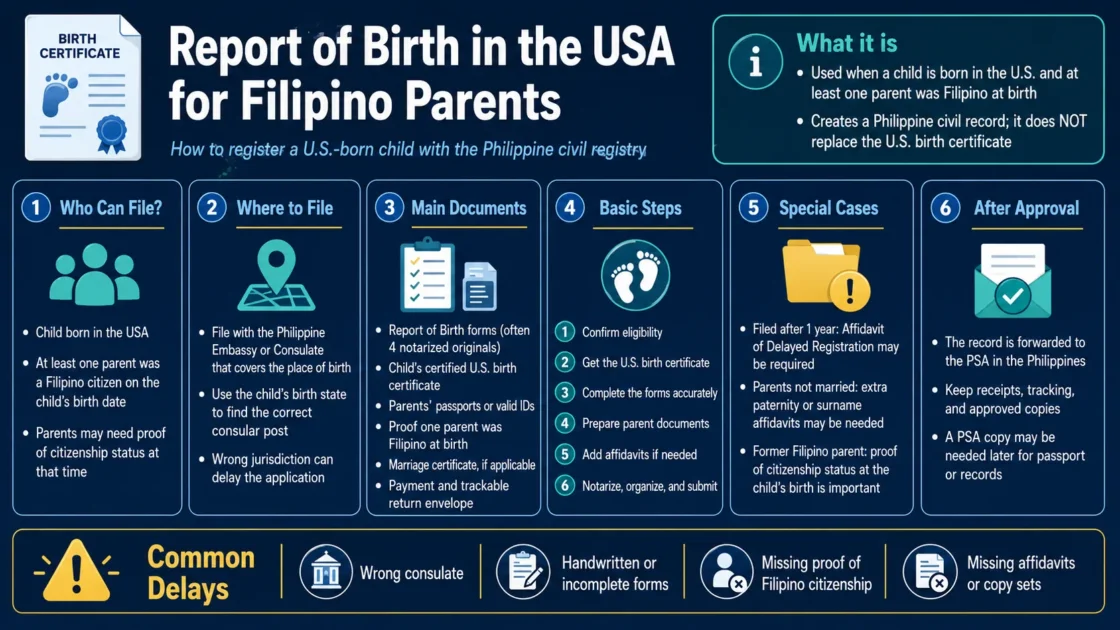
A Report of Birth is the Philippine civil registry process used when a child is born in the United States and at least one parent was a Filipino citizen at the time of the child’s birth. It allows the birth to be recorded with the Philippine Statistics Authority through the proper Philippine Embassy or Consulate, which is often needed later for a Philippine passport, school records, identity documents, or future civil registry transactions.
Why this matters →
For Filipino families in the United States, reporting a child’s birth helps preserve the child’s Philippine civil record and citizenship documentation from the start.
Required Documents: Most Report of Birth applications require the following documents, but the exact copy count, payment method, and submission procedure must be checked with the Philippine Embassy or Consulate that has jurisdiction over the birth location.
- Completed Report of Birth forms, usually four originals, signed and notarized.
- U.S. birth certificate of the child, usually an original or certified copy plus photocopies.
- Passport data pages or valid IDs of both parents.
- Proof that at least one parent was a Filipino citizen when the child was born.
- Marriage certificate of the parents, if applicable.
- Additional affidavits if the parents were not married, married after the birth, or are reporting the birth more than one year later.
- Return envelope with tracking, if the post processes the application by mail.
- Money order, cashier’s check, or another payment format accepted by the specific post.
Who Can File a Report of Birth
This section explains when a U.S.-born child may be reported to the Philippine civil registry system.
For children born in the United States today, the usual basis is that the child had at least one Filipino parent at the time of birth. Philippine citizenship follows parentage, not only place of birth; the 1987 Philippine Constitution recognizes as citizens those whose fathers or mothers are citizens of the Philippines.[a]
The Report of Birth does not replace the child’s U.S. birth certificate. The U.S. birth certificate is issued by the state or local vital records office where the child was born, while the Report of Birth is the Philippine record of the same birth.
Procedure Note: A child born in the United States may already have U.S. citizenship under U.S. law. The Report of Birth is a Philippine civil registry process and should not be confused with a U.S. Consular Report of Birth Abroad, which is generally used for children born outside the United States to a U.S. citizen parent.[f]
When One Parent Was a Former Filipino
If the Filipino parent had already become a U.S. citizen before the child was born, the timing of naturalization matters. The consulate may ask for proof of the parent’s citizenship status at the time of the child’s birth, such as Philippine citizenship documents, dual citizenship documents, or naturalization records. If the parent reacquired Philippine citizenship under dual citizenship rules, the child’s situation should be checked with the post before documents are notarized.
Where to File the Report of Birth
The correct office depends on consular jurisdiction, not personal preference.
The Report of Birth should be filed with the Philippine Embassy or Consulate that has jurisdiction over the place where the birth occurred. The Philippine Embassy’s Consulate Finder lists U.S. consular jurisdictions by state and territory, including the Embassy in Washington, D.C. and Consulates General in locations such as New York, Chicago, Houston, Los Angeles, San Francisco, Honolulu, Agana, and Seattle.[c]
Tip: The state printed on the child’s U.S. birth certificate is usually the starting point for finding the correct Philippine consular post.
Warning: Filing with the wrong consular post can delay the application or cause the package to be returned. Before mailing documents, confirm whether the post accepts applications by mail, email pre-assessment, appointment, or a combined procedure.
Step 1: Confirm the Child’s Eligibility
The first step is to confirm that the child had a Filipino parent at the time of birth.
Parents should review the child’s U.S. birth certificate and the citizenship status of each parent on the child’s date of birth. The consular post may look for proof that one parent was still a Filipino citizen when the child was born, or proof that Philippine citizenship had been retained or reacquired before the child’s birth.
Common proof may include a valid Philippine passport, Philippine birth certificate, green card, valid visa, work permit, dual citizenship Identification Certificate, Oath of Allegiance, Order of Approval, or naturalization documents, depending on the parent’s situation and the post’s checklist.
Step 2: Get the Child’s U.S. Birth Certificate
The U.S. birth certificate is the base record used to prepare the Philippine report.
The child’s birth certificate should be obtained from the state or local vital records office where the birth occurred. Consulates commonly require an original, certified true copy, or notarized copy, plus several photocopies. The certificate should show the child’s full name, date and place of birth, and the parents’ names clearly.
Document Note: If there is a spelling difference, missing middle name, wrong parent name, or mismatch between passports and the U.S. birth certificate, correction may be needed before filing. Name discrepancies are easier to handle before notarized forms and photocopy sets are prepared.
Step 3: Complete the Report of Birth Forms
The form should match official records and the post’s formatting instructions.
Many Philippine posts require four original Report of Birth forms, printed or typewritten, with original signatures and notarization. The Philippine Embassy in Washington, D.C. states that handwritten Report of Birth forms are not accepted for its mail-in process and that complete, accurate applications are processed and dispatched within its stated processing window after receipt.[b]
Parents should copy names exactly from official documents unless the consulate instructs otherwise. The child’s name order, mother’s maiden surname, father’s surname, and middle name treatment can affect future Philippine passport and PSA records.
Tip: Some posts allow or encourage draft forms to be checked before notarization. This can prevent paying for notarization twice when a name, date format, or citizenship detail needs correction.
Step 4: Prepare Parent Documents
Parent documents show identity, marital status, and the citizenship basis for reporting the birth.
Both parents’ passport data pages are commonly requested, even when only one parent is Filipino. If a parent does not have a passport, the consulate may accept another valid government-issued ID, but this should be confirmed before filing.
If the parents were married when the child was born, a marriage certificate is usually required. If the marriage took place in the Philippines, the post may ask for a PSA-issued marriage certificate. If the marriage took place outside the Philippines and has not yet been reported, the post may require or allow a Report of Marriage to be filed with the Report of Birth.
| Parent Situation | Common Extra Document | Why It Matters |
|---|---|---|
| Parents married before the child was born | Marriage certificate or PSA marriage record | Shows the civil status of the parents at the time of birth. |
| Parents married after the child was born | Joint Affidavit of Legitimation and related civil registry documents | May affect how the child’s status and surname are recorded. |
| Parents not married and father’s surname is used | Affidavit of Admission of Paternity and Affidavit to Use the Surname of the Father | Supports the child’s use of the father’s surname in Philippine records. |
| Report filed more than one year after birth | Affidavit of Delayed Registration | Explains why the birth was not reported earlier. |
Step 5: Handle Late Reporting or Special Circumstances
Late reports and surname issues should be handled before the application package is mailed.
If the birth is reported more than one year after the child was born, consulates commonly require an Affidavit of Delayed Registration. The Philippine Consulate General in New York states that an affidavit is required when the application is filed more than one year after birth, and it also notes that applications are filed by email first for its process.[d]
IMPORTANT WARNING: A delayed Report of Birth may still be accepted, but it can require extra affidavits, extra copies, and closer review. Delays may also affect the timing of a child’s Philippine passport application or future PSA copy request.
When the parents were not married at the time of the child’s birth, the use of the father’s surname should be reviewed carefully. Some posts require notarized and apostilled affidavits for acknowledgment of paternity or for the child’s use of the father’s surname. Requirements can change based on the child’s age and whether the child can sign personally.
Step 6: Notarize, Copy, and Organize the Package
The application is easier to review when originals and copies are arranged in the same order as the post’s checklist.
Notarization should usually happen only after the forms are complete and checked against the official checklist. Parents should use the exact number of originals and photocopies required by the post. If the post asks for four sets, each set should be complete and readable.
- Use clear photocopies of passports, IDs, certificates, and citizenship documents.
- Do not staple original civil registry documents unless the post instructs it.
- Keep a scanned copy of the full package before mailing.
- Use a tracked envelope for both mailing and return delivery when filing by mail.
- Write contact information clearly in the cover letter.
Step 7: Submit the Application
Submission rules differ by post, so the final checklist should come from the correct office.
Some Philippine posts process civil registry reports by mail, while others require email pre-assessment before the physical package is sent. A package that is complete for one consulate may still be incomplete for another because copy counts, notarization wording, payment format, and return envelope rules can differ.
Procedure Note: The cover letter should identify the requested service as “Report of Birth,” list the enclosed documents, and include a mobile number, email address, and return mailing details.
Processing time should be read as the post’s internal processing estimate after a complete package is received, not a guarantee of total delivery time. Mailing delays, incomplete documents, name discrepancies, and requests for extra affidavits can extend the total timeline.
After Approval: PSA Copy, Passport, and Records
Approval by the consular post is not always the final document needed for future Philippine transactions.
After a Report of Birth is approved, the post forwards the record to Manila so it can become part of the PSA civil registry system. The Philippine Embassy advises requesting transmittal details from the DFA Consular Records Division and then obtaining an authenticated PSA copy after six months from the date of approval.[e]
The consular Report of Birth may sometimes be used for a child’s Philippine passport application if it is recent and issued by the same post, but many later transactions require a PSA-issued copy. Parents should keep all receipts, tracking records, approved report copies, and transmittal details.
The PSA provides channels for requesting civil registry documents, including birth certificates, for delivery in the Philippines or abroad.[g]
Common Mistakes That Delay a Report of Birth
Most delays come from mismatched names, wrong jurisdiction, incomplete copy sets, or missing affidavits.
- Sending the application to the wrong Philippine Embassy or Consulate.
- Using handwritten forms when the post requires printed or typewritten forms.
- Not notarizing each required original form.
- Submitting a hospital souvenir birth record instead of an official state or county birth certificate.
- Leaving out proof that the Filipino parent was still Filipino when the child was born.
- Forgetting the Affidavit of Delayed Registration when filing more than one year after the birth.
- Using the father’s surname without the required paternity or surname affidavit when parents were not married.
- Paying by a method not accepted by the specific post.
- Not including a trackable return envelope.
Tip: Before mailing, compare the child’s name, parents’ names, birth date, birth place, and citizenship details across every form and supporting document.
When to Contact the Consulate Before Filing
Some cases need confirmation before forms are signed or notarized.
Parents should contact the correct post before filing if the child is already an adult, the birth was many years ago, the Filipino parent naturalized before the birth, the parents were not married, the child’s name differs across documents, the U.S. birth certificate was amended, or the child was included in a parent’s dual citizenship petition.
For cases involving older births, former Filipino parents, adoption, disputed parentage, or court-corrected civil records, the consulate may require additional documents or may refer the applicant to a separate civil registry or citizenship recognition process.
IMPORTANT WARNING: Consular rules, fees, accepted payment formats, affidavit wording, and mailing procedures can change. Before sending original documents, verify the current checklist on the official page of the Philippine Embassy or Consulate with jurisdiction over the child’s place of birth.
Sources
[a] Supreme Court E-Library, “Article IV — Citizenship” — explains the Philippine constitutional citizenship rule based on Filipino parentage. This is reliable because it is an official Philippine judiciary legal repository.
[b] Embassy of the Republic of the Philippines in Washington, D.C., “Report of Birth: Application by Mail” — outlines mail-in requirements, copy counts, processing notes, delayed registration, fees, and next steps. This is reliable because it is an official Philippine Embassy consular service page.
[c] Embassy of the Republic of the Philippines in Washington, D.C., “Consulate Finder” — lists Philippine consular jurisdictions in the United States. This is reliable because it is an official Embassy directory for consular coverage.
[d] Philippine Consulate General in New York, “Report of Birth of a Filipino Abroad” — explains jurisdiction, email-first filing, notarized form requirements, and delayed registration documents. This is reliable because it is an official Philippine Consulate General page.
[e] Embassy of the Republic of the Philippines in Washington, D.C., “Philippine Statistics Authority (PSA) Certificates” — explains transmittal details and requesting an authenticated PSA copy after an approved civil registry report. This is reliable because it is an official Embassy civil registry information page.
[f] U.S. Department of State, “Birth of U.S. Citizens and Non-Citizen Nationals Abroad” — explains that a U.S. Consular Report of Birth Abroad is for children born abroad who acquired U.S. citizenship at birth. This is reliable because it is an official U.S. government passport and consular information source.
[g] Philippine Statistics Authority, “Birth Certificate” — provides official information about requesting civil registry documents. This is reliable because it is the official website of the Philippine Statistics Authority.