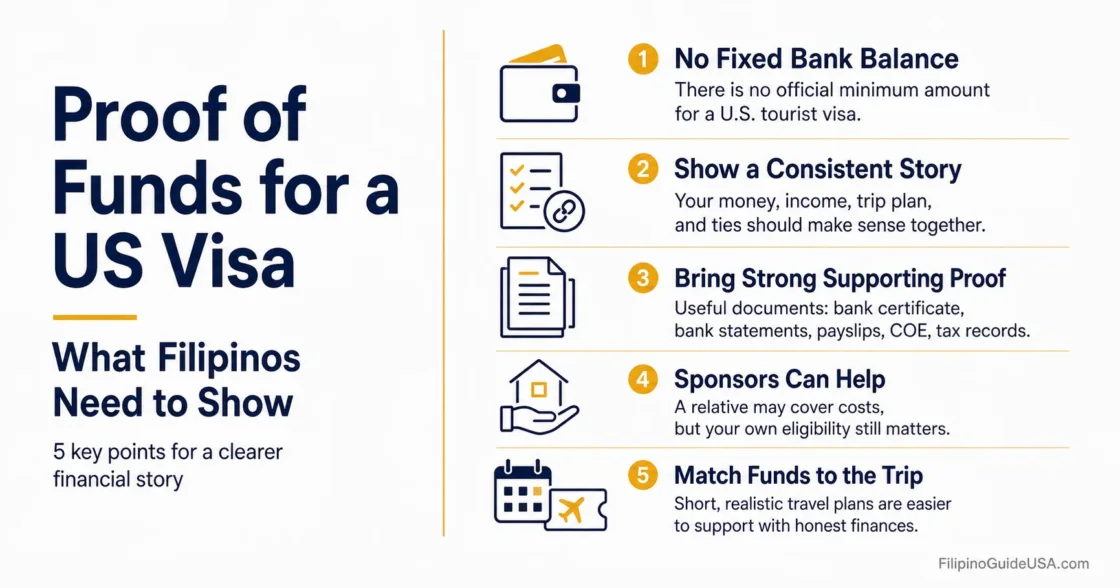
Proof of funds for a U.S. visa is not about showing a magic bank balance. For most Filipino applicants, the real question is whether your money, income, trip plan, and personal situation make sense together. A bank statement can help, but it does not approve a visa by itself. A consular officer may look at your travel purpose, your plan to leave the United States after the trip, and your ability to pay for the trip without working in the U.S.[a]
What Proof of Funds Means for a U.S. Visa
Proof of funds means evidence that you can pay for your stay in the United States. For a visitor visa, this may include your own savings, regular income, business income, or support from another person who will pay part of the trip.
For Filipinos applying from the Philippines, this usually matters most for B-1/B-2 visitor visa applications, but money can also matter in student, exchange, fiancé(e), immigrant, and certain temporary work cases. The right financial proof depends on the visa category.
The most useful way to think about it is simple: your documents should explain how you will pay for the trip and why your travel plan fits your real life in the Philippines.
There Is No Fixed Bank Balance for a U.S. Tourist Visa
The U.S. Department of State does not publish a fixed peso or dollar amount that Filipino B-1/B-2 applicants must show. Be careful with advice that says every applicant needs a specific amount, such as ₱100,000, ₱300,000, ₱500,000, or more. Those numbers may appear in online discussions, but they are not official requirements.
A short trip with paid leave, a modest itinerary, and clear employment may require a different financial picture from a long trip with multiple cities, expensive hotels, and no clear income source. The officer is not just looking at the balance. The officer is looking at whether the full story is believable.
For example, a bank account with a high balance may still look weak if the money appeared suddenly with no clear source. On the other hand, a smaller but steady balance may look more natural if it matches your salary, business income, trip length, and travel plans.
Documents Filipinos Can Prepare as Proof of Funds
For a visitor visa, these documents are usually treated as supporting evidence. You may not be asked to show all of them during the interview. Still, preparing clean and honest documents helps you answer confidently if the officer asks how you will pay for the trip.
| Document | What It Shows | Best For |
|---|---|---|
| Bank Certificate | Current account balance, account holder name, and bank details | Showing available funds at the time of application |
| Bank Statements | Account movement over time, deposits, withdrawals, and balance pattern | Showing that funds are stable and not newly staged |
| Certificate of Employment | Position, salary, employment date, and sometimes approved leave | Employed applicants with regular income |
| Payslips | Recent salary payments and income consistency | Employees who want to connect bank deposits to salary |
| BIR Form 2316 or Income Tax Return | Reported income and tax record | Employees, professionals, and business owners |
| Business Registration and Permits | Business ownership and operating history | Self-employed applicants and business owners |
| Sponsor Letter and Sponsor Financial Proof | Who will pay, what they will cover, and whether they can afford it | Applicants whose trip is partly or fully sponsored |
A bank certificate alone is not always enough because it usually shows only a snapshot. Bank statements can give better context because they show how the money moves. If your salary, remittances, business deposits, or savings pattern can be seen clearly, your financial story becomes easier to understand.
What the Officer May Be Trying to Understand
During a visitor visa interview, financial documents are only one part of the decision. U.S. visa officers review each case individually and may consider travel plans, financial resources, and ties outside the United States when deciding whether an applicant qualifies for a temporary visa.[b]
Your answers and documents should make these points clear:
- You know the purpose of your trip.
- You can pay for the travel costs without unauthorized work in the United States.
- Your trip length is reasonable for your job, business, studies, or family situation.
- You have reasons to return to the Philippines after the visit.
- Your financial documents match what you wrote in your DS-160.
This is why proof of funds should not be prepared separately from the rest of the application. A 10-day vacation, a family visit, a conference trip, and a medical-related visit each require a different money story.
How Much Money Should You Show?
Since there is no official minimum balance, start with your real trip cost. Estimate airfare, accommodation, food, local transportation, travel insurance if you plan to get it, event costs if any, and extra funds for normal travel needs.
Then compare that estimated cost with your income and savings. If your planned trip costs more than what your financial situation reasonably supports, the issue is not only the bank balance. The issue is that the trip may look out of proportion to your current situation.
A practical estimate should answer these questions:
- How many days will you stay?
- Where will you sleep?
- Who will pay for the airfare?
- Who will pay for food and local transport?
- Will you stay with relatives or pay for hotels?
- Will your employer approve the leave period?
- Will you still have enough money after the trip?
If your U.S. relative will provide housing, your personal travel cost may be lower. If you will pay for hotels in several cities, your expected funds should reflect that. The amount should match the plan.
Bank Certificate vs. Bank Statement
A bank certificate usually confirms that an account exists and shows the balance as of a certain date. Some banks may include account opening date or average daily balance, depending on the bank’s format.
A bank statement shows activity over a period of time. This can be more useful when you need to show that the money came from regular salary, business revenue, savings, or family support. For many applicants, both documents can work together: the certificate gives the summary, and the statement gives the history.
If your account has a large recent deposit, be ready to explain it honestly. It may be from a bonus, sale of property, business income, savings transfer, OFW remittance, or family support. Keep proof of the source if the amount is large compared with your usual account movement.
If Someone Else Will Pay for the Trip
A sponsor can help explain how the trip will be paid for, but a sponsor does not replace the need to qualify for the visa. For B-1/B-2 visitor visas, the State Department explains that applicants must qualify based on their own ties abroad, not only on assurances from U.S. family or friends. It also states that an invitation letter or Affidavit of Support is not required for a visitor visa and is not one of the factors used to decide issuance or denial.[c]
This does not mean a sponsor letter is useless. It means the letter should support a clear travel plan, not try to carry the whole application. If your sibling in California will host you, for example, the letter can explain where you will stay and what costs they will cover. Your own situation in the Philippines still matters.
If using a sponsor, prepare documents that make the arrangement easy to understand:
- A signed letter from the sponsor explaining the relationship and what expenses they will cover.
- Proof of the sponsor’s U.S. status, if relevant to the relationship and visit.
- Proof of the sponsor’s address if they will provide accommodation.
- Sponsor income or bank evidence, if they will pay major costs.
- Your own financial documents, even if the sponsor will help.
A sponsored trip is usually clearer when the relationship is real, the visit reason is simple, and the sponsor’s support matches their financial capacity.
For Employed Applicants in the Philippines
If you are employed, your documents should connect your income, leave approval, and return plan. A clean set may include a Certificate of Employment, recent payslips, bank statements showing salary deposits, and proof of approved leave if available.
The Certificate of Employment is more helpful when it includes your position, start date, compensation, and leave details. If the trip is for a conference, training, or business meeting, the document should match the business purpose you gave in the DS-160.
Try to avoid overloading your folder with unrelated papers. Bring documents that can answer a real question. If the officer asks who will pay for your trip, your salary record and bank statements should answer that directly.
For Self-Employed Applicants and Business Owners
Self-employed applicants often need to show both income and business activity. A bank balance may not explain enough if your income comes from sales, clients, commissions, online work, freelancing, or a family business.
Useful documents may include business registration, permits, invoices, contracts, tax records, business bank statements, or proof of ongoing clients. The goal is to show that the business is real, active, and tied to your return to the Philippines.
If business income changes month to month, that is normal. What matters is that the documents match your real work. Do not create a cleaner story than the truth. A simple but consistent file is better than a polished file with weak explanations.
For Students Applying for a U.S. Student Visa
Student visa financial proof is different from tourist visa proof. For F or M visas, the school and Form I-20 are central to the process. The State Department explains that after acceptance at a SEVP-approved school, the student is registered in SEVIS, pays the SEVIS I-901 fee, receives Form I-20, and presents the Form I-20 at the visa interview.[d]
For Filipino students, proof of funds usually needs to match the school’s listed cost of attendance. This may include tuition, living expenses, fees, and other school-estimated costs shown on the I-20. Funds may come from parents, relatives, scholarships, personal savings, approved loans, or a mix of sources.
Student applicants should organize financial proof by source. If parents will pay, include parent income and bank records. If there is a scholarship, include the official award letter. If the student has personal savings, include bank documents under the student’s name.
For Immigrant Visa and Family-Based Cases
Immigrant visa financial proof is usually more formal than visitor visa proof. In many family-based immigrant visa cases, the financial sponsor must submit an Affidavit of Support and financial evidence. The State Department notes that each financial sponsor, including petitioners, joint sponsors, and household members when used, must submit the required Affidavit of Support and financial evidence, and missing items can delay the case.[e]
This is a different process from bringing bank statements to a B-1/B-2 interview. Immigrant visa cases may involve NVC document review, sponsor tax evidence, household size, income rules, and sometimes a joint sponsor. If your case is immigrant or fiancé(e)-related, do not rely only on tourist visa advice.
Common Proof of Funds Mistakes
Many Filipino applicants become too focused on the bank balance and miss the parts that actually make the file easier to understand. These are common mistakes to avoid:
- Borrowing money shortly before the interview just to raise the balance.
- Preparing a trip that is too expensive for your normal income.
- Listing a sponsor in the DS-160 but bringing no clear sponsor explanation.
- Using documents that do not match your answers.
- Showing business income without proof that the business is active.
- Bringing property documents but no clear proof of travel funds.
- Submitting or presenting altered, false, or misleading documents.
False documents can cause serious visa problems. If a document is not available, it is safer to leave it out than to replace it with something inaccurate.
How to Organize Your Financial Documents
Your interview may be short, and the officer may not ask for every document. Organize your file so you can find the right paper quickly if asked.
A simple order works well:
- Passport and appointment-related documents.
- DS-160 confirmation page.
- Employment or business documents.
- Bank certificate and bank statements.
- Tax or income documents.
- Trip plan or invitation, if relevant.
- Sponsor documents, if someone else will pay.
- Other documents that directly support your situation.
The DS-160 confirmation page is part of the application process, and applicants are instructed to print and keep the barcode page after submitting the online form.[f] Make sure the information in your DS-160, interview answers, and financial documents all tell the same story.
What If Your Funds Are Limited?
Limited funds do not automatically mean a refusal, but your trip must be realistic. A short visit with family accommodation may be easier to explain than a long vacation with high daily costs. Adjust the trip to match what you can honestly afford.
If you recently started working, changed jobs, opened a business, or received family support, keep the explanation simple. The officer does not need a long speech. Clear answers usually work better than overexplaining.
If your current financial situation does not support the trip, it may be better to wait until your income, savings, employment record, or business records are more settled. Reapplying after a refusal usually requires a new application and fee, and for a 214(b) refusal, the State Department says applicants should be able to present evidence of changes in circumstances since the last application.[g]
Answers to Common Questions
Is a Bank Statement Required for a U.S. Tourist Visa?
It is not listed as a basic required document for every B-1/B-2 applicant, but it can be useful supporting evidence if the officer asks about your ability to pay. Bring it if it helps explain your trip funding.
Is a Bank Certificate Enough?
Sometimes it helps, but it may not show where the money came from. A bank statement can support the certificate by showing account history and regular movement.
Can My U.S. Relative Sponsor My Trip?
Yes, a relative may help pay for the trip or host you, but you still need to qualify for the visa based on your full situation. A sponsor letter is not a substitute for your own eligibility.
Should I Deposit a Large Amount Before the Interview?
Only deposit money that is truly yours or that has a clear source. A sudden unexplained deposit can raise questions. If the money came from a real source, keep proof of that source.
Do Property Titles Count as Proof of Funds?
Property can help show personal or family ties, but it is not the same as money available for travel. For trip expenses, liquid funds and income records are usually easier to understand.
Before You Apply
Check the latest instructions from the U.S. Embassy or Consulate where you will apply before preparing your final document set. Visa steps, fees, appointment rules, and document handling can change. Use official sources first, and make sure every document you bring is truthful, current, and consistent with your DS-160.
Sources
- [a] U.S. Department of State — Visitor Visa — Explains B-1/B-2 supporting evidence, including trip purpose, intent to depart, and ability to pay trip costs. This is a primary U.S. government visa source. ↩
- [b] U.S. Department of State — Visa Denials — Explains how officers review nonimmigrant visa cases, including circumstances, travel plans, financial resources, and ties outside the United States. This is a primary U.S. government source on visa eligibility and refusals. ↩
- [c] U.S. Department of State — Visitor Visa, Additional Documentation — Clarifies that invitation letters or Affidavits of Support are not required for visitor visa applications and do not replace the applicant’s own eligibility. This is the official visitor visa guidance page. ↩
- [d] U.S. Department of State — Student Visa — Explains the F and M visa process, SEVIS registration, and Form I-20 presentation at the visa interview. This is an official U.S. government visa category page. ↩
- [e] U.S. Department of State — Financial Documents — Covers financial evidence for immigrant visa Affidavit of Support processing. This is an official State Department immigrant visa process page. ↩
- [f] U.S. Department of State — DS-160 Online Nonimmigrant Visa Application — Explains DS-160 confirmation page handling, interview scheduling, and country-specific instructions. This is the official DS-160 information page. ↩
- [g] U.S. Department of State — Visa Denials, Reapplication — Explains reapplying after refusal and the need to show changed circumstances after a 214(b) refusal. This is an official U.S. government source on visa refusal rules. ↩