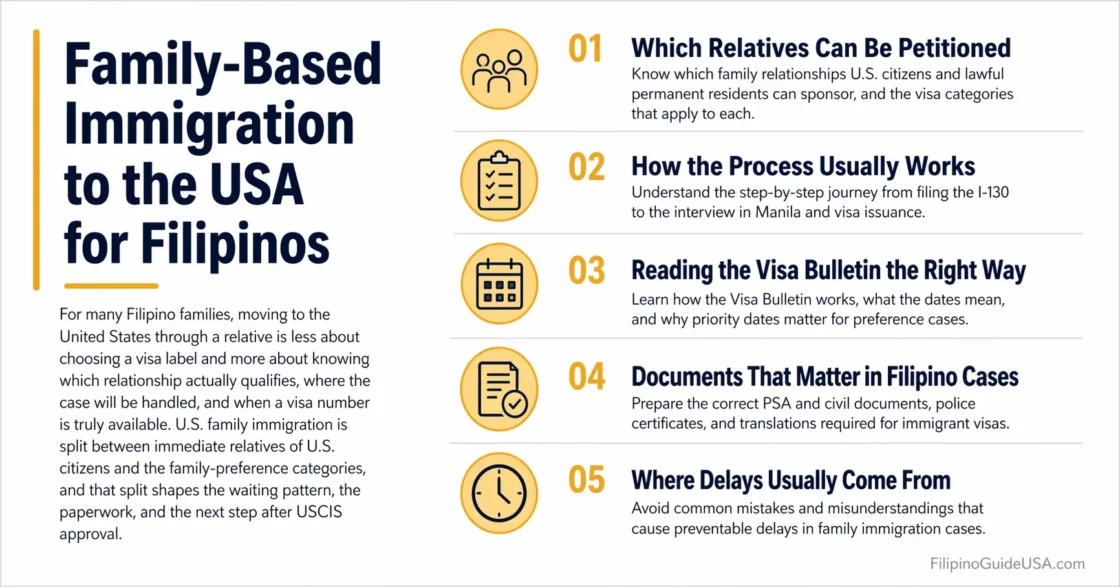
For many Filipino families, moving to the United States through a relative is less about choosing a visa label and more about knowing which relationship actually qualifies, where the case will be handled, and when a visa number is truly available. U.S. family immigration is split between immediate relatives of U.S. citizens and the family-preference categories, and that split shapes the waiting pattern, the paperwork, and the next step after USCIS approval.[a]
Which Relatives Can Be Petitioned
The first thing to sort out is the petitioner’s status. A U.S. citizen can petition for more relatives than a lawful permanent resident, and that difference decides whether a case can even start.
| Petitioner | Relative | Typical Category | Notes |
|---|---|---|---|
| U.S. Citizen | Spouse | Immediate Relative | No annual quota line applies to this category. |
| U.S. Citizen | Unmarried Child Under 21 | Immediate Relative | No annual quota line applies to this category. |
| U.S. Citizen | Parent | Immediate Relative | The petitioner must be a U.S. citizen and at least 21 years old.[b] |
| U.S. Citizen | Unmarried Son or Daughter 21 or Older | F1 | Numerically limited preference category. |
| U.S. Citizen | Married Son or Daughter | F3 | Numerically limited preference category. |
| U.S. Citizen | Brother or Sister | F4 | The petitioner must be a U.S. citizen and at least 21 years old.[c] |
| Lawful Permanent Resident | Spouse | F2A | Numerically limited preference category. |
| Lawful Permanent Resident | Unmarried Child Under 21 | F2A | Numerically limited preference category. |
| Lawful Permanent Resident | Unmarried Son or Daughter 21 or Older | F2B | Numerically limited preference category. |
A lawful permanent resident cannot petition for a parent, a sibling, or a married child through the family-based immigrant visa system, while a U.S. citizen can petition the broader group listed above.[a]
How the Process Usually Works From the Philippines
If the relative is already in the United States and is otherwise eligible, adjustment of status may be possible. If the relative is outside the United States, the case usually moves through consular processing after USCIS and NVC stages. Each sponsored person needs a separate Form I-130.[e]
For most Philippines-based family cases, the sequence looks like this:
The petitioner files Form I-130 with USCIS. Petition approval is required before the case can move to the National Visa Center.[d]
If the case is in a preference category, the family waits for the priority date to become current under the Visa Bulletin.
NVC collects the DS-260, the Affidavit of Support, and supporting civil and financial documents through CEAC.
When the case is ready for interview in Manila, the applicant follows the local embassy instructions, completes the medical exam, and brings the required originals to the interview.
After visa issuance, the immigrant pays the USCIS immigrant fee and travels before the visa expires.
One Philippines-specific point that still causes confusion is where the petition is filed. USCIS permanently closed its Manila field office in 2019, so regular family petitions are no longer handled as if there were a normal USCIS filing office in Manila.[k]
Reading the Visa Bulletin the Right Way
For F1, F2A, F2B, F3, and F4 cases, the published cut-off date matters. In the October 2026 Visa Bulletin, the Philippines remains subject to Final Action Dates in each family-preference category.[f]
| Category | Who It Covers | Philippines Final Action Date October 2026 |
|---|---|---|
| F1 | Unmarried Sons and Daughters of U.S. Citizens | November 1, 2013 |
| F2A | Spouses and Children of Permanent Residents | September 22, 2026 |
| F2B | Unmarried Sons and Daughters of Permanent Residents | October 1, 2013 |
| F3 | Married Sons and Daughters of U.S. Citizens | July 22, 2006 |
| F4 | Brothers and Sisters of Adult U.S. Citizens | May 15, 2008 |
These dates are not estimates of total waiting time. They are cut-off dates used to decide whether a visa can actually be issued in that category for that month.
This is the part many families miss: an approved I-130 does not automatically mean an interview is near. NVC schedules preference cases only after required documents are reviewed and a visa is available for the case. Visa Bulletin dates can also move forward or backward from one month to another.[g]
2026 Public Charge Bond Pilot
On August 5, 2026, the U.S. Department of State announced that it is using a Public Charge Bond procedure as a pilot for select immigrant visa applications. The bond is not a new fee that every family-based immigrant must pay, and applicants should not try to arrange one simply because they are applying for an immigrant visa.[l]
The pilot can become relevant after a consular officer has found an immigrant visa applicant ineligible under INA 212(a)(4) on public-charge grounds. An applicant may first try to overcome that finding by providing evidence showing that they are not likely to become a public charge. For selected cases, a consular officer may also permit the applicant to seek a Public Charge Bond through USCIS as another way to address the public-charge ineligibility. If the bond is approved and the applicant is otherwise eligible, the previously refused immigrant visa may be issued.[l]
Do not post a bond unless instructed: The Department of State says the procedure is being used for selected applications. An applicant who is required to post a Public Charge Bond will be notified by a consular officer. The bond amount is set for the individual case based on the totality of the circumstances rather than through one standard amount for all immigrants.[l]
I-864, Public Charge Review, and a Public Charge Bond Are Different
| Item | What It Does | What It Does Not Mean |
|---|---|---|
| Form I-864 Affidavit of Support | Provides the legally required financial sponsorship for most family-based immigrants and shows the sponsor’s income, assets, household size, and support obligation. | A sufficient I-864 does not automatically end every public-charge inquiry. |
| Public-Charge Determination | The consular officer evaluates whether the applicant is likely to become a public charge under INA 212(a)(4), considering the applicable statutory factors and financial evidence. | It is not simply a check of whether the sponsor met the I-864 income threshold. |
| Public Charge Bond | For a selected immigrant visa case already affected by a public-charge finding, it may provide an additional path to address that ineligibility when the consular officer authorizes the procedure. | It is not a routine immigrant visa fee, a universal deposit, or a requirement for every family immigrant. |
The State Department’s I-864 guidance specifically says that a sufficient Affidavit of Support is not the only consideration in a public-charge review. Consular officers may also consider factors such as the applicant’s age, health, family status, assets, resources, financial status, education, and skills. A joint sponsor can help satisfy the I-864 financial sponsorship requirement, but that does not convert the separate public-charge determination into an automatic approval.[m]
Practical distinction: Most family-based immigrant cases still need the appropriate I-864 even when no Public Charge Bond is involved. The bond pilot applies only when the public-charge issue arises in a selected immigrant visa case and the consular officer tells the applicant that the bond procedure is available.
Documents That Matter in Filipino Cases
For Philippine civil records, the State Department’s country reciprocity page points applicants to PSA-issued documents and adds a detail that matters in real cases: if a record reflects a legal correction, annulment, name change, or court action, the applicant should request the version with a CDLI endorsement. If a needed civil document is unavailable, the reciprocity page directs applicants to obtain a PSA certificate of non-availability instead.[i]
The general immigrant-visa document rules also require civil documents from the official issuing authority, original or certified copies where required, police certificates for applicants aged 16 or older under the State Department rules, and certified translations when a document is not in English or in the official language accepted for the place of application.[j]
Manila adds its own practical points. The embassy’s current immigrant-visa instructions tell family-based applicants to bring the right Affidavit of Support, complete the medical exam with St. Luke’s Medical Center Extension Clinic before the interview, carry the appointment letter, passport, and DS-260 confirmation page, and bring original civil documents even if they were uploaded in CEAC. The same page also says petitioners are not required to attend the immigrant visa interview, warns applicants not to make travel arrangements before the visa is issued, and explains that the USCIS immigrant fee must be paid after issuance and before travel.[h]
Check whether the case needs only the applicant’s birth certificate or also the petitioner’s birth certificate to prove the relationship.
Match names, dates, and civil-status details across the I-130, DS-260, passport, and PSA records.
If a Philippine record was amended by court action or legal correction, request the PSA version that shows that history.
Upload what CEAC asks for, but still carry the originals to the interview.
Where Delays Usually Come From
Many delayed cases are not delayed because the relationship is weak. They are delayed because the family treats USCIS approval as the end of the case, misreads the Visa Bulletin, uploads the wrong civil document format, or reaches interview day without the originals that the Manila post expects.
Confusing petition approval with visa availability.
Ignoring the difference between immediate-relative cases and preference-category cases.
Using Local Civil Registrar copies when the case really needs the PSA-issued version.
Missing a CDLI-endorsed record when a Philippine document has been legally corrected.
Sending documents by mail when the case is being handled through CEAC uploads.
Booking flights or making final move plans before the visa is actually printed.
Spouse cases, parent petitions, and sibling cases do not all move the same way, so the safest habit is to check the rule that matches the exact family relationship rather than relying on a friend’s timeline or a general social media summary.
Questions Filipino Families Ask Early
Can a Green Card Holder Petition Parents or Siblings?
No. A lawful permanent resident may petition a spouse or an unmarried son or daughter, but not a parent or sibling through this family-based immigrant route.[a]
Does I-130 Approval Mean the Interview Will Happen Soon?
Not always. In an immediate-relative case, approval can move the case directly into the next stage. In a preference case, approval only confirms that the relationship was accepted; the case still depends on visa availability under the monthly bulletin.[g]
Does Every Family Immigrant Have to Pay a Public Charge Bond?
No. The August 2026 pilot is being used only for selected immigrant visa applications. A bond becomes relevant only when the consular officer applies the procedure to a case and notifies the applicant. It should not be treated as a standard immigrant visa fee.[l]
Do Filipino Applicants Need PSA Documents Even if They Have Older Local Copies?
For visa processing, the State Department’s Philippines reciprocity page treats PSA records as the standard source for Philippine civil documents. Where there has been a legal change or court action, the correct PSA version matters.[i]
Does the Petitioner Need to Attend the Manila Interview?
No. Manila’s immigrant-visa instructions say petitioners are not required to attend. What matters more is that the applicant arrives with the right originals and follows the post’s medical and interview instructions.[h]
Sources
- U.S. Department of State – Family Immigration (Used for the distinction between immediate relatives and family-preference cases, and for which relatives U.S. citizens and lawful permanent residents may petition. Reliable because it is the State Department’s official immigrant visa page.)
- USCIS – Bringing Parents to Live in the United States as Permanent Residents (Used for the rule that a parent petition requires a U.S. citizen petitioner who is at least 21. Reliable because USCIS is the agency that decides family petitions.)
- USCIS – Bringing Siblings to Live in the United States as Permanent Residents (Used for the rule that a sibling petition requires a U.S. citizen petitioner who is at least 21. Reliable because USCIS is the agency that decides family petitions.)
- U.S. Department of State – Immigrant Visa Process, Step 1: Submit a Petition (Used for the point that Form I-130 starts the process and USCIS approval must come before the case moves to NVC. Reliable because it is the State Department’s official immigrant visa process page.)
- USAGov – Family-Based Immigrant Visas and Sponsoring a Relative (Used for the inside-the-U.S. versus abroad distinction and for the rule that each sponsored family member needs a separate I-130. Reliable because USAGov is the U.S. government’s official public information portal.)
- U.S. Department of State – Visa Bulletin for October 2026 (Used for the Philippines family-preference Final Action Dates shown in the table. Reliable because the Visa Bulletin is the State Department’s official monthly record of immigrant visa availability.)
- U.S. Department of State – IV Scheduling Status Tool (Used for the explanation that NVC scheduling depends on document review and visa availability. Reliable because it is the State Department’s official immigrant visa scheduling resource.)
- U.S. Department of State – U.S. Embassy Manila Immigrant Visa Instructions (Used for Manila-specific medical exam, interview, original-document, petitioner-attendance, travel-planning, and immigrant-fee points. Reliable because it is the official post page for immigrant visa applicants in Manila.)
- U.S. Department of State – Philippines Reciprocity and Civil Documents Page (Used for PSA-issued records, CDLI endorsements, and certificate-of-non-availability rules. Reliable because it is the State Department’s official country-specific civil document authority page.)
- U.S. Department of State – Step 7: Collect Civil Documents (Used for the general civil-document, police-certificate, and translation rules in immigrant visa cases. Reliable because it is part of the State Department’s official immigrant visa process.)
- USCIS – Philippines USCIS Manila Field Office (Used for the note that the USCIS Manila field office closed in 2019. Reliable because it is an official USCIS archive page documenting the closure.)
- U.S. Department of State – Public Charge Bonds for Immigrant Visa Applicants (Used for the August 5, 2026 pilot procedure, selected-case limitation, INA 212(a)(4) context, consular notification rule, and case-specific bond amount. Official State Department visa-policy notice.)
- U.S. Department of State – I-864 Affidavit of Support FAQs (Used for the distinction between the I-864 financial sponsorship requirement and the broader public-charge determination. Official State Department immigrant visa guidance.)
Procedures, embassy instructions, public-charge procedures, and Visa Bulletin dates can change without much notice. Before filing, uploading documents, posting any bond, or booking travel, check the latest USCIS, NVC, Visa Bulletin, and U.S. Embassy Manila pages that match your exact family relationship and case type.