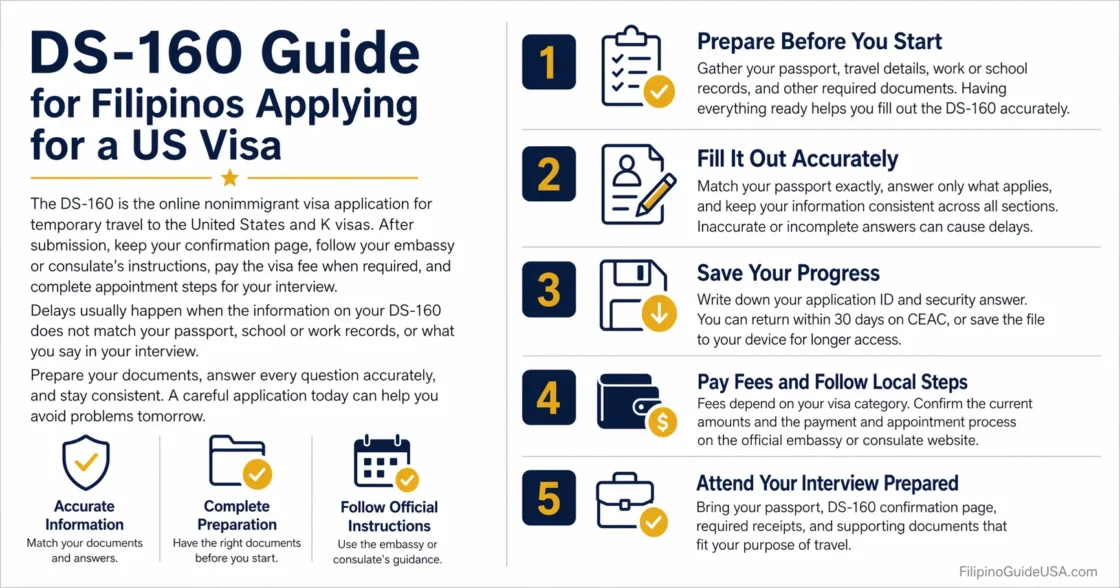
For many Filipinos, the DS-160 is the form that starts the U.S. visa process, but it is only one part of that process. It is the online nonimmigrant visa application used for temporary travel to the United States and for K visas, and after you submit it, you still need to keep the confirmation page, follow the embassy or consulate’s local instructions, pay the visa fee when required, and complete appointment steps for the post where you will interview.[a]
The part that causes delays is usually not the form itself. It is the mismatch between what appears on the DS-160, what is on your passport and school or work records, and what you later say in your interview. Filling it out calmly, with the right documents beside you, usually saves more trouble than trying to rush through it in one sitting.[b]
What The DS-160 Covers and Who Should Use It
You will normally use the DS-160 if you are applying for a nonimmigrant visa such as a visitor visa, student visa, exchange visitor visa, many temporary work visas, or a K visa. It is not the immigrant visa form, so if your process is for permanent immigration, a different application is usually involved.[a]
This matters because many Filipinos read mixed advice online and end up combining nonimmigrant and immigrant steps. Before you begin, make sure your visa category matches your reason for travel. A tourist or business trip, a school program, an exchange program, and a petition-based work case can all use the DS-160, but the supporting documents around the form are not the same.
What To Prepare Before You Start
The official instructions are clearer than many short guides suggest: it helps to collect your details first, then open the form. At minimum, you should have your passport ready. If you already have travel plans, keep your itinerary nearby as well. If you have traveled to the United States before, have the dates of your last five U.S. trips ready, and be prepared for questions about your broader international travel history for the past five years. Depending on your case, you may also need your education and work history, your employer details, or visa-specific records such as a school document or petition information.[b]
Your current passport
Your planned travel dates and U.S. contact details, if already known
Dates of previous U.S. trips, if any
International travel history for the past five years
Current and previous employment details
Current and previous education details
For F, J, or M visas: your SEVIS ID and school or program address
For petition-based work visas: petition information from your approved filing
Many guides also skip an important language point. The answers on the DS-160 must be in English, using English characters, except where the form specifically asks for your full name in your native alphabet. The form also treats most fields as mandatory, while some can be left blank only when they are marked optional or when “Does Not Apply” fits the question.[b]
How To Fill It Without Creating Problems Later
Match Your Passport Exactly
Your name, date of birth, passport number, and passport validity should be entered exactly as they appear on the passport you expect to use for travel. If your passport has only one name, the DS-160 help text explains how to handle that, and if no first or given name appears in the passport, the official instructions give a specific way to enter it. The main point is simple: do not improvise your identity details on the form.[b]
Keep Your Story Consistent Across Every Section
Your trip purpose, intended length of stay, school or employer details, and contact information should make sense together. If you say you are applying for a student visa, your school information should line up with your school document. If you say you are traveling for tourism, your answers should not read like a work or study plan. Consistency does not mean using complicated language. It means giving the same truthful facts each time they appear.
Answer Only What Applies to You
Do not force extra information into fields that do not ask for it. On the other hand, do not leave required questions half-finished. The DS-160 system does not accept a form with mandatory fields missing, and the Department of State warns that inaccurate or incomplete answers can force you to correct the application and reschedule your interview.[b]
Remember That The Applicant Signs The Form
Someone can help you understand the questions or type the answers, but the applicant is still responsible for the form. The CEAC instructions say the applicant must electronically sign and submit the application unless an exemption applies. That point matters for parents helping minors, relatives helping older applicants, or friends helping first-time travelers.[i]
How To Avoid Losing Your Progress
A practical detail that many short articles leave out is the save process. When you start a new DS-160, you receive an application ID after choosing and answering a security question. Keep both. The official FAQ says you can return to a partially completed application within 30 days on the CEAC system, and if you want access after that, you should save the file to your own device. It also states that completed pages are automatically saved, so a timeout or connection problem does not necessarily mean you lost everything.[b]
Write down your application ID immediately.
Save your security question answer somewhere secure.
Use the “Save Application to File” option if you may need more time.
Do not leave the form open for a long period without moving through the pages.
If you use a shared computer, avoid saving the file there.
Details Filipinos Often Overlook
Social Media Identifiers May Be Requested
The Department of State formally updated visa application forms to request additional information, including social media identifiers, from most U.S. visa applicants worldwide. That means it is better to be ready for that part of the form than to be surprised by it while you are halfway through your application.[h]
The Interview Location Still Matters
Current Department of State guidance says nonimmigrant visa applicants should schedule interviews in the country of their nationality or residence. For Filipinos, that usually means planning around the U.S. embassy or consulate that has authority over the place where you live or where you are eligible to apply, then checking that post’s local instructions before paying or booking anything.[f]
The DS-160 Is Not The Same as Appointment Booking
Submitting the form does not book an interview by itself. The official DS-160 page is direct about this: after submission, you keep the barcode confirmation page, then follow the interview post’s instructions for fee payment and scheduling. If you are applying from the Philippines, rely on the local U.S. embassy or official visa service instructions for the latest appointment flow rather than copying steps from another country’s guide.[a]
Fees Connected to The DS-160 Process
The fee depends on visa category, not on the DS-160 form alone. For many common non-petition-based nonimmigrant visas, including visitor, student, and exchange visitor visas, the application processing fee is currently $185. Petition-based visa categories such as H, L, O, P, Q, and R are listed at $205, while K visa applicants are listed at $265.[c]
Visa Category Group | Examples | Current Fee |
|---|---|---|
Non-petition-based nonimmigrant visas | B, C-1, D, F, I, J, M, TN/TD | $185 |
Petition-based nonimmigrant visas | H, L, O, P, Q, R | $205 |
K visas | K-1, K-2, related K categories | $265 |
Because payment systems and appointment steps can change by post, do not assume that a fee page from another country applies to the Philippines in the same way. Use the fee amount as your baseline, then confirm the local payment method on the official embassy or scheduling site before you pay.
Photo Rules That Are Easy To Miss
Your visa photo or digital image must meet specific requirements. The State Department says it must be in color, taken within the last six months, taken against a plain white or off-white background, and show your full face with both eyes open. Eyeglasses are generally not allowed in new visa photos except in rare medical situations documented by a signed medical statement.[d]
One detail that helps a lot at interview time is the confirmation page image. If there is an “X” instead of your photo on the DS-160 confirmation page, the official photo FAQ says the upload failed, and you should bring one printed photo that meets the requirements along with the confirmation page. If the confirmation page includes your photo, the upload was successful and no separate photo is required for that reason.[e]
What You Usually Bring After Filing The DS-160
For a standard visitor visa process, the Department of State says applicants should prepare the passport, the DS-160 confirmation page, the fee receipt if required before interview, and a photo if the upload failed. It also notes that additional documents may be requested to show the purpose of the trip, intent to leave the United States after the visit, or ability to pay travel costs.[j]
Passport valid for travel
Printed DS-160 confirmation page with barcode
Fee receipt, when your post requires payment before interview
Printed photo if your upload did not go through
Visa-category-specific supporting documents
Records that support the purpose of your trip and your personal circumstances
That last item is where many applicants either overpack or underprepare. Bring documents that fit your actual case. A tourist applicant, a student applicant, and a temporary worker should not carry the same document set.
Interview Waivers Are Narrower Than Many Older Guides Suggest
If you are reading older blog posts, be careful with interview waiver advice. State Department guidance updated in September 2025 says most nonimmigrant visa applicants, including applicants under 14 and over 79, will generally need an in-person interview unless they fit one of the listed exceptions, such as certain diplomatic or official categories and some recent renewals in the same visa class. Even then, consular officers may still require an in-person interview case by case.[g]
Questions Filipinos Often Ask About The DS-160
Can One Family Use A Single DS-160?
No. Each person who needs a visa must have a separate application, even if family members are traveling together.[j]
Do I Need To Print The Full Application?
No. The official DS-160 instructions say you should print and keep the barcode confirmation page. That is the page you are expected to bring through the later stages of the application process.[a]
Can I Pause The Form And Finish It Later?
Yes. You can return to a partially completed application within 30 days on CEAC, and you can keep it longer by saving the application file to your device.[b]
Should I Use A Travel Agency Or Fill It Out Myself?
Either is possible, but the answers are still your responsibility. If someone assists you, review every answer before submission and make sure the facts match your documents and your real travel purpose.[i]
Before You Submit
Read the full form one more time from top to bottom. Check names, passport details, travel purpose, U.S. contact details, prior travel, work history, and school information. Make sure the visa class you selected matches the reason you are traveling. Then save the application record, submit it, and keep the confirmation page where you can find it again without stress.
This process can change over time, especially where fees, interview waiver rules, local appointment steps, and post-specific instructions are concerned. Before you pay, book, or attend an appointment, check the official U.S. government pages for the embassy or consulate handling your case.
Sources
[a] U.S. Department of State, “DS-160: Online Nonimmigrant Visa Application” — used here for who must use the DS-160, what the form is for, and the required next steps after submission. (Reliable because it is the official U.S. Department of State visa forms page.) Official page
[b] U.S. Department of State, “DS-160: Frequently Asked Questions” — used for preparation items, language rules, mandatory fields, name and passport guidance, saving and retrieving the application, and accuracy warnings. (Reliable because it is the official FAQ maintained by the agency that runs the visa process.) Official page
[c] U.S. Department of State, “Fees for Visa Services” — used for current nonimmigrant and K visa fee amounts. (Reliable because it is the Department of State’s official visa fee page.) Official page
[d] U.S. Department of State, “Photo Requirements” — used for current visa photo standards such as background, age of photo, face position, and eyeglasses rules. (Reliable because it is the official State Department photo requirements page for visa applications.) Official page
[e] U.S. Department of State, “Photo Frequently Asked Questions” — used for the rule about bringing a printed photo when the DS-160 confirmation page shows an “X” instead of the uploaded image. (Reliable because it is an official State Department FAQ focused on visa photo handling.) Official page
[f] U.S. Department of State, “U.S. Visas” — used for the current guidance that nonimmigrant visa applicants should schedule interviews in their country of nationality or residence. (Reliable because it is the central official overview page for U.S. visa policy and process.) Official page
[g] U.S. Department of State, “Interview Waiver Update September 18, 2025” — used for the current interview waiver categories and the general rule that most nonimmigrant applicants now require an in-person interview. (Reliable because it is an official policy update published by the Department of State.) Official page
[h] U.S. Department of State, “Collection of Social Media Identifiers from U.S. Visa Applicants” — used for the point that most visa applicants may be asked for additional information including social media identifiers. (Reliable because it is an official Department of State announcement about visa application form changes.) Official page
[i] Consular Electronic Application Center (CEAC), “Online Nonimmigrant Visa Application (DS-160)” — used for the note that others may assist, but the applicant must electronically sign and submit the application unless exempt. (Reliable because CEAC is the official online system where the DS-160 is completed.) Official page
[j] U.S. Department of State, “Visitor Visa” — used for the document checklist language on passport, DS-160 confirmation page, fee receipt, photo handling, and examples of additional documents that may be requested. (Reliable because it is the official Department of State page for B visitor visa procedures and interview preparation.) Official page