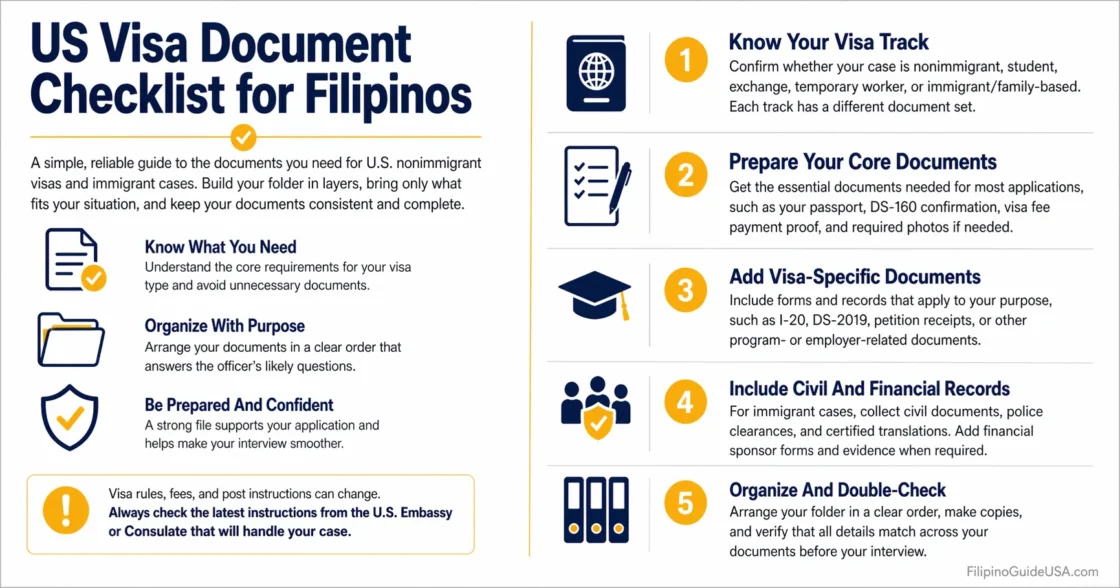
For many Filipino applicants, the hard part is not collecting a huge stack of papers. It is knowing which documents are truly required, which ones only matter for a specific visa class, and which popular “requirements” online are only optional supporting papers. The cleanest approach is to build your folder in layers: start with the nonimmigrant core set, then add only the papers that match your purpose of travel.
Which Visa Track This Page Covers
This checklist is built around the U.S. nonimmigrant visa process used for temporary travel such as visitor, student, exchange, and many work visas. Those cases use Form DS-160, and after you submit it, you should keep the barcode confirmation page, arrange your interview, and follow the fee instructions for the embassy or consulate where you will apply.[a]
If your case is immigrant or family-based, keep reading to the later section because the document set changes and civil records become much more important.
Before You Open The DS-160
Many delays start before the interview, not at the window. The DS-160 asks for travel, work, and education details, so it helps to gather the records below before you begin.[b]
Your current passport
Your travel itinerary, if you already have one
The dates of your last five trips to the United States, if any
Your broader international travel history for the past five years
Your current and previous education and work history
Your visa-class documents if they apply, such as an I-20, DS-2019, or I-129 details
A reminder that the DS-160 must be completed in English, using English characters except where the form asks for your native alphabet
Core Documents For Most Nonimmigrant Applications
For a standard visitor application, the required set is shorter than many third-party checklists suggest, and it gives a useful baseline for many other temporary-visa folders as well.[c]
A passport valid for at least six months beyond your intended period of stay in the United States
The DS-160 confirmation page with the barcode
Proof of visa-fee payment if your post requires payment before the interview
One printed visa photo only if the photo upload failed during the DS-160 process
A separate application for each traveler, even if family members appear in the same passport
For B-1/B-2 visitor visas, supporting papers are not a fixed bundle. A consular officer may ask for documents that show the purpose of the trip, your intent to leave the United States after the visit, and how the trip will be paid. That is why employment papers, business records, enrollment documents, trip plans, or sponsor funding evidence can help when they fit your situation. A visitor visa does not require an invitation letter or an Affidavit of Support as a standard filing document.
Helpful Visitor Visa Papers By Situation
If you are employed: bring documents such as a certificate of employment, approved leave, and recent income records if they help explain your trip and your return plans.
If you run a business: bring business registration papers and current operating records if they help show what ties you back to the Philippines or your country of residence.
If you are a student: bring a certificate of enrollment and clear proof of who will pay for the trip.
If someone else is paying: bring proof of your relationship to that person and evidence that the sponsor can realistically cover the trip.
Bring only what matches your case. A neat file that answers the officer’s likely questions is more useful than a thick folder full of unrelated papers.
What To Add For Student Visas
Student applicants should keep the core nonimmigrant documents above, then add the school and funding records tied to the I-20.[d]
Your signed Form I-20
Academic records such as transcripts, diplomas, degrees, certificates, or any required test scores
Evidence that you can pay tuition, living expenses, and travel costs
If dependents will apply with you, an individual Form I-20 for each dependent
What To Add For Exchange Visitor Visas
J-1 applicants should keep the same core nonimmigrant folder and then add the program documents issued through the exchange system.[e]
Your Form DS-2019
Form DS-7002 if you are applying in the trainee or intern category
Any funding records or sponsor papers that help explain how the program is structured and paid for
If your program is U.S.-government sponsored and falls under the categories listed by the Department of State, the visa application fee rules may differ, so check that before paying.
What To Add For Temporary Work Visas
Temporary work visas also start with the standard passport and DS-160 file, but petition-based cases need petition records that many generic checklists leave out.[f]
Your petition receipt number as shown on Form I-129 or Form I-797
Form I-129S if you are covered by an L blanket petition
Job-related papers that help explain the employer, the role, and the temporary nature of the assignment if the officer asks for more context
For many temporary worker categories, especially those outside H-1B and L, ties outside the United States can still matter, so bring documents that support your residence, long-term plans, or return path when they fit your case.
Immigrant And Family-Based Cases Use A Different Folder
Once an immigrant case reaches the DS-260 stage, you and each immigrating family member must collect civil documents from the official issuing authority in the country that issued them. Documents that are not in English, or not in the official language of the country where you are applying, must also be accompanied by certified translations.[g]
For Philippine civil records, that usually means PSA-issued documents. If a required Philippine civil document is unavailable, the State Department reciprocity page says to obtain a PSA certificate of non-availability instead of substituting informal records.[h]
When the National Visa Center asks for documents, send photocopies unless you are specifically told otherwise, but still bring the original civil records to your visa interview.[i]
If your interview will be in Manila, applicants over 16 generally need a valid NBI clearance for travel purposes, and the post asks for an AKA entry that includes maiden names, birth-certificate names, aliases, and alternate spellings that appear in other records. The Manila post also says family-based cases should bring the proper Form I-864 for each financial sponsor.[j]
On the sponsor side, the financial file should normally include the Affidavit of Support plus supporting evidence. State Department guidance says the most recent IRS tax transcript is preferred, and if the sponsor’s reported income is below the guideline level, current income proof such as pay statements or an employer letter should be added.[k]
For Immigrant Or Family-Based Cases, Your Folder Usually Needs
Birth certificates and any marriage, divorce, annulment, adoption, or death records that apply to your case
Police certificates, including Philippine NBI clearance when required
A passport biographic-page copy and the original passport for interview day
Financial sponsorship forms and sponsor evidence if your case requires an Affidavit of Support
Certified translations for records that are not in the accepted language format
How To Arrange Your Folder
A simple order makes the interview day easier.
Front section: passport, DS-160 or DS-260 confirmation, and any appointment or fee records you need to show first.
Visa-class section: I-20, DS-2019, petition receipt, I-129S, or other case-specific forms.
Supporting section: employment, school, business, or funding papers that explain the trip and your return plans.
Civil-record section: birth, marriage, police, and court records if your case uses them.
Copy section: a clean set of photocopies behind the originals whenever your case type calls for them.
A Simple Final Check Before You Leave
Make sure your name, birth date, passport number, and case details match across every document.
Check that barcodes are clear and printable pages are easy to scan.
If you use more than one name, spelling, or surname format, make sure that difference is explained consistently in your records.
Remove papers that do not help your case, especially old photocopies that create confusion.
Keep your answers and your documents aligned. A strong file is one where the paperwork supports what you say without extra explanation.
Visa rules, fees, and post instructions can change. Before you pay, book, or attend an interview, check the latest instructions from the U.S. Embassy or Consulate that will handle your case.
Sources
[a] U.S. Department of State: DS-160 Online Nonimmigrant Visa Application — Used for the DS-160 barcode page, interview scheduling, and fee-payment step. (Reliable because it is the official U.S. Department of State visa instruction page.)
[b] U.S. Department of State: DS-160 Frequently Asked Questions — Used for the records applicants should gather before completing the form, including travel, education, and work history. (Reliable because it is an official Department of State visa FAQ.)
[c] U.S. Department of State: Visitor Visa — Used for the standard visitor-visa document list, photo rule if upload fails, and the explanation that supporting evidence should match trip purpose, return intent, and ability to pay. (Reliable because it is the official Department of State page for B visitor visas.)
[d] U.S. Department of State: Student Visa — Used for the I-20 requirement and the added academic and funding documents student applicants may need. (Reliable because it is the official Department of State page for F and M visas.)
[e] U.S. Department of State: Exchange Visitor Visa — Used for DS-2019, DS-7002 for trainee and intern cases, and fee notes for qualifying government-sponsored J programs. (Reliable because it is the official Department of State page for J visas.)
[f] U.S. Department of State: Temporary Worker Visas — Used for petition receipt numbers, I-129S for L blanket applicants, and the added documentation pattern for temporary work cases. (Reliable because it is the official Department of State employment-visa page.)
[g] U.S. Department of State: Civil Documents — Used for immigrant-case civil-document rules, official issuing authorities, and certified translation requirements. (Reliable because it is part of the official immigrant visa process on Travel.State.Gov.)
[h] U.S. Department of State: Philippines Reciprocity And Civil Documents — Used for PSA-issued Philippine civil records and the instruction to obtain a certificate of non-availability when a required record does not exist. (Reliable because it is the Department of State’s country-specific civil-document authority page.)
[i] U.S. Department of State: Submitting Documents To The NVC — Used for the rule that NVC generally wants photocopies, while originals still need to be brought to the interview. (Reliable because it is the official National Visa Center instruction page.)
[j] U.S. Department of State: U.S. Embassy Manila, Philippines Supplement — Used for Manila-specific interview rules on NBI clearance, AKA naming, foreign police certificates, and the I-864 requirement for family-based cases. (Reliable because it is the official Manila post supplement published by the Department of State.)
[k] U.S. Department of State: Financial Documents — Used for sponsor-side financial evidence, including the preference for the most recent IRS tax transcript and added proof of current income when needed. (Reliable because it is an official immigrant-visa financial-document instruction page.)