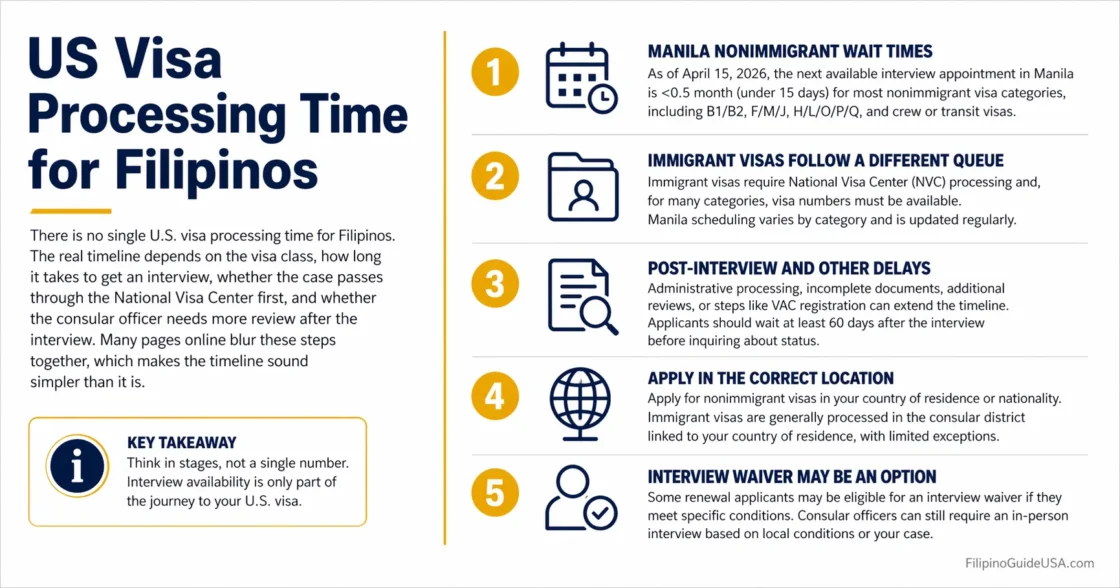
There is no single U.S. visa processing time for Filipinos. The timeline depends on the visa class, interview availability, whether the case goes through the National Visa Center (NVC), and whether the consular officer needs additional review after the interview. These are separate stages, and the published wait times do not measure all of them.
What “Processing Time” Usually Means
When people ask how long a U.S. visa takes, they are often referring to one of three different waiting periods:
- Nonimmigrant interview availability for visitor, student, exchange, crew, and many work visas.
- Immigrant visa scheduling after the case becomes documentarily complete at NVC and, for preference categories, a visa number is available.
- Post-interview administrative processing when the consular officer cannot finish the case at the interview.
A short appointment wait does not mean the visa will be issued within the same period. The Department of State publishes these stages separately for that reason.
Current Manila Wait Times for Nonimmigrant Visas
The Department of State’s Global Visa Wait Times table is updated monthly. It measures interview availability, not the total time from application to visa issuance. Months are counted in 30-day increments, so <0.5 month means less than 15 days.[a]
Checked on October 15, 2026. The Department of State table was last updated September 17, 2026.
| Visa Category | Manila Next Available Appointment | What the Figure Measures |
|---|---|---|
| B1/B2 Visitor | <0.5 month | Next available interview appointment |
| F, M, J | 1 month | Next available interview appointment |
| H, L, O, P, Q | <0.5 month | Next available interview appointment |
| C, D, C1/D | <0.5 month | Next available interview appointment |
The F/M/J figure is therefore different from the other short-wait groups in Manila: student and exchange applicants are currently shown at 1 month, while B1/B2, petition-based H/L/O/P/Q, and crew/transit categories are shown at less than half a month.
The B1/B2 “average wait time” field may show NA even when a next-available appointment is listed. The Department of State currently publishes a B1/B2 average wait figure only when the next available appointment is more than three months away.[a]
Appointment wait is not visa issuance time: Nonimmigrant wait-time figures do not include case-specific administrative processing or the time needed to return the passport by courier or local mail after adjudication.[c]
Manila Immigrant Visa Scheduling Uses a Different Queue
Immigrant visa cases do not use the nonimmigrant appointment table. NVC schedules interviews according to the date a case became documentarily complete, meaning the required fees and documents have been accepted for scheduling purposes. For family-sponsored and employment-based preference cases, a visa must also be available under the Visa Bulletin before NVC can schedule the interview.[b]
Checked on October 15, 2026. The IV Scheduling Status Tool is updated monthly.
| Manila Immigrant Category | NVC Is Scheduling Documentarily Complete Cases From | What the Date Means |
|---|---|---|
| Immediate Relative | February 2026 | Cases that became documentarily complete in that month are within the scheduling range shown for Manila. |
| Family-Sponsored Preference | June 2021 | Scheduling also depends on visa availability for the preference category. |
| Employment-Based Preference | March 2023 | Scheduling also depends on visa availability for the employment preference category. |
These are not petition filing dates, priority-date cutoffs, or promises of an interview in a particular number of days. They are monthly NVC scheduling snapshots for Manila. A family preference applicant, for example, must still have an available visa number even if the case is otherwise documentarily complete.
NVC also publishes a separate weekly operations page for case creation, document review, and Public Inquiry Form response timing.[d] Those weekly figures answer a different question from the Manila interview queue and can change every few days. For that reason, the live NVC Timeframes page should be used when checking whether NVC should already have created a newly received case or reviewed submitted documents.
Administrative Processing Has No Standard Completion Time
Administrative processing begins only after a consular officer determines that a visa application cannot be completed at the interview and needs additional review or information. The Department of State does not publish a fixed processing period for these cases; duration depends on the individual circumstances.[c]
Checked on October 15, 2026.
| Post-Interview Situation | Published Timing or Rule | What It Means |
|---|---|---|
| Administrative processing | No fixed completion time | The State Department says processing time varies by the circumstances of the individual case. |
| Manila immigrant visa status inquiry | Wait at least 60 days after the interview | U.S. Embassy Manila asks applicants in administrative processing to wait at least 60 days before asking about status. |
| 221(g) request for additional information | Submit the requested material as soon as possible; the general rule allows one year from refusal to provide requested information | If the requested information is not provided within that period, the applicant generally must reapply and pay a new application fee. |
U.S. Embassy Manila’s immigrant visa instructions also separate administrative processing from a request for missing documents. If documents are required, the refusal letter explains how to submit them. If the case needs administrative processing, the embassy states that it needs additional time to review the case.[e]
Why an Immigrant Visa Case Can Take Longer Than the Queue Date
Reaching Manila’s scheduling range is only one part of an immigrant visa case. The embassy currently requires applicants to register online and schedule a Visa Application Center (VAC) appointment before the embassy interview. The VAC appointment must occur before the interview, and failure to schedule it can result in cancellation of the embassy appointment.[e]
Other delays can occur when documents are incomplete, NVC has not yet finished review, a preference category does not have a visa number available, the applicant needs to submit additional evidence, or the case enters administrative processing. These stages should not be converted into one estimated “total processing time.”
If You Are Applying Outside the Philippines
A Filipino applicant living in another country should not automatically use Manila’s figures. Under the Department of State instructions updated in July 2026, nonimmigrant visa applicants should schedule in their country of nationality or residence. Applicants relying on residence must be able to show that they reside in the country where they apply.[f]
For immigrant visas, NVC generally schedules applicants in the consular district for their place of residence, or in their country of nationality if requested, subject to the Department’s rules and limited exceptions.[g] A person interviewing outside Manila should check the wait times and post instructions for the actual embassy or consulate handling the case.
Interview Waiver Rules Are Narrower Than They Used to Be
The current Department of State interview-waiver policy no longer gives a broad 12-month waiver path to anyone renewing the same visa category. Most nonimmigrant applicants generally require an in-person interview unless they fit one of the listed exceptions.[h]
For ordinary Filipino travelers and workers, the most relevant renewal exceptions are:
- B-1, B-2, or B1/B2 renewal: the prior visa must have expired within the previous 12 months, it must have been issued for full validity, and the applicant must have been at least 18 when it was issued.
- H-2A renewal: the prior H-2A visa must have expired within the previous 12 months, it must have been issued for full validity, and the applicant must have been at least 18 when it was issued.
Applicants relying on these waiver provisions must also apply in their country of nationality or usual residence, have no visa refusal that remains unresolved or unwaived, and have no apparent or potential ineligibility. A consular officer can still require an in-person interview in an individual case.[h]
Common Timing Questions
Does “<0.5 month” mean the visa will be issued in under 15 days?
No. It means the next available interview appointment is estimated at less than 15 days. Administrative processing and passport return time are outside that figure.
Why Is the F/M/J Wait Longer Than B1/B2 in Manila?
The current Manila table lists different next-appointment estimates by visa group. As checked on October 15, 2026, F/M/J is 1 month, while B1/B2 is <0.5 month. Appointment capacity can change when the Department of State refreshes the monthly table.
Can I Compare the Manila NVC Queue Date Directly With My Priority Date?
No. The IV Scheduling Status Tool is based on the month the case became documentarily complete. A priority date serves a different purpose: in preference categories it helps determine whether a visa number is available under the Visa Bulletin.
Does Reaching the NVC Scheduling Month Mean an Interview Is Guaranteed Immediately?
No. The tool gives an indication of where NVC is scheduling documentarily complete cases with visas available. Individual cases can still differ, and the published month is not an appointment guarantee.
Should I Book Nonrefundable Travel After Receiving an Interview Date?
No. U.S. Embassy Manila advises immigrant visa applicants not to make nonrefundable travel arrangements until the visa has actually been received. A case can require more documents or administrative processing after the interview.[e]
Sources
- U.S. Department of State — Global Visa Wait Times — Official monthly table for Manila nonimmigrant interview availability and the Department’s definitions for appointment wait-time reporting.
- U.S. Department of State — IV Scheduling Status Tool — Official monthly NVC scheduling snapshot for Manila by Immediate Relative, Family-Sponsored Preference, and Employment-Based Preference category.
- U.S. Department of State — Administrative Processing Information — Official explanation of 221(g), case-specific administrative processing, requested documents, and what standard wait-time figures exclude.
- U.S. Department of State — NVC Timeframes — Official weekly page for NVC case creation, document review, and Public Inquiry Form response timing.
- U.S. Department of State — U.S. Embassy Manila, Philippines (MNL) — Official Manila immigrant visa instructions, including the VAC requirement, post-interview procedures, and the 60-day administrative-processing inquiry instruction.
- U.S. Department of State — Adjudicating Nonimmigrant Visa Applicants in Their Country of Residence — Current instructions on where nonimmigrant applicants should schedule visa interviews.
- U.S. Department of State — Adjudicating Immigrant Visa Applicants in Their Country of Residence — Current NVC interview-location rules for immigrant visa applicants.
- U.S. Department of State — Interview Waiver Update, September 18, 2025 — Current published interview-waiver categories and renewal conditions effective October 1, 2025.
Visa appointment availability, NVC scheduling ranges, and local embassy procedures can change. Check the applicable Department of State and U.S. Embassy Manila pages again before paying fees, submitting time-sensitive documents, or making travel arrangements.