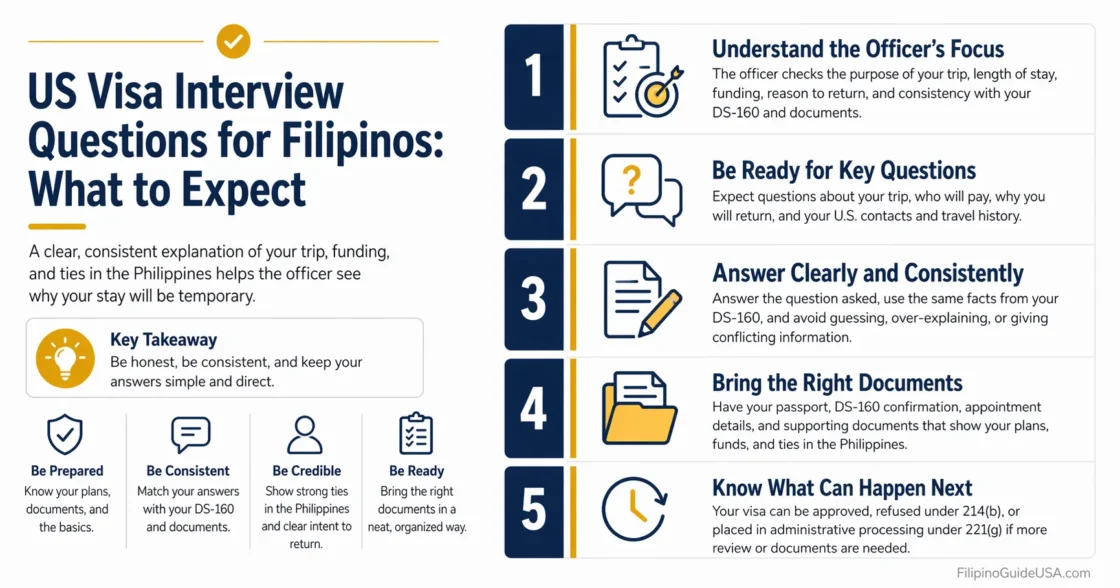
If you are a Filipino applicant preparing for a U.S. visa interview, it helps to think of the interview as a short eligibility check rather than a test full of trick questions. In the Philippines, many applicants now deal with two separate appointment steps: one at the Visa Application Center for photo and fingerprints, and another for the embassy interview itself. That makes it even more important to arrive at the interview stage with a clear, consistent explanation of why you are traveling, who is paying, and why your stay will be temporary.[a]
For most people searching this topic, the real concern is the visitor visa interview for B-1, B-2, or B-1/B-2 travel. That is where the officer decides whether you qualify for the visa category you applied for and whether your overall story fits a temporary trip.
What the Officer Is Really Checking
U.S. visitor visa officers do not rely on one magic document or one polished answer. They look at each case on its own facts and weigh your travel plans, financial situation, and ties outside the United States that support your return after a temporary stay.[c]
| What the Officer May Focus on | What Your Answer Should Make Clear |
|---|---|
| Purpose of the trip | Your reason matches the visa type and your plans are specific and realistic. |
| Length of stay | You know roughly when you plan to go, how long you expect to stay, and why. |
| Funding | You can explain who will pay for the trip and how the costs will be covered. |
| Reason to return | Your job, studies, family responsibilities, business, or other ties show why you will come back. |
| Consistency | Your interview answers line up with your DS-160 and any supporting documents. |
Questions You Should Be Ready For
There is no fixed public script, but the official factors used in visa decisions make the usual question themes fairly easy to anticipate. Most questions are simple on the surface. The difficulty usually comes from vague, inconsistent, or over-explained answers.[c]
Questions About Your Trip
- Why do you want to go to the United States?
- Is this trip for tourism, visiting family, business, or medical treatment?
- Which cities do you plan to visit?
- How long do you expect to stay?
- When do you plan to travel?
- Where will you stay?
These questions sound basic because they are basic. The officer is checking whether your answer fits the visa category and whether your plan feels real rather than improvised.
Questions About Who Will Pay
- Who is paying for your trip?
- What do you do for work?
- How long have you been with your employer or in your business?
- How much do you expect this trip to cost?
- If someone else is helping, what is that person’s relationship to you?
For a visitor visa, the point is not to prove wealth. It is to show that the trip is financially believable and that your explanation matches your situation.
Questions About Why You Will Return to the Philippines
- What do you do in the Philippines now?
- Who lives with you or depends on you?
- Do you have work, school, or business commitments after the trip?
- Do you own or rent a home?
- Why are you returning after this visit?
This is where many applicants focus too narrowly on bank balances and miss the bigger point. U.S. law puts real weight on your ties outside the United States, and those ties can include your work, home, and family relationships.[c]
Questions About U.S. Contacts and Travel History
- Do you have relatives or friends in the United States?
- What is their status there?
- Will you stay with them?
- Have you traveled abroad before?
- Have you been to the United States before?
- Have you ever overstayed or had a visa refused?
If you have family in the United States, that does not automatically ruin your case. It also does not replace the need to qualify on your own. For visitor visas, the Department of State says applicants qualify based on their ties abroad, not on assurances from U.S. relatives or friends.[b]
How to Answer Without Creating New Questions
Your answers should match your DS-160 closely. The Department of State specifically warns applicants to complete the DS-160 accurately and fully because mistakes can lead to corrections and even a need to reschedule the interview.[d]
- Answer the question asked first, then stop.
- Use the same facts you put in your DS-160.
- If something changed after submission, say that clearly instead of hoping it will not come up.
- Do not guess about dates, prior travel, employer details, or family information.
- Keep your answer natural. A memorized speech often creates follow-up questions.
Many Filipino applicants also put too much weight on invitation letters. For a standard visitor visa, an invitation letter or Affidavit of Support is not required to apply, and it is not one of the deciding factors by itself. What matters more is whether your trip makes sense, your funding is believable, and your temporary intent is clear.[b]
Documents Worth Having Ready
For a visitor visa interview, the official baseline documents include your valid passport, DS-160 confirmation page, fee receipt if required before the interview, and a printed photo if the photo upload failed. Depending on your case, the officer may also ask for documents that help show the purpose of your trip, your ability to pay, or your intent to return.[b]
- Passport valid for travel
- DS-160 confirmation page
- Appointment confirmation and payment record, if applicable
- Printed visa photo only if the upload issue applies to your case
- Simple supporting proof related to work, business, finances, travel plans, or family situation
Bring documents in a neat, easy-to-find order. You may not be asked for all of them, but if the officer wants one item, you should be able to show it quickly.
Social Media Screening for Some Visa Categories
The Department of State expanded its online presence review rules again on March 30, 2026. The expansion applies to applicants in A-3, C-3 when applying as a domestic worker, G-5, H-3, H-4 as a dependent of an H-3 applicant, K-1, K-2, K-3, Q, R-1, R-2, S, T, and U classifications. These categories were added to H-1B applicants and their H-4 dependents, as well as F, M, and J student and exchange visitor applicants that were already covered.[f]
Applicants in the covered categories are instructed by the Department of State to adjust the privacy settings on all of their social media profiles to “public” or “open.” The instruction now applies to A-3, qualifying C-3, G-5, H-3, H-4 covered by the rule, K-1, K-2, K-3, Q, R-1, R-2, S, T, U, H-1B, F, M, and J nonimmigrant visa applicants.[f]
B-1 and B-2 visitor visas are not included in the classifications listed in the Department of State’s March 30, 2026 announcement. If you are applying in another visa category, check the current Department of State instructions for that classification before your appointment because the online presence review rules are not limited to student and H-1B cases anymore.[f]
What Usually Goes Wrong
- The purpose of travel is too vague.
- The applicant gives one answer in the DS-160 and a different one at the window.
- The funding story is unclear.
- The applicant relies only on a U.S. relative’s invitation and cannot explain personal ties in the Philippines.
- The applicant gives long answers that wander beyond the question.
Most of these problems are avoidable. A short, believable answer is usually stronger than an elaborate one.
What Can Happen After the Interview
If the officer is not convinced that you fit the nonimmigrant visa category or that you have shown enough ties to leave after a temporary stay, the case can be refused under section 214(b). The Department of State explains that this often turns on whether the applicant showed strong enough ties to the home country and whether the overall circumstances support a temporary visit.[c]
Some cases do not end with a simple yes or no on the spot. A refusal under section 221(g) can mean the officer needs more documents or that the case requires administrative processing. When that happens, the officer is supposed to tell you at the end of the interview, and processing time can vary from case to case.[e]
What to Expect on the Day Itself
For a regular visitor visa case, the interview itself is often brief. A consular officer will speak with you, determine whether you qualify for the visa, and fingerprints are usually taken as part of the process, although the exact handling can vary by location.[b]
- Arrive with your documents already organized.
- Listen carefully before answering.
- Speak in a calm, direct way.
- Do not volunteer extra details unless they help answer the question clearly.
- Be ready for a very short interview.
If your case is for a student, work, fiancé, or immigrant visa rather than a visitor visa, expect more category-specific questions tied to your school, employer, petition, or relationship. The same basic rule still applies: your answers should be accurate, consistent, and easy to verify from your file.
Before your appointment, check the latest local instructions again. Embassy procedures, interview rules, appointment steps, social media requirements for covered visa classes, and local handling can change over time, so it is smart to verify the current details on the official pages for the Philippines and the Department of State before you go.[a][f]
Sources
- [a] U.S. Embassy in the Philippines, “FAQs: The New Visa Appointment System and Process” — used for the Philippines-specific appointment flow, including the separate VAC and embassy interview steps. (Open source) (Reliable because it is the official U.S. Embassy website for local visa procedures in the Philippines.)
- [b] U.S. Department of State, “Visitor Visa” — used for the visitor visa interview stage, required baseline documents, additional proof that may be requested, and the note that invitation letters are not required deciding factors. (Open source) (Reliable because it is the Department of State’s official visa information page for B-1/B-2 travel.)
- [c] U.S. Department of State, “Visa Denials” — used for the explanation of strong ties, temporary intent, and the individualized review of travel plans, finances, and ties outside the United States. (Open source) (Reliable because it is the Department of State’s official explanation of refusal standards, including section 214(b).)
- [d] U.S. Department of State, “DS-160: Frequently Asked Questions” — used for the requirement to complete the DS-160 accurately and fully and the warning that errors can force corrections or rescheduling. (Open source) (Reliable because it is the Department of State’s official FAQ for the nonimmigrant visa application form.)
- [e] U.S. Department of State, “Administrative Processing Information” — used for the explanation of section 221(g), requests for extra documents, and administrative processing after the interview. (Open source) (Reliable because it is the Department of State’s official page on post-interview administrative processing.)
- [f] U.S. Department of State, “Announcement of Expanded Screening and Vetting for Visa Applicants,” updated March 25, 2026 — used for the March 30, 2026 expansion of online presence review and the instruction for covered nonimmigrant visa applicants to set social media profiles to public or open. (Open source) (Reliable because it is the Department of State’s official announcement listing the visa classifications covered by the expanded rule.)