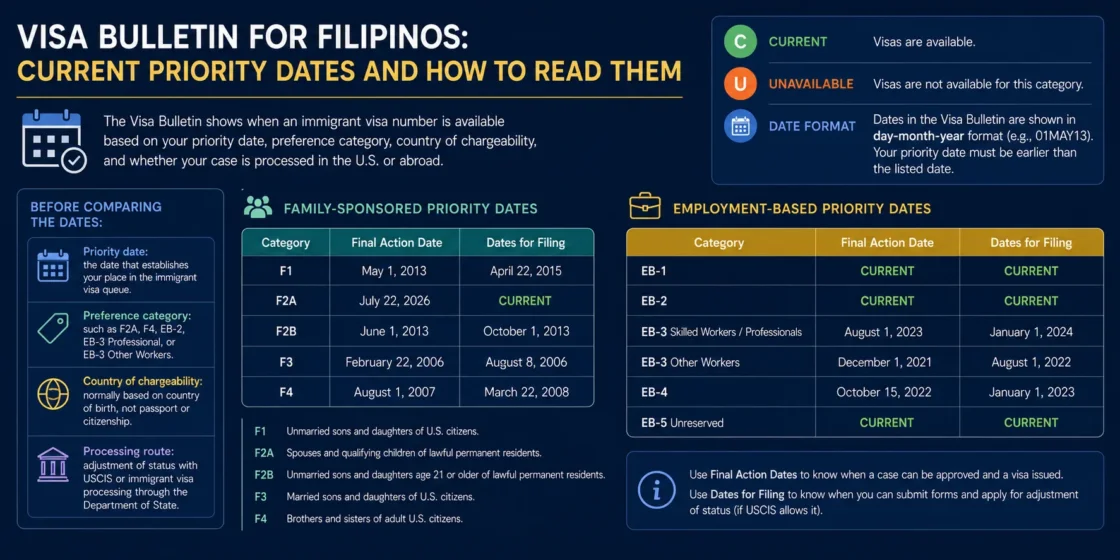
For Filipino applicants in numerically limited family-sponsored or employment-based immigrant categories, the October 2026 Visa Bulletin determines whether a priority date has reached a filing or final-action stage. The Philippines has separate cutoff dates in several family categories, while employment-based categories such as EB-2 and EB-3 now have dated cutoffs that differ from September. The correct comparison depends on the applicant’s preference category, country of chargeability, priority date, and whether the case is proceeding through adjustment of status in the United States or immigrant visa processing abroad.
Why this matters → A petition can already be approved while the applicant still has to wait for visa availability, and using the wrong Visa Bulletin chart can produce the wrong answer about whether a case may move forward.
Before Comparing the Dates:
- Priority date: the date that establishes the applicant’s place in the immigrant visa queue.
- Preference category: such as F2A, F4, EB-2, EB-3 Professional, or EB-3 Other Workers.
- Country of chargeability: normally based on country of birth rather than passport or citizenship.
- Processing route: adjustment of status with USCIS or immigrant visa processing through the Department of State.
October 2026 Visa Bulletin Dates for the Philippines
The Department of State publishes two sets of dates: Final Action Dates and Dates for Filing. They serve different purposes and should not be treated as interchangeable.
The official Visa Bulletin prints dates in day-month-year format, such as 01NOV13. The tables below expand those dates into a more readable format. A listed date means the applicant’s priority date generally must be earlier than that cutoff. “C” means the category is current, while “U” means immigrant visa numbers are unavailable for that category during the applicable period.[a]
Family-Sponsored Priority Dates for Filipinos
| Category | Final Action Date | Dates for Filing |
|---|---|---|
| F1 | November 1, 2013 | April 22, 2015 |
| F2A | September 22, 2026 | Current |
| F2B | October 1, 2013 | October 1, 2014 |
| F3 | July 22, 2006 | October 22, 2006 |
| F4 | May 15, 2008 | March 22, 2009 |
The family-sponsored categories shown above are:
- F1: unmarried sons and daughters of U.S. citizens.
- F2A: spouses and qualifying children of lawful permanent residents.
- F2B: unmarried sons and daughters age 21 or older of lawful permanent residents.
- F3: married sons and daughters of U.S. citizens.
- F4: brothers and sisters of adult U.S. citizens.
Employment-Based Priority Dates for Filipinos
| Category | Final Action Date | Dates for Filing |
|---|---|---|
| EB-1 | Current | Current |
| EB-2 | January 1, 2025 | March 15, 2026 |
| EB-3 Skilled Workers / Professionals | August 15, 2023 | January 1, 2024 |
| EB-3 Other Workers | January 1, 2022 | June 1, 2022 |
| EB-4 | December 15, 2022 | January 1, 2025 |
| Certain Religious Workers | December 15, 2022 | January 1, 2025 |
| EB-5 Unreserved | Current | Current |
| EB-5 Rural Set-Aside | Current | Current |
| EB-5 High-Unemployment Set-Aside | Current | Current |
| EB-5 Infrastructure Set-Aside | Current | Current |
Current Does Not Mean Approved: When a category is marked “Current,” there is no Visa Bulletin cutoff restricting applicants in that category based on priority date. The applicant must still satisfy all other requirements for adjustment of status or immigrant visa issuance.
What Changed for Filipinos From September to October 2026?
October begins fiscal year 2027 and brings forward movement in several Philippines family categories. Employment-based changes are mixed: EB-3 advances slightly, while EB-2 changes from Current to a dated Final Action cutoff.
The table compares the September and October Final Action Dates and shows the October Dates for Filing beside them.[a][e]
| Philippines Category | Current Month Final Action | Previous Month Final Action | Movement | October Dates for Filing |
|---|---|---|---|---|
| F1 | November 1, 2013 | May 1, 2013 | Moved forward | April 22, 2015 |
| F2A | September 22, 2026 | August 22, 2026 | Moved forward | Current |
| F2B | October 1, 2013 | June 1, 2013 | Moved forward | October 1, 2014 |
| F3 | July 22, 2006 | February 22, 2006 | Moved forward | October 22, 2006 |
| F4 | May 15, 2008 | August 22, 2007 | Moved forward | March 22, 2009 |
| EB-2 | January 1, 2025 | Current | New cutoff; no longer Current | March 15, 2026 |
| EB-3 Skilled / Professional | August 15, 2023 | August 1, 2023 | Moved forward 14 days | January 1, 2024 |
| EB-3 Other Workers | January 1, 2022 | December 1, 2021 | Moved forward | June 1, 2022 |
| EB-4 | December 15, 2022 | December 15, 2022 | No change | January 1, 2025 |
Family-sponsored Dates for Filing also moved in several Philippines categories. F2B advanced from October 1, 2013 to October 1, 2014, F3 moved from August 8, 2006 to October 22, 2006, and F4 moved from March 22, 2008 to March 22, 2009. F1 remained April 22, 2015, while F2A remained Current.
Important: October movement does not establish how far a category will move next month. Cutoff dates may advance, remain unchanged, retrogress, or become unavailable as visa demand and annual numerical limits change.
Which Visa Bulletin Chart Should Be Used?
Before comparing any priority date, determine whether the relevant chart is Final Action Dates or Dates for Filing.
The Department of State publishes both charts, but USCIS separately announces which chart adjustment-of-status applicants may use each month. For October 2026, USCIS designated the Dates for Filing chart for both family-sponsored and employment-based preference adjustment cases.[b]
USCIS Filing Chart for October 2026:
- Family-sponsored adjustment of status: use the Dates for Filing chart.
- Employment-based adjustment of status: use the Dates for Filing chart.
This chart selection applies to Form I-485 filing eligibility for the month. Final approval still depends on visa availability under the Final Action Dates chart.
This change matters for Philippine employment cases. An EB-3 Skilled Worker or Professional has an October 2026 Dates for Filing cutoff of January 1, 2024 and a Final Action Date of August 15, 2023. An otherwise eligible adjustment applicant with a priority date between those two cutoffs may be able to file Form I-485 in October because USCIS is using Dates for Filing, but the case cannot receive final action until a visa number is available under the Final Action Dates chart.
Final Action Dates and Dates for Filing Mean Different Things
| Chart | What It Indicates |
|---|---|
| Dates for Filing | An earlier processing stage. For Department of State cases, applicants whose dates meet the cutoff may be asked to assemble and submit required documents to the National Visa Center. For adjustment of status, it may be used only when USCIS designates that chart for the month. |
| Final Action Dates | The visa-number availability stage used for final action. An immigrant visa cannot be issued, or an adjustment case finally approved on a numerically limited preference basis, unless a visa number is available. |
A case can therefore reach the Dates for Filing cutoff before it reaches the Final Action Date. This is normal and does not mean the two government charts conflict with each other.
How to Read a Philippine Priority Date
Four pieces of information must match before the Visa Bulletin can be interpreted correctly.
Step 1: Find the Priority Date
The priority date establishes the applicant’s place in the immigrant visa queue. In family-sponsored preference cases, it is generally the date the qualifying immigrant petition was properly filed. Employment-based priority dates depend on the type of case; when labor certification is required, the date can be tied to when the Department of Labor accepted the labor certification application for processing. USCIS notices and the underlying petition records should be used to identify the actual case date.[f]
Step 2: Identify the Exact Preference Category
Do not compare the date with the nearest-looking category. An F2B beneficiary cannot use F2A. An F4 sibling case cannot use F3. An employment applicant classified as an EB-3 Other Worker cannot use the cutoff for EB-3 Skilled Workers and Professionals.
This distinction is particularly relevant for Philippine EB-3 cases because the October 2026 Final Action Dates are:
- EB-3 Skilled Workers / Professionals: August 15, 2023.
- EB-3 Other Workers: January 1, 2022.
Step 3: Confirm the Country of Chargeability
The Philippines column is based on chargeability, not simply Filipino citizenship. The Department of State explains that immigrant visa chargeability is normally based on place of birth. A person born in another country may therefore use a different chargeability column even if the person holds a Philippine passport. Certain limited rules can also permit alternate chargeability, including some cases involving a spouse’s country of birth.[c]
Attention: Philippine citizenship does not automatically mean the Philippines column is the correct Visa Bulletin column. Applicants born outside the Philippines should confirm their country of chargeability before comparing dates.
Step 4: Compare the Priority Date With the Correct Cutoff
If a calendar date is listed, the priority date must normally be earlier than the listed cutoff date. If the category displays “C,” the category is current for Visa Bulletin purposes. If it displays “U,” visa numbers are not authorized for issuance in that category for that period.
Tip: Think of the cutoff as a boundary, not as an estimated approval date. A Visa Bulletin date does not show how long an individual case will take to finish.
The Exact Cutoff Date Does Not Qualify as Earlier
This small detail can change the result of a date comparison. Department of State instructions say that a priority date must be earlier than the listed cutoff.
Consider the October 2026 Philippines EB-3 Skilled Workers and Professionals Final Action Date:
Cutoff: August 15, 2023
- Priority date August 14, 2023 → earlier than the cutoff.
- Priority date July 15, 2023 → earlier than the cutoff.
- Priority date August 15, 2023 → the same date, not earlier.
- Priority date August 16, 2023 → later than the cutoff.
Important Warning: If the Visa Bulletin lists August 15, 2023, a priority date of August 15, 2023 itself has not passed the “earlier than” test. The date must precede the published cutoff unless the category is shown as Current.
Examples for Filipino Family-Sponsored Cases
F4 Brother or Sister of a U.S. Citizen
Assume a Philippines-chargeable F4 applicant has a priority date of December 10, 2008.
| October 2026 F4 Philippines | Date | Comparison |
|---|---|---|
| Priority Date | December 10, 2008 | Applicant’s date |
| Dates for Filing | March 22, 2009 | Priority date is earlier |
| Final Action Date | May 15, 2008 | Priority date is not earlier |
The case has reached the Dates for Filing stage but not the Final Action Date. Because USCIS is using Dates for Filing for family-sponsored adjustment cases in October 2026, that distinction may affect filing eligibility for an otherwise eligible Form I-485 applicant.
F2A Spouse of a Lawful Permanent Resident
Assume a Philippines-chargeable F2A applicant has a priority date of January 10, 2026. The October Final Action Date is September 22, 2026, so January 10 is earlier than the Final Action cutoff. The Dates for Filing chart is also Current for F2A.
This does not mean the immigrant visa or green card is automatically approved. Petition approval, admissibility, required documentation, interview or adjustment processing, and other applicable requirements remain separate parts of the case.
Examples for Filipino Employment-Based Cases
EB-3 Professional With a July 2023 Priority Date
Assume a Philippine-born EB-3 Professional has a priority date of July 15, 2023. The October 2026 Philippines Final Action Date is August 15, 2023, and the Dates for Filing cutoff is January 1, 2024.
Because July 15, 2023 is earlier than both dates, the priority date is within the October filing cutoff and Final Action cutoff. Other adjustment-of-status or immigrant-visa requirements still apply.
EB-3 Professional With a September 2023 Priority Date
A Philippine EB-3 Professional with a priority date of September 12, 2023 is later than the August 15, 2023 Final Action cutoff but earlier than the January 1, 2024 Dates for Filing cutoff.
October 2026 I-485 Filing Difference: USCIS is using the Dates for Filing chart for employment-based adjustment cases in October. An otherwise eligible Philippine EB-3 Professional with a September 12, 2023 priority date falls before the January 1, 2024 filing cutoff and may therefore be able to file Form I-485, even though the priority date has not yet reached the August 15, 2023 Final Action cutoff for approval.
EB-3 Other Worker
An applicant classified as an EB-3 Other Worker must use the Other Workers row. The October 2026 Philippines Final Action Date is January 1, 2022, while the Dates for Filing cutoff is June 1, 2022. Those dates cannot be replaced with the newer EB-3 Skilled Workers and Professionals cutoffs.
The classification on the underlying employment petition matters. An applicant should not choose whichever EB-3 row has the newer date.
What C and U Mean in the Visa Bulletin
C — Current
“C” means the category is current. There is no priority-date cutoff restricting qualified applicants in that category for the particular chart.
For the Philippines in October 2026, examples include:
- EB-1 on both the Final Action Dates and Dates for Filing charts.
- EB-5 Unreserved on both charts.
- EB-5 set-aside categories on both charts.
- F2A on the Dates for Filing chart.
EB-2 is not Current for the Philippines in October. Its Final Action Date is January 1, 2025, and its Dates for Filing cutoff is March 15, 2026.
U — Unavailable
“U” means immigrant visa numbers are not authorized for issuance in that category during the applicable period. A category that becomes unavailable can later reopen when visa numbers become available again, but applicants should rely on the published bulletin rather than assuming when that will happen.
Why the Philippines Has Its Own Column
The Visa Bulletin does not give every country a separate column. Most countries fall under “All Chargeability Areas Except Those Listed.” The Philippines is listed separately because it is one of the oversubscribed chargeability areas to which the Visa Bulletin’s country allocation provisions currently apply.
The October 2026 bulletin, which begins fiscal year 2027 visa-number availability, states an annual minimum family-sponsored preference limit of 226,000, a worldwide employment-based preference level of at least 140,000, and a statutory per-country limit of 25,620. These numerical controls are part of the reason a country with high demand can have different cutoff dates from the general worldwide column.[a]
A separate Philippines cutoff does not mean every Filipino applicant waits the same amount of time. The queue still depends heavily on the individual preference category and priority date.
Immediate Relatives of U.S. Citizens Usually Do Not Use These Preference Cutoffs
The family-sponsored F1 through F4 tables apply to numerically limited preference categories. They should not be confused with the immediate-relative classifications of U.S. citizens, for which immigrant visa numbers are not subject to the same annual preference backlog.
Immediate relatives generally include:
- a spouse of a U.S. citizen;
- an unmarried child under age 21 of a U.S. citizen; and
- a parent of a U.S. citizen who is at least 21 years old.
Example: A spouse of a lawful permanent resident is generally in F2A and may need to follow Visa Bulletin availability. A spouse of a U.S. citizen is normally an immediate relative and does not look for an F2A cutoff merely because the case involves marriage.
Visa availability and case-processing speed are still different issues. An immediate-relative visa may be numerically available while petition processing, document review, or interview scheduling still takes time.
Adjustment of Status and Consular Processing Use the Bulletin Differently
Adjustment of Status in the United States
An applicant filing Form I-485 must first check the Visa Bulletin and then confirm which chart USCIS has authorized for the relevant month. The chart selection can change from month to month.
For October 2026:
- Identify whether the case is family-sponsored or employment-based.
- Use Dates for Filing for family-sponsored adjustment cases.
- Use Dates for Filing for employment-based adjustment cases.
- Find the correct preference category and chargeability column.
- Confirm that the priority date is earlier than the applicable filing cutoff, or that the category is Current.
- Remember that final approval still requires visa availability under the Final Action Dates chart.
- Confirm all other adjustment-of-status requirements separately before filing.
Immigrant Visa Processing Through the Department of State
For applicants processing an immigrant visa abroad, including cases that may ultimately be interviewed in Manila, the Dates for Filing table can determine when the Department of State considers a case within a timeframe for document submission. Applicants should follow instructions received from the National Visa Center rather than submitting documents solely because a date appears favorable in the bulletin.
The Final Action Date remains relevant to actual immigrant visa availability. Reaching a filing date, becoming documentarily complete, receiving an interview appointment, and having an immigrant visa number available are separate milestones.
Why Visa Bulletin Dates Can Stop or Move Backward
The Department of State allocates numerically limited immigrant visas according to reported demand, statutory category limits, country limits, and available visa numbers. As demand becomes clearer during the fiscal year, cutoff dates can change.
Forward Movement
A date may advance when the Department of State determines that additional applicants can be reached while remaining within the available allocation. October 2026 brought forward movement in several Philippines family-sponsored Final Action Dates and in Philippine EB-3.
No Movement
A cutoff can stay in exactly the same place for one or more months. Philippine EB-4 is an October example: its Final Action Date remained December 15, 2022 from September to October 2026.
Retrogression
Retrogression occurs when a cutoff moves backward to an earlier date. A category can also change from Current to a dated cutoff. Philippine EB-2 illustrates the latter in October 2026: its Final Action Date changed from Current in September to January 1, 2025 in October.
Unavailable Status
If an applicable annual, category, or country allocation is reached, a preference category can be marked “U.” The October bulletin also notes that FY 2027 filing and final-action dates advanced across various categories as new fiscal-year numbers became available, while some employment categories for other chargeability areas moved backward to remain within quarterly and annual limits.[a]
Do Not Convert Monthly Movement Into a Wait-Time Prediction: A large advance in one bulletin does not mean the same amount of movement will occur the following month. A date that stays unchanged also does not establish how long it will remain there.
Children Near Age 21 Need an Additional CSPA Review
Visa Bulletin timing can have additional consequences when a child beneficiary or derivative beneficiary is approaching age 21. The Child Status Protection Act can preserve a person’s classification as a child in some immigration cases, but the calculation is not simply “priority date became current before age 21.”
USCIS revised its policy effective August 15, 2025. For requests filed on or after that effective date, USCIS considers a visa available for the CSPA age calculation under the applicable family- and employment-based preference provisions when a visa is authorized for issuance according to the Final Action Dates chart.[d]
Attention for Families With a Child Near 21: Do not rely only on the Dates for Filing chart to determine whether CSPA protects a child from aging out. CSPA calculations can depend on petition timing, visa availability, and the requirement to seek permanent residence within the applicable period.
Common Visa Bulletin Mistakes for Filipino Applicants
- Using Philippine citizenship instead of country of chargeability. Chargeability is normally tied to country of birth.
- Looking only at Dates for Filing. The Final Action Date serves a different purpose and may be much earlier.
- Ignoring the USCIS monthly chart selection. USCIS does not automatically allow adjustment applicants to use the more favorable table.
- Treating the cutoff date itself as eligible. A listed calendar cutoff generally requires a priority date earlier than that date.
- Using EB-3 instead of EB-3 Other Workers. These rows can have very different cutoffs.
- Using F2A for the spouse of a U.S. citizen. A qualifying spouse of a U.S. citizen is normally an immediate relative rather than an F2A preference beneficiary.
- Assuming an approved petition means a visa number is available. Petition approval and Visa Bulletin availability are different decisions.
- Assuming “Current” means immediate approval. All other eligibility and processing requirements still apply.
- Predicting a green card date by measuring monthly movement. Visa Bulletin movement is not linear.
- Using an old screenshot or saved table. The applicable bulletin and USCIS chart designation should be checked for the actual filing month.
How to Interpret a Priority Date in Practice
The simplest reliable method is to compare the case in this order:
- Find the actual priority date.
- Confirm the exact family or employment preference classification.
- Confirm country of chargeability.
- Choose the correct month’s Visa Bulletin.
- Determine whether Final Action Dates or Dates for Filing applies to the action being considered.
- Compare the priority date with the cutoff.
- If the priority date is earlier, confirm all other filing or issuance requirements before taking action.
| Example | October 2026 Result |
|---|---|
| Philippines F4, PD December 10, 2008 | Earlier than the March 22, 2009 Dates for Filing cutoff, but not earlier than the May 15, 2008 Final Action Date. |
| Philippines F2A, PD January 10, 2026 | Earlier than the September 22, 2026 Final Action Date; Dates for Filing is Current. |
| Philippines EB-3 Professional, PD July 15, 2023 | Earlier than both the January 1, 2024 Dates for Filing cutoff and the August 15, 2023 Final Action Date. |
| Philippines EB-3 Professional, PD August 15, 2023 | Same as the Final Action cutoff, so it does not satisfy the “earlier than” rule for final action; it is earlier than the January 1, 2024 filing cutoff. |
| Philippines EB-3 Professional, PD September 12, 2023 | Earlier than the January 1, 2024 Dates for Filing cutoff but later than the August 15, 2023 Final Action Date. USCIS permits employment-based applicants to use Dates for Filing in October 2026. |
Frequently Asked Questions
Is EB-3 Philippines Current in October 2026?
No. For Philippine EB-3 Skilled Workers and Professionals, the October 2026 Final Action Date is August 15, 2023. The Dates for Filing cutoff is January 1, 2024.
What Is the F4 Priority Date for the Philippines in October 2026?
The Philippines F4 Final Action Date is May 15, 2008. The F4 Dates for Filing cutoff is March 22, 2009.
What Is the F2A Priority Date for the Philippines?
For October 2026, the Philippines F2A Final Action Date is September 22, 2026. The Dates for Filing chart is Current.
What Is the EB-2 Priority Date for the Philippines in October 2026?
Philippine EB-2 is no longer Current on the Final Action Dates chart. The October 2026 Final Action Date is January 1, 2025, while the Dates for Filing cutoff is March 15, 2026.
Which Chart Should Family-Based I-485 Applicants Use in October 2026?
USCIS designated the Dates for Filing chart for family-sponsored preference adjustment-of-status applicants in October 2026.
Which Chart Should Employment-Based I-485 Applicants Use in October 2026?
USCIS also designated the Dates for Filing chart for employment-based adjustment-of-status applicants in October 2026.
Can an Applicant File if the Priority Date Is Exactly the Same as the Cutoff?
A listed cutoff generally requires a priority date earlier than the published date. A priority date that is exactly the same as the cutoff does not satisfy that comparison.
Why Does Philippine EB-3 Show Two Different Dates?
The two dates come from different Visa Bulletin charts. The January 1, 2024 date is the Dates for Filing cutoff, while August 15, 2023 is the Final Action Date for Philippine EB-3 Skilled Workers and Professionals in October 2026. USCIS permits employment-based adjustment applicants to use Dates for Filing for October filing eligibility, but final approval still depends on Final Action visa availability.
Does an Approved I-130 or I-140 Mean the Priority Date Is Current?
No. Petition approval establishes or confirms the underlying immigrant classification, but numerically limited preference applicants may still have to wait until the relevant Visa Bulletin cutoff reaches their priority date.
Does “Current” Mean a Green Card Will Be Approved Immediately?
No. “Current” addresses visa-number availability under the chart. It does not remove other eligibility requirements, document review, security checks, medical requirements, interview procedures, or ordinary case-processing time.
A Filipino Applicant Was Born Outside the Philippines. Which Column Applies?
Chargeability is normally based on country of birth rather than nationality. A Filipino citizen born elsewhere should not automatically use the Philippines column. Certain alternate-chargeability rules may also apply in limited situations.
Can Visa Bulletin Dates Move Backward?
Yes. This is called retrogression. A category may also change from Current to a dated cutoff, as Philippine EB-2 did from September to October 2026.
Can the Next Visa Bulletin Date Be Predicted From This Month’s Movement?
Not reliably. The Department of State adjusts cutoff dates according to visa demand and available numerical allocations. A large advance, small advance, or month with no movement does not establish the next month’s cutoff.
Verification Note: Visa Bulletin dates and USCIS filing-chart selections can change every month. Applicants should check the applicable Department of State Visa Bulletin and USCIS adjustment-of-status filing chart again before submitting an application or making a time-sensitive immigration decision.
Sources
- U.S. Department of State — Visa Bulletin for October 2026 — Official Philippines Final Action Dates, Dates for Filing, FY 2027 visa-number information, and October visa-availability instructions. (Official U.S. government source.)
- USCIS — Adjustment of Status Filing Charts From the Visa Bulletin — Official monthly determination of which Department of State chart adjustment-of-status applicants may use. (Official U.S. government immigration authority.)
- U.S. Department of State — Visa Glossary — Official explanation of immigrant visa chargeability and its relationship to place of birth. (Official U.S. government source.)
- USCIS — Revising Age Calculation Under the Child Status Protection Act — Official policy update explaining the Final Action Dates rule for CSPA age calculations effective August 15, 2025. (Official U.S. government policy document.)
- U.S. Department of State — Visa Bulletin for September 2026 — Official prior-month dates used to compare Philippines category movement from September to October 2026. (Official U.S. government source.)
- USCIS — Visa Availability and Priority Dates — Official USCIS information on priority dates, visa availability, preference queues, and adjustment-of-status timing. (Official U.S. government immigration authority.)