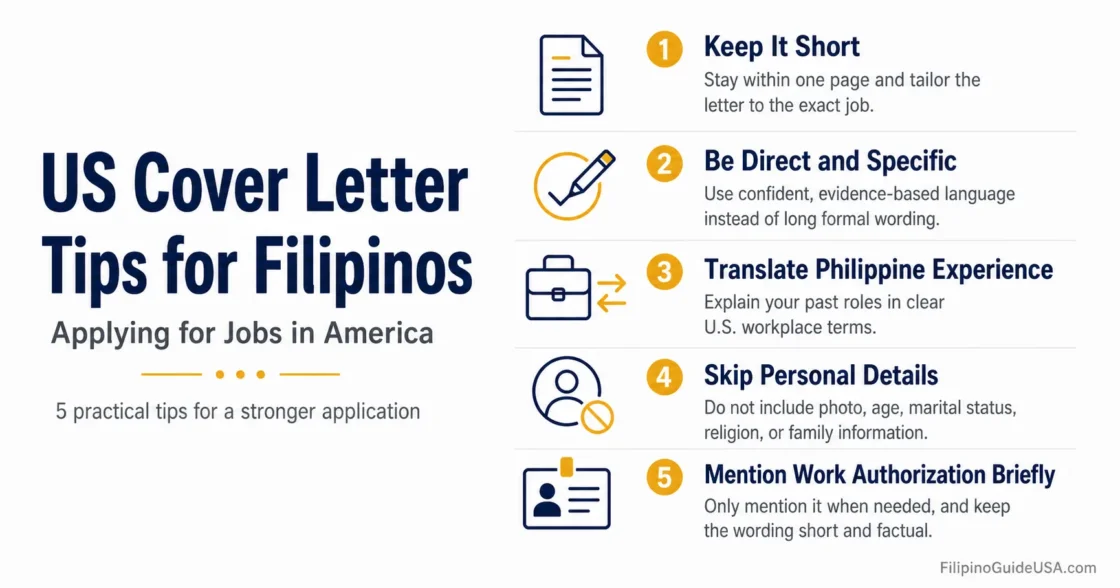
US Cover Letter Tips for Filipinos Applying for Jobs in America
A U.S. cover letter should not read like a life story, a visa explanation, or a second copy of your resume. For Filipino applicants, the stronger approach is simple: write one short page that connects your experience to the exact job, uses clear proof, and shows that you understand how U.S. employers read applications.
The reader usually wants to know what you can contribute, how your experience matches the position, and why your background deserves an interview. Philippine work experience can be useful evidence when it is described in terms the employer can understand.
What a U.S. Cover Letter Should Do
A cover letter is a short business letter sent with your resume. Its job is to explain why your background fits the role, not to repeat every item on your resume. U.S. career offices commonly advise applicants to keep it focused on the specific position, give brief examples, and stay within one page.[a]
For many Filipino applicants, the biggest adjustment is tone. In the Philippines, formal respect, humility, and long explanations can feel natural. In the U.S. hiring process, the letter usually works better when it is polite, direct, and evidence-based.
A good cover letter answers three plain questions:
Which job are you applying for?
Why does your experience match the employer’s need?
What can the employer expect from you if they invite you to interview?
Best Length, Format, and File Style
Most U.S. cover letters should be one page or less. Three to five short paragraphs are enough for most applications. If the employer gives exact instructions in the job posting, follow those instructions first.
| Section | What to Include | What to Avoid |
|---|---|---|
| Opening | Name the role, mention where you saw it if useful, and give one clear reason you fit. | Long greetings, personal background, or general praise for the company. |
| Middle | Use one or two examples from work, school, training, or volunteer experience. | Repeating your resume line by line. |
| Fit | Connect your skills to the employer’s job description. | Generic claims such as “I am hardworking” without proof. |
| Closing | Thank the employer and invite a conversation. | Pressure, over-apology, or too much explanation about your situation. |
For file uploads, use the format requested in the job posting or application portal. PDF is common when accepted because it preserves layout, while some recruiting systems may specifically request Word or another file type. Use a simple file name such as Maria_Santos_Cover_Letter.pdf. If applying by email and no attachment is requested, the cover letter may be placed in the email body.
How Filipinos Should Adjust Their Cover Letter for U.S. Employers
Use Confident Language Without Sounding Pushy
Many Filipino applicants understate their experience. A U.S. cover letter should be respectful, but it should still say clearly what you can do. Instead of writing, “I humbly hope you will consider me,” write something closer to, “My customer service experience and scheduling background match the needs of this role.”
The goal is not to boast. The goal is to help the hiring manager understand your value without guessing.
Translate Philippine Experience Into U.S. Workplace Terms
Job titles, school names, and workplace duties from the Philippines may not be familiar to a U.S. employer. Keep the original title if needed, but explain the function in plain terms.
For example, “administrative staff” may become stronger when paired with details such as appointment scheduling, records management, customer support, billing assistance, or inventory tracking. “Barangay volunteer work” may be clearer if described as community service, local documentation support, event coordination, or public assistance work, depending on what you actually did.
Do Not Add Personal Details That Do Not Help the Hiring Decision
A U.S. cover letter normally does not include age, marital status, religion, family details, a photo, height, weight, or personal documents. The Equal Employment Opportunity Commission advises employers to avoid hiring questions tied to protected personal characteristics such as race, religion, national origin, sex, and age, and federal rules place additional limits on disability-related questions before a job offer.[b]
This does not mean you should hide being Filipino. It means the letter should focus on job-related value: skills, experience, training, reliability, communication, certifications, and results.
What to Say About Work Authorization
Work authorization can be confusing, especially for new arrivals, students, green card holders, U.S. citizens from Filipino families, temporary workers, and applicants with an Employment Authorization Document. In most standard job applications, your cover letter does not need a long immigration explanation.
For people hired to work in the United States, employers use Form I-9 to verify identity and employment authorization.[c] Form I-9 is part of the hiring process after a job has been accepted, not something that should be attached to a cover letter. If an application asks whether you are authorized to work in the United States or will require sponsorship, answer those questions accurately.
If you choose to mention work authorization, keep it short and factual:
“I am authorized to work in the United States.”
“I am available to complete employment eligibility verification if selected.”
“I can provide required employment eligibility documentation during the hiring process.”
Avoid giving extra visa history, family immigration details, or personal hardship in the cover letter. Those details usually distract from your qualifications.
Document Note: During Form I-9 verification, employees may choose which acceptable documents to present from the official Lists of Acceptable Documents. An employer generally cannot require a particular I-9 document simply because an applicant is an immigrant or appears foreign.[e]
Cover Letter Structure You Can Use
Opening Paragraph
Start with the job title and one strong match. Do not begin with a long self-introduction.
I am applying for the Patient Services Representative position. My background in front-desk support, appointment coordination, and bilingual customer service matches the needs described in the posting.
Middle Paragraph
Use proof. One clear example is better than five general claims.
In my previous role, I handled daily client calls, updated records, prepared billing documents, and coordinated schedules for a small team. That experience helped me build accuracy, patience, and a calm communication style with clients who needed clear instructions.
Second Middle Paragraph
If useful, add another job-related strength. This is where Filipino applicants can explain overseas experience in a way U.S. employers understand.
My work experience in the Philippines also trained me to handle high-volume service situations, follow written procedures, and work closely with supervisors. I am comfortable learning new systems and keeping records organized.
Closing Paragraph
End with a calm, professional close.
Thank you for your consideration. I would be glad to discuss how my background fits the position and your team’s needs.
Words and Phrases That Usually Work Better
Small wording changes can make the letter sound more natural to U.S. employers.
| Less Effective | Better Option | Why It Works |
|---|---|---|
| “I am humbly applying…” | “I am applying for…” | It sounds polite but more direct. |
| “I am willing to be trained.” | “I learn new systems quickly and follow procedures carefully.” | It shows trainability with a workplace skill. |
| “I can work under pressure.” | “I handled daily customer concerns while keeping records accurate.” | It gives proof instead of a common phrase. |
| “I need this job to support my family.” | “I am interested in this role because my background matches your service and scheduling needs.” | It keeps the letter focused on the employer’s needs. |
How to Present Philippine Education and Credentials
If your degree, training, or license was earned in the Philippines, mention it only when it supports the job. Use the full school name when helpful, and describe the field in U.S.-friendly terms.
For regulated fields such as nursing, teaching, accounting, engineering, or healthcare support, be careful. A Philippine credential may be valuable, but U.S. licensing or employer rules may still apply. Your cover letter should not imply that you hold a U.S. license unless you actually do.
Better wording might look like this:
“I completed a Bachelor of Science in Nursing in the Philippines and have experience supporting patient intake and documentation.”
“My accounting background includes invoice review, spreadsheet tracking, and monthly report preparation.”
“My education in hospitality management prepared me for guest service, scheduling, and front-desk communication.”
Common Mistakes to Avoid
Sending the same letter to every employer: Change the job title, employer name, and examples for each application.
Writing too formally: “Dear Sir/Madam” can be understood, but “Dear Hiring Manager” usually sounds more natural in a U.S. application when no contact name is available.
Explaining too much personal history: Keep the focus on the job.
Using only personality traits: Words like hardworking, honest, and patient are better when paired with a real example.
Forgetting the job posting: Use the employer’s own terms when they truly match your background.
Adding salary details when not asked: Discuss salary only when the employer requests it.
Ignoring application instructions: CareerOneStop advises applicants to read the application carefully and provide the information requested.[d]
Sample Cover Letter for a Filipino Applicant
This sample is not meant to be copied word for word. Use it as a model for tone and structure.
Dear Hiring Manager,
I am applying for the Administrative Assistant position. My experience in office support, scheduling, records management, and customer communication matches the needs described in your posting.
In my previous role, I handled daily phone and email inquiries, prepared documents, updated records, and helped coordinate appointments for clients and staff. This work required accuracy, patience, and clear communication, especially when clients needed step-by-step instructions.
My background in the Philippines also gave me experience working with different departments and adapting to busy office settings. I am comfortable learning new software, following written procedures, and keeping information organized.
Thank you for reviewing my application. I would welcome the opportunity to discuss how my experience can support your team.
Sincerely,
Maria Santos
Examples for Different Filipino Applicant Situations
New Arrival With Philippine Work Experience
Focus on transferable skills. U.S. employers may not know your past company, but they can understand customer service, documentation, billing, scheduling, sales support, inventory, data entry, caregiving, or team coordination.
My previous work in the Philippines involved client support, daily reporting, and coordination with supervisors. These tasks prepared me to handle service requests carefully and communicate clearly with customers and team members.
Recent Graduate or Student
If you have limited paid experience, use internships, school projects, volunteer work, campus activities, or part-time work. The example must still connect to the job.
Through my internship and class projects, I developed experience preparing reports, organizing files, and presenting information clearly. I am interested in this role because it would allow me to use those skills in a customer-focused office setting.
Healthcare, Caregiving, or Service Background
Many Filipinos apply for roles in healthcare support, caregiving, hospitality, food service, retail, and customer service. In these fields, employers often look for reliability, clear communication, safety awareness, and steady service under busy conditions.
My experience supporting clients in a care setting has helped me build patience, attention to detail, and respect for daily routines. I understand the value of clear communication, accurate documentation, and dependable attendance.
Career Changer
If you are changing industries, do not apologize for the change. Explain the connection between your old work and the new role.
Although my recent experience is in retail, the role strengthened skills that match this office position, including customer communication, problem solving, payment handling, and accurate record updates.
Before Sending Your Cover Letter
Use this review list before uploading or emailing the letter:
The job title and employer name are correct.
The letter is one page or shorter.
The first paragraph names the role clearly.
The middle section gives proof, not only personality traits.
Philippine experience is explained in U.S.-friendly workplace terms.
No photo, age, marital status, religion, or family details are included.
Work authorization is mentioned only when useful or requested.
The file format follows the employer or application portal instructions.
The file name looks professional.
The resume and cover letter tell the same story.
The letter has been checked for spelling, grammar, and copied template text.
Questions Filipino Applicants Often Ask
Should I Mention That I Am Filipino?
Only mention it if it helps explain job-related experience, language ability, community knowledge, or cultural familiarity needed for the role. Do not include nationality as a personal detail if it does not serve the application.
Should I Explain My Visa Status in the Cover Letter?
Usually, no. If the employer asks about work authorization or sponsorship in the application, answer there. If you mention authorization in the cover letter, keep it short and factual. Form I-9 instructions also state that employees may choose which acceptable documents to present and warn employers against treating workers differently based on citizenship, immigration status, or national origin.[e]
Can I Use “Dear Sir/Madam”?
You can, but “Dear Hiring Manager” is often more natural for U.S. applications when no name is listed. If the job posting gives a recruiter or manager name, use that name.
Should I Include References?
No, not in the cover letter unless the employer asks for them. Prepare references separately so you are ready if the employer requests them later.
Is a Cover Letter Always Required?
Not always. Some online applications make it optional. If the employer allows one, a short tailored letter can help explain why your background fits the role, especially when your experience was gained outside the United States.
When Official Details Matter
Hiring forms, work authorization rules, employer verification steps, and job application requirements can change. If your situation involves a visa, Employment Authorization Document, Form I-9, licensing, or a regulated occupation, check the current official source before relying on any general advice. For personal legal questions, use qualified professional guidance.
Sources
[a] MIT Career Advising & Professional Development, “How to Write an Effective Cover Letter” — supports the one-page, job-specific, example-based cover letter approach. MIT is a university career office with employer-facing application guidance. Back to reference
[b] U.S. Equal Employment Opportunity Commission, “What Shouldn’t I Ask When Hiring?” — supports the advice to avoid unnecessary hiring questions concerning protected personal characteristics. The EEOC enforces federal employment discrimination laws. Back to reference
[c] U.S. Citizenship and Immigration Services, “Form I-9, Employment Eligibility Verification” — explains that Form I-9 is used to verify identity and employment authorization for people hired to work in the United States. USCIS is the federal agency responsible for Form I-9 guidance. Back to reference
[d] CareerOneStop, “Job Applications” — supports the advice to read application instructions carefully and provide the information requested. CareerOneStop is sponsored by the U.S. Department of Labor, Employment and Training Administration. Back to reference
[e] USCIS, “Instructions for Form I-9, Employment Eligibility Verification” — supports employee choice among acceptable I-9 documents and the warning against document demands or different treatment based on citizenship, immigration status, or national origin. Back to reference