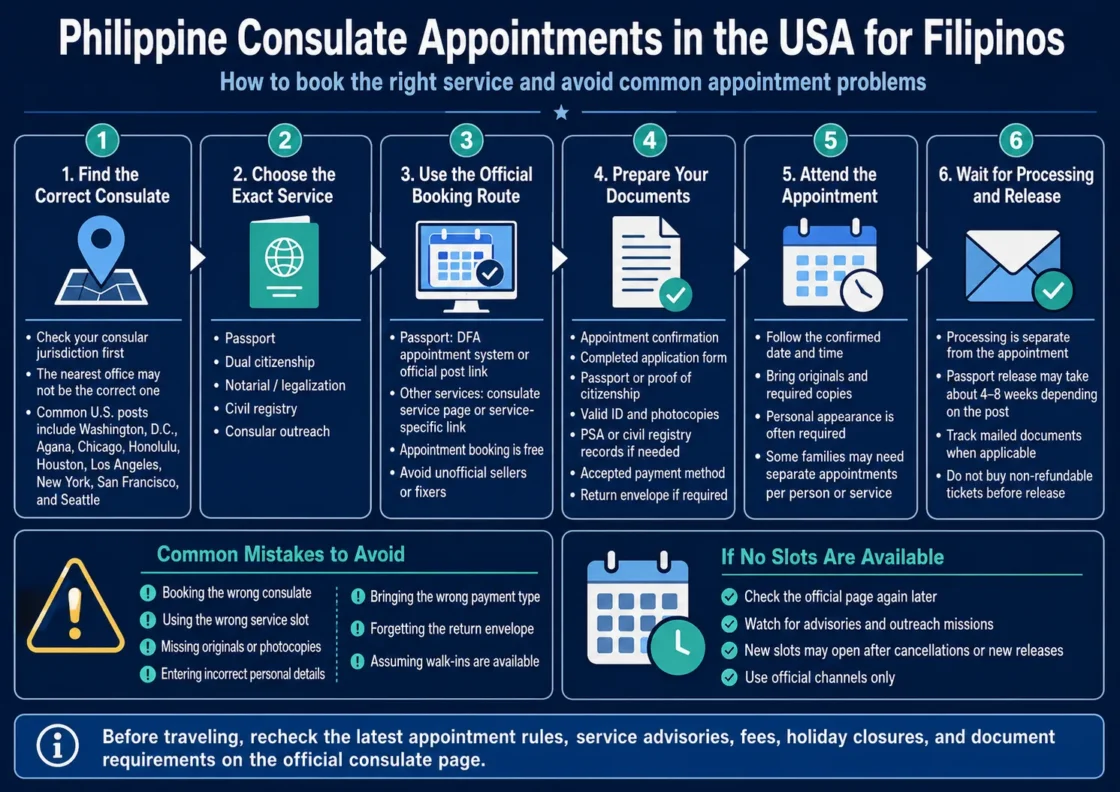
Philippine Consulate Appointments in the USA for Filipinos
Philippine consulate appointments in the United States are used for passport services, dual citizenship, notarization, civil registry matters, travel documents, and selected in-person requests. The right booking path depends on three things: the applicant’s consular jurisdiction, the service needed, and whether the chosen post uses the DFA passport system, its own appointment page, mail-in processing, or an outreach schedule.
Why this matters →
A correct appointment prevents wasted travel, missed passport timelines, and rejected visits at the consulate counter.
Required Documents: Requirements vary by service, but most applicants should prepare these before booking or attending an appointment:
- Printed or digital appointment confirmation, if the service requires an appointment
- Completed application form for the selected service
- Current Philippine passport, old passport, or proof of Philippine citizenship when required
- Valid government-issued ID and photocopies requested by the consulate
- PSA-issued or consular civil registry documents, if the service involves birth, marriage, death, name use, or citizenship records
- Supporting documents listed on the exact consulate page for that service
- Accepted payment method shown by the consulate, because card, cash, money order, and cashier’s check rules may differ
- Self-addressed return envelope when the consulate requires mailing of the processed document
Start With the Correct Consulate
The first step is to confirm which Philippine post handles the applicant’s state, territory, or county.
Filipinos in the United States should not assume that the nearest office is always the correct one. Philippine posts in Washington, D.C., Agana, Chicago, Honolulu, Houston, Los Angeles, New York, San Francisco, and Seattle serve different jurisdictions. The official Consulate Finder lists addresses, contact details, and jurisdiction coverage for each post.[a]
Tip: Applicants in California and Nevada should check jurisdiction carefully. Southern California and Southern Nevada are generally handled differently from Northern California and Northern Nevada.
Understand Which Appointment System Applies
Passport, dual citizenship, notarization, and civil registry requests may use different booking routes.
| Service Type | Common Appointment Route | What to Check Before Booking |
|---|---|---|
| Passport application or renewal | Often booked through the DFA Global Online Appointment System or the passport appointment link provided by the post | Whether the selected post is available in the DFA system, whether personal appearance is required, and what documents apply to the applicant category |
| Dual citizenship | Usually booked through the consulate’s own appointment page or service-specific link | Whether the applicant needs a separate passport appointment after reacquiring Philippine citizenship |
| Notarial or legalization services | Often handled through a consulate appointment system, with personal appearance for documents that must be signed before a consular officer | Original IDs, unsigned documents when required, number of signatories, and accepted payment method |
| Civil registry | May be mail-in, appointment-based, or processed according to the post’s service page | Whether the Report of Birth, Report of Marriage, or Report of Death must be mailed, filed in person, or handled by appointment |
| Consular outreach | Usually announced separately for a city and date range | Eligibility, slot release date, payment instructions, and whether the outreach accepts the exact service needed |
The Philippine Embassy in Washington, D.C. states that appointment scheduling is free and separates appointment links by service, including passport, dual citizenship, notarial services, checklists, and outreach matters.[b]
Step 1: Choose the Exact Service Before Looking for a Slot
The appointment should match the transaction, not only the location.
A passport appointment cannot normally be used for dual citizenship, notarization, or civil registry filing. The New York appointment page, for example, separates the passport appointment system from the dual citizenship and notarization appointment system.[c]
Applicants should decide whether the main purpose is passport renewal, first Philippine passport after dual citizenship, lost passport replacement, Report of Birth, notarized affidavit, Special Power of Attorney, visa matter, or another service. This prevents booking the wrong slot and being turned away at check-in.
Tip: When a household needs more than one service, each person and each transaction may need its own appointment. Always read the appointment page before booking a family trip to the consulate.
Step 2: Book Passport Appointments Through the Official Passport System When Directed
Passport slots should be booked only through official channels.
The DFA passport appointment website states that passport appointments are free and should only be made through the official passport.gov.ph portal. It also warns applicants against using fixers or social media accounts for appointment booking.[d]
Several Philippine posts in the United States direct passport applicants to the DFA Global Online Appointment System. The San Francisco passport page states that confirmed passport appointment and personal appearance are required, and that passport appointments can be obtained through the DFA’s Global Online Appointment System.[e]
Notice: Do not pay a third party to obtain a Philippine consulate appointment. Official passport appointment slots are free, and some consulate appointment terms state that slots are non-transferable. Incorrect or inaccurate information may delay or affect the application.
Step 3: Check Whether the Consulate Offers an Alternative Passport Site
Some locations may have extra service routes, but they are not always for every applicant.
Los Angeles has published passport appointment options for applying at the Philippine Consulate General in Los Angeles or at the Philippine ePassport Renewal Center in Los Angeles, known as LA PaRC. The LA page states that LA PaRC is operated by VFS Global and charges a convenience fee in addition to the passport renewal fee.[f]
This type of option should be reviewed carefully. A third-party renewal center may be limited to certain passport applicants, while other categories may still need to apply directly at the consulate.
Step 4: Prepare the Documents Before the Appointment Date
A confirmed appointment does not replace the service requirements.
Applicants should download the latest form from the relevant service page, print the appointment confirmation, prepare original documents, and bring the required photocopies. For passport services, the applicant’s photo, fingerprints, and signature are generally captured on-site during personal appearance.
Common reasons for appointment problems include missing photocopies, expired IDs, unsigned or incorrectly signed forms, wrong name order, missing PSA records, wrong payment type, and booking a passport slot when the person actually needs dual citizenship, civil registry, or notarization service.
Practical note: Some consulates do not provide printing or photocopying facilities on site. Applicants should arrive with complete forms and copies instead of relying on nearby services.
Step 5: Attend the Appointment According to the Confirmation Rules
The check-in process may differ by post, building, security desk, and service type.
Applicants should follow the time and entry instructions in the appointment confirmation. Some posts remind applicants to bring a confirmed appointment, complete requirements, payment, and a return envelope when required. New York’s appointment reminders also note arrival timing, payment, and return envelope expectations for selected services.[g]
For most in-person services, only the applicant or required signatory should attend unless the service page allows a parent, guardian, interpreter, witness, or representative. Minors usually require parent or guardian presence according to the passport or civil registry rules for that specific case.
Step 6: Track or Receive the Document After Processing
Processing and release are separate from the appointment itself.
Passport release timelines vary by post and workload. New York states that regular passport applications received from Philippine Embassies or Consulates are available about four to six weeks from the date of application, and advises applicants to plan travel only after receiving the new passport.[h]
Houston’s passport service page describes a process that includes appointment scheduling, document preparation, personal appearance, biometric data collection, and mailed passport delivery within six to eight weeks after the appointment. It also reminds applicants that they are responsible for a clear, properly prepared return envelope when using mail delivery.[i]
Travel warning: Do not buy non-refundable international tickets based only on an appointment date. Passport printing, mailing, courier delays, holidays, and missing-document follow-ups can affect the final release date.
When No Appointment Slots Are Available
No-slot situations are common during travel seasons and outreach periods.
If no slot is available, applicants should return to the official appointment page at different times, check the consulate’s advisories, and review whether an outreach mission is scheduled for their area. Slots can open when new batches are released or when other applicants reschedule.
Applicants should avoid unofficial appointment sellers. Consulates and the DFA repeatedly remind the public that appointment booking should be done through official channels. Paying someone does not make the application stronger and can create privacy, accuracy, and cancellation problems.
Common Appointment Mistakes to Avoid
Most appointment issues come from choosing the wrong post, wrong service, or wrong document set.
- Booking at a consulate that does not cover the applicant’s residence area
- Using a passport appointment for dual citizenship, notarization, or civil registry
- Arriving without printed forms, photocopies, or required originals
- Using a nickname, different spelling, or wrong birth date in the appointment form
- Bringing an unacceptable payment method
- Forgetting the return envelope when mail delivery is required
- Buying travel tickets before the new passport is released
- Assuming walk-in service is available without checking the current advisory
Appointments for Consular Outreach Missions
Outreach appointments are separate from regular appointments at the main consulate.
Consular outreach missions help Filipinos in cities far from the main consulate, but they are usually limited by date, location, service type, and available slots. A passport outreach slot may not cover civil registry, dual citizenship, notarization, or other services unless the advisory says so.
Applicants should read the outreach notice fully before booking. Important details usually include the city, venue, appointment link, accepted services, payment rules, document checklist, and whether return mailing is required.
What to Recheck Before Traveling to the Consulate
A final review helps prevent appointment-day problems.
- Correct consulate or outreach mission
- Correct service and applicant category
- Exact date and time on the appointment confirmation
- Building address, suite number, parking, and security entry rules
- Original documents and required photocopies
- Accepted payment method
- Return envelope and tracking number, if required
- Latest holiday closure or service advisory
Verification note: Consular appointment systems, fees, payment rules, accepted services, outreach schedules, and release timelines can change. Applicants should recheck the official consulate page and the appointment confirmation before traveling.
Sources
- [a] Philippine Embassy in Washington, D.C. Consulate Finder — used for official U.S. post locations and jurisdiction guidance. This is an official Philippine government diplomatic post website.
- [b] Philippine Embassy in Washington, D.C. Schedule an Appointment — used for appointment-free warning and service-based booking links. This is an official Philippine Embassy page.
- [c] Philippine Consulate General in New York Online Appointment — used for separate passport and dual citizenship/notarization appointment systems. This is an official Philippine Consulate General page.
- [d] DFA Online Passport Appointment System — used for official passport appointment booking and warning that passport appointments are free. This is the official DFA passport appointment portal.
- [e] Philippine Consulate General in San Francisco Passport — used for passport personal appearance and DFA GOAS appointment guidance. This is an official Philippine Consulate General page.
- [f] Philippine Consulate General in Los Angeles Passport Appointment Options — used for LA Consulate and LA PaRC passport appointment options. This is an official Philippine Consulate General page.
- [g] Philippine Consulate General in New York Appointment Reminders — used for check-in reminders such as appointment confirmation, requirements, payment, and return envelope notes. This is an official Philippine Consulate General page.
- [h] Philippine Consulate General in New York Passport Processing FAQ — used for passport release timing and travel planning caution. This is an official Philippine Consulate General page.
- [i] Philippine Consulate General in Houston Passport Services — used for passport appointment steps, biometric collection, mailed delivery, and return-envelope responsibility. This is an official Philippine Consulate General page.