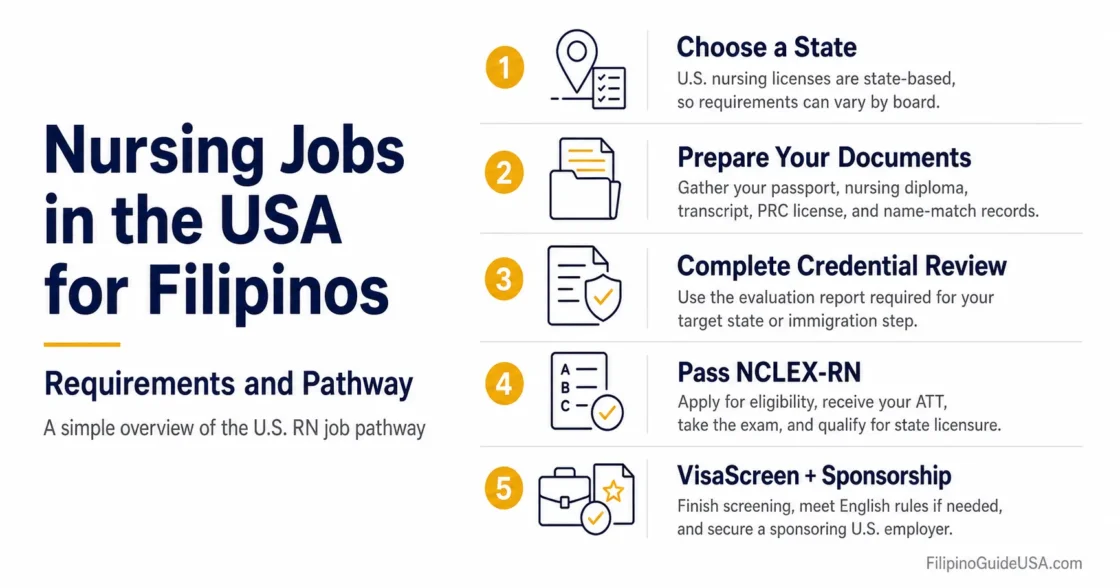
For Filipino nurses, working in the United States usually means preparing two tracks at the same time: the nursing license track and the immigration track. A U.S. employer may be ready to interview you, but you still need the right state nursing approval, NCLEX-RN status, credential screening, and work authorization before you can practice as a registered nurse in the U.S.
The pathway is realistic, but it is document-heavy. The main mistake many applicants make is treating “USRN,” “VisaScreen,” and “job sponsorship” as one step. They are connected, but each one serves a different purpose.
What Kind of Nursing Jobs Are Open to Filipino Nurses?
Most Filipino nurses who move to the U.S. are hired for registered nurse roles in hospitals, long-term care facilities, rehabilitation centers, dialysis units, home health settings, and specialty clinics. The strongest demand is usually for nurses with bedside experience, because U.S. employers need staff who can move into patient care with less adjustment time.
Registered nurses remain one of the large healthcare occupations in the U.S. The U.S. Bureau of Labor Statistics lists a median annual wage of $93,600 for registered nurses in May 2024 and projects 5 percent employment growth from 2024 to 2034, with about 189,100 openings each year on average.[a]
Common job titles may include:
- Staff Nurse
- Medical-Surgical Registered Nurse
- ICU Registered Nurse
- Emergency Room Registered Nurse
- Operating Room Registered Nurse
- Dialysis Nurse
- Long-Term Care Registered Nurse
- Rehabilitation Nurse
- Home Health Registered Nurse
Not every U.S. nursing job sponsors foreign nurses. Many job posts are only for nurses who already have U.S. work authorization. Filipino nurses usually need to look for employers, hospitals, or ethical recruiters that understand international nurse processing.
The Basic Requirements for Filipino Nurses
The usual pathway starts with nursing education and licensure in the Philippines, then moves into U.S. credential review, NCLEX-RN eligibility, state licensure, VisaScreen, and employer sponsorship.
| Requirement | What It Means | Why It Matters |
|---|---|---|
| Nursing Education | You completed a nursing program that can be evaluated against U.S. standards. | State boards and credential evaluators review your academic record. |
| Philippine RN License | You hold or previously held a valid nursing license from the Philippines. | License validation is part of many credential and immigration checks. |
| Credential Evaluation | Your school records and license records are reviewed by an accepted evaluation service. | Many state boards require this before they decide NCLEX eligibility. |
| NCLEX-RN | You pass the U.S. national nursing licensure exam for registered nurses. | All U.S. boards use the NCLEX-RN for RN licensure decisions. |
| State RN License | You meet the rules of the state where you plan to work. | Nursing licenses are issued by states, not by one national nursing office. |
| VisaScreen or Health Care Worker Certification | Your education, license, English ability, and nursing knowledge are screened for immigration use. | Foreign healthcare workers usually need this for U.S. occupational visa processing. |
| U.S. Employer Sponsorship | A qualified employer files or supports the immigration petition. | Most employment-based nurse pathways need a U.S. employer petitioner. |
Step 1: Choose the State Where You Want to Be Licensed
There is no single “U.S. nursing license” for all states. Each U.S. state is responsible for licensing nurses within that state, and rules can vary. NCSBN explains that all U.S. boards of nursing use the NCLEX-RN for registered nurse licensure, but state-specific licensure requirements are still handled by each nursing board.[b]
This matters because one state may ask for a certain credential evaluation report, while another may ask for a different service, course, form, or document format. Some Filipino nurses choose a state based on where their employer is located. Others choose a state first, pass NCLEX, and later seek endorsement to another state if allowed.
Before paying for exams or document services, check the state board page for:
- Internationally educated nurse instructions
- Required credential evaluation provider
- English exam rules, if any
- Fingerprinting or background check process
- Application timing and document validity
- Whether a Philippine license must be active or only verifiable
Step 2: Prepare Philippine Nursing Documents
Filipino applicants should expect document requests from more than one place: the U.S. state board, the credential evaluation service, the VisaScreen provider, and sometimes the employer or recruiter.
Documents often include:
- Passport identity page
- Nursing diploma or certificate of graduation
- Official transcript or record of nursing education
- Related Learning Experience or clinical records, if requested
- PRC license information
- License validation or state board verification forms
- Proof of name change, if your records do not match exactly
- English exam results, if required
The Professional Regulation Commission provides online services for license verification and certification or authentication of PRC documents, which can help applicants confirm their professional record before sending requests to U.S. boards or evaluation agencies.[c]
Name consistency matters. If your school record, PRC record, passport, and exam account show different versions of your name, prepare supporting documents early. Even a small mismatch can delay credential review.
Step 3: Complete Credential Evaluation
Credential evaluation checks whether your nursing education and professional records can be accepted for the U.S. process you are applying for. The exact report depends on the state board or purpose. For example, one applicant may need a professional credential evaluation for a state board, while another may need VisaScreen for immigration.
TruMerit, formerly known to many Filipino nurses as CGFNS, explains that foreign-educated nurses may need academic and professional credentials evaluated before state board review, licensure, employment, or immigration steps.[d]
Do not order a report just because another nurse used the same one. Always match the report to the state board or immigration purpose. The wrong report can waste time and money.
Step 4: Apply for NCLEX-RN Eligibility
The NCLEX-RN is the exam used for registered nurse licensure in the United States. You do not simply register and take the exam. First, you apply to the nursing regulatory body where you want to be licensed. After that board decides you are eligible, you register with Pearson VUE and wait for Authorization to Test.
The official NCLEX registration process explains that candidates must apply for licensure or registration with the nursing regulatory body, register with Pearson, pay the exam-related fees, receive Authorization to Test, and then schedule the exam appointment.[e]
The usual NCLEX sequence looks like this:
- Choose the U.S. state board or nursing regulatory body.
- Submit the state application for RN licensure by examination.
- Send school, PRC, identity, and credential evaluation documents as required.
- Wait for the board to confirm eligibility.
- Register with Pearson VUE for the NCLEX-RN.
- Receive Authorization to Test.
- Schedule and take the exam.
- Complete any remaining state board requirements before license issuance.
Passing the NCLEX is a major milestone, but it does not always mean you can work immediately. You still need an issued state license and legal work authorization.
Step 5: Understand VisaScreen and English Testing
VisaScreen is not the same thing as a work visa. It is a healthcare worker screening certificate used in immigration processing for certain foreign healthcare professionals. For registered nurses, the screening can include education records, license validation, proof of nursing knowledge, and English-language competency.
TruMerit’s VisaScreen information says applicants may need license validation, professional education records, evidence of passing either the CGFNS Qualifying Exam or NCLEX-RN, and approved English-language exam results unless an exemption applies.[f]
Filipino nurses should not assume that English instruction in the Philippines automatically removes the English exam requirement. Exemption rules are specific. If an English test is required, check the accepted exam types and score rules directly with the screening provider before booking the test.
Step 6: Find an Employer or Ethical Recruiter
Many Filipino nurses work with international nurse recruiters because the U.S. process involves employer sponsorship, licensing timelines, credential files, and immigration coordination. A recruiter can be useful, but the contract should be read carefully.
Before signing, review:
- Who pays for exams, credential evaluation, VisaScreen, immigration filing, and travel
- Whether costs become repayable if you leave early
- How long the work commitment lasts
- Which state and facility you may be assigned to
- Whether housing, relocation support, or orientation is provided
- Whether the employer is the actual petitioner or the recruiter is placing you elsewhere
- How family members are handled in the immigration process
A good job offer should be clear about the nursing role, location, shift expectations, pay structure, benefits, license requirements, and immigration pathway. Avoid any arrangement that asks you to misrepresent experience, documents, exam status, or work authorization.
Step 7: Know the Usual Immigration Pathway
Many registered nurses use an employment-based immigrant pathway, often discussed as EB-3 for skilled workers or professionals. For professional nurses, U.S. regulations also include Schedule A, Group I, which covers professional nurses and physical therapists. Under 20 CFR 656.5, professional nurses may qualify through evidence such as a CGFNS certificate, a full and unrestricted state nursing license, or passing NCLEX-RN.[g]
Schedule A does not mean automatic approval. It means the occupation has a special labor certification route. The employer still has filing duties, the nurse still needs to meet licensing and immigration requirements, and visa availability still matters.
For nurses outside the U.S., the process often includes:
- Employer job offer and sponsorship decision
- Employer filing of the immigrant petition
- Priority date creation
- VisaScreen certificate preparation
- National Visa Center processing when the case becomes ready
- Consular interview at the correct U.S. embassy or consulate
- U.S. entry as an immigrant worker after approval
For nurses already in the U.S. in another lawful status, the path may involve adjustment of status if the nurse is eligible and a visa number is available. This is a legal and timing-sensitive area, so applicants should get advice from a qualified immigration professional when needed.
Why Priority Dates Matter for Filipino Nurses
Filipino nurses should pay attention to the U.S. Department of State Visa Bulletin because the Philippines can be listed separately in employment-based categories. The May 2026 Visa Bulletin lists the Philippines separately under employment-based charts and shows EB-3 dates that affect when cases can move forward.[h]
A priority date is usually tied to when the employer’s immigrant petition process begins. If the category is backlogged, a nurse may pass NCLEX and receive a job offer but still wait for visa movement before final immigrant visa processing can finish.
This is why two Filipino nurses can have different timelines even if both passed NCLEX. Their employer, filing date, state license status, VisaScreen timing, document completion, and visa bulletin category can all affect the final wait.
Documents to Prepare Before Applying
A clean document file saves time. Keep scanned copies for your own records, but remember that many agencies require official documents to come directly from the school, PRC, testing company, or licensing authority.
Useful documents to organize include:
- Valid passport
- Birth certificate
- Marriage certificate or name-change document, if applicable
- Nursing diploma
- Transcript of records
- Clinical or Related Learning Experience records, if requested
- PRC license card or license details
- PRC board rating or license verification record, if requested
- Employment certificates from hospitals or facilities
- Job descriptions from previous nursing roles
- NCLEX candidate records
- English exam results, if required
- VisaScreen or credential evaluation account records
Common Delays Filipino Nurses Should Avoid
Most delays are not caused by one big problem. They usually come from small document issues that stack up over time.
- Name mismatch: Use the same name format across passport, school, PRC, exam, and immigration records whenever possible.
- Wrong state choice: Check the board requirements before ordering credential reports.
- Expired documents: Some validations and exam scores have time limits.
- Unclear employment history: Keep certificates of employment and role descriptions from past nursing jobs.
- Delayed school response: Ask your nursing school early about transcript and form processing.
- Assuming NCLEX is enough: NCLEX helps with licensure, but immigration screening and employer sponsorship are separate.
- Signing before reading: Review recruiter contracts, repayment clauses, assignment rules, and resignation terms.
Best Time to Apply for U.S. Nursing Jobs
The best time depends on your current status. If you have not started NCLEX eligibility, focus first on the state board and credential evaluation route. If you already passed NCLEX, employers may take your application more seriously, especially if your documents are organized and your VisaScreen plan is clear.
A practical order is:
- Confirm your target state and its international nurse rules.
- Prepare school and PRC documents.
- Complete the credential evaluation required by that state.
- Apply for NCLEX eligibility.
- Pass NCLEX-RN.
- Start or continue VisaScreen preparation.
- Interview with employers or recruiters that sponsor international nurses.
- Track immigration filing and visa bulletin movement.
Some nurses interview before NCLEX, but many U.S. employers prefer candidates who have already passed or are close to testing. A passed NCLEX can make your file easier to present, though it does not guarantee sponsorship.
Questions Filipino Nurses Often Ask
Can a Filipino Nurse Work in the U.S. Without NCLEX?
For a registered nurse role, passing NCLEX-RN is usually needed for state licensure. Some employers may interview candidates before NCLEX, but actual RN practice requires the proper state license and work authorization.
Is VisaScreen the Same as a Visa?
No. VisaScreen is a healthcare worker screening certificate used for immigration purposes. The visa or green card process is separate and usually depends on employer sponsorship, petition approval, document processing, and visa availability.
Do Filipino Nurses Need an English Exam?
Many Filipino nurses should plan for an English exam unless they clearly meet an exemption listed by the screening provider. Accepted tests and score rules can change, so check the current provider page before booking.
Can a Nurse Bring Family Members to the U.S.?
In many employment-based immigrant cases, eligible spouses and unmarried children under 21 may be included as derivatives. The exact process depends on the visa category, timing, and family documents.
Can a Filipino Nurse Choose Any U.S. State?
You can apply to a state board if you meet that board’s rules, but you must follow the requirements of the state where you seek licensure. If your employer is in a different state, you may need that state’s license or endorsement process.
Before You Move Forward
A strong U.S. nursing application is not only about passing an exam. It is about keeping your records consistent, choosing the correct state board path, understanding VisaScreen, working with a reliable employer, and watching visa availability. For Filipino nurses, the process can take time, but it becomes easier to manage when each step is handled in the right order.
Rules for nursing licensure, credential screening, English testing, visa processing, and employer sponsorship can change. Before submitting forms or paying fees, recheck the current instructions from the state board of nursing, NCLEX, TruMerit or the approved screening provider, USCIS, and the U.S. Department of State.
Sources
- [a] U.S. Bureau of Labor Statistics, Registered Nurses Occupational Outlook Handbook — used for RN wage, employment outlook, and openings data. (Reliable because it is the official U.S. labor statistics agency.)
- [b] National Council of State Boards of Nursing, U.S. Nursing Licensure for Internationally Educated Nurses — used for state licensure and NCLEX-RN context. (Reliable because NCSBN works directly with U.S. nursing regulatory bodies.)
- [c] Professional Regulation Commission, Certification and Authentication — used for Philippine license and document verification context. (Reliable because PRC is the official professional licensing body in the Philippines.)
- [d] TruMerit, How to Work as a Nurse in the U.S. — used for foreign-educated nurse credential evaluation and U.S. nurse pathway context. (Reliable because TruMerit, formerly CGFNS, is an established healthcare credential evaluation organization.)
- [e] NCLEX, Registration Process — used for the NCLEX registration and Authorization to Test sequence. (Reliable because it is the official NCLEX registration information page.)
- [f] TruMerit, VisaScreen: Visa Credentials Assessment — used for VisaScreen document, nursing knowledge, and English requirement context. (Reliable because it is the credentialing service page for healthcare worker screening.)
- [g] Electronic Code of Federal Regulations, 20 CFR 656.5 Schedule A — used for Schedule A Group I professional nurse criteria. (Reliable because eCFR is the official published federal regulation source.)
- [h] U.S. Department of State, Visa Bulletin for May 2026 — used for employment-based visa availability and Philippines category context. (Reliable because the Department of State publishes the official monthly Visa Bulletin.)