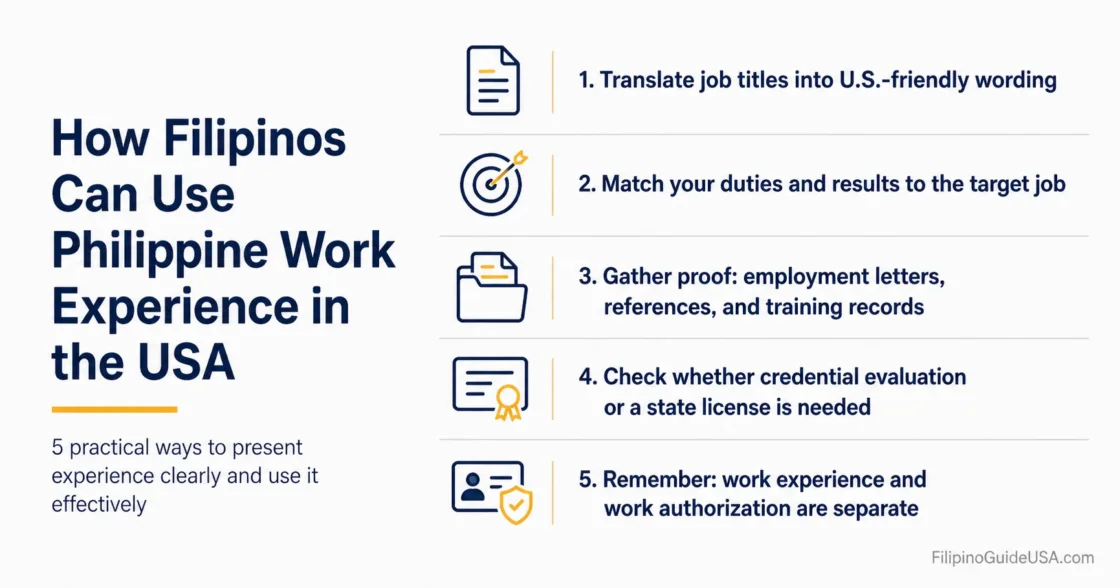
Philippine work experience can help Filipinos build a strong career path in the United States, but it needs to be presented in a way U.S. employers, recruiters, licensing boards, and HR systems can understand. Experience from the Philippines is not “wasted” just because it happened outside the U.S. It can support your resume, interviews, salary discussions, professional licensing file, credential evaluation, and long-term career plan. The main task is to translate that experience clearly, prove it with the right records, and know when a U.S. license or credential review is still required.
For many Filipinos, this question comes up after moving to the U.S. as a permanent resident, spouse, student, temporary worker, petitioned professional, or newly arrived family member. It also comes up before migration, while preparing documents in the Philippines. The answer depends on the type of job. A software developer, customer service specialist, accountant, nurse, teacher, engineer, architect, caregiver, or administrative worker may all use Philippine experience differently.
In the U.S., there is no single national office that automatically “accepts” all foreign work experience. Depending on the purpose, recognition may come from an employer, a school, a state licensing board, or an immigration authority. The U.S. Department of Education explains that employers, state-level licensing authorities, education institutions, and federal immigration authorities may each play a role in recognizing foreign qualifications.[a]
What Philippine Work Experience Can Do for You
Philippine experience can support your U.S. job search in several practical ways. It can show that you already know how to work with clients, manage deadlines, handle tools or software, supervise teams, keep records, follow procedures, or serve customers. Employers care less about the country name and more about whether your past work matches the job they need filled.
Philippine experience may help you:
Qualify for jobs that ask for prior experience in a similar role.
Explain your technical, administrative, healthcare, education, finance, logistics, hospitality, or customer support background.
Show measurable results, such as accounts handled, reports prepared, patients assisted, tickets resolved, projects completed, or teams supervised.
Support applications for promotions after you start working in the U.S.
Prepare for licensing, credential review, or further education when your profession is regulated.
Build confidence during interviews, especially if you are worried that your experience “doesn’t count” because it came from the Philippines.
The most useful approach is to connect your Philippine duties to the U.S. job description. For example, “encoder” may be clearer as “data entry specialist,” while “accounting staff” may need to be described as accounts payable, accounts receivable, bookkeeping support, payroll support, or general accounting support depending on the actual duties.
Where Philippine Experience Does Not Automatically Transfer
Philippine work history can strengthen your profile, but it does not always replace U.S. requirements. Some jobs are open to experienced applicants without a U.S. license. Others are controlled by state law, federal rules, or employer-specific policies.
| Situation | How Philippine Experience Helps | What May Still Be Needed |
|---|---|---|
| Private-sector jobs with no license requirement | Can be used directly on a resume and in interviews if it matches the role. | Clear U.S.-style wording, references, and proof of employment if requested. |
| Jobs requiring a degree | Can show practical ability and career progression. | A credential evaluation may be requested to compare Philippine education with U.S. education. |
| Licensed professions | Can support the licensing file and explain prior practice. | State board review, exams, credential evaluation, supervised practice, or U.S. license may be required. |
| Federal jobs | Can support specialized experience if the job announcement allows it. | Foreign education may need review by a U.S.-based credential evaluation service. |
| Immigration-related filings | Can help document professional background when relevant to the petition type. | Employer sponsorship, eligibility evidence, legal forms, or attorney-reviewed documentation may be needed. |
This distinction matters because an applicant may be highly experienced but still unable to work in a regulated role until the U.S. requirement is met. A PRC license, Philippine hospital experience, board exam result, school transcript, or employment certificate can be useful evidence, but it should not be treated as the same thing as a U.S. state license.
Turn Philippine Experience into U.S.-Ready Proof
Many Filipino applicants have real experience but weak documentation. This creates problems when a U.S. employer, credential evaluator, school, or licensing board asks for details. Before leaving the Philippines, or as soon as possible after arriving in the U.S., it is wise to gather records while former employers and schools can still respond.
Useful documents may include:
Certificate of Employment with job title, dates, department, and company contact details.
Detailed job description signed or issued by HR, a supervisor, or the employer.
Reference letters from supervisors, managers, clients, or department heads.
Promotion letters, training certificates, awards, or performance review summaries.
Professional license records, board rating, PRC identification card, or certificate of registration where relevant.
College transcript, diploma, course descriptions, and internship or clinical rotation records if the job is tied to education.
Portfolio samples for fields such as design, writing, architecture support, IT, engineering support, project work, or marketing.
For PRC-regulated professions, the Professional Regulation Commission provides certification and authentication services for professional license or registration certificate records. PRC’s published procedure includes an action sheet, documentary stamps for copies, payment of prescribed fees, and claiming documents as scheduled.[g]
Some U.S. recipients may also ask for formal authentication, notarization, or an apostille for certain Philippine public documents. Do not assume every employer needs this. Ask the employer, evaluator, school, or licensing board what format they want before spending money. The Philippine Apostille site lists documentary requirements for authentication-related requests, including common civil and government-issued records.[h]
Use U.S. Job Language Without Hiding Your Philippine Background
A common mistake is copying a Philippine job title exactly and expecting a U.S. recruiter to understand it. Another mistake is changing the title so much that it becomes misleading. The safest method is to keep the original title where useful, then add a clear U.S.-friendly equivalent or description.
| Philippine Term or Role | Clearer U.S. Wording | What to Explain |
|---|---|---|
| Accounting Staff | Accounting Assistant, Bookkeeping Assistant, Accounts Payable Assistant, or Accounts Receivable Assistant | Specify whether the work involved invoices, payroll, ledgers, reconciliation, taxes, or reporting. |
| Encoder | Data Entry Specialist or Records Clerk | Mention accuracy, database tools, document types, and volume handled. |
| BPO Agent | Customer Support Representative, Technical Support Representative, Claims Support Specialist, or Sales Support Representative | Clarify account type, tools used, call/chat/email support, metrics, and customer region served. |
| Admin Aide or Office Staff | Administrative Assistant, Office Assistant, Records Assistant, or Front Desk Assistant | List scheduling, filing, procurement support, reception, reporting, or document control duties. |
| Staff Nurse | Registered Nurse in the Philippines, Clinical Nurse, or Hospital Staff Nurse | State that the license was issued in the Philippines and check U.S. state board requirements before using “RN” as a U.S. credential. |
| OJT | Internship, Practicum, Clinical Rotation, or On-the-Job Training | Explain department, supervised duties, hours if documented, and skills learned. |
The U.S. Bureau of Labor Statistics Occupational Outlook Handbook can help you compare job titles, duties, education, training, work experience, licensing, and certification language for U.S. occupations.[b] This is useful when you are unsure whether your Philippine role is closer to “administrative assistant,” “records clerk,” “operations coordinator,” “bookkeeper,” or another U.S. title.
When Credential Evaluation Helps
Credential evaluation usually focuses on education, not ordinary work experience. Still, it can help when your U.S. job target asks for a degree, diploma, course credits, or professional education. For example, an employer may understand your years of experience but still need proof that your Philippine bachelor’s degree is comparable to a U.S. degree.
A credential evaluation may be useful when:
A job posting says a bachelor’s degree or higher is required.
An employer asks how your Philippine degree compares with a U.S. degree.
A state licensing board requires evaluation of your school records.
You are applying to a U.S. college, graduate program, or certificate program.
You are applying for certain federal jobs and relying on education completed outside the United States.
NACES states that it does not perform evaluations itself, but its member agencies provide evaluation services and work electronically with clients from around the world.[c] Before ordering any report, ask the employer, school, licensing board, or agency which evaluator and report type they accept. A general evaluation and a course-by-course evaluation are not the same, and choosing the wrong one can delay your application.
What Credential Evaluation Usually Does Not Do
A credential evaluation does not automatically give you a U.S. license. It also does not guarantee a job offer. It explains how your education compares with U.S. education. Your work experience, references, interview performance, work authorization, and state rules may still be reviewed separately.
Licensed Professions Need a Separate Plan
Some Filipino professionals cannot simply apply for the same job title in the U.S. right away. Nursing, teaching, engineering, architecture, accounting, physical therapy, dentistry, medicine, pharmacy, social work, and several other fields may have state licensing requirements.
The U.S. Department of Education states that regulated professions are generally licensed at the state level and that the proper authority is usually the state or territorial licensing authority where the person intends to work.[d] This means a Filipino nurse in California, a teacher in Texas, an engineer in New York, or a physical therapist in Florida may face different steps.
For licensed professions, Philippine experience can still matter. It may help show that you have practiced in the field, completed supervised duties, handled real cases, or met professional standards in the Philippines. But it usually sits beside other requirements, such as:
State board application.
Credential evaluation or transcript review.
English language testing if required by the board or credentialing body.
Professional exams.
Background checks or identity documents.
Supervised practice, bridging coursework, or U.S. clinical or field experience, depending on the profession.
Practical Path for Filipino Professionals in Regulated Fields
If your profession is licensed, do not start by asking, “Will my Philippine license count?” Start with three more useful questions:
Which U.S. state do I plan to work in?
Which state board controls this profession?
What exact documents does that board require from foreign-trained applicants?
After that, prepare your Philippine documents around the board’s instructions. This avoids paying for the wrong evaluation, requesting the wrong certificate, or submitting records in a format the board will not accept.
How to Present Philippine Experience on a U.S. Resume
A U.S. resume should make your value easy to understand. The reader may not know your Philippine employer, school, province, city, or job title. Give enough context, but do not overload every bullet with background explanation.
A strong entry can look like this:
Customer Support Representative
ABC Business Solutions, Cebu City, Philippines
Handled inbound email and chat support for a U.S.-based retail account, resolved order issues, documented cases in CRM software, and met monthly quality and response-time targets.
This format works because it explains the role, location, account type, tools, and duties in terms a U.S. employer can quickly understand.
Resume Details That Help
Use month and year for employment dates when possible.
Write the city and country for Philippine employers.
Add a short employer description if the company is not widely known.
Use action verbs tied to real duties: processed, coordinated, documented, reconciled, supported, trained, scheduled, reviewed, maintained, prepared, monitored.
Use numbers only when they are true and easy to support.
Explain tools clearly, such as Excel, QuickBooks, SAP, Salesforce, Zendesk, EMR systems, AutoCAD, Canva, Google Workspace, or Microsoft Office.
Resume Details to Avoid
Do not call yourself U.S.-licensed unless you already hold the U.S. license.
Do not translate every Philippine title into a higher U.S. title.
Do not list duties you only observed during training.
Do not hide the country of employment if the dates and employer location matter.
Do not use unexplained acronyms that only Filipino readers would understand.
How to Discuss Philippine Experience in Interviews
During interviews, some applicants become too apologetic about foreign experience. That is not needed. Speak about your Philippine background as real work, then connect it to the U.S. role.
A clear answer can follow this pattern:
Situation: Explain the workplace briefly.
Task: State what you were responsible for.
Action: Describe what you personally did.
Result: Share the outcome, number, improvement, or lesson.
For example:
“In my previous role in Manila, I supported payroll documentation for more than 200 employees. My task was to check timekeeping records, flag missing entries, and prepare reports for review. I created a tracking sheet that helped our team reduce repeated missing entries. That experience is close to this HR assistant role because it required accuracy, confidentiality, and regular coordination with department supervisors.”
This kind of answer does not ask the employer to guess. It shows the connection between Philippine work and the U.S. job.
Work Authorization Is Separate from Work Experience
Philippine work experience may help you look qualified, but it does not replace U.S. work authorization. U.S. employers must complete Form I-9 for people hired to work in the United States, and the process verifies identity and employment authorization.[e]
This is why two questions are separate:
Can I do the job? Your work experience, skills, education, license, and references answer this.
Am I allowed to work in the U.S. for this employer? Your immigration status, employment authorization, and I-9 documents answer this.
Employers should not treat Filipino applicants as if they must show special documents just because they have foreign experience. The EEOC explains that employees may choose which valid documents to show from the Form I-9 lists, and employers should not demand extra documents from people they perceive as foreign.[f]
Common Situations for Filipinos
Filipino BPO Experience
BPO experience can be very useful in the U.S., especially for customer support, technical support, claims support, sales support, data entry, quality assurance, workforce scheduling, team lead, and operations roles. The main issue is wording. Instead of only saying “BPO agent,” describe the account type, support channel, tools, metrics, and customer base.
Good resume wording may include:
Handled chat and email support for U.S. retail customers.
Resolved billing and order concerns using CRM and ticketing tools.
Documented customer interactions according to account procedures.
Trained new agents on call flow, quality standards, and escalation rules.
Filipino Healthcare Experience
Healthcare experience from the Philippines can help show patient care background, clinical exposure, teamwork, and familiarity with hospital or clinic routines. Still, licensed roles in the U.S. usually need state-specific review. A nurse, physical therapist, pharmacist, dentist, or physician should check the relevant state board before assuming that Philippine practice allows direct U.S. practice.
Some Filipinos choose related roles while working toward licensure, such as medical assistant, patient care technician, caregiver, unit clerk, healthcare customer service, clinical documentation support, or administrative healthcare roles. The right option depends on state rules, employer policy, and the person’s long-term plan.
Filipino Teaching Experience
Teaching experience can support applications for school roles, tutoring, childcare, education support, curriculum work, training, or community education. Public school teaching, however, is usually state-regulated. A teacher trained in the Philippines may need transcript evaluation, testing, educator preparation review, or state certification steps.
Filipino Accounting and Finance Experience
Accounting experience can transfer well when the duties are described clearly. Many U.S. employers understand accounts payable, accounts receivable, bookkeeping, payroll support, audit support, bank reconciliation, billing, and financial reporting. CPA practice is different because licensing is state-based. A Philippine CPA credential may strengthen your profile, but it does not automatically make you a U.S. CPA.
Filipino IT and Technical Experience
IT experience often transfers more easily than licensed fields because employers can test skills through portfolios, technical interviews, coding exercises, certifications, and project history. Be specific about systems, languages, cloud tools, help desk platforms, ticketing systems, cybersecurity duties, databases, and project results.
Documents to Prepare Before Applying
A well-prepared Filipino applicant does not wait until the employer asks for proof. Having documents ready can make the process smoother, especially when former employers are in a different time zone.
Prepare a master resume. Keep a longer private version with all Philippine roles, dates, duties, tools, supervisors, and achievements.
Create a shorter U.S. resume for each job type. Adjust wording to match the target role without changing the truth.
Request employment letters early. Ask for job title, employment dates, work location, department, duties, and HR contact details.
Save proof of training. Include employer training, TESDA-related records if relevant, professional seminars, software certificates, and safety or compliance training.
Keep education records organized. Store transcripts, diploma, course descriptions, and school contact details.
Check license records. PRC-regulated professionals should keep license, registration, board rating, and authentication options in order.
Prepare references. Ask former supervisors if they are willing to respond by email or phone, and confirm the time zone difference.
Federal Job Applications Need Extra Care
Federal job applications often follow stricter document instructions than private employers. If you rely on education completed outside the United States, USAJOBS states that foreign education must be equivalent to education gained in a conventional or accredited U.S. program, and a U.S.-based credential evaluation may be needed.[i]
For federal applications, read the job announcement slowly. Do not assume that the resume style, page length, document upload rules, or foreign education instructions are the same as private-sector hiring. If the announcement says to attach transcripts, evaluation reports, or proof of specialized experience, follow the exact wording.
How to Build U.S. Experience Without Ignoring Philippine Experience
Some Filipinos feel pressured to “start from zero” in the U.S. That may happen in some licensed professions, but it should not be the default mindset. A better plan is to use Philippine experience as the foundation while adding U.S.-specific proof.
Useful steps may include:
Apply for roles that sit close to your Philippine background, even if the title is slightly different.
Take short courses or certifications only when they match your target job.
Volunteer or take part-time roles only when they add relevant U.S. references or exposure.
Use a bridge role if your licensed profession requires time, exams, or evaluation.
Keep a record of U.S. accomplishments from your first job, even if it is not your final career target.
The goal is not to erase Philippine experience. The goal is to make it understandable, verifiable, and connected to the next step in the U.S.
Frequently Asked Questions
Does Philippine Work Experience Count in the USA?
Yes, Philippine work experience can count in the U.S. job market, especially for private-sector jobs where the employer mainly wants proof of skills and past duties. It may not automatically satisfy licensing, degree, or immigration requirements.
Should I Put Philippine Jobs on My U.S. Resume?
Yes, include Philippine jobs that are relevant to the role you want. Use clear U.S.-friendly wording, list the employer location, explain the duties, and show results where possible.
Do I Need Credential Evaluation for Work Experience?
Usually, credential evaluation is for education, not ordinary work experience. You may need it if the job, school, state board, federal agency, or immigration-related process asks for proof that your Philippine education is comparable to U.S. education.
Can a Philippine PRC License Be Used in the USA?
A PRC license can support your professional background, but it is not the same as a U.S. state license. Regulated professions usually require state board review, and each state may have its own process.
What If My Philippine Employer Closed?
Try to collect any available proof, such as old employment certificates, contracts, payslips, training records, tax or contribution-related records, portfolio samples, or reference letters from former supervisors. For formal evaluations or licensing, ask the requesting organization what substitute documents they accept.
Should I Translate Philippine Documents?
Many Philippine employment and school documents are already in English. If a document is in Filipino, Cebuano, Ilocano, Hiligaynon, Waray, or another language, the U.S. recipient may ask for an English translation. Follow the specific instructions from the employer, school, evaluator, or licensing board.
Before You Rely on Any Requirement
Work authorization rules, licensing steps, credential evaluation requirements, document formats, and agency procedures can change. Before paying for evaluations, requesting apostilles, or submitting professional records, check the current instructions from the employer, state licensing board, school, credential evaluator, or official government agency handling your case.
Sources
[a] U.S. Department of Education — Recognition of Foreign Qualifications; used for how foreign qualifications may be recognized by employers, education institutions, licensing authorities, and federal immigration authorities. (Official .gov source from the U.S. Department of Education.) ↩
[b] U.S. Bureau of Labor Statistics — Occupational Outlook Handbook Occupation Finder; used for U.S. occupation language, training, work experience, licensing, and certification context. (Official .gov labor statistics source.) ↩
[c] National Association of Credential Evaluation Services — Members directory; used for credential evaluation agency context and the point that NACES members handle evaluations directly. (Longstanding credential evaluation association used by U.S. institutions and agencies.) ↩
[d] U.S. Department of Education — Professional Licensure; used for state-level licensing and the difference between licensure and certification. (Official .gov source explaining professional licensure recognition.) ↩
[e] U.S. Department of Labor — I-9 Central; used for Form I-9 identity and employment authorization verification. (Official .gov source from the U.S. Department of Labor.) ↩
[f] U.S. Equal Employment Opportunity Commission — Pre-Employment Inquiries and Citizenship; used for applicant document choice and limits on demanding specific documents based on citizenship status or national origin. (Official .gov civil rights enforcement source.) ↩
[g] Professional Regulation Commission — Certification / Authentication; used for PRC professional document certification and authentication procedures. (Official Philippine government professional regulation source.) ↩
[h] Philippine Apostille — Documentary Requirements; used for Philippine document authentication and apostille-related records. (Official Philippine government apostille service source.) ↩
[i] USAJOBS Help Center — Qualifying Education; used for foreign education equivalency in federal employment applications. (Official U.S. federal jobs help source operated under OPM.) ↩