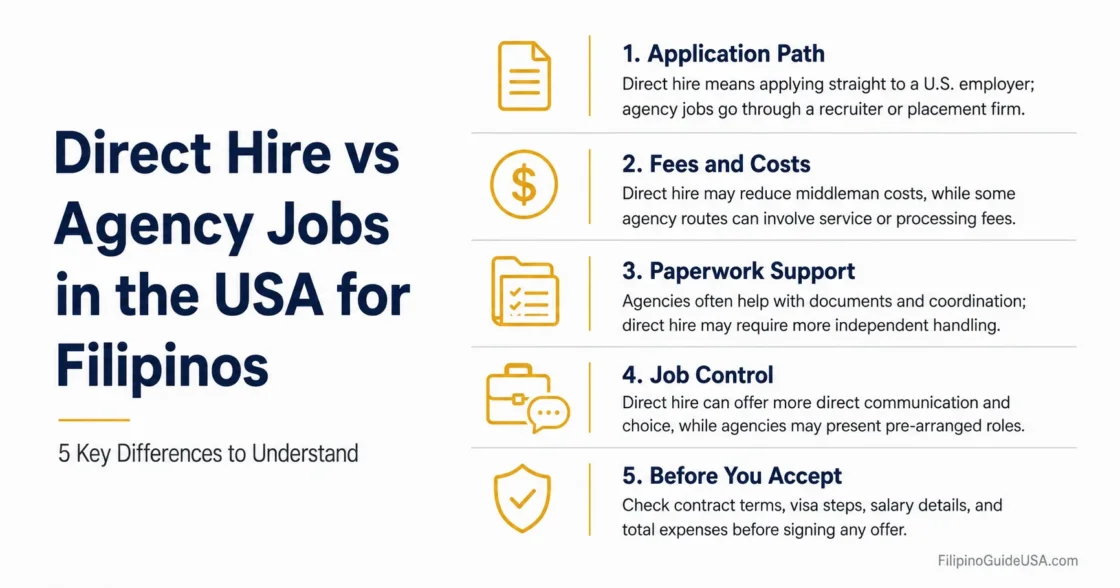
Choosing between a direct hire job and an agency-arranged job in the United States can affect how a Filipino worker is recruited, who manages the paperwork, who pays wages, who provides workplace support, and how easily the offer can be checked before accepting it. The safest choice is not always the one that looks fastest. It depends on where the worker is applying from, the visa or work authorization involved, the type of employer, and whether the recruitment path can be verified through official channels.
Why this matters →
For Filipino workers, the difference between direct hire and agency hiring can shape visa planning, contract protection, recruitment costs, and the risk of dealing with an unverified job offer.
Before Comparing Job Offers:
- Confirm who the legal employer will be: the U.S. company, a staffing agency, or another placement firm.
- Ask whether the job requires U.S. work authorization, a temporary work visa, or an employment-based immigrant visa process.
- Check whether the recruitment agency is properly licensed if the worker is applying from the Philippines.
- Request a written job offer or contract showing the job title, work location, wages, schedule, benefits, deductions, and contact details.
- Never rely on a social media message, verbal promise, or payment request as proof that a job is real.
Direct Hire and Agency Jobs Explained
This section separates the two hiring paths in plain terms before comparing them side by side.
A direct hire job usually means the worker is recruited and employed directly by the company that needs the employee. The company may interview the worker, issue the offer, manage onboarding, and supervise the job after hiring. In some U.S. employment-based immigration cases, the employer may also be the party that starts or supports the immigration process.
An agency job means a staffing agency, recruitment agency, placement firm, or manpower agency is involved between the worker and the company where the work may happen. The agency may recruit, screen, assign, sponsor, place, or pay the worker depending on the arrangement. In temporary staffing, the worker may report to a host company day to day while still being paid by the agency. OSHA explains that workers supplied by staffing agencies are generally considered temporary or supplied workers, and both the staffing agency and host employer can share safety responsibilities for them.[a]
| Area | Direct Hire | Agency Job |
|---|---|---|
| Main contact | The employer that needs the worker | The agency, recruiter, or staffing firm |
| Who may pay wages | Usually the direct employer | Often the agency, especially in staffing arrangements |
| Recruitment support | Less third-party support; the worker deals with the employer more directly | More structured screening, placement, and communication support may be available |
| Verification need | Verify the employer, job offer, visa path, and contract terms | Verify the agency license, approved job order when applicable, employer, fees, and contract terms |
| Common risk | Unclear immigration sponsorship, informal offers, or no support after signing | Fake recruiters, unlicensed agencies, excessive fees, or unclear employer responsibility |
Tip: The safest offer is the one that can be verified in writing, through official channels, and without pressure to pay first.
Which Hiring Path Fits Which Situation?
The better option depends on the worker’s location, work authorization, profession, and need for recruitment support.
For Filipinos Already in the United States
Filipinos already in the United States may compare direct employer jobs, staffing agency roles, contract roles, and temp-to-hire positions. The first question is not whether the job is direct or agency-based. The first question is whether the worker is legally authorized to work for that employer and role.
U.S. employers use Form I-9 to verify the identity and employment authorization of people hired for employment in the United States.[b] Some employers also use E-Verify, but E-Verify does not replace the need for the worker to understand their own immigration or work authorization limits.
IMPORTANT WARNING: A job offer does not automatically create U.S. work authorization. A worker should not begin employment unless the worker’s immigration status, visa classification, green card, EAD, or other lawful authorization allows that specific work.
For Filipinos Applying From the Philippines
For workers applying from the Philippines, the comparison becomes more sensitive because overseas recruitment rules may apply before departure. The Department of Migrant Workers maintains tools for checking licensed recruitment agencies and approved job orders for overseas employment.[c]
Direct hire may sound simpler, but it can require extra care because the worker may need to process documents through the proper Philippine overseas employment channel. Agency hiring may feel more structured, but the worker still needs to verify that the agency is licensed and that the job order is legitimate.
Procedure Note: For overseas applicants, a U.S. job offer should be reviewed together with Philippine deployment rules, U.S. immigration requirements, and the actual employer’s written terms. These are separate checks, not one single approval.
Advantages of Direct Hire Jobs
Direct hire can give the worker clearer access to the employer, but it also places more verification work on the applicant.
Clearer Employer Relationship
In a direct hire setup, the worker usually knows which company is hiring, who supervises the role, where the job will be performed, and who is responsible for pay and benefits. This can make communication easier, especially for professional roles in healthcare, information technology, engineering, education, accounting, or other fields where the employer wants to hire a specific candidate.
Better View of Long-Term Terms
Direct hire may be more suitable when the job is intended to be permanent, full-time, or tied to long-term employer sponsorship. For employment-based immigrant visa categories, the U.S. Department of State explains that a prospective employer or agent may need to obtain labor certification approval from the Department of Labor before filing the immigrant petition with USCIS in certain categories.[d]
Less Confusion About Who Makes Decisions
Because fewer parties are involved, the worker may be able to ask direct questions about salary, shifts, worksite, benefits, onboarding, relocation support, and sponsorship. This does not remove risk, but it can reduce mixed messages.
Disadvantages of Direct Hire Jobs
Direct hire can be attractive, but it may leave the worker without the support that a legitimate agency sometimes provides.
More Responsibility on the Worker
A direct hire applicant may need to verify the employer, contract terms, visa pathway, credential requirements, licensing steps, relocation details, and Philippine processing requirements without much help. This can be hard for first-time overseas workers who are not familiar with U.S. hiring language.
Higher Risk of Informal Promises
Some fake offers use the words “direct hire” to sound more trustworthy. A real direct hire offer should still provide a written employer identity, job description, compensation details, work location, and a lawful work authorization plan. If the recruiter avoids written details or asks for money before providing verifiable documents, the offer should be treated carefully.
Possible Immigration Confusion
Some workers assume that a U.S. employer’s interest is enough to start work. That is not correct. U.S. work authorization depends on the worker’s status, visa classification, petition approval, employment authorization document, or other legal basis. Direct communication with an employer does not replace official immigration approval.
Advantages of Agency Jobs
A legitimate agency can help organize recruitment, but the worker must still check the agency and the job.
More Structured Recruitment
Agency jobs can be easier for workers who need help with screening, document collection, interview scheduling, employer matching, and deployment steps. This is why agency recruitment is common in overseas hiring, healthcare staffing, caregiving, hospitality, logistics, and other roles with repeated hiring needs.
Support During Placement
A legitimate agency may help explain timelines, employer expectations, pre-employment documents, and worksite rules. In staffing arrangements inside the United States, the agency and host employer may both have responsibilities for safety training and workplace protection, depending on the facts of the assignment.[a]
Verification Through Official Lists
For overseas recruitment from the Philippines, agency hiring has one major advantage: the worker can check the agency license and approved job orders through the Department of Migrant Workers’ official systems. That verification step can help separate real recruitment from fake job posts.
Disadvantages of Agency Jobs
Agency hiring can be useful, but unclear fees, vague contracts, or unlicensed recruitment can create serious problems.
Less Direct Access to the Employer
In some agency arrangements, the worker may not speak directly with the final employer until late in the process. This can make it harder to confirm the work location, supervisor, schedule, benefits, and long-term job outlook.
Fee and Deduction Concerns
Workers should be careful with any request for advance payment, training fees, processing fees, or “reservation” fees before a job is verified. The FTC warns that honest placement firms usually do not charge job candidates because the hiring company pays them to find qualified candidates.[e]
Unclear Employer Responsibility
Agency workers should know who pays wages, who handles time records, who provides safety training, who approves leave, who receives complaints, and who can end the assignment. If the agency and host company each point to the other for basic duties, the worker may face delays when problems arise.
IMPORTANT WARNING: The Department of Migrant Workers advises job applicants not to apply through agencies that are not licensed, not to deal with licensed agencies without job orders, not to accept a tourist visa for overseas work, and not to deal with fixers.[f]
How to Compare a Direct Hire Offer and an Agency Offer
A side-by-side review helps workers focus on the written terms rather than the recruiter’s promises.
| Question | Why It Matters |
|---|---|
| Who is the legal employer? | This affects pay, benefits, supervision, taxes, records, and complaint channels. |
| Is the job offer in writing? | Written terms are easier to review than chat messages or phone promises. |
| What work authorization is needed? | A job offer is not enough if the worker is not authorized to work in the role. |
| Is the agency licensed and connected to an approved job order? | This is especially important for workers applying from the Philippines. |
| Who pays recruitment or immigration-related costs? | Unclear fees can create debt pressure or signal a scam. |
| What happens if the assignment ends? | Agency jobs may depend on client needs; direct hire jobs may have different termination terms. |
| What are the wage and overtime terms? | U.S. wage rules may apply depending on worker classification and job duties. |
Workers should also compare the wage structure carefully. The Fair Labor Standards Act sets federal minimum wage, overtime, recordkeeping, and youth employment standards for covered employees, and covered nonexempt employees must generally receive overtime pay for hours worked over 40 in a workweek.[g]
Tip: A higher advertised salary is not enough. Compare actual hourly pay, unpaid waiting time, housing deductions, transportation costs, required uniforms, insurance, benefits, and the number of guaranteed hours.
Step 1: Verify the Employer or Agency
Verification should happen before sending documents, paying money, resigning from a current job, or making travel plans.
For a Direct Hire Offer
- Check the employer’s official website and business contact details.
- Confirm that the recruiter uses a company email address, not only a personal email or messaging app.
- Ask for the full legal name of the employer, worksite address, job title, and supervisor or HR contact.
- Check whether the employer has explained the lawful work authorization or visa process.
- Be cautious if the employer refuses video calls, avoids written documents, or pressures the worker to act immediately.
For an Agency Offer
- Search the agency in the DMW licensed recruitment agency directory if the worker is applying from the Philippines.
- Check the approved job order, employer name, position, and country.
- Confirm that the person communicating with the worker is an authorized representative of the agency.
- Do not transact outside the agency’s registered office or authorized recruitment venue.
- Ask for official receipts for any allowed payments and avoid cash-only arrangements.
Documents to Review Before Accepting:
- Written job offer or employment contract
- Employer’s full legal name and worksite address
- Job title, duties, schedule, wage rate, benefits, and deductions
- Visa or work authorization pathway, if the worker is not already authorized
- Agency license and job order details, when applying from the Philippines
- Recruiter’s official contact details
- Any repayment, bond, training, housing, or placement fee language
Step 2: Check the Work Authorization Path
The job path must match the worker’s legal ability to work in the United States.
For Filipinos already in the United States, the employer will normally complete employment eligibility verification after hiring. The worker should make sure the job fits the limits of the worker’s current status, visa, EAD, green card, or other work authorization.
For Filipinos outside the United States, a U.S. job may involve a temporary worker route, an employment-based immigrant route, or another lawful process depending on the job and the worker’s qualifications. USCIS states that a common way to work temporarily in the United States as a nonimmigrant is for the prospective employer to file a petition on the worker’s behalf.[h]
DANGER SIGN: A recruiter who says a worker can enter the United States as a tourist and then simply “convert” to work later should not be trusted without qualified legal review. A tourist visa is not a work visa.
Step 3: Read the Contract Like a Worker, Not Like a Recruiter
The contract should answer practical questions about money, duties, location, and responsibility.
A job contract should not only say that the worker has been selected. It should explain the actual job. For Filipino workers moving to the United States or changing jobs within the United States, the most useful contract details are often the simple ones: where the work happens, how many hours are expected, how pay is calculated, who provides housing or transport if offered, and what deductions may be taken.
The worker should read especially carefully for:
- Repayment clauses if the worker resigns early
- Training fees, bond clauses, or salary deduction language
- Housing deductions or shared housing rules
- Assignment changes after arrival
- Promises that are not included in the written offer
- Restrictions on speaking to the employer directly
- Unclear visa or immigration cost responsibility
Tip: If the recruiter promised free housing, overtime, relocation reimbursement, green card sponsorship, or family support, those promises should appear clearly in writing before the worker relies on them.
Step 4: Compare Support After Hiring
A job that looks good before arrival may feel different once the worker needs help.
Direct hire workers may have faster access to the employer’s HR department, but they may have less recruitment support if the employer is unfamiliar with overseas Filipino processing. Agency workers may have a case handler or coordinator, but they should know whether that person can actually solve workplace issues or only handles recruitment.
Useful support questions include:
- Who answers questions after arrival or onboarding?
- Who handles payroll mistakes?
- Who explains workplace safety training?
- Who helps if the job location changes?
- Who receives complaints about unpaid wages, unsafe work, or contract changes?
- Who provides documentation for licensing, credentialing, or visa steps?
For temporary staffing arrangements, OSHA notes that host employers must treat temporary workers like other workers in terms of training and safety protections, while staffing agencies also have duties to inquire into workplace conditions.[a]
Warning Signs That Apply to Both Paths
Scam patterns can appear in both direct hire and agency recruitment.
DANGER SIGNS:
- The recruiter asks for payment before providing a verifiable written job offer.
- The job is offered only through social media chat, with no official employer or agency email.
- The worker is told not to contact the employer, DMW, USCIS, or any official source.
- The recruiter promises guaranteed visa approval.
- The worker is asked to send passport details, bank information, or identity documents before the job is verified.
- The recruiter gives a vague job title but requests urgent payment.
- The job requires travel on a tourist visa for actual employment.
The FTC advises job seekers not to pay for the promise of a job and warns that fake employers may use job offers to collect money or personal information.[e]
Which Option Is Better for Filipino Workers?
There is no single answer; the stronger choice is the one with clearer documents, lawful work authorization, and verifiable parties.
Direct hire may be better when the employer is clearly identified, the job is long-term, the worker can communicate directly with HR, and the visa or work authorization process is properly explained in writing. It may also fit workers who already have U.S. work authorization and do not need overseas recruitment processing.
Agency hiring may be better when the worker needs structured recruitment support, the agency is licensed, the job order is approved, the employer is clearly named, and the agency provides real help with documents, interviews, and deployment steps.
Neither option is safe if the offer cannot be verified, the recruiter asks for advance payment, the employer is hidden, the visa path is vague, or the worker is told to ignore official procedures.
| Worker Situation | Often Better Fit | Reason |
|---|---|---|
| Already authorized to work in the U.S. | Direct hire or reputable staffing agency | The main issue is employer fit, pay, classification, and workplace terms. |
| Applying from the Philippines for overseas work | Verified agency or properly processed direct hire | Philippine overseas employment checks and U.S. immigration steps may both matter. |
| Healthcare or licensed profession | Direct employer or specialized agency | Credentialing, exams, state licensing, and sponsorship details must be coordinated. |
| Short-term assignment | Staffing agency, if reputable | The agency may handle placement logistics, but pay and safety responsibilities must be clear. |
| Offer asks for money first | Neither | Advance payment before verification is a serious warning sign. |
Practical Review Before Saying Yes
A final review should focus on documents, official verification, and realistic timelines.
- Identify the employer. Get the full legal name, worksite address, and official contact details.
- Identify the recruiter. Confirm whether the person is a direct company recruiter, staffing agency employee, licensed Philippine recruiter, or third-party agent.
- Verify the job path. Check DMW systems for overseas agency recruitment and official U.S. immigration pages for work authorization requirements.
- Review the written terms. Pay attention to wages, work hours, deductions, housing, benefits, contract period, repayment clauses, and job location.
- Pause before paying. Do not pay for a promised job or visa shortcut without official verification and proper receipts where allowed.
- Keep records. Save emails, contracts, receipts, screenshots, recruiter names, phone numbers, and official documents.
- Recheck before departure or job start. Confirm that the job, employer, worksite, and authorization status have not changed.
Verification Note: Employment, visa, recruitment, and deployment rules can change. Before accepting an offer, signing a contract, paying any allowed fee, traveling, or starting work, the worker should recheck the latest official DMW, USCIS, Department of Labor, and FTC information that applies to the exact situation.
Sources
- OSHA – Protecting Temporary Workers — Used for staffing agency and host employer safety responsibilities for temporary workers. (Official U.S. Department of Labor / OSHA source.)
- USCIS – I-9, Employment Eligibility Verification — Used for the requirement that U.S. employers verify identity and employment authorization for hires. (Official U.S. Citizenship and Immigration Services source.)
- Department of Migrant Workers – Approved Job Orders — Used for checking overseas job orders tied to licensed recruitment agencies. (Official Philippine Department of Migrant Workers source.)
- U.S. Department of State – Employment-Based Immigrant Visas — Used for employer or agent steps in certain employment-based immigrant visa categories. (Official U.S. Department of State source.)
- FTC Consumer Advice – Job Scams — Used for warnings about job fees, fake offers, and placement firm scams. (Official U.S. Federal Trade Commission consumer protection source.)
- POEA Archive / DMW – How to Avoid Illegal Recruitment — Used for warnings about unlicensed agencies, job orders, tourist visas, and fixers. (Official Philippine overseas employment archive hosted by DMW.)
- U.S. Department of Labor – Wages and the Fair Labor Standards Act — Used for federal wage, overtime, and recordkeeping context for covered employees. (Official U.S. Department of Labor Wage and Hour Division source.)
- USCIS – Working in the United States — Used for the general rule that temporary work as a nonimmigrant often requires a prospective employer petition. (Official U.S. Citizenship and Immigration Services source.)