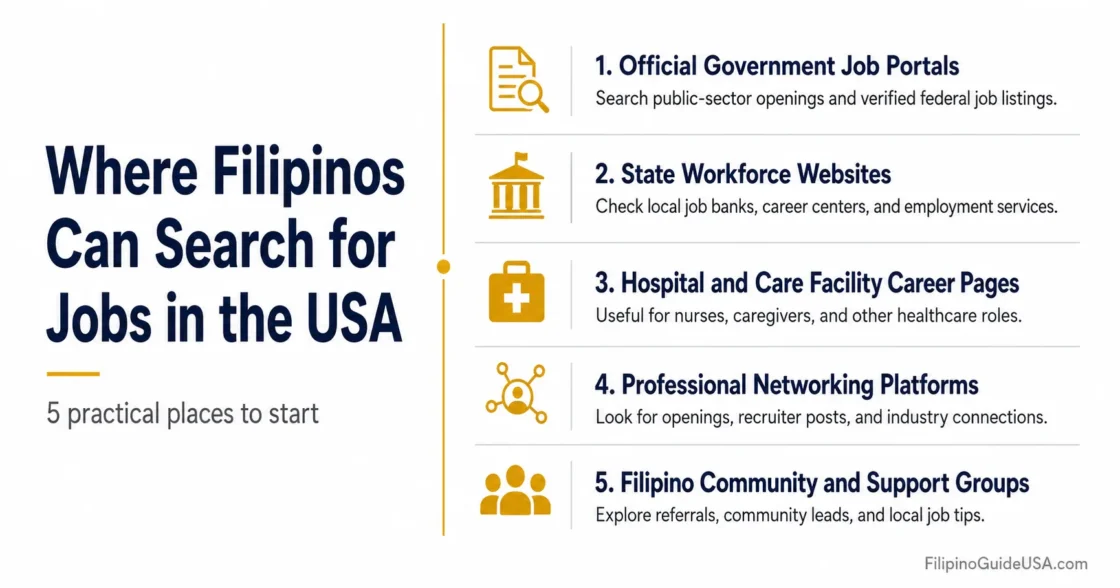
For Filipinos looking for work in the United States, the safest starting point is not a single job board. It is a clear search path: official U.S. employment resources, employer career pages, trusted job platforms, and Philippine verification tools when recruitment begins from the Philippines. The goal is to find real openings, avoid paid “guaranteed job” offers, and understand when a job listing also requires a separate work authorization or visa process.
Why this matters →
A structured job search helps Filipino applicants focus on real U.S. opportunities, avoid recruitment scams, and prepare documents before an employer asks for them.
Prerequisites: Before applying, applicants should prepare a current resume, a professional email address, reachable phone number, work history, education details, references, copies of licenses or certifications when relevant, and clear information about their current U.S. work authorization or visa situation.
- A U.S.-style resume focused on skills, duties, and measurable work experience
- A list of target job titles, not only one broad keyword such as “office job” or “caregiver”
- Preferred U.S. state, city, remote option, or relocation limit
- Proof of professional license, board exam status, or credential evaluation if the field requires it
- For applicants still in the Philippines, the recruitment agency name and job order details for verification through official Philippine government channels
Important Warning: A job listing is not the same as legal permission to work in the United States. Many applicants need valid U.S. work authorization, an employer-filed petition, or another lawful employment basis before starting work. U.S. Citizenship and Immigration Services explains that temporary work in the United States commonly begins with a prospective employer filing a petition when the visa category requires it.[a]
Best Places to Search for Jobs in the USA
This section separates official search channels, private job boards, and Filipino-specific verification tools.
| Search Channel | Best For | How to Use It | Main Caution |
|---|---|---|---|
| CareerOneStop, state job banks, and American Job Centers | General U.S. job search, local employment help, training leads, and state-level openings | Search by occupation, city, state, or training need. USAGov points job seekers to CareerOneStop, state job banks, American Job Centers, local newspapers, and public libraries as job search resources.[b] | Services and eligibility rules can vary by state or local center. |
| USAJOBS | Federal government jobs | Create a profile, upload resumes and documents, search by location and hiring path, then read each announcement carefully before applying. | Federal postings may have strict citizenship, clearance, location, or eligibility limits. |
| Company career pages | Direct applications to hospitals, hotels, schools, logistics companies, technology firms, banks, and large employers | Find the employer’s official website, open the “Careers” or “Jobs” section, and apply there instead of relying only on reposted listings. | Fake websites can copy employer names. Check the domain carefully before entering personal details. |
| Major private job boards | Broad searches across industries, remote roles, hourly work, and professional roles | Use specific titles such as “medical assistant,” “hotel front desk,” “registered nurse,” “software QA analyst,” or “warehouse associate.” Add city, state, license, or shift terms. | Private job boards may include duplicate, outdated, or third-party recruiter postings. |
| DMW approved job orders and licensed agency records | Applicants in the Philippines reviewing overseas recruitment offers | Verify whether a job order and agency appear in official Department of Migrant Workers tools before paying, signing, or sending documents. | An online job ad using a U.S. employer name is not enough. The job order and agency status should be checked separately. |
| SeasonalJobs.dol.gov | Temporary or seasonal U.S. jobs connected to the U.S. Department of Labor’s seasonal job registry | Search by occupation, employer, location, industry, or case number when looking at seasonal or temporary openings.[c] | Seasonal jobs are time-limited and may involve separate visa or recruitment rules. |
Step 1: Start With Official U.S. Employment Resources
Official portals are useful because they point applicants toward public job banks, federal hiring systems, and local employment support.
CareerOneStop is a practical starting point for applicants who are already in the United States or choosing a target state. It connects job seekers to job banks, salary information, training resources, and American Job Center tools. For Filipino newcomers, this is useful because the U.S. job market is highly local: a healthcare support role in Texas, a hospitality role in Nevada, and a warehouse role in New Jersey may appear on different state or regional platforms.
American Job Centers can also help with local job searches, training referrals, and employment-related questions. The U.S. Department of Labor notes that services are designed around local needs and may vary by state, so applicants should check the nearest center’s details before visiting.[d]
Tip: Search the same role in two ways: the Filipino applicant’s familiar job title and the U.S. employer’s likely job title. For example, “caregiver” may also appear as “home health aide,” “personal care aide,” or “direct support professional.”
Step 2: Use USAJOBS for Federal Government Openings
Federal jobs use a separate application system and require careful reading of each announcement.
USAJOBS is the official federal employment site for U.S. government jobs. Applicants can create a profile, save searches, upload resumes and documents, and apply for federal openings through the system.[e] This can be useful for eligible applicants interested in administrative, technology, healthcare, logistics, inspection, research, or public service roles.
Application Note: Federal job announcements often include eligibility limits, required documents, closing dates, pay scales, location rules, and special hiring paths. Applicants should read the full announcement before preparing the resume because a private-sector resume may not include enough detail for a federal application.
Some federal jobs are open to the public, while others are limited to specific hiring paths or require U.S. citizenship, background checks, or security clearance. Applicants should not assume that every federal listing is open to every lawful worker.
Step 3: Search Company Career Pages Directly
Employer websites reduce the risk of outdated listings and help applicants confirm that a job actually exists.
For many Filipino applicants, direct employer searching is more reliable than scrolling through broad job boards. Hospitals, senior care providers, hotels, cruise-related employers, logistics companies, school districts, universities, food service companies, banks, and technology firms usually maintain their own career pages.
A strong search method is to combine the employer type with the target city or state. Examples include “hospital careers Los Angeles,” “hotel careers Las Vegas,” “warehouse jobs New Jersey company careers,” or “school district jobs Texas.” After finding the employer’s official website, applicants should apply through the employer’s own career portal when possible.
Practical Search Method: When a job appears on a private board, copy the exact job title and employer name, then search for the same opening on the employer’s official career page. If the position is not listed there, the applicant should be more cautious before sharing documents.
Step 4: Use Private Job Boards Carefully
Private job platforms are useful for discovery, but every offer still needs verification.
Large job boards can help Filipino applicants discover openings quickly, especially for office support, customer service, retail, hospitality, healthcare support, logistics, IT, accounting, and remote roles. They are also useful for comparing job titles, typical qualifications, schedules, and employer names in a specific city.
Search filters should be specific. Instead of searching only “jobs in USA,” applicants can search by role, state, shift, work setting, and credential. Better searches include “CNA night shift Houston,” “Tagalog bilingual customer service remote,” “accounting assistant Los Angeles,” “hotel front desk New York,” or “registered nurse visa sponsorship hospital.”
Attention: A private job board listing should not be treated as proof that a recruiter, employer, or visa offer is legitimate. The Federal Trade Commission warns that honest employers do not ask applicants to pay to get a job, and federal or postal job applications are free through official channels.[f]
Step 5: Verify Overseas Recruitment From the Philippines
Applicants still in the Philippines should add Philippine government verification before trusting overseas job offers.
When a Filipino applicant is recruited from the Philippines for a U.S. job, the search should not stop at the job ad. The Department of Migrant Workers provides an approved job order search and notes that job orders are considered active unless canceled by the employer or recruitment agency, while also warning users to verify with the agency whether the job order is still active.[g]
The DMW also maintains records of licensed recruitment agencies. Its licensed recruitment agency page states that the list includes agencies licensed to recruit Filipino workers for overseas jobs, both land-based and sea-based.[h] This matters because a person can post a convincing U.S. job offer online without being authorized to recruit workers from the Philippines.
Recruitment Verification Checklist: Before sending money or original documents, applicants in the Philippines should check the agency name, license status, job order, employer name, position title, country, and whether the vacancy is still active.
- Search the agency name in the official licensed agency record.
- Search the position or employer in the approved job order tool.
- Confirm whether the job order is still active with the agency through official contact details.
- Keep copies of emails, receipts, contracts, and messages.
- Avoid recruiters who refuse to provide agency license or job order details.
Step 6: Understand Work Authorization Before Applying Broadly
The right job search depends on whether the applicant can already work in the United States or needs employer sponsorship.
Filipino applicants already in the United States may be in very different situations: permanent resident, U.S. citizen, employment-authorized noncitizen, international student, dependent visa holder, asylum-related applicant, temporary worker, or visitor. These categories do not carry the same work rights. U.S. employers use Form I-9 to verify the identity and employment authorization of individuals hired for employment in the United States.[i]
Some noncitizens may need an Employment Authorization Document, often called a work permit, to prove that they are authorized to work for a specific period. USAGov explains that certain nonimmigrant visa holders may be able to work temporarily in the United States with an Employment Authorization Document.[j]
Important Warning: Applicants should not accept paid work in the United States unless their immigration status or work authorization allows it. A recruiter’s promise, job board message, or verbal offer does not create legal work authorization.
Step 7: Match the Search Site to the Career Field
Different industries use different hiring channels, so the best search source depends on the occupation.
Filipino job seekers often search across healthcare, caregiving, hospitality, logistics, IT, education support, accounting, customer service, and skilled trades. The U.S. Bureau of Labor Statistics Occupational Outlook Handbook can help applicants compare job duties, education, training, pay ranges, and outlook by occupation before choosing search terms.[k]
| Field | Where to Search First | Useful Search Terms | Extra Check |
|---|---|---|---|
| Healthcare and nursing | Hospital career pages, state licensing boards, healthcare staffing firms, and major job boards | registered nurse, CNA, medical assistant, caregiver, home health aide, physical therapist | Confirm license, credential evaluation, and visa-related requirements when listed. |
| Hospitality and food service | Hotel group career pages, restaurant groups, local job boards, and seasonal job sources | front desk agent, housekeeper, cook, banquet server, guest services | Check shift, location, transportation, housing claims, and whether the employer is direct or a staffing agency. |
| Technology and office work | Company career pages, professional networks, private job boards, and recruiter listings | QA analyst, data analyst, software engineer, accounting assistant, administrative assistant | For sponsorship searches, look for clear language about work authorization and employer sponsorship. |
| Warehouse, logistics, and production | Employer career pages, staffing agencies, state job banks, and local job boards | warehouse associate, picker packer, forklift operator, production worker, shipping clerk | Watch for unpaid training fees, equipment fees, or vague employer names. |
| Seasonal or temporary labor | SeasonalJobs.dol.gov, verified recruiters, and employer pages | seasonal worker, hotel seasonal, landscape laborer, seafood processor, farmworker | The U.S. Department of Labor’s foreign labor recruiter list can help workers connect recruiter names with H-2B case numbers and related job orders.[l] |
Step 8: Screen Every Job Offer Before Sending Personal Documents
A careful screening process protects applicants from fake offers, fake checks, and false visa promises.
A real employer should be able to explain the job title, work location, pay structure, schedule, hiring process, and required documents. The employer should also communicate through a professional channel and direct applicants to an official company website or verified hiring portal.
Applicants should be cautious when a recruiter promises immediate U.S. placement, asks for payment before a formal process, pressures the applicant to act within hours, offers unusually high pay for vague duties, or sends a check before work begins. These patterns are common in job scams.
Attention: Do not send passport scans, Social Security numbers, bank details, or payment until the employer, recruiter, job order, and process have been verified through official or direct channels. For U.S. federal and postal jobs, applicants should never pay a fee to apply.
A Practical Weekly Job Search Routine
A simple routine helps applicants avoid random applications and track real progress.
- Choose three target roles. Use U.S. job titles, not only Philippine job titles.
- Choose two target locations. Search by state, metro area, or remote eligibility.
- Check official sources first. Use CareerOneStop, state job banks, American Job Center tools, USAJOBS, or SeasonalJobs when relevant.
- Apply on employer websites. Use private boards to discover openings, then confirm the job on the employer’s own career page.
- Keep an application tracker. Record the employer, job title, date applied, source, contact person, and next step.
- Verify recruiters. For overseas recruitment from the Philippines, check DMW records before sending documents or money.
- Review work authorization wording. Look for phrases such as “must be authorized to work in the U.S.” or “sponsorship available,” then confirm during the process.
Tip: A smaller number of targeted applications usually works better than sending the same resume to every listing. Each resume should match the job title, duties, tools, license, and work setting in the posting.
Common Questions About Job Searching in the USA
These answers cover the points Filipino applicants often need to clarify before applying.
Can Filipinos Apply Directly to U.S. Employers?
Yes, Filipinos can apply directly to U.S. employers, especially through official company career pages and major job platforms. Whether the employer can hire the applicant depends on work authorization, visa category, licensing rules, and the employer’s hiring policy.
Which Site Is Best for Jobs With Visa Sponsorship?
No single site reliably captures every sponsorship-friendly employer. Applicants can search employer career pages, professional job boards, healthcare systems, universities, technology firms, and official labor resources. The job description should be read carefully because some employers clearly state whether they sponsor or do not sponsor work visas.
Should Applicants Pay a Recruiter to Get a U.S. Job?
Applicants should be very cautious with any request for payment. Honest employers generally do not charge applicants to receive a job. For overseas recruitment from the Philippines, agency and job order details should be checked through official DMW tools before any payment or document transfer is considered.
Are U.S. Government Jobs Open to Filipino Applicants?
Some federal jobs may be open to noncitizens, but many require U.S. citizenship, a specific hiring path, or security clearance. Each USAJOBS announcement should be checked line by line before applying.
What Should Applicants Do if a Job Offer Looks Suspicious?
Applicants should stop communication, avoid sending more documents, save copies of messages, verify the employer through official channels, and report suspected fraud through the proper consumer protection or government reporting channel when appropriate.
Verification Note: Job platforms, visa procedures, agency records, and work authorization rules can change. Applicants should recheck official U.S. and Philippine government sources before relying on any job offer, recruiter message, or immigration-related instruction.
Sources
- [a] USCIS, “Working in the United States” — used for the point that many temporary U.S. work paths require an employer-filed petition or lawful employment basis. This is reliable because USCIS is the U.S. federal agency that administers immigration benefit petitions.
- [b] USAGov, “How to find a job” — used for official U.S. job search resources such as CareerOneStop, state job banks, American Job Centers, USAJOBS, local newspapers, and public libraries. This is reliable because USAGov is the official guide to U.S. government information and services.
- [c] U.S. Department of Labor, “SeasonalJobs.dol.gov Find Jobs” — used for seasonal and temporary job search methods by occupation, employer, location, industry, or case number. This is reliable because it is an official U.S. Department of Labor job registry.
- [d] U.S. Department of Labor, “American Job Centers” — used for local employment service and training support information. This is reliable because it is published by the U.S. Department of Labor’s Employment and Training Administration.
- [e] USAJOBS, “The Federal Government’s Official Employment Site” — used for federal job search, profiles, resumes, documents, saved searches, and federal applications. This is reliable because USAJOBS is operated as the official federal hiring site.
- [f] Federal Trade Commission, “Job Scams” — used for warnings about paying for jobs, fake checks, and federal or postal job application scams. This is reliable because the FTC is the U.S. federal consumer protection agency.
- [g] Department of Migrant Workers, “Approved Job Orders” — used for verifying overseas job orders and the warning to confirm whether a job order is still active. This is reliable because DMW is the Philippine government department responsible for migrant worker matters.
- [h] Department of Migrant Workers, “Licensed Recruitment Agencies” — used for checking whether a recruitment agency is licensed for overseas recruitment. This is reliable because it is an official Philippine government recruitment agency record.
- [i] USCIS, “I-9, Employment Eligibility Verification” — used for the statement that U.S. employers verify identity and employment authorization for hired workers. This is reliable because USCIS publishes the official Form I-9 guidance.
- [j] USAGov, “Work in the U.S. with a work permit (EAD)” — used for the point that certain nonimmigrant visa holders may be able to work temporarily with an Employment Authorization Document. This is reliable because USAGov summarizes official government service information.
- [k] U.S. Bureau of Labor Statistics, “Occupational Outlook Handbook” — used for researching occupations, duties, education, training, pay, and outlook. This is reliable because BLS is the U.S. federal statistical agency for labor market information.
- [l] U.S. Department of Labor, “Foreign Labor Recruiter List” — used for checking recruiter names and H-2B case numbers connected with disclosed foreign labor recruitment. This is reliable because it is published by the Department of Labor’s Office of Foreign Labor Certification.