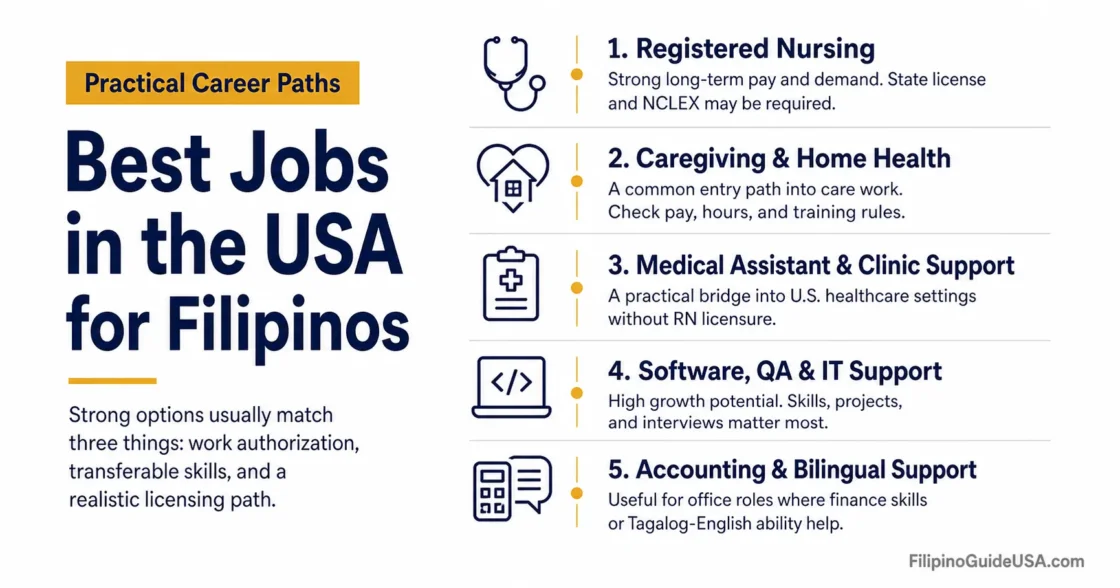
The best jobs in the USA for Filipinos are usually found where three things meet: legal work authorization, skills that transfer well from the Philippines, and a realistic path to U.S. licensing or employer requirements. For many Filipino workers, healthcare, caregiving, technology, accounting, bilingual support, hospitality management, and medical office roles are the strongest options. The right choice depends less on nationality and more on your current status, training, English level, state rules, and how quickly you need to start earning.
Filipino immigrants in the United States tend to have strong education levels compared with the overall immigrant population; in 2023, 53 percent of Filipino immigrant adults ages 25 and older reported having at least a bachelor’s degree, according to Migration Policy Institute analysis of U.S. Census data.[a] That matters because many good U.S. jobs reward formal training, but the U.S. job market also separates “having experience” from “being licensed to do the job.” A nurse, accountant, teacher, engineer, or medical technologist may still need state review, exams, credential evaluation, or extra documentation before working in the same role.
First, Know Whether You Can Legally Work
Before comparing jobs, check your work authorization. In the U.S., a green card holder, certain visa holders, some people with an Employment Authorization Document, and U.S. citizens can work, but the rules are not the same for every status. USAGov explains that many nonimmigrant visa holders need an Employment Authorization Document before being hired, while lawful permanent residents and some workers tied to a specific employer may not need a separate work permit.[b]
This step is not only paperwork. It changes which jobs are realistic. Some workers can apply broadly. Others may work only for the sponsoring employer. Some may need to wait for an EAD card before accepting paid work. A job that looks perfect on salary and location can still be wrong if it does not match your immigration status.
Green card holders can usually apply for most private-sector jobs, subject to licensing and employer requirements.
EAD holders should check the validity dates and renewal rules before changing jobs or accepting a start date.
Employer-sponsored workers should confirm whether the job title, location, employer, and duties match the visa petition.
Students and exchange visitors should not assume they can work off campus without separate authorization.
Jobs That Often Fit Filipino Workers Well
The list below is not a promise of easy hiring. It is a practical ranking based on transferable skills, English use, Filipino community experience in the field, licensing paths, and current labor-market data from official career sources.
| Job Area | Best Fit For | Main Advantage | Main Watchpoint |
|---|---|---|---|
| Registered Nursing | Licensed nurses or nursing graduates from the Philippines | Good pay, clear demand, familiar path for many Filipino professionals | State license, NCLEX, credentials, English or healthcare certification requirements may apply |
| Caregiving and Home Health | New arrivals, healthcare aides, workers seeking faster entry | Large number of openings and many local employers | Pay varies; some roles need training, testing, or agency certification |
| Medical Assistant and Clinic Support | Workers who want a clinic job without RN licensing | Good bridge into U.S. healthcare settings | Certificate preferences vary by employer and state |
| Software, QA, and IT Support | Computer science graduates, coders, tech support workers, career shifters | High pay potential and less state licensing than healthcare | Portfolio, U.S.-style resume, interviews, and technical screening matter |
| Accounting, Payroll, and Bookkeeping | Business, finance, and accounting graduates | Transferable office skills and many private-sector openings | CPA licensing is state-based; U.S. tax and payroll rules must be learned |
| Tagalog-English Interpreting | Strong bilingual speakers with clear English and Filipino language skills | Language can be a direct job skill in healthcare, courts, schools, and call centers | Medical or legal interpreting may require training or certification |
| Hospitality, Food Service, and Operations | Workers seeking local entry, supervisor growth, or customer-facing jobs | Accessible starting roles and practical promotion paths | Wages, schedules, and benefits vary widely by employer |
Registered Nurse: One of the Strongest Long-Term Paths
Registered nursing remains one of the clearest professional paths for Filipino workers with nursing education or experience. The U.S. Bureau of Labor Statistics reported a median annual wage of $93,600 for registered nurses in May 2024 and projected 5 percent employment growth from 2024 to 2034.[c] For Filipino nurses, the appeal is easy to understand: hospitals, long-term care facilities, home health providers, specialty clinics, and travel nursing agencies all need licensed nurses.
The hard part is that U.S. nursing is regulated at the state level. A nurse educated in the Philippines usually cannot simply arrive and work as an RN. State boards of nursing may review education, license history, English proficiency, exam results, and background documentation. NCSBN’s international nurse licensure resources explain that internationally educated nurses need to follow the requirements of the board of nursing where they plan to practice.[d]
Why Nursing Works Well for Many Filipinos
Philippine nursing education often gives workers a base that can be reviewed for U.S. licensure.
English is widely used in Philippine nursing education and documentation.
There are established Filipino nurse communities in many U.S. states.
The career can grow into charge nurse, nurse educator, case manager, nurse practitioner, or healthcare administration roles.
What Filipino Nurses Should Prepare
A nurse planning to work in the U.S. should prepare school records, license verification, employment history, passport information, exam records, and English-language documents early. Some healthcare workers seeking an occupational visa may also need a VisaScreen certificate or related healthcare worker certification; CGFNS states that its VisaScreen service provides an official certificate that satisfies U.S. federal screening requirements for covered healthcare professionals seeking occupational visas.[e]
For many Filipino nurses, the best strategy is not only “apply to hospitals.” It is to choose the target state first, check that board’s nursing requirements, then build the job search around employers that understand internationally educated nurse processing.
Caregiver and Home Health Jobs: Accessible, but Read the Details
Caregiving, personal care, and home health aide work can be a realistic entry point for Filipinos who want to work in healthcare but are not yet licensed as nurses in the U.S. These jobs may involve helping older adults, people with disabilities, or recovering patients with daily tasks, mobility, basic household support, and personal care.
The U.S. Bureau of Labor Statistics reported that home health and personal care aides had a median annual wage of $34,900 in May 2024, with employment projected to grow 17 percent from 2024 to 2034.[f] That growth makes the field easier to enter in many areas, but pay and working conditions can differ a lot by state, agency, client type, and whether the role includes benefits.
When Caregiving Is a Good Fit
You need a faster path into paid work and already have authorization to work.
You are comfortable with hands-on care, patience, and long shifts.
You want U.S. healthcare experience before pursuing CNA, LPN, RN, or medical assistant roles.
You live in an area with a large senior population or many home care agencies.
What to Be Careful About
Caregiver job ads sometimes use phrases like “visa sponsorship,” “live-in position,” or “urgent hiring.” Read these carefully. A legitimate employer should be clear about pay, hours, duties, location, deductions, housing terms if any, and whether the role is employee or contractor work. Do not rely only on a social media post or verbal promise.
If you are coming under a temporary worker category, read your rights before travel and before signing. The U.S. Department of State says temporary workers have the right to be paid fairly and that an employer cannot mistreat, fire, or refuse to pay a worker for exercising rights.[g]
Medical Assistant and Clinic Support Roles
Medical assistant jobs can be a strong middle path for Filipinos who want healthcare work but do not yet have a U.S. nursing license. Medical assistants may help with patient intake, vital signs, scheduling, records, basic clinical tasks, and front-desk coordination. In some clinics, bilingual ability and familiarity with immigrant patient concerns can also be useful.
BLS reported a median annual wage of $44,200 for medical assistants in May 2024 and projected 12 percent employment growth from 2024 to 2034.[h] Some employers train on the job, but many prefer a certificate or prior clinic experience. This role can also help internationally educated nurses learn U.S. clinic systems while working toward licensure, as long as the job duties stay within the allowed scope for that role.
Common Related Job Titles
Medical assistant
Clinic assistant
Patient care coordinator
Front office medical receptionist
Phlebotomy technician, where training and state rules allow
Patient access representative
Software, QA, and IT Jobs
Technology can be one of the best U.S. career paths for Filipinos with computer science, engineering, business systems, customer support, or self-taught coding backgrounds. Unlike nursing, most software and QA jobs do not require a state license. Employers care more about proof of skill: projects, GitHub work, certifications, coding tests, problem solving, and communication.
BLS reported a May 2024 median annual wage of $133,080 for software developers and $102,610 for software quality assurance analysts and testers.[i] Those figures are national medians, not entry-level promises. A new arrival may start lower, especially without U.S. experience, but tech still offers strong upward movement when skills are current.
Good Tech Roles to Consider
Software developer
QA analyst or software tester
IT support specialist
Data analyst
Business systems analyst
Cybersecurity support or SOC analyst
Cloud support associate
For Filipinos still in the Philippines, U.S. remote job ads can be confusing. A U.S. company hiring a worker who remains abroad is not the same as being authorized to work inside the United States. If the job requires living in the U.S., ask what status or work authorization the employer expects. If the job is remote from the Philippines, check tax, contractor, and local registration issues separately.
Accounting, Payroll, and Finance Office Jobs
Accounting is another practical path because many Filipino graduates have business, finance, audit, bookkeeping, banking, or administrative backgrounds. U.S. employers hire for accounts payable, accounts receivable, payroll, billing, tax support, audit support, and staff accountant roles. For many workers, the first job is not CPA-level accounting but a finance operations role that builds local experience.
BLS reported a median annual wage of $81,680 for accountants and auditors in May 2024.[j] CPA licensing is handled by state boards, so a Philippine CPA or accounting graduate should check state education rules before assuming the credential transfers directly. Even without CPA licensing, workers can often target bookkeeping, payroll, billing, accounting clerk, tax preparer, and finance assistant roles, depending on employer needs.
Skills That Help Filipino Applicants Stand Out
Excel or Google Sheets confidence
QuickBooks, Xero, NetSuite, SAP, Oracle, or other accounting software exposure
Payroll basics and attention to deadlines
Clear written English for vendor and client communication
Understanding of U.S. sales tax, W-2, 1099, and payroll terms
Tagalog-English Interpreting and Bilingual Support
Tagalog-English skills can become a direct job advantage in hospitals, schools, law offices, government service contractors, call centers, community organizations, insurance companies, and social service settings. Interpreting is not the same as casual bilingual speaking. Medical, legal, and school interpreting require accuracy, neutrality, confidentiality, and often training.
BLS reported a median annual wage of $59,440 for interpreters and translators in May 2024.[k] Tagalog demand depends heavily on location. Areas with larger Filipino communities, such as parts of California, Nevada, Hawaii, Washington, New York, New Jersey, Texas, and Illinois, may have more need for Filipino language support. Remote interpreting companies may also hire across states, but equipment, background checks, scheduling, and certification expectations vary.
Related Roles Beyond Interpreting
Tagalog customer support representative
Healthcare call center associate
Community outreach coordinator
Patient navigator
School family liaison
Insurance member services representative
Hospitality, Food Service, and Operations Jobs
Hospitality and food service jobs are not always the highest-paying starting roles, but they can be useful for newly arrived workers who need U.S. work history, local references, and supervisor experience. Filipinos with restaurant, cruise, hotel, culinary, housekeeping, or customer service backgrounds may find familiar work in hotels, senior living facilities, hospitals, airports, restaurants, and catering companies.
The better long-term target is usually not only server, cashier, or line cook. Look for paths into shift lead, kitchen supervisor, banquet coordinator, hotel front desk lead, housekeeping supervisor, inventory coordinator, or operations assistant. Those roles can build a resume that later supports office, logistics, healthcare support, or management applications.
Which Job Is Best Based on Your Situation?
A useful way to choose is to match the job to your starting point. A Filipino RN, a new immigrant with no U.S. credential, a tech worker, and a spouse waiting for an EAD do not need the same job plan.
| Your Situation | Best First Targets | Why This Route Makes Sense |
|---|---|---|
| Philippine-trained nurse | RN licensure path, NCLEX preparation, healthcare support role while processing | The long-term reward is stronger if you complete state nursing requirements instead of staying in lower-paid care work. |
| No U.S. license yet, but healthcare experience | Caregiver, CNA where eligible, medical assistant, patient care coordinator | These roles can provide U.S. healthcare experience while you prepare credentials. |
| IT or engineering background | QA, IT support, software development, data analyst, business analyst | Employers can assess your skills through projects and interviews rather than state licensing. |
| Business or accounting background | Bookkeeping, payroll, billing, accounts payable, staff accountant | Many finance tasks transfer well, but U.S. tax and payroll terms must be learned. |
| Strong English and Tagalog | Interpreter, customer support, patient navigator, school liaison | Language becomes a paid skill when paired with accuracy and professional conduct. |
| New arrival needing local experience | Healthcare support, hospitality, office admin, warehouse coordination, customer service | These roles can create U.S. references and work history while you build toward a better role. |
Best States and Cities to Consider
The best location depends on your job field. Filipino community size can help with referrals and support, but it should not be the only factor. Compare pay, rent, transportation, licensing speed, commute, childcare, and whether employers in your field are hiring.
Places Often Worth Checking
California: large Filipino communities, many hospitals, tech hubs, and service jobs, but high housing costs in many areas.
Nevada: hospitality, healthcare, and Filipino community networks, especially around Las Vegas.
Hawaii: strong Filipino presence and healthcare/service needs, but island living costs can be high.
Texas: healthcare, tech, logistics, accounting, and lower-cost metro options than many coastal cities.
New York and New Jersey: healthcare, finance, community services, and dense immigrant networks.
Washington: healthcare, tech, logistics, and Filipino communities around the Seattle area.
Illinois: healthcare, transportation, office, and professional roles around Chicago and nearby suburbs.
For licensed careers, do not choose a state only because family lives there. Check the licensing board first. A state with a faster or clearer credential process may save months of delay.
Documents and Skills to Prepare Before Applying
Many Filipino applicants lose time because their resume is ready but their documents are not. Prepare early, especially if your education or license comes from the Philippines.
U.S.-style resume with clear job titles, dates, tools, and measurable duties
Diploma, transcript, board license, PRC records, and training certificates where relevant
Credential evaluation documents if the profession requires them
English test results if required by a board, school, or healthcare credential process
Professional references with updated email addresses and phone numbers
Proof of work authorization that matches the job start date
LinkedIn profile or online portfolio for tech, admin, design, writing, or professional roles
Job Offers That Need Extra Care
Most employers are ordinary businesses trying to hire workers, but applicants should still be careful. A good job offer should be written, clear, and consistent with your status. Be cautious when a recruiter avoids basic details or rushes you to pay money.
Do not pay large “placement” or “processing” fees to unknown individuals for a promised U.S. job.
Do not accept paid work before your work authorization allows it.
Do not hand over your passport for an employer to “keep safe.”
Do not rely on a job title alone; ask for duties, pay, worksite, schedule, and benefits in writing.
Do not assume “visa sponsorship” means the employer can sponsor any worker for any job.
Do not ignore state licensing rules for nursing, teaching, therapy, engineering, or accounting.
Practical Job Search Approach
A better job search is usually focused, not random. Start with two or three job families that match your background. Then build separate resumes for each one. A nurse applying for medical assistant, patient care coordinator, and RN transition roles should not use the exact same resume for all three.
Confirm your work authorization and job restrictions.
Choose your target state or metro area.
Check licensing rules before applying to regulated jobs.
Prepare a U.S.-style resume with plain job titles and specific duties.
Apply to employers that match your status, schedule, and credential level.
Use Filipino community networks for referrals, but verify every offer independently.
Track applications, interview dates, pay ranges, and recruiter names in one spreadsheet.
Questions Filipino Applicants Often Ask
What Is the Best Job in the USA for Filipinos?
For licensed Filipino nurses, registered nursing is often one of the strongest long-term options because pay, demand, and career growth can be good. For workers without a U.S. license, caregiving, medical assistant, IT support, accounting support, customer service, and hospitality operations can be more realistic starting points.
Can a Filipino Work in the U.S. Without a Green Card?
Yes, some people can work without a green card if they have another valid work-authorized status, a work permit, or an employer-specific visa that allows the job. The exact answer depends on the person’s immigration category, employer, and start date.
Are Caregiver Jobs in the U.S. Good for Filipinos?
Caregiver jobs can be good for Filipinos who enjoy care work, have legal work authorization, and understand the pay and schedule. They can also help build U.S. healthcare experience. The main caution is that not every caregiver job includes visa sponsorship, benefits, or stable hours.
Can a Filipino Nurse Work as an RN Right Away in the U.S.?
Usually not. A Philippine-trained nurse normally needs to meet the requirements of the state board of nursing, which may include credential review, NCLEX, English requirements, and other documentation. Some nurses work in healthcare support roles while completing the process.
Is IT a Good Career for Filipinos in America?
IT can be a good path for Filipinos with technical skills because many roles care more about skills, projects, and experience than state licensing. Software, QA, data, cloud support, cybersecurity support, and IT help desk roles can all be worth considering.
What Should I Check Before Accepting a U.S. Job Offer?
Check the employer name, pay, schedule, worksite, job duties, benefits, visa or work authorization fit, licensing requirements, and whether the offer is in writing. If the job involves immigration paperwork, check official government sources and consider qualified legal guidance before making a decision.
Before You Apply or Accept an Offer
U.S. job rules, work permit policies, visa processing, licensing requirements, and wage conditions can change. Before accepting a job, check the official agency page for your status or profession, confirm the employer’s written offer, and make sure the job matches your current permission to work. For licensed fields such as nursing, teaching, accounting, therapy, or engineering, always check the state board or official credentialing body before paying for exams, evaluations, or training.
Sources
[a] Migration Policy Institute, “Filipino Immigrants in the United States” — used for education and labor-market context about Filipino immigrants in the U.S. (trusted because MPI is a long-running policy research organization that analyzes U.S. Census and immigration data).
[b] USAGov, “Work in the U.S. with a Work Permit (EAD)” — used for work authorization and EAD context. (trusted because USAGov is an official U.S. government information service).
[c] U.S. Bureau of Labor Statistics, Occupational Outlook Handbook, “Registered Nurses” — used for RN wage and job outlook data. (trusted because BLS is the official U.S. labor statistics agency).
[d] National Council of State Boards of Nursing, “U.S. Nursing Licensure for Internationally Educated Nurses” — used for international nurse licensure context. (trusted because NCSBN supports U.S. boards of nursing and nursing regulation).
[e] CGFNS International, “VisaScreen: Visa Credentials Assessment” — used for healthcare worker credential screening information. (trusted because CGFNS is a recognized credential evaluation organization for internationally educated healthcare professionals).
[f] U.S. Bureau of Labor Statistics, Occupational Outlook Handbook, “Home Health and Personal Care Aides” — used for caregiver wage, training, and job outlook data. (trusted because BLS is the official U.S. labor statistics agency).
[g] U.S. Department of State, “Rights and Protections for Temporary Workers” — used for worker rights and fair-pay protection context. (trusted because it is an official U.S. Department of State visa information page).
[h] U.S. Bureau of Labor Statistics, Occupational Outlook Handbook, “Medical Assistants” — used for medical assistant wage and growth data. (trusted because BLS is the official U.S. labor statistics agency).
[i] U.S. Bureau of Labor Statistics, Occupational Outlook Handbook, “Software Developers, Quality Assurance Analysts, and Testers” — used for software and QA wage data. (trusted because BLS is the official U.S. labor statistics agency).
[j] U.S. Bureau of Labor Statistics, Occupational Outlook Handbook, “Accountants and Auditors” — used for accounting wage data. (trusted because BLS is the official U.S. labor statistics agency).
[k] U.S. Bureau of Labor Statistics, Occupational Outlook Handbook, “Interpreters and Translators” — used for interpreter and translator wage data. (trusted because BLS is the official U.S. labor statistics agency).