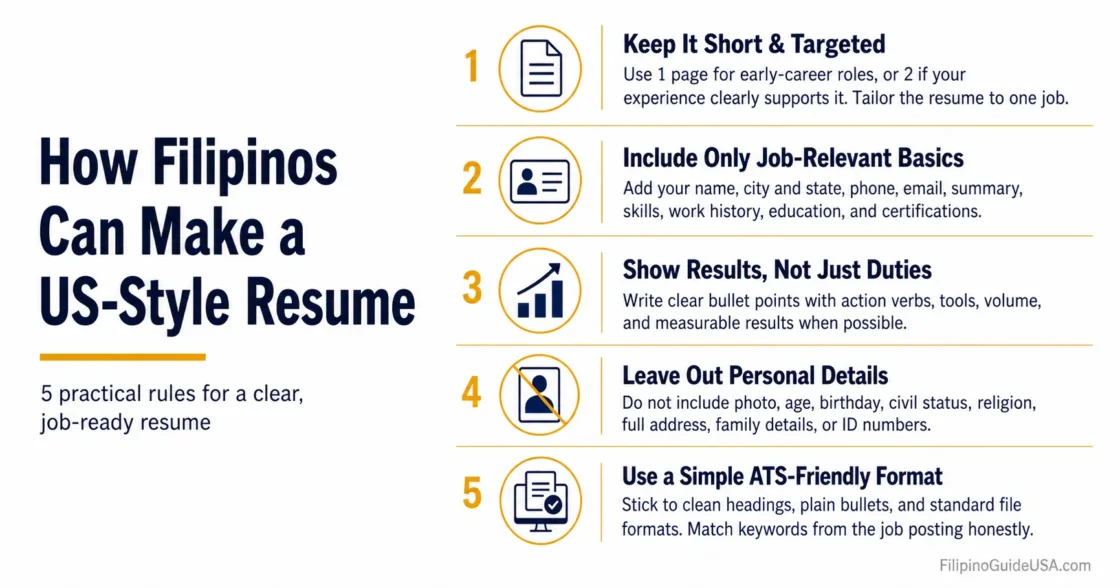
For Filipinos applying for jobs in the United States, a US-style resume should be short, direct, and focused on proof of fit for one job opening. It is not the same as a Philippine biodata, a long CV, or a personal profile sheet. A strong US resume usually highlights your name, contact details, work history, education, skills, certifications, and measurable results, while leaving out personal details such as age, civil status, religion, full home address, photo, and family information.
The goal is simple: help a recruiter understand, within a short scan, what job you can do, what experience proves it, and why your background from the Philippines, the United States, or both fits the role.
What Makes a Resume “US-Style”?
A US-style resume is usually built for one job application, not for your entire life history. It uses clear section headings, short bullet points, action verbs, and results where possible. Harvard’s career office describes strong resume language as specific, active, fact-based, and easy for people or systems to scan quickly.[a]
For Filipino applicants, the biggest adjustment is often removing details that feel normal on Philippine documents but are not expected on a US resume. A US employer does not need your height, weight, birthday, complete address, religion, parents’ names, spouse’s name, number of children, or a formal ID-style photo on the resume.
That does not mean hiding who you are. It means using the resume space for job-related information only.
| Item | Often Seen in Philippine Biodata or CV | Better for a US-Style Resume |
|---|---|---|
| Photo | Often included | Leave it out unless the employer specifically requests it for a lawful reason |
| Personal Details | Age, birthday, civil status, religion, height, weight | Do not include these details |
| Length | Can be several pages | Usually 1 page for early-career applicants, 2 pages when experience supports it |
| Work History | May list many duties | Focus on relevant duties, results, tools, volume, and achievements |
| References | Sometimes listed directly | Leave off the resume unless requested |
| Tone | Formal and document-like | Clear, job-focused, and easy to scan |
The Best Resume Format for Most Filipino Applicants
For most applicants, the safest format is reverse chronological. This means your most recent job appears first, then older jobs below it. US recruiters are used to this layout because it shows your recent experience clearly.
A good order is:
- Full name and contact information
- Short professional summary
- Skills matched to the job posting
- Work experience
- Education
- Licenses, certificates, training, or technical tools
- Volunteer work, projects, or community work if relevant
A functional resume, where skills are listed without clear dates and job history, can be risky. It may make employers wonder whether you are trying to hide gaps. A combination format can work if you are changing careers, but it should still include a clear work history.
Contact Information to Put at the Top
Your contact section should be simple. Use the name you use professionally, a US phone number if you have one, a professional email address, your city and state, and a LinkedIn profile or portfolio link if it supports your application.
A clean contact line can look like this:
Maria Santos
Dallas, TX | maria.santos@email.com | (214) 555-0198 | linkedin.com/in/mariasantos
You do not need to list your full street address. City and state are usually enough. Do not put your Social Security number, passport number, green card number, driver’s license number, or bank details on a resume.
Write a Short Professional Summary
The summary should be two to four lines. It should not sound like a personal essay. Use it to connect your background to the job.
A weak summary sounds like this:
I am hardworking, honest, flexible, and willing to learn. I am looking for a company where I can grow and share my abilities.
A stronger US-style summary sounds like this:
Customer service professional with 5 years of experience handling billing questions, account updates, and service complaints for telecom and retail customers. Skilled in CRM systems, call documentation, email support, and resolving high-volume customer requests with clear communication.
The second version gives the employer job-related information. It shows field, experience level, duties, tools, and work setting.
Turn Philippine Work Experience into US Employer Language
Experience from the Philippines can be very valuable in the US job market, but it may need translation into terms US employers understand. Do not assume the recruiter knows Philippine company names, school systems, local job titles, government agencies, or industry terms.
For each job, include:
- Job title
- Employer name
- City and country, or city and state for US jobs
- Month and year started
- Month and year ended, or “Present”
- Three to six bullet points showing duties, tools, volume, and results
Use numbers when they are real and useful. Numbers can show scale: number of customers assisted, cases processed, students taught, patients supported, reports prepared, invoices handled, team members trained, or systems used.
Before and After Example
Philippine-style duty:
Responsible for assisting customers and doing reports as assigned by supervisor.
US-style bullet:
Handled 40–60 customer inquiries per shift through phone and email, documented account updates in a CRM system, and escalated billing cases to the correct support team.
The second version is stronger because it shows volume, channel, tool, and task ownership.
Use Bullet Points That Show Results
US resumes do not need full sentences under every job. Bullet points are easier to scan. Start most bullets with action verbs, then add the task and result.
A practical pattern is:
Action verb + task + tool, volume, or result
Examples:
- Processed daily cash, card, and online payments while balancing end-of-shift records.
- Prepared weekly inventory reports using Excel and helped reduce stock count errors.
- Supported new hires by explaining store procedures, customer service scripts, and POS system steps.
- Managed appointment scheduling for 3 providers and confirmed patient information before visits.
- Created social media captions and product posts for a small retail business using Canva and Meta Business Suite.
Keep every bullet tied to the job you want. If you are applying for an office assistant role, highlight scheduling, data entry, customer service, records, email, and software. If you are applying for a caregiver role, highlight care routines, safety, documentation, communication with families, and reliability.
Education, Degrees, and Philippine Credentials
List your education in a way that is easy for a US employer to read. Include the school name, degree, field of study, and graduation year if it helps. If the school is in the Philippines, write the country after the school or city.
Bachelor of Science in Nursing
University of Santo Tomas, Manila, Philippines
If your field requires a license in the United States, the resume alone is not enough. The US Department of Education explains that employers may request a credential evaluation for education completed outside the United States, and licensed professions are handled by state or territorial licensing authorities.[b]
This matters for nurses, teachers, accountants, engineers, physical therapists, medical technologists, and other regulated occupations. On the resume, you can list your Philippine degree and Philippine license if relevant, but do not present yourself as licensed in a US state unless you already hold that state license.
Skills to Include Without Overloading the Page
The skills section should match the job posting. Do not list every skill you have. Choose skills that the employer is asking for and that you can prove through work, training, or projects.
Useful skill categories may include:
- Software: Microsoft Excel, Google Workspace, QuickBooks, Salesforce, Canva, AutoCAD, Epic, or other tools used in the role
- Administrative skills: scheduling, records management, data entry, invoicing, email handling
- Customer service skills: call handling, complaint resolution, account support, appointment confirmation
- Healthcare skills: patient intake, charting support, vital signs, care coordination, HIPAA-aware documentation if trained
- Languages: English, Filipino or Tagalog, Cebuano, Ilocano, Hiligaynon, Kapampangan, or other languages you can use professionally
When you are unsure which terms US employers use for your occupation, O*NET can help you compare job duties, tools, knowledge, and skills across US occupations.[c]
Should You Mention Filipino or Tagalog Language Skills?
Yes, if it helps the job. Language skills can be useful in healthcare, customer service, schools, social services, community programs, legal support offices, call centers, hospitality, and roles serving Filipino communities.
Write language skills honestly. For example:
- English: Professional working proficiency
- Filino or Tagalog: Native or fluent
- Cebuano: Conversational
- Spanish: Basic
Do not list a language as fluent if you cannot use it in a workplace conversation, phone call, email, or customer interaction.
Work Authorization and Visa Details on a Resume
Do not put sensitive immigration document numbers on your resume. Do not include your passport number, Alien Registration Number, Social Security number, visa receipt number, green card number, or copies of documents in a resume file.
If you are already authorized to work in the United States, a short line such as “Authorized to work in the United States” may be useful in some situations. If an application asks whether you need sponsorship now or in the future, answer accurately. After a person is hired, US employers use Form I-9 to verify identity and employment authorization for employment in the United States.[d]
If your situation involves a visa, pending work authorization, adjustment of status, or sponsorship, check official immigration instructions or speak with a qualified immigration professional before giving answers you are not sure about.
Personal Details to Leave Out
US resumes are shaped partly by employment fairness rules and hiring norms. The Equal Employment Opportunity Commission says pre-employment information should generally be limited to what is needed to determine whether a person is qualified for the job, and that information such as race, sex, national origin, age, and religion is not relevant for that purpose.[e]
Leave these off your resume:
- Photo
- Date of birth
- Age
- Gender
- Height and weight
- Religion
- Civil status
- Number of children
- Parent or spouse names
- Full street address
- Social Security number
- Passport or green card number
- Signature
Some Filipino applicants worry that the resume will look incomplete without these details. It will not. In the US, leaving them out usually makes the resume look more professional.
Resume Formatting for Online Applications
Many US employers use online application systems. A simple resume is usually safer than a highly designed one. Use standard headings, clear spacing, and plain bullets. Avoid text boxes, photos, icons, heavy graphics, unusual fonts, and complex columns if the employer’s system might have trouble reading them.
Good section headings include:
- Professional Summary
- Skills
- Work Experience
- Education
- Certifications
- Projects
- Volunteer Experience
Use file names that look professional:
- Maria-Santos-Resume.pdf
- Juan-Dela-Cruz-Administrative-Assistant-Resume.docx
- Ana-Reyes-Caregiver-Resume.pdf
If the job post asks for a PDF, send a PDF. If it asks for a Word document, send a Word document. Following the instruction matters.
Private-Sector Resume vs Federal Resume
A private-sector resume and a federal resume are not always the same. If you apply through USAJOBS, read the announcement carefully. USAJOBS says federal resumes must show how the applicant meets the job announcement’s requirements and may need details such as month and year dates, hours worked per week, employer name, job title, and descriptions tied to the required qualifications.[f]
For a private company, your resume can often be shorter and more targeted. For a federal job, the resume must answer the announcement more directly. Do not reuse a short private-sector resume for USAJOBS without checking the required details.
| Resume Area | Private Company | Federal Job Through USAJOBS |
|---|---|---|
| Main Focus | Fit for the role and interview selection | Proof that you meet the job announcement requirements |
| Dates | Month and year are usually helpful | Month and year are commonly expected |
| Hours per Week | Usually not included | May be needed for each role |
| Duties | Short, selected bullet points | More detail tied to duties and qualifications |
| Documents | Resume and sometimes cover letter | Resume plus any required documents listed in the announcement |
How to Handle Employment Gaps
Many Filipinos moving to the US have gaps because of migration, caregiving, licensing exams, credential evaluation, family transition, or waiting for work authorization. A gap does not automatically ruin a resume. The best approach is to keep the work history honest and use the summary, skills, volunteer work, training, or projects to show that you are ready for the role.
If the gap included useful activity, you can include it when relevant:
- Completed CNA training while preparing for US healthcare employment
- Provided full-time family care and managed scheduling, records, appointments, and household budget
- Completed online training in Excel, bookkeeping, customer service, or medical terminology
- Volunteered at a church, school, pantry, community event, or nonprofit organization
Do not over-explain the gap on the resume. Save longer context for the interview if the employer asks.
Resume Examples for Common Filipino Applicant Backgrounds
Customer Service or Call Center Background
Customer service representative with 4 years of experience supporting US-based telecom customers from a Manila contact center. Handled billing questions, account updates, service complaints, and call documentation using CRM tools. Comfortable with high-volume calls, email support, and performance targets.
- Resolved 50–70 customer calls per shift related to billing, account access, and service changes.
- Documented customer interactions in CRM software and escalated unresolved cases to tier 2 support.
- Maintained quality scores by following call scripts, verification steps, and service recovery procedures.
Healthcare or Caregiving Background
Caregiver with experience supporting older adults with daily routines, meal preparation, mobility assistance, appointment reminders, and family communication. Known for calm communication, careful documentation, and dependable attendance.
- Assisted clients with personal care routines, mobility support, meals, and light housekeeping.
- Recorded daily observations and reported changes in condition to family members or supervisors.
- Followed care plans, safety procedures, and privacy expectations during in-home support.
Administrative or Office Background
Administrative assistant with experience in scheduling, records management, invoice tracking, email coordination, and customer support. Skilled in Microsoft Office, Google Workspace, document preparation, and front-desk communication.
- Managed appointment calendars, meeting reminders, and daily office correspondence for a 12-person team.
- Prepared reports, encoded records, and organized digital files for faster document retrieval.
- Coordinated with vendors, clients, and internal staff through email, phone, and in-person support.
Common Mistakes Filipino Applicants Should Fix
Before sending your resume, check for these issues:
- Using “biodata” format instead of a job-focused resume
- Adding a photo when it is not requested
- Including age, birthday, civil status, religion, or family details
- Writing long paragraphs instead of bullet points
- Using Philippine-only acronyms without explanation
- Listing duties without results, tools, or work volume
- Using the same resume for every job
- Forgetting to update phone number, email, city, or state
- Adding “References available upon request” when space is limited
- Saving the file with an unclear name such as “resume final final 2”
Also watch for fake job offers. The Federal Trade Commission warns that honest employers, including the federal government, do not ask people to pay to get a job, and job scams may involve fake checks, upfront payments, or requests for sensitive personal information too early in the process.[g]
A Simple Resume Template You Can Follow
Use this structure as a starting point. Replace each part with your own real information.
Full Name
City, State | Phone Number | Email | LinkedIn or PortfolioProfessional Summary
Two to four lines about your field, years of experience, work setting, tools, and strengths related to the job.Skills
Skill 1 | Skill 2 | Skill 3 | Skill 4 | Skill 5 | Skill 6Work Experience
Job Title
Employer Name, City, Country or State | Month Year – Month Year• Bullet showing task, tool, volume, or result
• Bullet showing responsibility tied to the job posting
• Bullet showing measurable work or workplace contributionEducation
Degree or Program
School Name, City, Country or StateCertifications or Training
Certificate Name, Issuing Organization, Year
Before You Send the Resume
Read the job posting again before you apply. Then compare the posting with your resume. If the employer asks for scheduling, Excel, customer service, inventory, patient care, bilingual support, bookkeeping, or a license, those words should appear naturally in your resume if they are true for you.
Check spelling, dates, phone number, email, and file format. Ask someone with strong English writing skills to read it if possible. If you are applying to several job types, create separate resume versions instead of forcing one resume to fit every role.
Resume Questions Filipino Applicants Often Ask
Should I Put My Photo on a US Resume?
Usually, no. For most US jobs, leave the photo out unless the employer specifically asks for it and there is a lawful job-related reason. A plain resume without a photo is normal in the United States.
Can I Use Work Experience from the Philippines?
Yes. Experience from the Philippines can be included if it is relevant. Write it in a way US employers can understand, explain acronyms, and show duties, tools, volume, and results.
Should I List My Philippine License?
List it if it supports the job, but label it clearly as a Philippine license. Do not imply that it is a US state license. For regulated jobs, check the state licensing board before applying.
Is One Page Enough?
One page is enough for many entry-level or early-career applicants. Two pages can work if you have enough relevant experience, certifications, or technical work to justify the space.
Should I Include “Authorized to Work in the US”?
You may include it if you are already authorized and you think it will help reduce employer uncertainty. Do not include document numbers or copies of immigration documents in the resume.
Do I Need a Different Resume for Every Job?
You do not need to rewrite everything each time, but you should adjust the summary, skills, and top bullet points so they match the job posting honestly.
Check Official Requirements When the Resume Connects to a Formal Process
Resume standards are fairly stable, but job application rules, federal resume instructions, work authorization steps, credential evaluation requests, and state licensing requirements can change. Before applying for a regulated job, a federal job, or a role connected to immigration status, review the employer’s instructions and the relevant official source again.
Sources
- [a] Harvard Faculty of Arts and Sciences, Mignone Center for Career Success — resume language, formatting, and common resume mistakes. This source is useful here because it comes from a university career office with employer-facing resume guidance. ↩
- [b] U.S. Department of Education — recognition of foreign qualifications and state-level licensing context. This source is useful here because it is an official federal education resource. ↩
- [c] O*NET OnLine — occupation duties, skills, tools, and work activities used across the US labor market. This source is useful here because O*NET is sponsored by the U.S. Department of Labor. ↩
- [d] U.S. Citizenship and Immigration Services — Form I-9, Employment Eligibility Verification. This source is useful here because USCIS is the official agency source for I-9 employment eligibility verification information. ↩
- [e] U.S. Equal Employment Opportunity Commission — pre-employment inquiries and job-related hiring information. This source is useful here because EEOC is the federal agency that explains employment discrimination rules. ↩
- [f] USAJOBS Help Center — federal resume content and formatting expectations. This source is useful here because USAJOBS is the federal government’s official job application portal. ↩
- [g] Federal Trade Commission Consumer Advice — job scam warning signs and safe job search advice. This source is useful here because the FTC is the federal consumer protection agency. ↩