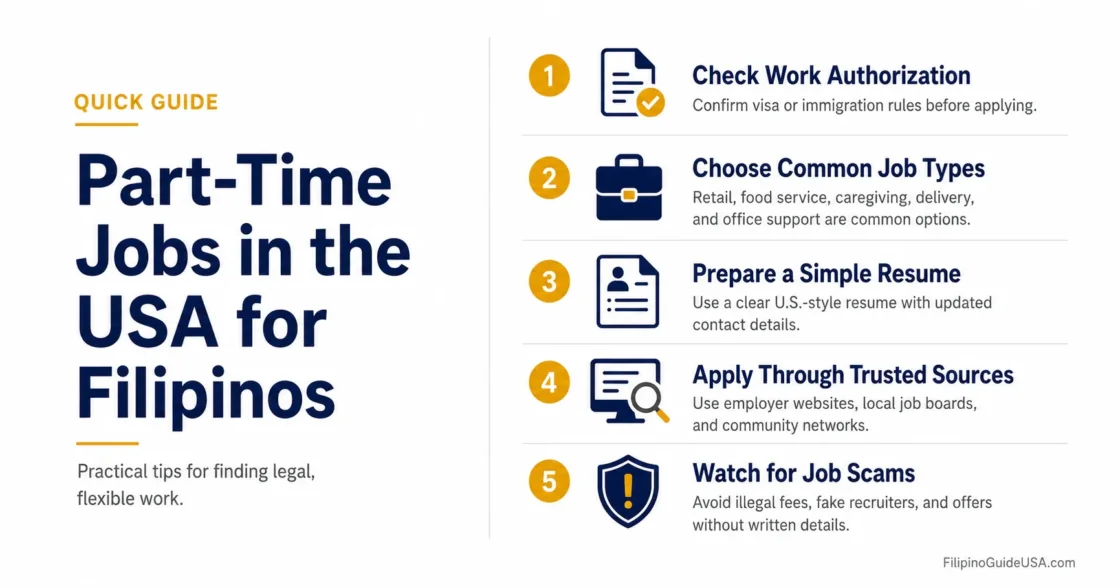
Part-time work in the United States can help Filipino newcomers, students, permanent residents, and work-authorized immigrants build income, local experience, and a more stable weekly routine. The safest starting point is not the job title itself. It is the person’s legal ability to work, the documents an employer may request, the expected schedule, and whether the role pays correctly under federal, state, and local wage rules.
Why this matters →
For Filipinos in the U.S., a part-time job can support household expenses and community adjustment, but only when work authorization, pay, taxes, and worker rights are handled correctly from the start.
Important Warning: Paid work in the United States must match the worker’s immigration status and employment authorization. A job offer alone does not make someone eligible to work, and U.S. employers must verify identity and employment authorization through Form I-9 after hiring.[a]
Documents To Prepare Before Applying:
- A valid government-issued photo ID, such as a passport, state ID, or driver’s license.
- Proof of work authorization, if required for the person’s immigration status.
- A Social Security number, when eligible and required for payroll reporting.
- A simple U.S.-style resume with work history, skills, language ability, and availability.
- Any job-specific license, certificate, or background check document required by the employer or state.
- A written weekly availability schedule, especially for students, parents, caregivers, and workers with another job.
Who Can Usually Work Part-Time in the United States
This section explains why immigration status should be checked before choosing a job category.
Part-time work is not a separate immigration category. A person must already have permission to work, or must be in a status that allows the specific kind of work being offered. For Filipinos already in the U.S., the answer depends on whether the person is a U.S. citizen, lawful permanent resident, employment-authorized noncitizen, student, temporary worker, or visitor.
| Situation | Part-Time Work Rule | What To Check First |
|---|---|---|
| U.S. citizen or naturalized citizen | May generally work for any U.S. employer, subject to age, licensing, and job rules. | Employer onboarding documents, tax withholding, wage rate, and schedule. |
| Lawful permanent resident | May generally work for U.S. employers without a separate work permit. | Valid identity and employment authorization documents for Form I-9. |
| EAD holder | May work while the Employment Authorization Document is valid and the category permits employment. | Card validity dates and renewal timing. |
| F-1 student | May have limited work options, often starting with on-campus work under specific rules. Off-campus work requires proper authorization. | Designated School Official guidance, school rules, CPT, OPT, or other authorization limits.[b] |
| Temporary worker visa holder | May work only as allowed by the visa classification, petition, and employer conditions. | Whether the status allows extra work outside the sponsoring employer. |
| Visitor or tourist | A visitor status is not a general work status. | A proper work visa or employment authorization before accepting paid work.[c] |
Tip: When the job is paid, casual, remote, cash-based, or only a few hours a week, it still counts as work if services are being exchanged for compensation.
Part-Time Job Types That Often Fit Filipino Workers
This section lists practical job paths without treating any role as automatically legal for every immigration status.
Many Filipino workers look for part-time roles that match English ability, caregiving experience, hospitality skills, customer service background, or flexible family schedules. The right choice depends on location, transportation, licensing, work authorization, and comfort level with public-facing work.
Retail And Grocery Store Roles
Cashier, stock associate, sales floor assistant, bakery counter, customer service desk, and seasonal store positions are common entry points. These jobs may offer evening or weekend shifts, which can help workers balancing school, childcare, or another job.
Food Service And Hospitality
Restaurants, cafés, hotels, catering companies, and event venues may hire part-time hosts, servers, dishwashers, kitchen assistants, housekeepers, room attendants, and banquet staff. Workers should confirm whether tips are part of the pay structure and whether state wage rules differ for tipped employees.
Caregiving, Home Care, And Senior Support
Filipino workers with caregiving experience may consider home care aide, companion care, assisted living, or senior support roles. These jobs can require background checks, training, state registration, or employer-specific onboarding. Domestic service and live-in care roles are still covered by wage rules in many situations, including federal minimum wage and overtime protections when the law applies.[j]
Campus Jobs For Eligible Students
For eligible F-1 students, on-campus jobs may include library assistant, dining hall worker, lab assistant, office aide, tutoring support, bookstore staff, or student center roles. F-1 students must be careful with hour limits and off-campus work restrictions. USCIS guidance states that F-1 status may permit on-campus work up to 20 hours per week while school is in session when the rules are met.[b]
Tagalog, Filipino, And Bilingual Support Roles
Some employers need bilingual customer support, interpretation scheduling, community outreach, healthcare front desk support, or translation-related assistance. A bilingual role should still have normal payroll, lawful hiring procedures, and clear job duties. Language ability is a skill, not a reason to accept unclear pay terms.
Warehouse, Delivery Support, And Light Operations
Part-time warehouse associate, package handler, inventory assistant, fulfillment helper, and delivery support roles may suit workers who prefer structured shift work. These jobs can involve lifting, late hours, safety training, or background checks. Workers should check whether the position is employee-based or treated as independent contractor work.
Remote Customer Service And Administrative Work
Remote part-time jobs can be useful for workers with stable internet, a quiet workspace, and call-handling skills. Remote work should be treated with care because job scams often use fake customer service, personal assistant, equipment-purchase, and work-from-home offers.
Important Warning: A real employer should not require a worker to pay money to receive a job. The Federal Trade Commission warns that job scams often promise easy money, ask for payment, or send fake checks for equipment purchases.[h]
Step 1: Confirm Work Authorization Before Applying
This step prevents wasted applications and reduces the risk of accepting work that conflicts with immigration status.
Before sending applications, the worker should identify the exact status that gives permission to work. For a permanent resident, this may be straightforward. For a student, temporary worker, asylum applicant, adjustment applicant, or dependent visa holder, the details can be more limited.
The safest approach is to check official immigration documents, school or employer instructions, and current USCIS guidance before relying on community advice. A friend’s experience can be helpful, but it may not apply to a different visa category, school program, employer petition, or state.
Procedure Note: If the worker is unsure whether a job is allowed, the question should be checked before the first shift, not after the first paycheck. This is especially important for students, temporary visa holders, and anyone waiting for an Employment Authorization Document.
Step 2: Prepare A U.S.-Style Resume And Weekly Availability
This step helps employers quickly understand skills, schedule, and fit for part-time shifts.
A part-time resume in the U.S. should be direct and easy to scan. It does not need a photo, age, marital status, religion, or personal family details. A clean resume can include:
- Name, phone number, email address, and city or general area.
- A short summary focused on skills and availability.
- Work history from the Philippines, the U.S., or other countries.
- Customer service, caregiving, food handling, office, driving, language, or computer skills.
- Certifications, licenses, training, or relevant school programs.
- Availability by day and time, such as weekday evenings or weekend mornings.
For newly arrived Filipinos, Philippine work experience is still useful. Employers may not know local company names from the Philippines, so job duties should be described plainly: cash handling, inventory, elder care, appointment scheduling, patient support, food preparation, bookkeeping, teaching, or call center work.
Step 3: Search In Places That Match The Worker’s Situation
This step narrows the job search to safer and more relevant channels.
Part-time jobs can be found through company career pages, school career centers, local community boards, reputable job platforms, staffing agencies, and referrals. For Filipino workers, community referrals through churches, Filipino associations, school networks, and family contacts can be useful, but every offer should still be checked for lawful pay, written duties, and normal onboarding.
Good search phrases include:
- part-time cashier near me
- weekend caregiver jobs
- part-time hotel housekeeping
- Tagalog customer service representative
- part-time office assistant
- on-campus student jobs
- evening warehouse associate
- part-time food service worker
Tip: When searching online, add the city or state to the job title. A search such as “part-time caregiver Daly City” or “Tagalog customer support Los Angeles” usually gives more useful results than a broad national search.
Step 4: Check Pay, Hours, And Worker Rights Before Accepting
This step helps workers avoid unclear pay, unpaid overtime, and informal arrangements that create problems later.
Part-time does not mean fewer wage rights. The Fair Labor Standards Act covers minimum wage, overtime pay, recordkeeping, and youth employment standards for many full-time and part-time workers. Federal guidance states that covered nonexempt workers must receive at least the federal minimum wage and overtime pay after 40 hours in a workweek, unless a valid exemption applies.[d]
Many states and some local areas have higher minimum wage rules than the federal rate. When both federal and state minimum wage laws apply, the worker is generally entitled to the higher minimum wage.[e]
| Question | Why It Matters |
|---|---|
| What is the hourly rate? | The worker needs to compare the offer with federal, state, and local wage rules. |
| Is the job employee-based or contractor-based? | Taxes, benefits, schedule control, and worker protections may differ. |
| Will tips be part of pay? | Tipped wage rules can vary by state and job type. |
| How many hours are expected each week? | Students, caregivers, and workers with another job need a schedule that does not create conflicts. |
| How often is payroll issued? | Weekly, biweekly, or semi-monthly pay affects budgeting. |
| Is training paid? | Required job training may count as work time depending on the situation. |
Important Warning: Cash payment is not automatically illegal, but a worker should be cautious if the employer avoids payroll records, refuses written pay terms, asks the worker to use someone else’s identity, or says employment documents are not needed.
Step 5: Complete Hiring Paperwork Carefully
This step covers the forms many U.S. workers see after receiving a job offer.
After a person is hired, employers commonly complete Form I-9 for identity and employment authorization verification. The employer should provide the form instructions, and the worker must present acceptable documents from the I-9 rules. The worker should not send identity documents through unsafe channels or provide sensitive information before confirming that the job and employer are real.
Many employees also complete Form W-4 so the employer can withhold the correct federal income tax from wages.[f] Some states have separate withholding forms. A worker who is unsure how to complete tax forms should use official IRS guidance or a qualified tax professional, especially if the worker is a nonresident for U.S. tax purposes.
For Social Security numbers, the Social Security Administration states that, in general, only noncitizens authorized by DHS to work in the United States can get an SSN for work purposes.[g] An employer normally uses the worker’s SSN to report wages.
Step 6: Keep Records After Starting Work
This step makes it easier to resolve pay, schedule, and tax questions later.
Workers should keep basic records even when the employer has a payroll system. Good records can include:
- Job offer message or employment letter.
- Supervisor name and workplace address.
- Hourly rate and expected schedule.
- Copies of pay stubs.
- Personal notes of hours worked each day.
- Tip records, if tips are part of the job.
- Training dates and required meetings.
- Any written schedule changes.
These records help if there is a payroll mistake, missing overtime, tax question, or dispute about hours. They also help workers compare whether a second part-time job is realistic without creating fatigue, childcare gaps, transportation issues, or class attendance problems.
Special Notes For Filipino Students
This section focuses on the extra care needed for students who want part-time income while studying.
Filipino students in the U.S. should not assume that every part-time job is allowed. F-1 rules can distinguish between on-campus work, off-campus work, Curricular Practical Training, Optional Practical Training, and other special authorization categories. The student should speak with the Designated School Official before accepting any job that is not clearly permitted.
Common student-friendly options may include campus dining, library work, office assistant roles, resident support, tutoring, event staffing, bookstore work, or lab support. Off-campus roles require more caution and should be reviewed under current school and USCIS rules.
Procedure Note: A student should save written confirmation from the school office when work authorization, CPT, OPT, or an on-campus role is approved. Verbal advice can be misunderstood later.
Special Notes For Caregiving And Domestic Work
This section explains why home-based jobs still need clear pay and lawful boundaries.
Caregiving is a familiar field for many Filipino workers, but it can also create confusion when the job is inside a private home. A worker should clarify whether the employer is a family, a home care agency, an assisted living provider, or a staffing company. The worker should also ask whether the role includes personal care, companionship, housekeeping, medication reminders, transportation, overnight presence, or live-in duties.
Before accepting a caregiving role, the worker should request written details about:
- Hourly pay or live-in pay arrangement.
- Expected start and end times.
- Sleeping time, meal breaks, and overnight duties.
- Payroll method and pay schedule.
- Training, background checks, or state registration.
- Who supervises the worker and who handles pay.
Caregiving work should not rely only on trust, family-style language, or “helping out” when the worker is expected to follow a schedule and provide regular services for pay. Clear terms protect both the worker and the household.
How To Avoid Job Scams And Unsafe Offers
This section highlights warning signs that deserve extra caution before sharing documents or accepting a role.
Job scams often target newcomers because they may be unfamiliar with U.S. hiring customs. A worker should slow down when an offer feels rushed, vague, or too easy.
- The employer asks for money before hiring.
- The employer sends a check and asks the worker to buy equipment or return extra funds.
- The job promises high pay for very little work.
- The recruiter refuses to provide a company name, address, or official email.
- The employer asks for a Social Security number or bank details before a real interview or offer.
- The job posting copies the name of a real company but uses a personal email account.
- The employer avoids written pay terms.
- The role requires the worker to use another person’s documents.
Tip: A worker can search the company name together with words like “scam,” “complaint,” or “reviews” before sending documents. This simple check can prevent many fake job problems.
Discrimination And Fair Treatment At Work
This section explains how Filipino workers can recognize unfair treatment without turning the job search into a legal dispute.
Employers may verify work authorization and identity, but workers also have protections against certain types of workplace discrimination. The Equal Employment Opportunity Commission explains that national origin discrimination can involve unfair treatment because a person is from a particular country, has an accent, is connected to an ethnic background, or appears to be from a certain place.[i]
Examples that may deserve closer review include being rejected only because of a Filipino accent when the accent does not prevent job duties, being mocked for national origin, or being given worse shifts because of ethnicity. Workers should keep written notes, dates, messages, and names if they believe unfair treatment occurred.
Practical Ways To Choose The Right Part-Time Job
This section helps match job options with real-life needs such as transportation, childcare, school, and family support.
A part-time job should fit more than income goals. The weekly schedule should be realistic. For many Filipino households, the job may need to work around school pickups, elder care, church activities, public transportation, a spouse’s schedule, or sending support to family abroad.
Before accepting an offer, the worker should compare:
- Commute time and transportation cost.
- Shift length and late-night travel safety.
- Expected physical demands.
- English-speaking comfort level for the role.
- Need for uniforms, shoes, certificates, or tools.
- Childcare or family schedule conflicts.
- Whether the job helps build future U.S. work history.
- Whether the employer has clear payroll and scheduling practices.
A lower hourly rate close to home may sometimes be better than a higher rate with long travel, unreliable shifts, or expensive transportation. The best job is the one that is lawful, documented, fairly paid, and manageable week after week.
Common Questions About Part-Time Jobs In The USA For Filipinos
This section answers common concerns that come up before applying.
Can A Filipino Tourist Work Part-Time In The United States?
No. A visitor or tourist status is not a general work status. A Filipino who wants to work in the U.S. needs the proper immigration path, visa category, or employment authorization before accepting paid work.
Can A Filipino Student Work Off Campus?
Only when the student’s status and authorization allow it. F-1 students should speak with the school’s Designated School Official before accepting off-campus work. On-campus, CPT, OPT, and other work options have different rules.
Are Cash Jobs Safe?
Cash payment can create problems when there are no records, no tax documents, no proof of hours, or no lawful employment verification. Workers should be cautious with any job that avoids normal payroll, refuses written pay terms, or asks for false identity information.
Do Part-Time Workers Pay Taxes?
Part-time employees commonly have taxes withheld through payroll, and many complete Form W-4 for federal income tax withholding. Tax treatment can vary based on residency status, income, family situation, and state rules.
What Jobs Are Good For New Filipino Immigrants?
Common starting points include retail, grocery, food service, hotel work, caregiving, warehouse support, campus jobs for eligible students, bilingual customer support, and administrative roles. The best option depends on work authorization, English level, location, schedule, transportation, and prior experience.
Should A Worker Accept A Job Without Written Pay Details?
No. A worker should ask for the hourly rate, pay schedule, expected duties, supervisor name, and weekly schedule before starting. Clear written terms reduce confusion and help protect the worker if a pay issue occurs.
Verification Note: Immigration, student work, wage, tax, and employment rules can change. Before accepting a job, workers should recheck the current USCIS, Department of Labor, IRS, SSA, school, and state labor agency guidance that applies to their situation.
Sources
- [a] USCIS Form I-9, Employment Eligibility Verification — explains employer verification of identity and employment authorization after hiring. (Official U.S. immigration agency source.)
- [b] USCIS Students and Employment — explains student employment limits, including F-1 student work rules. (Official U.S. immigration agency source.)
- [c] U.S. Department of State Temporary Worker Visas — explains that foreign citizens who wish to work in the U.S. need the proper work visa path. (Official U.S. visa authority source.)
- [d] U.S. Department of Labor, Wages and the Fair Labor Standards Act — covers minimum wage, overtime, recordkeeping, and youth employment standards. (Official federal labor agency source.)
- [e] U.S. Department of Labor State Minimum Wage Laws — lists state wage rules and explains how state minimum wages may differ from federal rules. (Official federal labor agency source.)
- [f] IRS About Form W-4 — explains the employee withholding certificate used for federal income tax withholding. (Official U.S. tax agency source.)
- [g] Social Security Administration, Foreign Workers and Social Security Numbers — explains SSN access for noncitizens authorized to work. (Official U.S. Social Security agency source.)
- [h] Federal Trade Commission Job Scams — explains common fake job patterns, including payment requests and work-from-home scams. (Official U.S. consumer protection agency source.)
- [i] EEOC National Origin Discrimination — explains workplace discrimination based on country, ethnicity, accent, or perceived background. (Official U.S. employment discrimination agency source.)
- [j] U.S. Department of Labor Fact Sheet #79B — explains wage and overtime issues for live-in domestic service workers. (Official federal labor agency source.)