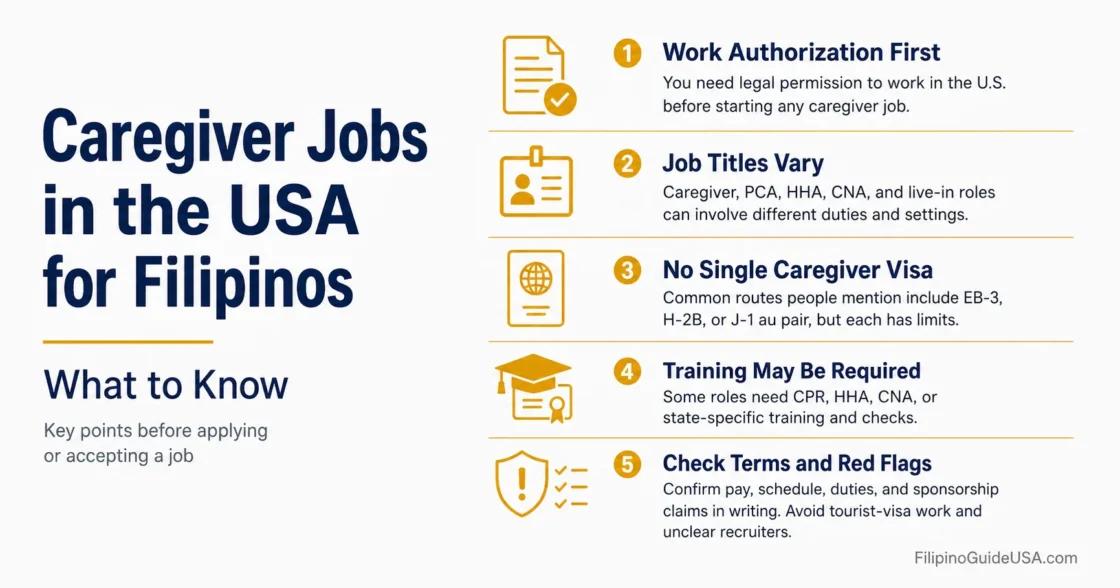
Caregiver jobs in the USA can be a real option for Filipinos, but the path depends on one thing before anything else: legal permission to work. Some Filipinos apply after already living in the United States with work authorization. Others look from the Philippines and need a U.S. employer, a valid visa route, and proper documentation before travel. The job itself may sound simple, but the details around job title, state rules, live-in work, training, pay, and sponsorship matter a lot.
In everyday use, “caregiver” can mean several different jobs. One employer may use it for nonmedical help such as meal preparation, companionship, bathing assistance, and light housekeeping. Another may expect Home Health Aide, CNA, or direct care experience. Before applying, read the job post carefully and confirm whether the role is private home care, agency-based home care, assisted living, nursing facility care, or child care.
What Caregiver Jobs Usually Mean in the USA
Most caregiver jobs involve helping a client with daily living needs. The work may include bathing, dressing, meal preparation, reminders, safe movement around the home, transportation to appointments, and basic observation of changes in the client’s condition. The U.S. Bureau of Labor Statistics describes home health and personal care aides as workers who help people with disabilities, chronic illness, or daily living needs, often in homes, group homes, or care communities.[a]
This is not the same as being a registered nurse. A caregiver normally does not make medical decisions, diagnose conditions, or change treatment plans. Some Home Health Aide roles may allow basic health-related tasks under supervision, depending on state rules and employer policy. CNA roles are usually more formal and may require state-approved training and a state competency exam.
| Job Title | Typical Setting | Common Work | Training or Certification |
|---|---|---|---|
| Caregiver | Private home, home care agency, assisted living | Companionship, daily living help, meal preparation, reminders, light household tasks | Often employer training; requirements vary |
| Personal Care Aide | Home care, community care, disability support | Nonmedical support, errands, mobility help, daily routine support | Often employer training; some states or agencies may require checks or courses |
| Home Health Aide | Home health agency, hospice, client homes | Daily care plus limited health-related tasks under supervision | Formal training or testing may be required in certified home health or hospice settings |
| Certified Nursing Assistant | Nursing facility, hospital, assisted living, home care | Hands-on patient care, vital signs, bathing, transfer assistance, care reporting | Often state-approved training and a competency exam |
| Live-In Caregiver | Client’s home | Care over extended hours, scheduled breaks, overnight presence, personal care support | Rules depend on employer type, state law, and duties |
Why Filipinos Are Often Drawn to Caregiver Work
Many Filipinos enter caregiving because the role fits skills that are already common in Filipino family and community life: patience with older adults, comfort with multigenerational households, practical help with daily routines, and respectful communication. Tagalog, Cebuano, Ilocano, Hiligaynon, or other Philippine languages may also help in areas with Filipino families looking for culturally familiar care.
That said, being Filipino is not a formal qualification by itself. U.S. employers still look at work authorization, background checks, references, English communication, physical ability, training, reliability, and whether the applicant can follow care instructions safely.
Work Authorization Comes Before the Job Offer
A caregiver must be legally authorized to work in the United States before starting paid work. USCIS explains that foreign nationals may work in the United States through a status that authorizes employment, a change of status to a work-authorized category, or adjustment to lawful permanent resident status.[b]
For Filipinos already in the USA, this means the first question is not “Can I find a caregiver job?” but “Does my current status allow me to work for this employer?” A green card holder, U.S. citizen, or person with a valid Employment Authorization Document may have a clearer path. A visitor visa holder usually does not.
For Filipinos still in the Philippines, a U.S. job offer alone is not enough. The employer must use a lawful hiring route, and the worker must complete the required immigration and overseas employment steps before leaving the Philippines.
Visa Routes People Often Mention for Caregiver Jobs
There is no simple “caregiver visa” that applies to every Filipino caregiver. Different routes may appear in job ads or agency discussions, but each has limits. Some are for permanent jobs. Some are for temporary work. Some are not caregiver routes at all, even if people online describe them that way.
| Route | What It May Cover | What to Watch For |
|---|---|---|
| EB-3 | Permanent employment for skilled workers, professionals, or other workers | Usually requires an employer, a real full-time job offer, and a labor certification process before the immigration petition moves forward |
| PERM Labor Certification | A Department of Labor step often used before some employment-based immigrant petitions | The employer, not the worker alone, handles the labor certification process |
| H-2B | Temporary nonagricultural work when an employer has a temporary need | Not every caregiver job qualifies, because many care roles are ongoing rather than temporary |
| J-1 Au Pair | Child care through a cultural exchange program | This is not elder care or general caregiving; it has age, education, English, sponsor, and program rules |
| B-1/B-2 Visitor Visa | Temporary business or tourism purposes | A visitor visa does not permit normal paid caregiver employment in the United States |
The EB-3 category includes “other workers” for certain jobs requiring less than two years of training or experience, but the case still depends on the employer, the job, the labor process, and USCIS requirements.[c] The Department of Labor also states that a permanent labor certification allows an employer to hire a foreign worker for permanent work in the United States, and in many cases the employer must obtain that certification before filing the immigration petition with USCIS.[d]
H-2B can be discussed in caregiver recruitment, but it is limited to temporary nonagricultural labor. The Department of Labor describes H-2B as a program for U.S. employers that need nonimmigrant workers to perform temporary nonagricultural services or labor.[e] A long-term live-in caregiver job for an elderly client may not fit that temporary structure, so the employer’s legal basis needs careful review.
For child care, the J-1 Au Pair Program is separate from elder care and home health work. The U.S. Department of State lists requirements such as spoken English proficiency, secondary school graduation or equivalent, age 18 to 26, a physical, an interview in English, and a background investigation.[f]
A visitor visa should not be treated as a shortcut to caregiver employment. The U.S. Department of State states that a person on a B1/B2 visitor visa is not permitted to accept employment or work in the United States.[g]
Training and Certification: What Filipinos Should Expect
Requirements depend on the state, the employer, and whether the job is nonmedical or health-related. Some private companion roles may train new workers on the job. A certified home health agency or hospice agency may require formal training and a standardized test. CNA jobs are usually stricter because nursing assistants often need to complete a state-approved education program and pass a state competency exam to become licensed or certified.[h]
Common requirements in caregiver job posts may include:
- High school diploma or equivalent, depending on the employer
- English communication strong enough for care notes, safety instructions, and family updates
- CPR or First Aid certification
- Negative TB test or health screening, depending on the workplace
- Background check and reference check
- Driver’s license, especially for errands or appointments
- CNA, HHA, or state caregiver training for certain roles
- Ability to lift, transfer, or assist clients safely when the job requires it
Applicants should not assume that a Philippine caregiver certificate automatically replaces U.S. state requirements. It can help show experience, but the U.S. employer may still require local training, state registration, or a new exam.
Live-In Caregiver Work Needs Clear Rules
Live-in work can sound attractive because housing may be included, but it needs a written understanding of schedule, pay, sleep time, food, privacy, breaks, days off, and who is the actual employer. The Department of Labor states that live-in domestic service workers are covered by federal wage rules and must be paid at least the federal minimum wage for all hours worked, with overtime rules depending on the employer and exemption rules.[i]
A safe live-in job agreement should answer these questions before the worker accepts:
- Is the employer a private household, a home care agency, or both?
- What hours are counted as work?
- When is sleep time unpaid, and what happens if the client wakes the caregiver?
- How many full days or hours off are given each week?
- Is the caregiver expected to cook, clean, drive, bathe, lift, or handle medication reminders?
- Will housing or meals be deducted from pay, and is that allowed under the applicable rules?
- Who keeps time records?
- Who pays taxes, insurance, and legally required deductions?
If a job says “24 hours care” but does not explain sleep time, breaks, and pay, ask for details in writing. A caregiver should not rely only on verbal promises.
Pay, Job Demand, and Schedule Reality
The U.S. caregiver labor market is large. BLS reported that home health and personal care aides held about 4.3 million jobs in 2024, with employment projected to grow 17 percent from 2024 to 2034. BLS also reported a median annual wage of $34,900 for home health and personal care aides in May 2024.[j]
Pay varies by state, city, employer, shift, certification, and setting. A caregiver in a private home may have a different pay structure from a CNA in a nursing facility or a home health aide working for a certified agency. Night shifts, weekend shifts, dementia care, transfer assistance, or bilingual care may affect employer demand, but the job offer should still be checked against local wage rules and the actual workload.
Filipino applicants should also think about transportation. In many U.S. suburbs, caregiver work may require driving between clients. A job may advertise “caregiver” but still expect the worker to run errands, take the client to medical appointments, or use a personal vehicle. Ask about mileage reimbursement, insurance expectations, and whether driving is required.
How to Read a Caregiver Job Post
A good job post should be clear about the employer, client needs, schedule, pay range, location, work authorization, training, and duties. Vague posts can waste time or hide problems.
Before applying, check for these details:
- Exact job title: caregiver, HHA, PCA, CNA, companion, direct support professional, or live-in aide
- Employer name: agency, facility, or private household
- Work location: city, state, and whether it is one home or multiple clients
- Schedule: hourly, overnight, 12-hour shifts, live-in, weekend-only, part-time, or full-time
- Pay method: hourly wage, salary, live-in rate, overtime policy, and pay frequency
- Required documents: work authorization, Social Security number, EAD, green card, or other acceptable employment documents
- Required training: CNA, HHA, CPR, First Aid, dementia care, or employer training
- Physical duties: lifting, transfers, bathing, toileting, wheelchair support, or fall-risk support
- Travel duties: driving, errands, appointments, or use of personal vehicle
- Sponsorship statement: whether the employer actually sponsors visas or clearly says sponsorship is not available
For Filipinos Already Living in the USA
If you are already in the United States, start with your work status. Do not accept cash-only work if you are not authorized to work. It can create immigration, tax, and workplace problems. If you are authorized, focus on matching your status, skills, and state requirements to the right job level.
A practical order is:
- Confirm that your immigration status allows employment with this type of employer.
- Check whether the job requires CNA, HHA, CPR, First Aid, or state registration.
- Prepare a simple resume listing caregiving experience, languages, certifications, and client-care skills.
- Gather references from past employers, families, facilities, or training programs.
- Apply to licensed home care agencies, assisted living facilities, nursing homes, and reputable job boards.
- Ask for the pay rate, schedule, duties, and overtime rules before accepting.
- Keep copies of your offer letter, time records, pay stubs, and training certificates.
Filipino community referrals can be useful, especially in areas with large Filipino populations, but the job should still be treated like formal employment. Ask for written terms, not just a text message or verbal agreement.
For Filipinos Applying from the Philippines
If you are applying from the Philippines, be extra careful with recruitment claims. A real U.S. caregiver opportunity should have a legitimate employer, a lawful work route, clear contract terms, and proper processing. The Department of Migrant Workers provides a directory of DMW-licensed overseas recruitment agencies that Filipino applicants can use to verify whether an agency is licensed.[k]
A safer process usually looks like this:
- Verify the recruitment agency through the DMW directory before paying or submitting documents.
- Ask for the employer name, job location, job title, pay, duties, and visa route.
- Check whether the job offer is for permanent employment, temporary employment, child care exchange, or another legal category.
- Review the contract before signing and keep copies of every document.
- Do not travel to the United States as a tourist if the real plan is to work as a caregiver.
- Complete the required Philippine overseas employment documentation before departure.
- Attend official orientations and keep emergency contact information after arrival.
Be cautious with anyone promising fast deployment, guaranteed approval, or a U.S. caregiver job in exchange for large upfront payments. POEA guidance warns applicants not to pay a placement fee without a valid employment contract and official receipt, and not to deal with training centers or travel agencies that promise overseas employment.[l]
Documents Applicants Commonly Prepare
The exact documents depend on the job and immigration route. Still, many Filipino caregiver applicants prepare a basic file early so they can respond quickly when an employer asks.
- Valid Philippine passport
- Resume written for U.S. employers
- Caregiver training certificate, if available
- CNA, HHA, CPR, or First Aid certificate, if available
- Employment certificates from past caregiving, nursing aide, domestic care, or facility work
- Reference letters with phone numbers or email addresses
- School records, if required by the visa or employer
- Police clearance or background documents, if requested through the proper process
- Vaccination or health records, if required by the employer or immigration process
- Proof of legal work authorization, if already in the USA
Do not submit original documents casually to strangers online. Send copies only when the employer or licensed agency is verified, and keep your own file organized.
Skills That Help Filipino Caregivers Stand Out
Many families and agencies look beyond certificates. They want someone calm, observant, punctual, and able to communicate changes in a client’s condition. A caregiver who can write simple care notes, report safety concerns, follow a care plan, and maintain professional boundaries is more valuable than someone who only says they are “hardworking.”
Useful skills include:
- Safe transfer and mobility assistance
- Basic understanding of fall prevention
- Respectful bathing, dressing, and toileting support
- Meal preparation for common dietary needs
- Medication reminder routines, when allowed by the employer and state rules
- Dementia care patience and redirection skills
- Clear communication with families, nurses, and agency coordinators
- Accurate timekeeping and care notes
- Boundary setting in live-in or private household work
- Driving reliability, if the job requires transportation
Warning Signs in Caregiver Recruitment
Caregiver applicants can be vulnerable because many are eager to work abroad or support family back home. A job offer should make the process clearer, not more confusing.
Be careful if someone:
- Promises a U.S. caregiver job but refuses to name the employer
- Says a tourist visa is enough for paid caregiver work
- Asks for large payments before a contract is shown
- Uses only social media messages and avoids official documents
- Claims visa approval is guaranteed
- Refuses to explain the exact visa category
- Asks you to lie about your purpose of travel
- Offers live-in work with no written schedule or pay terms
- Holds your passport or personal documents without a clear legal reason
- Changes the promised job after you arrive
A legitimate employer should be willing to explain the job, the pay, the schedule, and whether sponsorship is available. A licensed recruiter should be traceable through official records.
Questions to Ask Before Accepting a Job
Before saying yes, ask direct questions. This protects both the worker and the client.
- Who is my legal employer?
- Is this job hourly, salaried, or live-in?
- What is the pay rate and how often will I be paid?
- Will I receive overtime when required?
- What are the exact duties?
- Will I lift or transfer the client?
- Will I drive the client or use my own car?
- What training do you provide?
- Do you require CNA, HHA, CPR, or First Aid?
- Is visa sponsorship available for this specific position?
- If sponsorship is available, what visa route does the employer use?
- Will I receive a written contract or offer letter?
Where Caregiver Jobs Are Common
Caregiver jobs can be found across the United States, but demand is often easier to see in places with many older adults, large suburban communities, assisted living facilities, and home care agencies. Filipino applicants often look in states with large Filipino communities, such as California, Nevada, Washington, Hawaii, Texas, Illinois, New Jersey, New York, and Florida. The right state, though, depends on work authorization, cost of living, training rules, transportation, and family support.
Do not choose a state only because many Filipinos live there. Compare wages with rent, transportation costs, state certification rules, and whether the job is stable. A slightly higher hourly rate may not help if housing and commuting costs are much higher.
Caregiver Job Search Paths That Usually Make Sense
For Filipinos with U.S. work authorization, the most practical job search paths are licensed home care agencies, assisted living facilities, nursing homes, hospital-affiliated home health programs, and reputable job boards. For applicants in the Philippines, the safer route is to verify licensed recruitment channels and avoid informal job promises that skip legal processing.
A strong application should show:
- Legal work status or clear sponsorship need
- Caregiving experience with dates and duties
- Training certificates
- Languages spoken
- Comfort level with dementia care, mobility care, or companionship
- Availability for day, night, weekend, or live-in schedules
- Driving ability, if available
- References from past employers or families
Common Questions About Caregiver Jobs in the USA for Filipinos
Can Filipinos Work as Caregivers in the USA?
Yes, Filipinos can work as caregivers in the USA if they are legally authorized to work and meet the employer’s requirements. Those outside the United States need a lawful visa or immigration route before working.
Is There a Specific Caregiver Visa for Filipinos?
There is no single caregiver visa that fits every case. Some employers may use employment-based routes such as EB-3 for permanent jobs, while temporary routes such as H-2B have limits and depend on the employer’s temporary need.
Can I Work as a Caregiver on a Tourist Visa?
No. A B1/B2 visitor visa does not permit ordinary paid caregiver employment in the United States.
Do I Need a CNA Certificate?
Not always. Some caregiver and companion roles do not require CNA certification. CNA jobs usually require state-approved training and a competency exam. Home Health Aide roles may also require training or testing depending on the employer and state.
Are Live-In Caregiver Jobs Legal?
Live-in caregiver jobs can be legal, but they need clear pay, hours, sleep time, breaks, and employer rules. Workers should ask for written terms and keep time records.
Can a Private Family Sponsor a Filipino Caregiver?
It may be possible in limited cases, but it is not a simple personal invitation. The family or employer must use a lawful immigration route and meet the required U.S. labor and immigration rules.
Before You Move Forward
Caregiver work can be steady and meaningful, but it should be handled like formal employment. Confirm your work authorization, understand the job title, check state training rules, ask for written pay terms, and verify any recruiter or sponsorship claim before sending money or documents.
Visa rules, labor rules, state certification requirements, fees, and processing steps can change. Before applying, signing a contract, or traveling, check the latest information from USCIS, the U.S. Department of Labor, the U.S. Department of State, and the Department of Migrant Workers in the Philippines.
Sources
- [a] U.S. Bureau of Labor Statistics, Home Health and Personal Care Aides — used for job duties, work settings, training notes, job numbers, wage data, and job outlook. (Reliable because BLS is the federal statistical agency for U.S. labor market data.) ↩
- [b] U.S. Citizenship and Immigration Services, Working in the United States — used for the general rule that foreign nationals need a work-authorized status or immigration path to work legally. (Reliable because USCIS is the federal agency that administers immigration benefits.) ↩
- [c] U.S. Citizenship and Immigration Services, EB-3 Employment-Based Immigration: Third Preference — used for the EB-3 skilled worker, professional, and other worker categories. (Reliable because USCIS publishes official eligibility information for employment-based immigration.) ↩
- [d] U.S. Department of Labor, Permanent Labor Certification — used for the employer labor certification step often tied to permanent foreign worker hiring. (Reliable because DOL’s Employment and Training Administration manages foreign labor certification programs.) ↩
- [e] U.S. Department of Labor FLAG, H-2B Temporary Labor Certification for Non-Agriculture Workers — used for the temporary nonagricultural nature of H-2B. (Reliable because FLAG is the official DOL filing and information portal for foreign labor certification.) ↩
- [f] U.S. Department of State BridgeUSA, Au Pair Program — used for J-1 au pair eligibility requirements and to distinguish child care exchange from general caregiver work. (Reliable because BridgeUSA is the official State Department Exchange Visitor Program site.) ↩
- [g] U.S. Department of State, Visitor Visa — used for the rule that B1/B2 visitors may not accept employment or work in the United States. (Reliable because Travel.State.Gov is the official U.S. visa information site.) ↩
- [h] U.S. Bureau of Labor Statistics, Nursing Assistants and Orderlies — used for CNA training, certification, exam, and wage context. (Reliable because BLS is the federal source for occupational data.) ↩
- [i] U.S. Department of Labor Wage and Hour Division, Fact Sheet #79B: Live-in Domestic Service Workers Under the FLSA — used for live-in caregiver wage, overtime, sleep time, and recordkeeping context. (Reliable because DOL’s Wage and Hour Division enforces federal wage standards.) ↩
- [j] U.S. Bureau of Labor Statistics, Home Health and Personal Care Aides — used for 2024 employment, 2024 median wage, and 2024–2034 growth projection. (Reliable because BLS publishes official U.S. employment projections and wage statistics.) ↩
- [k] Department of Migrant Workers, Licensed Recruitment Agencies — used for verifying DMW-licensed overseas recruitment agencies. (Reliable because DMW is the Philippine government department responsible for overseas Filipino worker services and protection.) ↩
- [l] Philippine Overseas Employment Administration archive, How to Avoid Illegal Recruitment — used for warnings about placement fees, contracts, receipts, and agencies. (Reliable because it is an official POEA/DMW government resource for overseas employment safety.) ↩