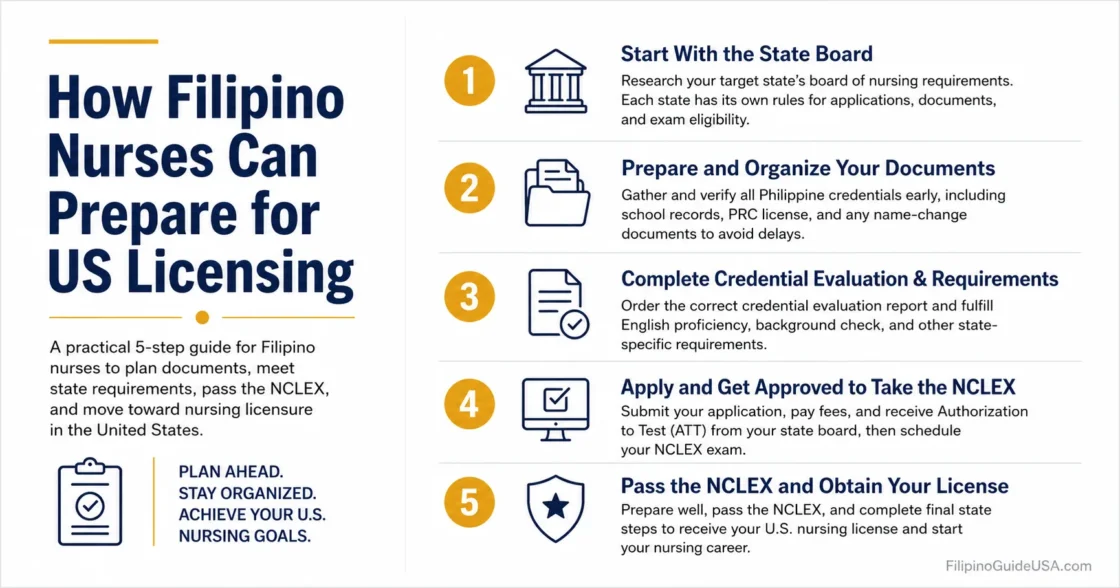
Filipino nurses preparing for U.S. licensing should treat the process as a state-based professional authorization pathway, not simply an NCLEX registration task. A U.S. nursing license is granted by a state board of nursing, and the board decides which credential evaluation, English proof, application forms, fees, and identity documents are required before a nurse can be approved to test or receive a license.[a]
Why this matters →
For Filipino nurses, early document planning can prevent months of avoidable delay between Philippine credential verification, NCLEX eligibility, and U.S. employment readiness.
Required Documents: Most Filipino nurse applicants should prepare a valid passport, Philippine nursing school transcript, nursing diploma, PRC license details, PRC license verification or state board validation documents when required, name-change documents if applicable, English test results if required by the chosen state, credential evaluation documents, and any state board application forms.
Important Warning: U.S. nursing licensure is not handled by one national nursing office. A nurse should not choose a state only because an online post says it is “fast.” The safer starting point is the state where the nurse plans to live, work, or later endorse a license.
Start With the State Board, Not the Exam
The NCLEX is the national licensure exam, but approval to take it usually comes through a state board of nursing. Each state may ask internationally educated nurses for different items, such as credential evaluation, English proof, Social Security number rules, Philippine license validation, or extra application forms. The NCSBN nurse licensure guidance tool is designed to point internationally educated nurses toward state-specific requirements.
For a Filipino nurse, the chosen state affects the order of the entire plan. A nurse applying to one state may need a Credentials Evaluation Service (CES) Professional Report from TruMerit, formerly CGFNS International. Another state may use a different evaluation service or ask for additional English documentation. Some states may allow the application to move forward before a Social Security number is issued, while others may have stricter license issuance rules. These details should be checked before paying for reports, exams, or review courses.[k]
Tip: Save the official state board page as a PDF or screenshot on the day the application plan is made. Requirements can change, and having a dated copy helps track what was reviewed.
Step-by-Step Preparation Path
The sequence below keeps state licensure, credential review, NCLEX eligibility, and immigration-related requirements separate.
Step 1: Choose the Target State Carefully
The target state should match the nurse’s likely employment location, family relocation plan, or long-term endorsement strategy. Choosing a state only because it appears easier online can cause problems later if the nurse needs to endorse the license into another state with different education, English, or identity rules.
Before opening an application, the nurse should confirm these items on the state board’s official site:
Whether the board accepts internationally educated nurse applications directly.
Which credential evaluation report is required.
Whether English proficiency proof is required or waived.
Whether the state requires a U.S. Social Security number for application, testing approval, or license issuance.
Whether Philippine license verification must be sent directly from PRC or through another approved process.
Whether the board has separate rules for nurses who already passed the NCLEX through another state.
Step 2: Organize Philippine Records Before Ordering Any Report
Philippine documents often take longer than expected because U.S. boards and evaluation agencies usually want records sent directly from the issuing school or licensing authority. The PRC state board verification process includes a Stateboard Verification Slip, payment steps, and document submission through PRC procedures; it also notes that mailing is handled as an office-to-office transaction.[b]
Names should be checked before anything is submitted. If the passport, PRC license, school transcript, and birth record show different name formats, the nurse should prepare marriage certificates, court records, or other legal name documents. Small differences in middle name, maiden name, suffix, or spacing can slow down credential matching.
Document Note: A nurse should use the same full legal name format across the state board application, credential evaluation account, Pearson VUE account, passport, and exam-day identification wherever possible.
Step 3: Order the Correct Credential Evaluation
Many internationally educated nurses need a credential evaluation before the state board will approve them for the NCLEX. The TruMerit Credentials Evaluation Service Professional Report reviews nursing credentials earned outside the United States, validates relevant licenses, registrations, and diplomas, and includes a statement comparing the applicant’s nursing education with U.S. nursing standards.[c]
TruMerit is the current name of the organization formerly known as CGFNS International. Older board instructions, saved forms, discussion groups, and search results may still use “CGFNS,” so applicants should recognize both names while following current TruMerit service instructions.[k]
The main mistake is ordering a report before confirming which report the state actually requires. Academic, professional, course-by-course, and state-specific evaluations are not automatically interchangeable. If the wrong report is ordered, the nurse may have to pay again or wait for a corrected report.
Step 4: Separate State Licensure English Rules From VisaScreen English Rules
English requirements can appear in both licensing and immigration files, but they are not the same requirement. A state board decides what English evidence is needed for nursing licensure. VisaScreen English standards come from federal healthcare-worker certification rules and currently follow the tests and scores published by the U.S. Health Resources and Services Administration (HRSA).
Studying nursing in English in the Philippines does not create one universal waiver that applies to every state board and every immigration certification. Each requirement must be checked separately.
Licensure and CES English Requirements
TruMerit states that only certain state boards require an English Language Proficiency Report to be attached to a CES Professional Report, while other boards apply their own English rules. The receiving state determines the score standard and whether an exemption applies.[c]
| Test or Issue | Licensure / CES Position | What Filipino Nurses Should Check |
|---|---|---|
| Cambridge English | Used in some state or CES English pathways | Confirm the target board’s accepted exam and required score. |
| IELTS Academic | Commonly accepted in state-specific English requirements | Required overall and speaking scores can differ by state. |
| MET | Appears in a number of state-specific requirements | Use the score published for the actual state and license type. |
| OET | Accepted in some state-specific pathways | Check whether all four subtests and separate minimum scores apply. |
| PTE Academic | Accepted by some boards and CES-linked state pathways | Do not substitute VisaScreen scores for a state board’s own score rule. |
| TOEFL iBT | Widely used, with scores determined by the receiving board | Confirm whether the board uses the current TOEFL scoring scale and its required speaking score. |
| TOEIC | Still appears in some state-specific nursing licensure or CES instructions | Do not assume it is accepted everywhere. Verify the exact state requirement before testing.[l] |
TOEIC Distinction: The removal of TOEIC from the current federal VisaScreen test list does not mean TOEIC disappeared from every state nursing licensure process. Current state-specific TruMerit pages can still list TOEIC for particular licensing pathways. The state board’s current instructions control the licensing file.
Step 5: Submit the State Board Application
The state board application should be filled out exactly as the board requests. Inconsistent answers, old addresses, incomplete education history, and missing license history can create delays. If the nurse has held licenses in more than one country or U.S. state, each license may need to be disclosed even if it is expired.
After submission, the nurse should monitor three separate places: the state board portal, the credential evaluation account, and email. Many delays come from missed messages asking for corrected school records, renewed PRC validation, English score transmission, or identity clarification.
Step 6: Register for the NCLEX Only When the State Path Is Clear
The NCLEX uses real-world case studies to measure clinical judgment and safe entry-level nursing decisions. The official NCLEX site provides exam preparation information, exam-day guidance, results information, and current test plan resources.[e]
Registering for the exam is not the same as being authorized to test. In most cases, the state board must approve eligibility before an Authorization to Test can be issued. A nurse who pays attention only to the exam registration step may miss the board’s document requirements.
Step 7: Prepare for Clinical Judgment, Not Memorization Alone
Filipino nurses often have strong clinical exposure, but the NCLEX style can feel different from Philippine board review. Preparation should include prioritization, delegation, safety, infection control, pharmacology, maternal-child nursing, mental health, adult health, and case-based clinical judgment. The goal is not just to remember facts; it is to choose the safest nursing action from options that may all sound partly correct.
Practice case studies with unfolding information.
Review rationales after every question set.
Track recurring weak areas by topic, not by score alone.
Use timed practice to build exam stamina.
Study U.S. nursing delegation and scope-of-practice language.
Review medication safety, adverse effects, and patient teaching.
Step 8: After Passing, Complete License Issuance Requirements
Passing the NCLEX does not always mean the license is issued immediately. Some boards may still require a Social Security number, background check completion, final credential review, fee payment, or additional documents. The nurse should wait for the board’s official license status before representing themselves as licensed in that state.
Attention: A nurse should not begin U.S. nursing practice until the correct state license or authorization is active. NCLEX passage alone is not permission to work as a registered nurse.
Document Checklist for Filipino Applicants
The documents below commonly matter before a U.S. nursing board can finish review.
| Document or Record | Usual Source | Why It Matters |
|---|---|---|
| Passport | Applicant | Used for identity matching, exam-day identification, and immigration-related records. |
| Nursing Transcript | Philippine nursing school | Used to evaluate nursing theory, clinical hours, and education comparability. |
| Nursing Diploma or Degree Record | Philippine nursing school | Confirms completion of the nursing program listed in the application. |
| PRC License or Registration Verification | Professional Regulation Commission | Shows Philippine nursing registration status and supports licensing history review. |
| Name-Change Evidence | Civil registry, court, or marriage record | Helps match school, PRC, passport, and application records when names differ. |
| English Test Scores, If Required | Approved English test provider | A state board, CES-linked English report, or federal immigration certification may require official scores. These requirements should be checked separately. |
| Credential Evaluation Report | Board-approved evaluation agency | Allows the board to compare foreign nursing education with U.S. standards. |
| State Board Application | Target state board of nursing | Creates the official licensing file and starts board review. |
Common Timing Problems That Delay Approval
Most delays come from mismatched documents, wrong report choices, or incomplete board files.
Filipino nurses can reduce delays by treating the application like a document chain. Each agency depends on another agency’s records. If the nursing school delays transcript release, the credential evaluation may pause. If PRC validation is incomplete, the report may not be issued. If the report is not issued, the board may not approve NCLEX eligibility.
Wrong state selection: The nurse applies to a state without checking English, Social Security number, or endorsement rules.
Wrong evaluation report: The nurse orders a report that the chosen board does not accept.
Name mismatch: Passport, school, PRC, and application names do not match cleanly.
Expired or outdated validation: A license validation may be too old for the evaluation agency or state board.
Unofficial documents: The nurse uploads copies when the agency requires direct school or PRC transmission.
Late English test planning: The board, CES-linked English requirement, or VisaScreen process requires official scores, but the nurse schedules the test after the file is already waiting.
Tip: Keep a simple tracker with four columns: document requested, issuing office, date requested, and date received by the board or agency.
VisaScreen and Work Authorization Are Separate From Licensing
A U.S. nursing license and a U.S. work visa are different processes. A state board decides whether a nurse may be licensed. Federal immigration rules determine whether a foreign healthcare worker meets immigration-related certification requirements and whether the person is otherwise authorized to enter or work in the United States.
TruMerit’s VisaScreen: Visa Credentials Assessment reviews education, professional licenses, English competency, and nursing knowledge evidence for registered nurses seeking covered occupational immigration benefits. For registered nurses, TruMerit accepts evidence of passing the NCLEX-RN or the TruMerit Qualifying Exam for the nursing-knowledge portion of VisaScreen.[f]
VisaScreen English Requirements After May 12, 2026
HRSA changed the federal English Language Proficiency test and score requirements effective May 12, 2026. TruMerit states that an English exam taken before May 12, 2026 is evaluated under the previous criteria, while an exam taken on or after May 12, 2026 is evaluated under the new criteria.[i][j]
| English Test | Current HRSA Score for Registered Nurses and Other B.S.-Level Health Workers | VisaScreen Status |
|---|---|---|
| Cambridge B2 First, C1 Advanced, or C2 Proficiency | 169 overall; 194 speaking | Accepted |
| TOEFL iBT | 4.5 overall; 4.5 speaking; 3.5 reading, listening, and writing | Accepted |
| IELTS | 6.5 overall; 7 speaking | Accepted |
| Michigan English Test (MET) | 58 overall; 59 speaking | Accepted |
| Occupational English Test (OET) | 360 speaking; 340 reading; 350 writing; 320 listening | Accepted |
| Pearson PTE Academic | 55 overall; 76 speaking; 62 reading, writing, and listening | Accepted |
| TOEIC | Not included in the May 12, 2026 HRSA approved-test table | Not accepted for VisaScreen when the exam was taken on or after May 12, 2026 |
TOEIC and VisaScreen: TruMerit states that TOEIC is no longer accepted for VisaScreen certification under the requirements effective May 12, 2026 because HRSA no longer lists it as an approved federal healthcare-worker English exam. A qualifying TOEIC exam taken before that date is evaluated under the earlier criteria.[j]
The federal table above should not be copied into a state licensure application as though it were the board’s score table. A state can use different exams, different scores, or a different exemption rule for nursing licensure.
VisaScreen English Exemption Is Narrower Than “Nursing Was Taught in English”
For the VisaScreen education-based English exemption, TruMerit currently requires both that the applicant’s entry-level professional education occurred in the United Kingdom, Australia, Canada except Quebec, New Zealand, Ireland, or the United States and that English was the language of instruction, including textbooks.[f]
A Filipino nurse whose entry-level nursing education was completed in the Philippines should therefore not assume that English-medium Philippine nursing education alone creates the VisaScreen exemption. This is separate from a state board’s ability to waive or modify an English requirement for its own licensing process.
Keep the Two Files Separate: A nurse can satisfy a state board’s licensing English rule and still have a different English requirement for VisaScreen. The reverse can also occur. Before ordering an English exam, identify whether the score is being used for the state board, a CES-linked report, VisaScreen, or more than one of those purposes.
Current immigration credentialing options should also be checked separately. In 2026, USCIS approved The Evaluation Company as an organization authorized to issue healthcare worker certificates and certified statements for registered nurses, licensed practical nurses, and licensed vocational nurses for certain immigration purposes. The authorization runs from March 27, 2026 through March 27, 2031.[g]
Important Warning: VisaScreen or another qualifying healthcare worker certification does not replace state licensure. HRSA also notes that meeting the federal English standard does not by itself authorize entry into the United States or professional nursing practice.[i]
After the First U.S. License
A first license may be the beginning of a longer licensing path, especially for nurses who move states.
After receiving the first U.S. nursing license, a nurse may later need endorsement into another state. Endorsement is not automatic in every case. Some states participate in shared verification systems, and Nursys is described by NCSBN as the national database for nurse licensure verification, discipline information, and practice privileges for participating jurisdictions.[h]
A nurse should keep copies of NCLEX results where available, board approval letters, license numbers, continuing education records, employer verification letters, and any state board correspondence. These records may be useful for endorsement, renewal, employer credentialing, or immigration-related review.
Practical NCLEX Study Plan for Filipino Nurses
A useful study plan should match the exam style and the applicant’s weak areas.
A Filipino nurse who already passed the Philippine Nurse Licensure Examination may still need to adjust to the U.S. exam style. NCLEX questions often test patient safety, clinical judgment, prioritization, delegation, and the nurse’s next best action. A study plan should be built around performance feedback, not only the number of questions completed.
Set a baseline: Take a mixed question assessment before choosing the final review schedule.
Study by client need area: Track weak areas such as management of care, safety, pharmacology, maternity, pediatrics, psychiatric nursing, and adult health.
Use rationales carefully: Write down why the correct answer is safest and why the tempting answer is not best.
Practice case-based questions: Focus on recognizing changes in condition, choosing interventions, and evaluating outcomes.
Review U.S. delegation rules: Pay attention to tasks appropriate for RNs, LPN/VNs, and assistive personnel.
Protect rest before exam day: Tired test-takers often misread priority words such as first, best, immediate, and most appropriate.
Preparation Note: A nurse who keeps failing one topic area should pause full-length practice tests and repair that topic directly. Repeating exams without targeted review can hide the real weakness.
Questions Filipino Nurses Often Ask
Can a Filipino Nurse Take the NCLEX Before Moving to the United States?
Yes, many nurses complete the board application and NCLEX process before moving, but the state board must approve eligibility first. The nurse should check the chosen state’s rules for internationally educated applicants, identity documents, credential evaluation, and license issuance.
Is IELTS Always Required for Filipino Nurses?
No. English testing depends on the exact purpose. A state board or CES-linked requirement may accept IELTS, TOEFL, OET, MET, PTE, Cambridge, TOEIC, or another test according to that state’s rules. VisaScreen uses the separate federal HRSA-approved list. For exams taken on or after May 12, 2026, TOEIC is not an approved VisaScreen test.
Is the TruMerit Qualifying Exam the Same as the NCLEX?
No. The TruMerit Qualifying Exam (formerly associated with the CGFNS Certification Program name) and the NCLEX are different exams. U.S. boards use the NCLEX-RN or NCLEX-PN as the licensure examination for the relevant nurse category. TruMerit’s Qualifying Exam can serve a different credentialing purpose, including the nursing-knowledge component of VisaScreen for registered nurses who use that route. The state board’s licensing requirements still control NCLEX eligibility.
Should a Nurse Apply Through the Fastest State?
Not automatically. A state that appears faster may still create problems later if the nurse does not plan to live or work there, cannot meet the license issuance requirements, or later needs endorsement into a stricter state. The better question is whether the state fits the nurse’s actual U.S. plan.
Can an Agency Handle the Entire Process?
An agency may help with paperwork, employer matching, or immigration coordination, but the nurse remains responsible for truthful applications, correct document requests, exam preparation, and checking official board requirements. Passwords, personal records, and licensing answers should be protected carefully.
Can TOEIC Still Be Used by a Filipino Nurse?
Possibly for a state-specific licensure or CES-related requirement when the receiving board currently accepts it. It should not be treated as a current VisaScreen option for an exam taken on or after May 12, 2026. Check the state licensing rule and the federal VisaScreen rule separately.
Before Submitting an Application
Before submitting any paid application, the nurse should confirm that the chosen state board, credential evaluation agency, exam registration, and any immigration-related certification all match the same long-term plan. A file prepared correctly at the beginning is usually easier to review than one repeatedly corrected after submission.
Confirm the exact state board name and application type.
Check whether the application is for RN licensure by examination, endorsement, or another category.
Confirm the required credential evaluation report before ordering.
Ask the nursing school how transcripts are sent to foreign credentialing agencies.
Check PRC verification, certification, and mailing procedures early.
Confirm whether English scores are needed for the state board, a CES-linked English report, VisaScreen, or more than one of these.
If VisaScreen is involved, check whether the English exam was taken before or on/after May 12, 2026.
Do not assume a TOEIC result accepted by a state board will also satisfy VisaScreen.
Make sure the passport name, application name, credentialing account name, and exam registration name match.
Keep proof of every request, payment, and submitted form.
Verification Note: Nursing licensing, credential evaluation, English testing, immigration certification, fees, and state board rules can change. Applicants should recheck the official state board, NCSBN, PRC, USCIS, HRSA, TruMerit, and other credentialing agency pages that apply to their case before paying fees or submitting documents.
Sources
[a] NCSBN Nurse Licensure Guidance — used for state-based licensing requirements, internationally educated nurse guidance, and state variation context. (NCSBN represents U.S. nursing regulatory bodies and maintains nurse licensure resources.)
[b] Professional Regulation Commission Stateboard Verification / Validation of Registration / License — used for PRC verification procedure and office-to-office mailing context. (PRC is the official Philippine professional licensing authority.)
[c] TruMerit — Credentials Evaluation Service Professional Report — used for current CES Professional Report purpose, credential verification, education comparability, and state-specific English Language Proficiency Report rules. (Official TruMerit service page.)
[e] NCLEX Official Site — used for NCLEX exam preparation, exam-day guidance, results information, and test-plan information. (Official NCLEX resource.)
[f] TruMerit — VisaScreen: Visa Credentials Assessment — used for VisaScreen requirements, current approved English exams, education-based English exemption, professional license review, and registered nurse examination evidence. (Official TruMerit VisaScreen service page.)
[g] Federal Register — Approval of The Evaluation Company for Health Care Worker Certification — used for the March 27, 2026 USCIS authorization covering registered nurses, licensed practical nurses, and licensed vocational nurses through March 27, 2031. (Official U.S. government notice.)
[h] NCSBN License Verification with Nursys — used for U.S. nurse license verification and endorsement-related information. (Official NCSBN licensure resource.)
[i] U.S. Health Resources and Services Administration — Updated Tests and Scores for Foreign Health Care Workers, May 12, 2026 — used for the current federal English examinations and registered nurse score requirements. (Official U.S. Department of Health and Human Services agency source.)
[j] TruMerit — Updated HRSA English Language Proficiency Exams and Score Requirements — used for the May 12, 2026 transition rule and confirmation that TOEIC is no longer accepted for VisaScreen for exams taken under the new requirements. (Official TruMerit statement.)
[k] TruMerit — Our New Name — used for the organization’s transition from CGFNS International to TruMerit. (Official organization announcement.)
[l] TruMerit — Virginia Nursing Licensure and Registration Information — used as a current example showing that TOEIC can still appear in a state-specific nursing licensure/CES English requirement even though it is no longer on the current VisaScreen list. (TruMerit state-specific licensure resource; the state board’s current rules should also be checked before testing.)