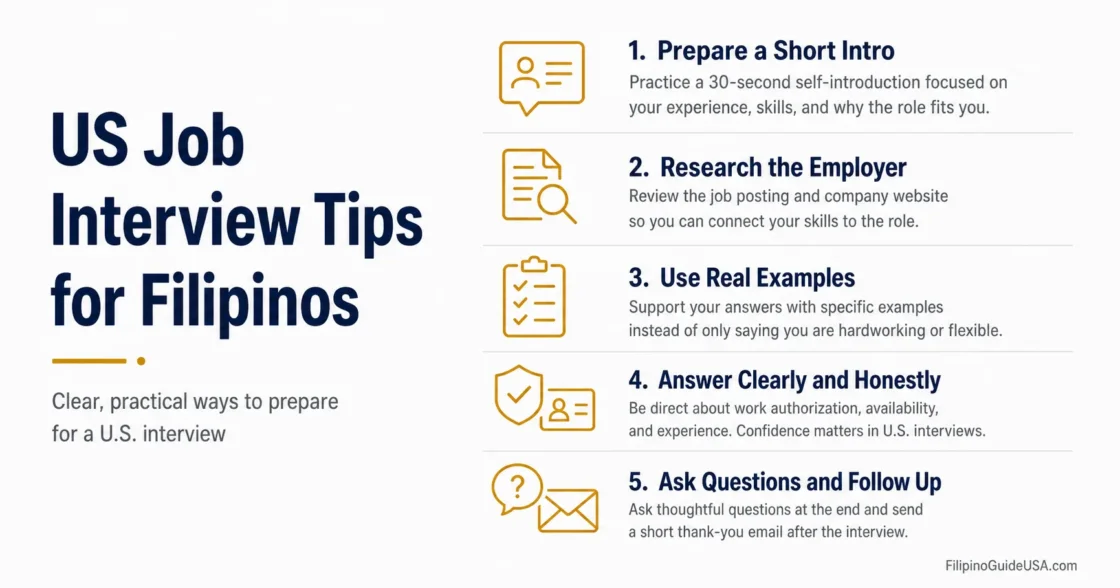
For many Filipinos applying for jobs in the United States, the interview can feel familiar in some ways and very different in others. Employers still want to know your skills, experience, attitude, and availability. The difference is in how directly you are expected to explain your value. A strong U.S. interview answer is usually clear, specific, and connected to the job. Being polite matters, but being too shy about your strengths can make a qualified applicant sound unsure.
This page is written for Filipinos already in the U.S., new immigrants, international graduates, employment-based applicants, Filipino nurses, caregivers, service workers, office professionals, remote workers, and anyone preparing for a U.S. job interview. The goal is simple: help you answer with confidence while staying honest, professional, and aware of basic U.S. hiring norms.
How U.S. Job Interviews Usually Work
A U.S. job interview is usually a practical conversation about whether you can do the work, communicate well with the team, and handle the responsibilities listed in the job posting. Many employers ask behavior-based questions, meaning they want real examples from your past work, school, training, volunteer experience, or daily responsibilities.
The U.S. Department of Labor advises job seekers to prepare a short summary of their experience, answer questions directly, use examples tied to the position, ask about next steps, and stay positive about past employers.[a] For Filipino applicants, this matters because U.S. interviewers often expect you to speak openly about your achievements. You do not need to brag. You do need to explain what you did, how you did it, and why it helped.
The Main Difference: Direct Answers Are Valued
In Filipino workplace culture, humility, respect, and pakikisama can shape how people speak about themselves. In the U.S., interview answers are often more direct. A hiring manager may not read between the lines. If you managed schedules, trained new staff, handled patient records, solved customer issues, or improved a process, say it plainly.
A helpful balance is:
Be respectful, but not too quiet.
Be warm, but stay focused on the job.
Be honest, but do not minimize your experience.
Be confident, but avoid sounding rehearsed.
Prepare a 30-Second Self-Introduction
Most interviews begin with some version of “Tell me about yourself.” This is not an invitation to tell your whole life story. It is a chance to connect your background to the job.
A good answer can follow this simple order:
Your current role or most relevant background.
Your strongest skills for the position.
One short example of experience.
Why this job fits your next step.
Example:
“I have four years of customer service experience, including two years in a busy retail setting where I handled customer questions, returns, and daily transactions. I’m comfortable working with different types of people, staying calm during busy hours, and following company procedures. I’m interested in this role because it matches my experience and gives me room to grow in a U.S. workplace.”
For a healthcare or caregiving role, the same structure works:
“I have experience supporting patients with daily care, safety routines, and documentation. In my previous role, I helped maintain a calm environment for clients, followed care instructions closely, and communicated updates to supervisors. I’m applying for this position because it fits my caregiving background and my ability to work patiently with people who need reliable support.”
Research the Employer Before the Interview
Before the interview, read the job posting again and visit the employer’s website. Look for the services they provide, the type of customers or patients they serve, the job duties, required skills, schedule expectations, and the words they use to describe the role. The U.S. Bureau of Labor Statistics notes that learning about the company and the position helps job seekers show interest and connect their qualifications to the employer’s needs.[b]
Do not memorize the company’s website. Instead, prepare two or three simple points:
What the company does.
Why the role interests you.
Which of your skills match the job description.
For example, if the job posting mentions “attention to detail,” prepare a real example where accuracy mattered. If it mentions “fast-paced environment,” prepare an example from a busy shift, clinic, call center, restaurant, school, office, or household work setting.
Use Real Examples, Not General Claims
Many applicants say, “I am hardworking,” “I am flexible,” or “I am willing to learn.” These are good qualities, but in a U.S. interview they are stronger when supported by a short example.
Instead of saying:
“I am very hardworking.”
Say:
“In my last role, I often handled the closing shift. I checked inventory, cleaned the work area, balanced records, and prepared the station for the next team. My supervisor trusted me with that routine because I was consistent and careful.”
Instead of saying:
“I can work under pressure.”
Say:
“During busy hours, I focus on one task at a time, speak clearly with customers, and ask for help early if a problem could delay service. That helped our team keep the line moving during peak times.”
Common U.S. Interview Questions and Better Answer Direction
| Interview Question | What the Employer Is Checking | How to Answer |
|---|---|---|
| Tell me about yourself. | Whether your background fits the role. | Give a short work-focused summary, then connect it to the job. |
| Why do you want this job? | Whether you understand the role and are likely to stay. | Mention the job duties, your experience, and your interest in growing in that field. |
| What are your strengths? | Whether your skills match the job. | Name one or two strengths and give proof from past experience. |
| Tell me about a difficult situation at work. | How you handle problems. | Explain the situation, what you did, and the result without blaming people. |
| Why did you leave your last job? | Professionalism and stability. | Keep the answer neutral. Focus on schedule, relocation, growth, contract ending, or a better role match. |
| Are you authorized to work in the United States? | Whether you can legally be employed. | Answer clearly based on your current status. Do not offer private immigration details unless needed. |
| Do you have any questions for us? | Whether you are engaged and thoughtful. | Ask about training, schedule expectations, team structure, or next steps. |
Talk About Philippine Experience in a U.S.-Friendly Way
Experience from the Philippines can be valuable in a U.S. interview, but the employer may not understand local company names, school systems, job titles, or workplace routines. Do not assume they know what your previous role involved. Translate your experience into plain job functions.
For example:
Instead of only saying “I worked as a cashier in the Philippines,” explain that you handled payments, customer concerns, inventory checks, and end-of-day records.
Instead of only saying “I was a nurse in the Philippines,” explain the type of unit, patient load, documentation duties, safety procedures, and teamwork involved.
Instead of only saying “I helped in our family business,” explain customer service, ordering, scheduling, bookkeeping, delivery coordination, or staff support.
Instead of only saying “I was a teacher,” explain lesson planning, classroom management, parent communication, student assessment, and recordkeeping.
If your license, degree, or credential from the Philippines is not yet recognized for the U.S. role, be clear about what you can do now. For example, a Filipino nurse who is not yet licensed in the state may apply for healthcare support roles, administrative roles, caregiving roles, or other positions that match current authorization and qualifications. Do not present yourself as licensed for a U.S. regulated role unless you already meet that state’s rules.
Work Authorization Questions: What to Know
Many Filipino applicants worry about how to discuss work authorization. A U.S. employer may ask whether you are authorized to work in the United States. That is a normal hiring question. The answer should be short and accurate.
For example:
“Yes, I am authorized to work in the United States.”
“Yes, I am authorized to work and can provide required documentation after hiring.”
“I will need employer sponsorship for this role.”
Most employers should not ask whether a job applicant is a U.S. citizen before making an offer, and federal law bars employers from completing Form I-9 or E-Verify before the employee has accepted an offer of employment.[c] This does not mean you should hide work authorization limits. It means the interview should stay focused on whether you are eligible for the job and can meet the employer’s hiring requirements.
If you are on a visa, pending status, OPT, STEM OPT, asylum-related work authorization, permanent residency, or another category, avoid giving a long legal explanation unless the employer asks for relevant information. A simple, truthful answer is usually better.
Accent, English, and Communication
Many Filipinos speak strong English, but accents, pacing, and local expressions can still affect interviews. You do not need to sound American. You need to be understandable, organized, and calm.
The EEOC recognizes national origin discrimination can involve linguistic traits, accent issues, fluency rules, and English-only policies when they are not handled properly under employment law.[d] In practical terms, an employer may care about communication when it is connected to the job, such as patient safety, customer service, documentation, phone support, teaching, or team coordination. The safest interview strategy is to show that you can communicate clearly for the work you are applying to do.
To make your answers easier to follow:
Speak a little slower than normal if you are nervous.
Use short sentences for important points.
Avoid too many acronyms from Philippine workplaces unless you explain them.
Pause before answering difficult questions.
Ask politely if you need the interviewer to repeat a question.
A natural phrase you can use is:
“I want to make sure I understood the question correctly. Are you asking about my experience with scheduling or my experience with customer complaints?”
Questions That May Be Too Personal
U.S. interviews should focus on job-related qualifications. The EEOC advises employers to avoid asking applicants about protected personal characteristics such as race, color, religion, sex, national origin, or age.[e] In real interviews, a question may still come up awkwardly. Sometimes it is intentional; sometimes the interviewer is simply untrained.
If a question feels too personal, you can answer in a way that brings the conversation back to the job.
| If Asked | Safer Response |
|---|---|
| Where are you really from? | “I’m based here now, and I’m authorized to work. I’d be happy to talk about my experience that relates to this role.” |
| Do you have children? | “My schedule availability is the important part for this role. I’m available for the shifts we discussed.” |
| What religion are you? | “I keep my personal background separate from work. I can meet the job schedule and responsibilities.” |
| How old are you? | “I meet the work requirements for the position. I can also confirm any legal age requirement if needed.” |
Keep your tone calm. You do not have to argue during the interview. A short redirect can protect your privacy while keeping the conversation professional.
Prepare for Video Interviews
Many U.S. employers use Zoom, Microsoft Teams, Google Meet, phone screens, or recorded interview platforms. Treat a video interview like an in-person interview. Test your setup before the call, especially if you are sharing housing, staying with relatives, or using a busy home space.
Before the interview:
Check your internet connection.
Charge your laptop or phone.
Use earphones if the room has noise.
Choose a clean, quiet background.
Make sure your camera shows your face clearly.
Keep your resume and job posting nearby.
Log in a few minutes early.
If there is a technical problem, be calm and direct:
“I’m sorry, my audio is cutting out. I’m going to reconnect right away so I can hear you clearly.”
Do not pretend you heard a question if the sound failed. It is better to ask for the question again than to answer the wrong thing.
Dress and Body Language in a U.S. Interview
Dress expectations depend on the job. A corporate office, hospital, bank, school, hotel, restaurant, warehouse, and home care agency may all have different standards. When unsure, choose neat and professional clothing that fits the role. You do not need expensive clothes. You need to look ready for work.
For body language:
Sit upright but relaxed.
Look at the interviewer when answering, without staring.
Smile naturally when greeting and thanking them.
Do not check your phone during the interview.
Take a breath before answering a difficult question.
Some Filipino applicants worry about appearing too assertive. In most U.S. interviews, clear eye contact, direct answers, and asking questions are signs of interest, not disrespect.
How to Discuss Salary and Schedule
Salary and schedule questions are normal in U.S. hiring. The best time to discuss pay depends on the employer’s process. If the interviewer asks for your expected pay, give a realistic range based on the role, your experience, the location, and the job duties. Avoid giving a number based only on what you earned in the Philippines, because U.S. wages and cost of living are different.
You can say:
“Based on the duties and my experience, I’m looking for a range that is fair for this role in this area. Could you share the budgeted range for the position?”
For schedule questions, be honest. If you cannot work certain hours because of childcare, transportation, school, or another job, do not overpromise. Employers often value reliability more than saying yes to everything.
Better answer:
“I’m available Monday through Friday after 8 a.m. and can work some weekends with advance notice.”
Risky answer:
“Anytime is fine,” when you know that is not true.
What to Bring to an In-Person Interview
For an in-person interview, bring only what supports the hiring conversation. Keep documents organized, but do not hand over immigration, identity, or work authorization documents unless the employer requests them at the correct stage of hiring.
Useful items include:
Two or three copies of your resume.
A list of references, if requested.
A pen and small notebook.
The interview address and contact person.
Copies of certifications or licenses if they are directly relevant.
A clean folder to keep papers neat.
For regulated jobs, such as healthcare, childcare, driving, education, or skilled trades, bring proof of training or credentials if the employer asked for them. If your Philippine documents need U.S. evaluation, licensing, or state approval, explain where you are in that process without exaggerating.
If You Need an Interview Accommodation
If you need a disability-related change for the interview, you can ask for a reasonable accommodation. The EEOC says reasonable accommodations may include accessible interview locations, written materials in accessible formats, interpreters, modified equipment, or adjusted application procedures.[f]
You do not need to share your full medical history. You only need to explain the change needed for the interview process. For example:
“I’m requesting written interview instructions in advance because it will help me participate fully in the interview process.”
Ask as early as you can. Some accommodations take time to arrange.
Questions Filipinos Can Ask the Employer
In the Philippines, some applicants hesitate to ask questions because they do not want to appear demanding. In the U.S., thoughtful questions are usually expected. They show that you are considering the role carefully.
UC Davis Career Center suggests asking about next steps, training, early assignments, team work, and where the position fits in the organization.[g] Choose questions that match the role and stage of the interview.
Good questions include:
“What would the first few weeks in this role look like?”
“What training is provided for new employees?”
“How is success usually measured in this position?”
“What schedule should the selected candidate expect?”
“What are the next steps after this interview?”
Avoid questions that make it sound like you are only interested in time off, benefits, or pay before you have shown interest in the work. Those topics matter, but timing and tone matter too.
Answering Difficult Questions Without Sounding Negative
Some interview questions are uncomfortable because they touch on gaps, job changes, lack of U.S. experience, or a previous workplace problem. A good answer is honest, brief, and focused on what you can do now.
If You Have No U.S. Work Experience
Do not apologize for your background. Connect your past experience to the job.
“Most of my experience is from the Philippines, but the main skills are very similar: customer service, recordkeeping, following procedures, and working with a team. I’m also learning U.S. workplace expectations and I’m ready to follow company training.”
If You Have an Employment Gap
Keep it simple. You do not need to share private family or immigration details unless they affect the job.
“I had a gap while relocating and settling my documents. During that time, I kept my skills current and I’m now ready to return to steady work.”
If You Left a Difficult Workplace
Do not criticize a past employer. Focus on the future.
“I learned a lot in that role, but I’m now looking for a position with clearer growth and a better match for my skills.”
Follow Up After the Interview
A short thank-you message can help you stay professional after the interview. Send it the same day or the next business day if you have the interviewer’s email.
Example:
Subject: Thank You for the Interview
Hello [Name],
Thank you for speaking with me about the [Job Title] position. I appreciated learning more about the team and the responsibilities of the role. My experience with [relevant skill] and [relevant skill] matches what we discussed, and I remain interested in the opportunity.
Thank you again for your time.
Sincerely,
[Your Name]
If the employer gave a timeline, wait until that timeline passes before following up. If no timeline was given, a polite follow-up after several business days is usually acceptable.
Practice Answers Before the Interview
Practice out loud. Reading answers silently is not enough. You want your mouth to get used to the words, especially if you become nervous in English interviews.
Practice these answers before the interview:
Your 30-second self-introduction.
Why you want the job.
One example of solving a problem.
One example of teamwork.
One example of handling pressure.
Your availability.
Your work authorization answer.
Two questions you want to ask the employer.
Do not memorize every sentence. Memorized answers can sound stiff. Instead, remember the main points and speak naturally.
Common Mistakes to Avoid
Many interview mistakes are easy to fix with preparation. Watch out for these:
Giving very short answers with no examples.
Talking too much about personal life instead of work skills.
Being too humble and hiding real achievements.
Arriving late or joining a video call unprepared.
Speaking negatively about a past employer.
Using Philippine job titles without explaining the duties.
Promising schedule availability you cannot keep.
Asking no questions at the end.
Giving uncertain answers about work authorization.
A Simple Practice Plan Before Interview Day
Use the day before the interview to prepare calmly. You do not need to study all night. Focus on the few things that will help you speak clearly.
Read the job posting again and highlight the main duties.
Write three examples from your past work that match the role.
Prepare your 30-second introduction.
Choose your outfit or video interview setup.
Check the address, parking, transit, or meeting link.
Print or save your resume.
Prepare two questions for the employer.
Sleep enough so you can answer with a clear mind.
The strongest interview version of you is not the person with perfect English or a perfect resume. It is the person who understands the job, gives clear examples, respects the employer’s time, and explains their value without hiding it.
Frequently Asked Questions
Should I Mention That I Am Filipino in a Job Interview?
You do not need to mention it unless it naturally relates to your work experience, language skills, relocation, or background. Focus first on your qualifications, availability, and ability to do the job.
Is It Okay To Have an Accent During a U.S. Job Interview?
Yes. An accent is normal. The practical goal is clear communication. Speak at a steady pace, organize your answers, and ask for clarification if needed.
How Do I Answer “Tell Me About Yourself”?
Give a short work-focused answer. Mention your relevant experience, one or two strengths, and why the role fits your next step. Avoid a long personal history.
Can an Employer Ask If I Am Authorized To Work in the U.S.?
Yes, an employer may ask whether you are authorized to work in the United States. Answer truthfully and briefly. Detailed document verification usually happens after a job offer, not before hiring is complete.
What If I Do Not Have U.S. Work Experience Yet?
Use examples from the Philippines, school, training, volunteering, family business work, or other real responsibilities. Explain the duties in plain terms so the employer understands how your experience applies.
Should I Send a Thank-You Email After the Interview?
Yes, if you have the interviewer’s email. Keep it short, professional, and focused on appreciation, the role, and your continued interest.
Sources
[a] — U.S. Department of Labor, “Interview Tips.” Used for interview preparation, arrival, answer style, final questions, and follow-up guidance. This source is reliable because it is an official U.S. Department of Labor page. Back to text
[b] — U.S. Bureau of Labor Statistics, Career Outlook, “Employment Interviewing: Seizing the Opportunity and the Job.” Used for employer research and practice guidance. This source is reliable because BLS is a federal labor statistics agency. Back to text
[c] — U.S. Equal Employment Opportunity Commission, “Pre-Employment Inquiries and Citizenship.” Used for work authorization and citizenship-related interview boundaries. This source is reliable because the EEOC enforces federal employment discrimination laws. Back to text
[d] — U.S. Equal Employment Opportunity Commission, “EEOC Enforcement Guidance on National Origin Discrimination.” Used for national origin, accent, language, and employment discrimination context. This source is reliable because it is official EEOC enforcement guidance. Back to text
[e] — U.S. Equal Employment Opportunity Commission, “What Shouldn’t I Ask When Hiring?” Used for personal interview questions employers should avoid. This source is reliable because it is official EEOC employer guidance. Back to text
[f] — U.S. Equal Employment Opportunity Commission, “Job Applicants and the ADA.” Used for reasonable accommodation during the hiring and interview process. This source is reliable because it is official EEOC guidance on disability rights in employment. Back to text
[g] — UC Davis Career Center, “Interview Questions and How to Prepare.” Used for examples of questions applicants can ask employers. This source is reliable because it comes from a university career center. Back to text
Hiring procedures, work authorization rules, and employer practices can change. Before relying on a rule for a specific job situation, check the current official agency page or ask a qualified employment or immigration professional when your case depends on legal status, licensing, or document timing.