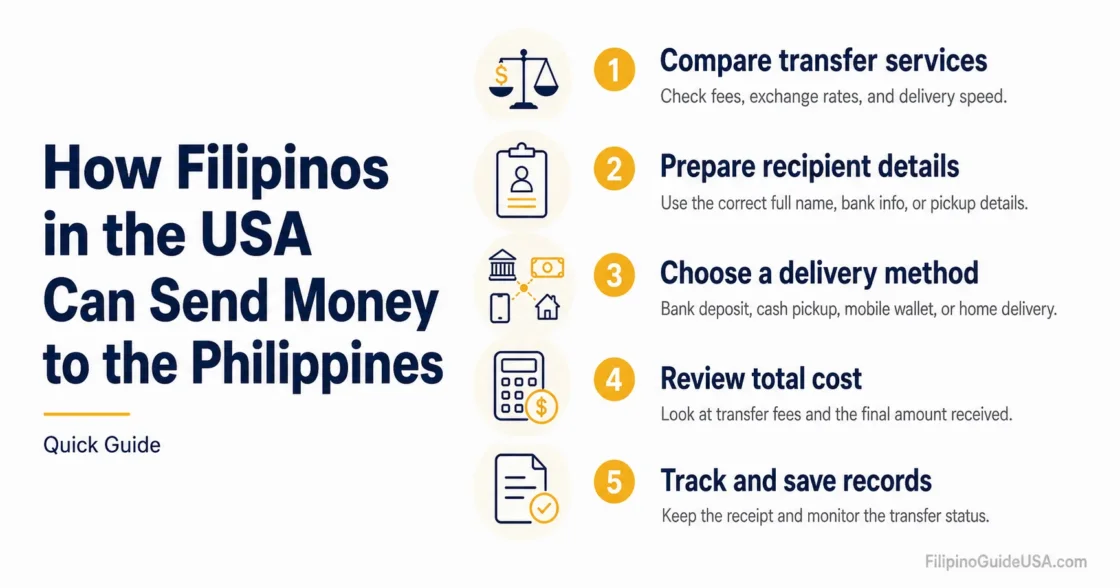
Sending money from the United States to the Philippines is usually simple, but the safest choice depends on how the family member in the Philippines will receive the funds, how fast the money is needed, and whether the total cost is clear before payment. For Filipino households, a remittance is often more than a transfer; it may cover school fees, medicine, rent, family events, or emergency expenses. The sender should compare the full cost, check the recipient details carefully, and keep the receipt until the money is confirmed.
Why this matters →
A clear remittance process helps Filipino families avoid delays, unexpected deductions, and unsafe transfer requests when supporting relatives in the Philippines.
Required Details Before Sending:
- Sender’s legal name, current U.S. address, phone number, and valid identification if the provider asks for it.
- Recipient’s full legal name exactly as it appears on a bank account, mobile wallet, or government ID.
- Recipient’s bank name, account number, mobile wallet number, or cash pickup location, depending on the delivery method.
- Recipient’s city or province, especially for cash pickup or home delivery options.
- Purpose of transfer if the provider requests it for compliance review.
- Enough funds to cover the transfer amount, fee, and any funding charge from the sender’s card or bank.
Important Notice: In the United States, many international money transfers above $15 are treated as remittance transfers when sent through a qualifying provider. Federal rules generally require providers to give certain information, such as fees, exchange rate, expected delivery amount, availability date, cancellation rights, and error instructions.[a]
Choose The Right Receiving Method
This section explains how to match the transfer method with the recipient’s real situation in the Philippines.
The best way to send money is not always the fastest advertised option. A family member with a Philippine bank account may prefer a bank deposit. Someone without easy bank access may need cash pickup. A younger recipient may prefer a mobile wallet if the account is verified and actively used. The sender should confirm the receiving method before comparing prices.
| Method | Works Best When | What To Check First |
|---|---|---|
| Bank Deposit | The recipient has an active Philippine bank account and can wait for normal processing. | Account name, account number, bank name, delivery time, and any receiving-bank deduction. |
| Cash Pickup | The recipient needs cash and can visit a pickup branch or partner outlet. | Recipient ID name match, pickup code, branch access, operating hours, and safety when collecting cash. |
| Mobile Wallet | The recipient uses a verified wallet and wants faster access for daily spending. | Wallet number, account limits, verification status, and possible wallet cash-out fees. |
| Bank Wire Or International Transfer | A larger transfer needs bank-to-bank routing and a formal bank record. | Bank fees, exchange rate, delivery estimate, receiving-bank fees, and exact beneficiary details. |
Step 1: Confirm What The Recipient Can Actually Use
This step prevents the most common cause of remittance delays: choosing a delivery option the recipient cannot easily access.
Before sending, the sender should ask the recipient which option is easiest to receive: bank deposit, cash pickup, mobile wallet, or another approved payout channel. A recipient in Metro Manila may have many cash pickup points nearby, while a recipient in a smaller town may prefer a bank account or wallet that can be used locally.
Tip: Ask the recipient to send their details in writing, then copy the name and numbers exactly instead of typing from memory.
If cash pickup is used, the recipient’s name must usually match the ID shown at pickup. A nickname, shortened middle name, missing suffix, or reversed surname can delay release. For bank deposits and mobile wallets, a wrong account or phone number may be harder to correct after the transfer is processed.
Step 2: Compare The Total Cost, Not Only The Fee
This step shows how to compare remittance offers in a way that reflects the amount the family will receive.
A low transfer fee does not always mean a low-cost transfer. The exchange rate can reduce the Philippine peso amount received even when the fee looks small. The sender should compare three numbers before paying: the dollar amount sent, the total charge paid by the sender, and the peso amount expected to reach the recipient.
Cost Comparison Rule: Compare the final peso amount shown before payment across at least two providers when time allows. The World Bank’s Remittance Prices Worldwide database is designed to report comparable remittance price data and service terms across country corridors, which can help users understand how costs are measured.[b]
When comparing options, pay attention to:
- Transfer fee: The charge shown separately by the provider.
- Exchange rate: The dollar-to-peso rate applied to the transfer.
- Funding method: Debit card, credit card, bank account, and cash funding can have different costs.
- Receiving method: Cash pickup, bank deposit, and wallet payout may not cost the same.
- Delivery time: Faster delivery may cost more, especially when funded by card.
- Possible receiving charge: Some banks or payout partners may deduct charges from the received amount.
Step 3: Use A Recognized Transfer Channel
This step focuses on safer transfer channels and why informal arrangements can create avoidable risk.
The sender should use a bank, licensed money transfer company, or recognized digital remittance service instead of sending funds through strangers, social media contacts, or informal hand-carry arrangements. The Bangko Sentral ng Pilipinas maintains an Overseas Filipino Portal with remittance-related directories, cost resources, exchange-rate links, and consumer protection materials for overseas Filipinos and their families.[c]
A recognized provider should be able to show the sender a receipt or transaction record. The receipt should include the tracking number, amount sent, fees, exchange rate when applicable, expected amount to the recipient, recipient details, delivery method, and customer service contact information.
Warning: Do not send money because of pressure from a caller, text message, online seller, dating contact, fake employer, or person claiming there is an emergency but refusing normal verification. The FTC warns that scammers often pressure people to pay through wire transfers, payment apps, cryptocurrency, or gift cards.[d]
Step 4: Review The Pre-Payment Details Slowly
This step helps catch mistakes before the transfer becomes difficult to cancel or amend.
Before pressing “send” or paying at a counter, the sender should check the transaction screen or printed form line by line. The most important details are the recipient name, transfer amount, delivery method, peso amount, exchange rate, fee, and expected availability date.
For cash pickup, the sender should confirm that the recipient has an acceptable ID and can reach the pickup branch during business hours. For bank deposit, the sender should confirm the bank account is active and owned by the intended recipient. For mobile wallet delivery, the sender should confirm the number and account status before payment.
Tip: For a first transfer to a new recipient account, sending a smaller test amount can reduce the risk of a larger mistake.
Step 5: Keep The Receipt Until The Recipient Confirms
This step protects the sender if the money is delayed, deducted, cancelled, or sent to the wrong place.
The receipt is not just proof of payment. It is also the document the provider may need when tracing a transfer. The sender should save the receipt, screenshot, confirmation email, tracking number, and any customer service messages. These records are useful if the recipient receives less than expected, cannot claim the funds, or sees no deposit after the stated delivery time.
If There Is A Problem: The CFPB says a sender should contact the transfer company right away. In many cases, an international money transfer can generally be cancelled within 30 minutes unless the recipient has already picked up the money or the funds have already been deposited; problems may also be reported within a stated time window shown under federal remittance rules.[e]
What To Do If The Money Is Delayed Or Incorrect
This section gives a calm order of action when a transfer does not arrive as expected.
If the recipient cannot receive the funds, the sender should not start a second transfer immediately unless the provider confirms that the first one failed or was refunded. Duplicate transfers can create confusion and may be hard to reverse after payout.
The sender should take these steps:
- Check the receipt for the expected delivery date and pickup or deposit instructions.
- Confirm with the recipient that the name, account number, wallet number, and pickup location were entered correctly.
- Contact the provider through the official app, website, or phone number on the receipt.
- Ask for a written case number or complaint reference.
- Save screenshots, emails, receipts, and chat transcripts.
- Request a correction, resend, refund, or investigation depending on the provider’s findings.
If the receiving side involves a Philippine bank or financial institution and the concern remains unresolved after contacting that institution, the Bangko Sentral ng Pilipinas provides consumer assistance channels for concerns involving BSP-supervised financial institutions, including the BSP Online Buddy and other complaint routes.[f]
Safety Rules For Filipino Families Sending And Receiving Money
This section covers practical safety habits that protect both the U.S. sender and the Philippine recipient.
- Never share a one-time password, login code, wallet PIN, or banking password with anyone.
- Do not post the tracking number, receipt, recipient name, or transfer amount on social media.
- Use the provider’s official app or website, not links sent by strangers or unverified messages.
- Call the recipient through a known number if a sudden emergency request arrives from a new account.
- Do not send money to “unlock” a prize, job offer, package, visa appointment, loan, or investment payout.
- For cash pickup, tell the recipient to collect money in a safe location and avoid showing cash publicly.
Do Not Share Verification Codes: The FTC warns that verification codes are meant only for the account holder’s login. A person asking for that code may be trying to access the account and move money without permission.[g]
How To Decide Between Speed, Cost, And Convenience
This section helps match the transfer choice with common family needs.
For routine monthly support, cost and reliability usually matter more than instant delivery. For emergencies, speed may matter more, but the sender should still check the exchange rate and final amount. For larger transfers, a bank deposit or formal account route may provide a clearer record. For recipients without a bank account, cash pickup or a verified mobile wallet may be more practical.
| Family Need | Likely Better Option | Reason |
|---|---|---|
| Monthly Allowance | Bank deposit or wallet transfer | Easier to repeat, track, and compare over time. |
| Emergency Cash | Fast cash pickup or instant wallet transfer | Recipient may need same-day access, but ID and pickup access must be confirmed. |
| School Or Tuition Support | Bank deposit | A clearer transaction record may help with family budgeting and school payment tracking. |
| Recipient Has No Bank Account | Cash pickup or verified wallet | The recipient can receive funds without a traditional bank account. |
| Large Family Expense | Bank transfer through a provider with clear documentation | The sender can keep better records and compare fees before payment. |
Common Mistakes That Delay Transfers
This section lists avoidable errors that often cause extra calls, refund requests, or pickup problems.
- Using a nickname instead of the recipient’s legal name.
- Entering the wrong mobile wallet number by one digit.
- Choosing cash pickup when the recipient has no accepted ID.
- Ignoring the exchange rate because the transfer fee looks low.
- Sending to a closed or inactive bank account.
- Deleting the receipt before the recipient confirms the funds.
- Sending money after receiving pressure from an unknown contact.
- Assuming every transfer can be cancelled after the recipient receives the funds.
Helpful Questions To Ask Before Sending
These questions create a simple review routine before payment.
- Is the recipient’s name exactly the same as the bank, wallet, or ID record?
- How much will the recipient receive in Philippine pesos after all shown charges?
- When should the money be available?
- Can the recipient access the chosen bank, wallet, or pickup branch?
- What happens if the transfer fails or the recipient cannot claim it?
- Does the receipt explain how to report an error?
- Is the request coming from a person the sender has verified directly?
FAQs About Sending Money To The Philippines
These answers address common questions from Filipinos sending support from the United States.
Is It Better To Send Dollars Or Philippine Pesos?
For most family support transfers, the sender should focus on the final peso amount the recipient will receive. Some providers show the exchange rate and the expected peso amount before payment. Comparing that number is more useful than comparing fees alone.
Can A Recipient Pick Up Money Without A Bank Account?
Yes, many providers offer cash pickup through partner locations. The recipient usually needs an accepted ID and the correct transaction details. The sender should confirm the recipient’s legal name before sending.
Why Did The Recipient Receive Less Than Expected?
The difference may come from the exchange rate, transfer fee, receiving-bank deduction, foreign taxes, payout partner charge, or a different delivery route than expected. The sender should compare the receipt with the provider’s pre-payment disclosure and contact the provider if the numbers do not match.
Can A Transfer Be Cancelled?
Some international transfers may be cancelled within a limited time, but cancellation may not be available after the recipient has picked up the money or after the funds have been deposited. The sender should act immediately and use the provider’s official support channel.
Should Receipts Be Saved?
Yes. The sender should keep the receipt until the recipient confirms receipt and any problem window has passed. A receipt helps identify the transaction if the provider needs to trace, correct, refund, or investigate it.
Before Sending The Next Transfer
This final review helps families build a safer routine for repeated support payments.
A careful remittance habit is simple: confirm the recipient details, compare the final peso amount, use a recognized provider, save the receipt, and verify delivery. Fees, exchange rates, provider rules, consumer procedures, and receiving options can change. Before sending money, the sender should review the latest information on the provider’s official page and check relevant U.S. and Philippine consumer resources when a problem or unusual request appears.
Sources
- [a] — Explains U.S. remittance transfer rights, provider disclosures, fees, exchange rates, cancellation information, and error instructions. (Reliable because it is a page from the Consumer Financial Protection Bureau, the U.S. federal consumer finance regulator.) ↩
- [b] — Provides remittance price and service-term data across international corridors. (Reliable because it is maintained by the World Bank, an international development institution with a dedicated remittance cost database.) ↩
- [c] — Lists BSP remittance directories, cost resources, exchange-rate links, and consumer protection materials for overseas Filipinos. (Reliable because it is published by Bangko Sentral ng Pilipinas, the central bank of the Philippines.) ↩
- [d] — Describes common scam payment pressure tactics, including wire transfers, payment apps, cryptocurrency, and gift cards. (Reliable because it is published by the Federal Trade Commission, a U.S. federal consumer protection agency.) ↩
- [e] — Explains what to do when there is a problem with an international money transfer, including cancellation and error steps. (Reliable because it is a CFPB consumer tool page focused on money transfers.) ↩
- [f] — Gives BSP consumer assistance channels for concerns involving BSP-supervised financial institutions. (Reliable because it is an official BSP consumer assistance page.) ↩
- [g] — Explains why account verification codes should not be shared and how scammers use them. (Reliable because it is an FTC consumer alert written for public scam prevention.) ↩