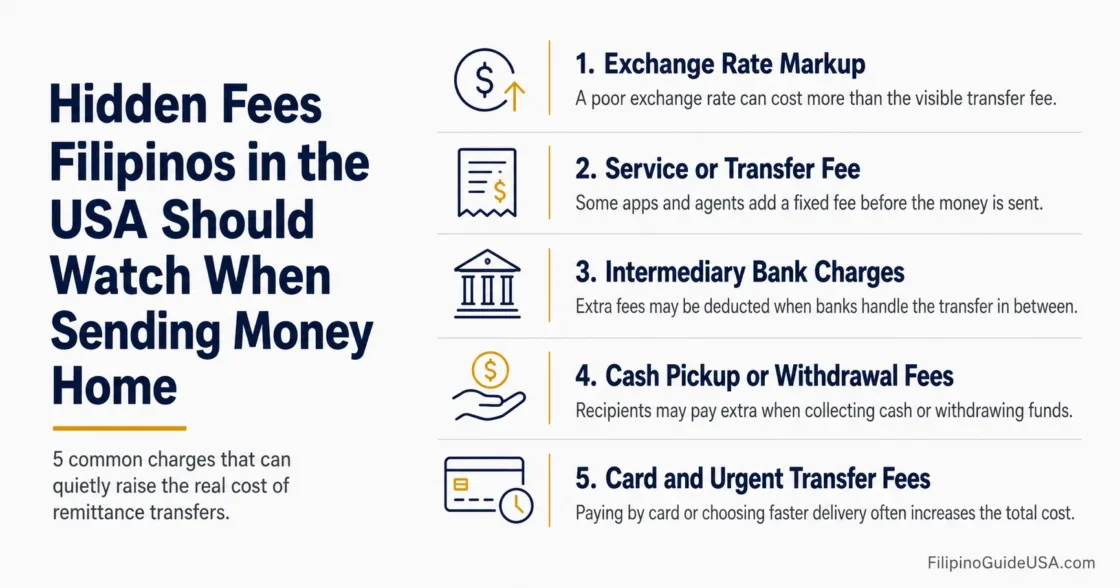
Sending money from the United States to family in the Philippines often looks simple: choose a provider, enter a dollar amount, review the peso amount, and send. The real cost, however, is not always limited to the transfer fee shown on the first screen. For Filipino households supporting parents, tuition, medical needs, home payments, or emergency expenses, the amount that actually arrives in pesos matters more than the advertised fee.
Why this matters →
Small deductions, weak exchange rates, and recipient-side charges can reduce the money available to a family member in the Philippines, especially when transfers are made often.
Information To Have Before Comparing Transfers:
- The exact amount in U.S. dollars to be sent.
- The preferred receiving method: bank deposit, e-wallet, cash pickup, or home delivery where available.
- The recipient’s correct legal name, mobile number, bank account, or wallet details.
- The peso amount the recipient is expected to receive after all disclosed charges.
- The provider’s exchange rate, transfer fee, delivery time, and cancellation policy.
- Any likely receiving-side charge from a Philippine bank, e-wallet, cash-out agent, or pickup location.
The Real Cost Is More Than The Transfer Fee
This section explains why a “low fee” transfer can still deliver fewer pesos than expected.
For remittances from the U.S., the sender normally reviews cost details before paying. U.S. consumer guidance from the Consumer Financial Protection Bureau says the sender generally sees the total cost, applicable exchange rate, and expected amount to be delivered before the transfer is sent.[a] That disclosure is helpful, but it still requires careful reading.
The fee shown as a line item is only one part of the cost. The other part may be hidden inside the dollar-to-peso exchange rate. A transfer with a “$0 fee” may still cost more if the provider uses a weaker rate than another provider charging a visible fee. The best comparison is not “Which fee is lowest?” but “How many pesos will the recipient receive for the same dollar amount?”
Tip: Compare at least two providers using the same send amount, same payment method, and same delivery method. Changing any one of those details can change the total cost.
Common Hidden Fees To Watch
This section lists the charges and cost differences that often affect Filipino remittance senders.
| Cost Type | Where It Appears | What To Check |
|---|---|---|
| Exchange Rate Margin | Built into the USD-to-PHP rate | Compare the final peso amount, not only the listed transfer fee. |
| Payment Method Fee | Debit card, credit card, bank account, or cash payment options | A card-funded transfer may cost more than an ACH or bank-funded transfer. |
| Receiving Bank Deduction | After the money reaches a Philippine bank account | Ask whether the recipient’s bank deducts an incoming or local processing charge. |
| Cash Pickup Or Cash-Out Fee | When the recipient collects cash or withdraws from a wallet | Confirm whether the amount shown online is the same amount available in cash. |
| Speed Fee | Instant, same-day, or urgent delivery options | A slower delivery option may deliver more pesos for non-urgent transfers. |
| Promo Rate Limit | First transfer offers or limited-time promotions | Check the regular cost before relying on the service for monthly support. |
The World Bank’s remittance price methodology treats the exchange rate margin as part of the transfer cost because it can be a major cost even when it is not shown as a separate fee.[b] For Filipino senders, that means a provider advertising a low upfront fee should still be checked against the actual peso payout.
Exchange Rate Margin
The exchange rate margin is the difference between a reference market rate and the rate offered to the sender. It is not always labeled as a “fee,” but it affects the final peso amount. A rate difference that looks small can matter when sending larger amounts or when sending money every payday.
For example, two providers can both claim low fees while offering different peso payouts. If one provider gives a weaker USD-to-PHP rate, the family in the Philippines may receive less even if the sender pays no visible transfer charge.
Payment Method Charges
The way the transfer is funded can change the cost. Bank account payments, debit cards, credit cards, and cash payments may each have different pricing. Credit card funding can also create separate card charges from the card issuer, depending on the card terms.
IMPORTANT NOTICE: A credit card-funded remittance can be more expensive than it appears on the transfer provider’s screen if the card issuer treats the transaction as a cash advance or applies separate finance charges. The sender should check the card agreement before using a credit card for remittances.
Recipient Bank Or Local Transfer Deductions
Some transfers arrive through local banking or payment rails in the Philippines. A receiving bank or local service may apply a deduction depending on the delivery route, the account type, or the receiving institution. The Bangko Sentral ng Pilipinas publishes a digital-channel fee summary for Philippine institutions, which can help recipients understand that local electronic transfer fees may vary by institution.[c]
This matters when a provider shows the amount “sent” but the recipient later sees a slightly different amount after a local charge. For support payments that must match a bill, tuition balance, or rent amount, the sender should allow a small buffer or confirm the receiving route before sending.
Cash Pickup And E-Wallet Cash-Out Costs
Cash pickup can be useful when a recipient does not have easy bank access. E-wallet delivery can also be convenient for daily expenses. Still, the cost check should not end when the digital transfer is marked complete. The recipient may later pay a fee to withdraw cash from a wallet, use a partner outlet, or collect funds from a cash agent.
A practical comparison should ask two questions: how many pesos arrive in the account or wallet, and how many pesos the recipient can actually use after withdrawal or cash-out charges.
How To Compare Providers Without Getting Misled
This section gives a simple process for comparing transfer offers in a way that reflects the real peso payout.
Step 1: Use The Same Send Amount
Start with the exact same dollar amount across providers. Comparing a $100 quote from one provider with a $500 quote from another can distort the result because many services change fees by amount, funding method, or delivery method.
Step 2: Match The Delivery Method
A bank deposit quote should be compared with another bank deposit quote. A cash pickup quote should be compared with another cash pickup quote. E-wallet delivery should be compared with e-wallet delivery. Each method can carry different pricing, delivery times, and local handling costs.
Step 3: Compare The Peso Amount Delivered
The final PHP amount is the cleanest comparison point. If Provider A charges a $4 fee but delivers more pesos than Provider B with a $0 fee, Provider A may be the lower-cost option for that transfer.
Step 4: Check The Receipt Before Paying
Before payment, the disclosure or quote should show the transfer amount, fees, exchange rate where applicable, and expected delivered amount. If the receipt includes language saying additional fees or taxes may apply, the sender should treat the quoted payout as possibly incomplete and verify with the recipient’s bank, wallet, or pickup location.
Procedure Note: A careful comparison uses the same amount, same funding method, same delivery route, and the final peso payout. The provider with the lowest advertised fee is not always the lowest-cost choice.
Receipt Details That Deserve Extra Attention
This section explains which lines on a remittance quote can reveal hidden cost differences.
- Transfer fee: The visible charge taken by the provider.
- Exchange rate: The USD-to-PHP rate used for the transaction.
- Total paid: The full amount charged to the sender, including fees and taxes shown by the provider.
- Amount to recipient: The estimated or expected peso amount delivered.
- Delivery date: The date or time the funds should become available.
- Possible third-party charges: Any warning that recipient-side, bank-side, or country-side charges may apply.
The phrase “amount expected to be delivered” should be read carefully. It may not always mean the recipient can withdraw the same amount in cash without any later deduction. The difference depends on the transfer route, the recipient’s institution, and the withdrawal method.
Tip: For regular family support, saving screenshots or PDFs of quotes and receipts can make it easier to notice when a provider changes pricing, exchange rates, or delivery terms.
When “Free Transfer” Is Not Really Free
This section explains why zero-fee offers still need a peso-payout check.
Promotional offers can be useful, especially for a first transfer or a limited period. The risk is assuming the same cost will apply every month. A provider may waive the visible transfer fee while using an exchange rate that produces fewer pesos than another provider. The sender should compare the regular rate after the promotion ends.
The World Bank’s Remittance Prices Worldwide database tracks the cost of sending and receiving relatively small remittances across many corridors, showing why total cost comparisons matter rather than fee-only comparisons.[d] For a Filipino sender in the U.S., the same principle applies at the household level: the best-looking fee label does not always mean the strongest peso value.
Delivery Speed Can Change The Cost
This section explains why urgent transfers may cost more than planned transfers.
Instant or same-day service can be useful for urgent family needs. For planned support, school payments, monthly bills, or savings contributions, a slower method may cost less. Some services price transfers differently based on speed, payment method, or delivery route.
Filipino senders can reduce avoidable costs by separating urgent transfers from routine transfers. Emergency funds may justify a higher fee. Regular support can often be scheduled earlier, compared more calmly, and sent through a lower-cost route.
Practical Note: A transfer needed within minutes should be judged differently from a transfer for a bill due next week. Delivery speed is part of the cost decision, not just a convenience feature.
Cancellation, Errors, And Refund Timing
This section explains why the cancellation window and error process should be checked before sending.
U.S. remittance rules provide cancellation rights in many covered transfers. CFPB regulation explains that a remittance transfer provider must follow cancellation and refund requirements when a valid cancellation request is received no later than 30 minutes after payment, as long as the funds have not already been picked up or deposited.[e]
IMPORTANT NOTICE: The cancellation window is time-sensitive and may no longer help once the money has been picked up or deposited. The sender should review the recipient name, delivery method, account number, mobile number, and payout amount before making payment.
Errors can also be expensive even when the fee is small. A wrong account number, misspelled recipient name, inactive wallet, or mismatched pickup ID can delay access to the money. For family support, the delay itself may create costs if the recipient is trying to pay a deadline-based bill.
Fraud-Related Costs And Unsafe Transfer Requests
This section covers safety checks that help protect senders from losing money outside the normal fee structure.
Not every remittance risk is a fee. A sender can lose the full transfer amount when money is sent under pressure, to a fake emergency contact, or to someone pretending to be from a government agency, business, or financial institution. The Federal Trade Commission warns consumers not to wire money to people they have not met in person and not to send money to anyone claiming to be a government agency demanding payment by wire transfer.[f]
For Filipino families, emergency messages can feel urgent, especially when they mention medical needs, travel problems, or relatives in distress. A safe transfer habit is to verify the request through a separate contact method before sending. A phone call to the known family number, a message to another relative, or a direct check with the recipient can prevent a costly mistake.
CAUTION: A transfer should not be sent when the sender is pressured to act immediately, asked to keep the transfer secret, or told to ignore normal verification steps. Urgency is a common warning sign in money transfer scams.
Better Habits For Regular Family Support
This section gives practical habits for Filipino senders who remit money often.
- Track the peso payout: Record how many pesos arrived for each dollar amount, not only the transfer fee.
- Separate urgent and routine transfers: Use faster options when needed, but compare slower options for planned support.
- Ask the recipient about deductions: A receiving bank, wallet, or cash-out point may affect the usable amount.
- Save receipts: Keep proof of the exchange rate, delivery date, recipient details, and total paid.
- Review promos carefully: A first-transfer discount may not reflect the regular monthly cost.
- Check official complaint channels: If a Philippine-side financial institution is involved, the BSP Consumer Corner can help users locate consumer protection information and complaint resources.[g]
A regular remittance routine benefits from simple records. Over several months, the sender can see whether one provider usually delivers more pesos, whether fees rise on certain payment methods, or whether a recipient-side method creates extra deductions.
Questions To Ask Before Sending
This section turns the fee check into a short decision list before payment.
Pre-Send Checklist:
- What is the exact total amount charged in U.S. dollars?
- What exchange rate is being used for USD to PHP?
- How many pesos should the recipient receive?
- Can the recipient use the full amount, or will a bank, wallet, or pickup fee apply?
- Is a faster delivery option adding cost that could be avoided?
- Does the receipt mention possible third-party charges?
- What is the cancellation window after payment?
- Has the recipient request been verified through a trusted contact method?
The most useful habit is to pause at the final confirmation screen and compare the delivered peso amount. If the page shows a low fee but a weaker exchange rate, the transfer may not be as low-cost as it appears.
Fee Information Can Change
This section explains why remittance costs should be checked again before each transfer.
Remittance pricing, exchange rates, delivery partners, bank fees, wallet charges, and cancellation terms can change over time. A method that was inexpensive last month may not be the lowest-cost route today. Before sending money home, the sender should review the current quote, confirm the final peso payout, and check official provider disclosures or regulator resources when a fee, delay, or complaint issue arises.
Sources
- [a] Consumer Financial Protection Bureau, “Problems sending money to another country?” — used for the explanation of remittance disclosures, total cost, exchange rate, and expected delivered amount. The CFPB is a U.S. federal consumer financial protection agency.
- [b] World Bank, Remittance Prices Worldwide Methodology — used for the explanation of exchange rate margin as part of remittance cost. The World Bank is an international institution that maintains a dedicated remittance cost database.
- [c] Bangko Sentral ng Pilipinas, “Summary of Transfer Fees via Digital Channels” — used for Philippine-side digital transfer fee context. The BSP is the central bank and payment system overseer of the Philippines.
- [d] World Bank, Remittance Prices Worldwide — used for the broader point that remittance costs should be compared by total cost, not fee labels alone. The database tracks remittance prices across country corridors through an international development institution.
- [e] Consumer Financial Protection Bureau, Regulation E § 1005.34 — used for cancellation and refund timing for covered remittance transfers. This is an official CFPB regulation page.
- [f] Federal Trade Commission, “What To Know Before You Wire Money” — used for scam and unsafe wire transfer warnings. The FTC is a U.S. federal consumer protection agency.
- [g] Bangko Sentral ng Pilipinas, Consumer Corner — used for Philippine financial consumer protection and complaint-resource context. The BSP is the official monetary and financial regulator for supervised institutions in the Philippines.