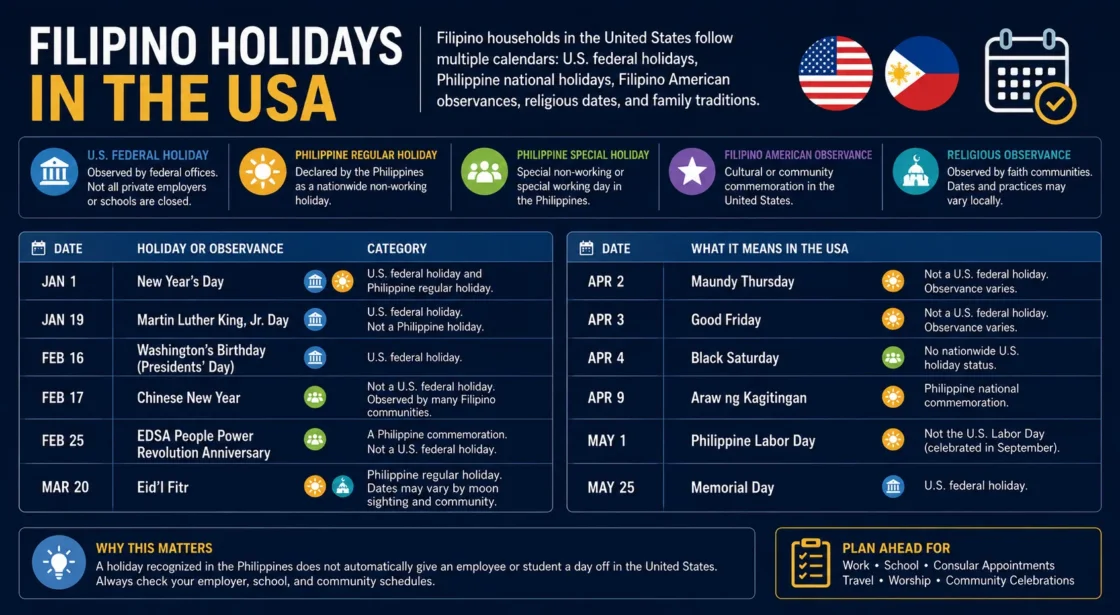
Filipino holidays in the United States do not follow one official calendar. A Filipino household may observe U.S. federal holidays, Philippine national holidays, Filipino American commemorations, Catholic or Muslim religious dates, and family traditions during the same year. The practical difference is important: a holiday recognized in the Philippines does not automatically give an employee or student a day off in the United States.
Why this matters →
Knowing which dates are U.S. federal holidays, Philippine holidays, or cultural observances helps Filipino families plan work, school, consular appointments, travel, worship, and community celebrations without assuming that the two countries follow the same calendar.
2026 Holiday Calendar for Filipino Households in the USA
The dates below combine the U.S. federal calendar with Philippine national holidays and selected Filipino American observances that are especially relevant to families living in the United States.
For 2026, the Philippine holiday schedule comes primarily from Proclamation No. 1006, with Eid’l Fitr and Eid’l Adha established separately after their dates were determined.[a] The U.S. federal schedule follows the Office of Personnel Management calendar.[b]
| Date | Holiday or Observance | Category | What It Means in the USA |
|---|---|---|---|
| January 1 | New Year’s Day | U.S. federal + Philippine regular holiday | A U.S. federal holiday and also an official Philippine holiday. |
| January 19 | Birthday of Martin Luther King, Jr. | U.S. federal holiday | Federal offices generally observe the holiday. It is not a Philippine national holiday. |
| February 16 | Washington’s Birthday | U.S. federal holiday | Official federal name for the holiday often informally called Presidents’ Day. |
| February 17 | Chinese New Year | Philippine special non-working day | Not a U.S. federal holiday. Observance varies by family and community. |
| February 25 | EDSA People Power Revolution Anniversary | Philippine special working day | A Philippine commemoration, not a U.S. federal holiday or automatic day off. |
| March 20 | Eid’l Fitr | Philippine regular holiday | The Philippines declared March 20 a regular holiday for 2026.[c] Muslim Filipinos in the U.S. may also follow local mosque or community observance schedules. |
| April 2 | Maundy Thursday | Philippine regular holiday | Not a U.S. federal holiday. Some Filipino Catholic communities hold Holy Week services. |
| April 3 | Good Friday | Philippine regular holiday | Not a U.S. federal holiday. Church, employer, and school schedules vary. |
| April 4 | Black Saturday | Philippine special non-working day | No nationwide U.S. holiday status. |
| April 9 | Araw ng Kagitingan | Philippine regular holiday | A Philippine national commemoration but not a U.S. federal holiday. |
| May 1 | Philippine Labor Day | Philippine regular holiday | Not the U.S. Labor Day. The American federal holiday occurs in September. |
| May 25 | Memorial Day | U.S. federal holiday | A federal holiday observed on the last Monday in May. |
| May 27 | Eid’l Adha | Philippine regular holiday | The Philippines declared May 27 a regular holiday for 2026.[d] It is not a U.S. federal holiday. |
| June 12 | Philippine Independence Day | Philippine regular holiday | One of the most visible Philippine national celebrations in Filipino American communities, but not a U.S. federal holiday. |
| June 19 | Juneteenth National Independence Day | U.S. federal holiday | A U.S. federal holiday. |
| July 3 | U.S. Independence Day — Federal Observance | U.S. federal holiday | July 4 falls on Saturday in 2026, so most federal employees observe the holiday on Friday, July 3. |
| August 21 | Ninoy Aquino Day | Philippine special non-working day | Not a U.S. federal holiday. |
| August 31 | National Heroes Day | Philippine regular holiday | A Philippine national holiday without automatic U.S. leave status. |
| September 7 | U.S. Labor Day | U.S. federal holiday | The U.S. holiday is observed on the first Monday in September, unlike Philippine Labor Day on May 1. |
| October | Filipino American History Month | Filipino American observance | A month of history, education, and community programming. It is not a month-long public holiday. |
| October 12 | Columbus Day | U.S. federal holiday | Listed under this official name on the federal calendar. State and local observance may differ. |
| October 18 | Anniversary of the First Documented Filipino Presence in the Continental U.S. | Filipino American historical observance | The date is closely connected with why Filipino American History Month is observed in October. |
| October 25 | Larry Itliong Day | California observance | California law designates October 25 each year as Larry Itliong Day; it is not a federal holiday.[i] |
| November 1 | All Saints’ Day | Philippine special non-working day | Associated with Undas traditions for many Filipino families, but not a U.S. federal holiday. |
| November 2 | All Souls’ Day | Additional Philippine special non-working day | A day of remembrance for many Filipino families; no federal holiday status in the U.S. |
| November 11 | Veterans Day | U.S. federal holiday | A U.S. federal holiday. |
| November 26 | Thanksgiving Day | U.S. federal holiday | A major U.S. family holiday that many Filipino American households also make part of their own family calendar. |
| November 30 | Bonifacio Day | Philippine regular holiday | Not a U.S. federal holiday. |
| December 8 | Feast of the Immaculate Conception of Mary | Philippine special non-working day | Not a federal holiday. Religious observance depends on the individual and parish. |
| December 24 | Christmas Eve | Additional Philippine special non-working day | Not one of the regular U.S. federal holidays. Filipino families may observe Noche Buena. |
| December 25 | Christmas Day | U.S. federal + Philippine regular holiday | Officially recognized on both national calendars. |
| December 30 | Rizal Day | Philippine regular holiday | A Philippine national commemoration, not a U.S. federal holiday. |
| December 31 | Last Day of the Year / Media Noche | Philippine special non-working day + cultural tradition | December 31 is not a regular U.S. federal holiday. Filipino households may gather for Media Noche before the New Year. |
Important: A Philippine holiday does not create an automatic right to a paid day off in the United States. U.S. federal law under the Fair Labor Standards Act does not generally require private employers to provide holidays off, holiday pay, or premium pay simply because work occurs on a holiday.[e] Employer policies, employment agreements, state rules, union agreements, and individual circumstances may provide different benefits.
Which Holidays Actually Give Filipinos a Day Off in the USA?
The answer depends more on the person’s U.S. employer, school, or government office than on the Philippine calendar.
Federal Employees
Federal employees generally follow the official U.S. federal holiday calendar. For 2026, that includes New Year’s Day, Martin Luther King Jr. Day, Washington’s Birthday, Memorial Day, Juneteenth, Independence Day, Labor Day, Columbus Day, Veterans Day, Thanksgiving Day, and Christmas Day.
A Philippine holiday such as June 12, Araw ng Kagitingan, National Heroes Day, Bonifacio Day, or Rizal Day does not become a federal employee holiday merely because the employee is Filipino.
Private-Sector Employees
Private employers commonly establish their own paid-holiday schedules. Some follow most federal holidays, while hospitals, restaurants, hotels, retail businesses, transportation services, warehouses, care facilities, and other operations may remain open.
This also means that working on Thanksgiving, Christmas, Memorial Day, or another federal holiday does not automatically create a federal right to special holiday pay under the FLSA. Company policy or another applicable rule may still provide it.
Schools and Colleges
School calendars are usually controlled by state, district, institution, or campus schedules. A child whose family observes Philippine Independence Day or Undas should not be assumed to have the day off from a U.S. school. The same principle applies to college classes and exams.
Philippine Holidays Celebrated Personally
Filipinos who want to observe a Philippine national, cultural, or religious date during a normal U.S. workday may need to plan around their employer’s vacation, personal leave, scheduling, or applicable accommodation policies. This becomes especially relevant for Holy Week, Eid observances, June 12 activities, Undas, and Simbang Gabi.
Tip: For a weekday Filipino celebration, check the work or school calendar before making travel, church, or event plans. A community celebration may also be moved to the nearest weekend.
Philippine Independence Day on June 12 in the United States
June 12 keeps its Philippine meaning in the United States even though it is not part of the U.S. federal holiday calendar.
Philippine Independence Day commemorates the proclamation of independence in Kawit, Cavite, on June 12, 1898.[g] For Filipino communities in the United States, the date may be marked through flag ceremonies, cultural programs, parades, community festivals, performances, Filipino food events, and gatherings organized by civic or cultural groups.
The exact community event does not always happen on June 12 itself. In New York, for example, the 2026 Philippine Independence Day Parade was held on Sunday, June 7, ahead of the official June 12 anniversary.[l] Weekend scheduling makes it easier for people who work or attend school during the week to participate.
June 12 in the USA: It is a Philippine national holiday and an important Filipino community celebration, but it is not a U.S. federal holiday. A June 12 parade, festival, or flag ceremony may also be scheduled on a nearby weekend instead of the exact date.
Why June 12 and July 4 Both Appear in Filipino American History
The two dates refer to different events. June 12 is the modern Philippine Independence Day and traces its national meaning to the 1898 declaration of independence.
July 4 is U.S. Independence Day. It also has a separate place in Philippine-U.S. history because the United States formally recognized the Republic of the Philippines as an independent state on July 4, 1946.[h]
| Date | Meaning | Current Holiday Status |
|---|---|---|
| June 12 | Philippine Independence Day; linked to the 1898 proclamation in Kawit | Philippine regular holiday; not a U.S. federal holiday |
| July 4 | U.S. Independence Day; also the date of U.S. recognition of Philippine independence in 1946 | U.S. federal holiday |
July 4 Is Observed on July 3 in 2026
In 2026, July 4 falls on a Saturday. For most federal employees, Friday, July 3, 2026 is therefore treated as the Independence Day holiday for pay and leave purposes. The calendar date of Independence Day remains July 4.
This distinction matters when planning appointments with federal offices or other organizations that follow the federal calendar.
Philippine Labor Day and U.S. Labor Day Are Different Dates
One of the easiest holiday-calendar differences to miss after moving to the United States is Labor Day.
| Country | 2026 Date | Status |
|---|---|---|
| Philippines | May 1, 2026 | Philippine regular holiday |
| United States | September 7, 2026 | U.S. federal holiday |
A Filipino working in the United States should therefore not assume that May 1 is an employer holiday. Conversely, the first Monday in September can affect U.S. government services, workplace schedules, schools, transportation, and business hours even though it is not the Philippine Labor Day date.
October Is Filipino American History Month
October is a month of historical remembrance and community programming rather than a federal vacation period.
The U.S. House of Representatives recognized the celebration of Filipino American History Month in October through House Resolution 780 in 2009. The resolution also records October 18, 1587, as the earliest documented Filipino presence in the continental United States, when people identified in the historical record as “Luzones Indios” arrived at what is now Morro Bay, California.[f]
Filipino American History Month may be observed through:
- museum and historical programs;
- school and university activities;
- oral-history projects;
- community exhibits;
- cultural performances;
- Filipino American history lectures;
- food and arts events; and
- local government or community recognitions.
It should not be confused with a federal holiday. October does not become a month of paid leave, and October 18 is not itself a nationwide federal day off.
October 25 — Larry Itliong Day in California
California gives another Filipino American date formal recognition. State law designates October 25 of each year as Larry Itliong Day and directs the governor to proclaim the date annually. Public schools and educational institutions are encouraged to conduct activities that remember his life and contributions.
Larry Itliong Day is a useful example of the difference between a day of special cultural or educational recognition and a public holiday that closes workplaces or schools. The designation does not make October 25 a nationwide federal holiday.
Holy Week for Filipino Families in the USA
Holy Week creates one of the clearest differences between the Philippine and U.S. calendars. In the Philippines, Maundy Thursday and Good Friday are regular holidays in 2026, while Black Saturday is a special non-working day. In the United States, none of those three dates is a federal holiday.
Filipino Catholics in the U.S. may still take part in parish services, devotional activities, or family observances. The practical schedule, however, often has to fit around normal work and school responsibilities.
This can produce a very different experience from Holy Week in the Philippines, where national holiday status changes normal business and government operations. A Filipino family in the U.S. may attend an evening service after work rather than having the full weekday available.
Eid’l Fitr and Eid’l Adha for Muslim Filipinos in the USA
Filipino holiday discussions can become too centered on Catholic traditions. Muslim Filipinos also have two major Philippine regular holidays represented in the 2026 calendar: Eid’l Fitr on March 20 and Eid’l Adha on May 27.
Neither is a U.S. federal holiday. Muslim Filipinos living in the United States may follow their local mosque, Islamic center, employer, school, or community schedule when planning religious observance.
Calendar distinction: The Philippine government can declare a national holiday for Eid while the same date remains a normal federal workday in the United States. Religious observance and government holiday status are separate questions.
Flores de Mayo and Santacruzan in Filipino American Communities
Flores de Mayo is a Marian devotional tradition associated with the month of May, while the Santacruzan is connected with processional celebrations. U.S. Catholic materials documenting Filipino religious life describe both traditions as practices carried into Filipino communities in America.[j]
These celebrations differ from national holidays because there is no single U.S. date on which every community observes them. A parish or Filipino organization may schedule a procession, Mass, cultural program, or community gathering according to local availability.
For Filipino families used to local fiestas in the Philippines, this distinction is useful: a Filipino cultural or religious event appearing on a U.S. community calendar does not necessarily mean the date is a Philippine national holiday, a U.S. holiday, or a day when schools and businesses close.
Undas in the United States
For many Filipino families, All Saints’ Day on November 1 and All Souls’ Day on November 2 are associated with Undas and remembrance of deceased relatives. In 2026, both dates receive special non-working status in the Philippine calendar, with November 2 included as an additional special non-working day.
In the United States, neither date is a federal holiday. Families may instead adapt the tradition to local circumstances by:
- visiting a cemetery before or after work;
- placing flowers at a relative’s grave;
- attending Mass or another religious service;
- praying or remembering relatives at home;
- sharing family stories with children born or raised in the United States; or
- choosing the nearest weekend for a family cemetery visit.
For families whose relatives are buried in the Philippines, remembrance may take place at home or through communication with family members overseas rather than through a local cemetery visit.
Thanksgiving in a Filipino American Household
Thanksgiving is not a traditional Philippine national holiday, but for families living in the United States it can quickly become part of the annual family calendar. In 2026, Thanksgiving falls on Thursday, November 26.
The gathering does not need to look exactly like either an American or Philippine celebration. A Filipino American table may combine turkey or other U.S. Thanksgiving foods with dishes such as pancit, lumpia, Filipino-style desserts, rice dishes, or family recipes brought from the Philippines.
The deeper practical change is scheduling. Because Thanksgiving is a U.S. federal holiday and many workplaces and schools alter their schedules around it, Filipino families may have more opportunity to organize a large gathering than they do for June 12, Undas, or a weekday Philippine holiday.
The Filipino Christmas Season in the USA
Christmas is one of the areas where Philippine family traditions and the U.S. holiday calendar overlap most visibly.
Simbang Gabi
Simbang Gabi is a Filipino Catholic novena tradition held in the period leading to Christmas. U.S. Catholic documentation shows that the tradition is practiced across Filipino communities in America and that parish schedules can be adjusted to local work and community needs.
For example, U.S. diocesan materials describe Simbang Gabi schedules that may use evening Masses or dates adapted for participating parishes rather than assuming that everyone is available for a pre-dawn service. This is a common example of a tradition retaining its Filipino identity while adapting to daily life in the United States.
Parols, Filipino choir music, communal meals, and Filipino food may also accompany parish celebrations. The exact arrangement depends on the local church and Filipino community.
December 24 — Noche Buena
Christmas Eve is an additional special non-working day in the Philippines for 2026, but it is not one of the regular U.S. federal holidays. Filipino households may still preserve Noche Buena as a late Christmas Eve family meal or gathering.
Work schedules can change how the tradition is practiced. Some families gather after an evening church service, while others move the main meal earlier or later to accommodate shifts, travel, or relatives arriving from another city.
December 25 — Christmas Day
Christmas Day is one of the simplest dates for Filipino families to understand because it appears on both national calendars: December 25 is a U.S. federal holiday and a Philippine regular holiday.
That does not mean every private business closes, but the overlap generally makes Christmas easier to coordinate than Philippine-only holidays.
December 30 — Rizal Day
Rizal Day remains a Philippine regular holiday but has no federal holiday status in the United States. Filipino cultural, educational, or civic organizations may hold commemorative programs, while most Filipino employees and students continue with their normal U.S. schedule unless their organization provides otherwise.
December 31 — Media Noche
The Philippine calendar lists December 31 as a special non-working day in 2026. In the United States, New Year’s Eve is not a regular federal holiday.
Filipino families may nevertheless continue Media Noche, gathering before midnight for food, family time, and New Year traditions. As with Noche Buena, the celebration often adapts to American work schedules rather than disappearing.
Filipino Community Events Do Not Always Match the Holiday Date
A common source of confusion is assuming that the printed holiday date and the public celebration date must be identical.
In the United States, organizers frequently work around:
- Saturday and Sunday availability;
- school schedules;
- work shifts;
- church calendars;
- venue availability;
- local parade permits; and
- travel time for families coming from neighboring cities or states.
As a result, a Philippine Independence Day celebration may occur on the weekend before June 12, a Santacruzan may be scheduled on a particular May weekend, and a Filipino Christmas gathering may happen before the actual Christmas holiday.
Tip: When attending a Filipino community event, distinguish between the official holiday date and the local event date. They often serve different purposes.
Philippine Consulates Can Follow a Different Holiday Calendar
Philippine consulates in the United States are another reason not to rely on only one country’s calendar. A consular post may close for selected U.S. holidays, Philippine holidays, or both.
The Philippine Consulate General in New York, for example, lists a 2026 non-working calendar containing U.S. holidays such as Martin Luther King Jr. Day, Washington’s Birthday, Memorial Day, U.S. Independence Day, Labor Day, Veterans Day, and Thanksgiving, alongside Philippine dates such as Maundy Thursday, Good Friday, Araw ng Kagitingan, Philippine Labor Day, Ninoy Aquino Day, National Heroes Day, Bonifacio Day, Christmas Eve, Rizal Day, and the Last Day of the Year.[k]
Important for consular appointments: Do not assume that every Philippine consulate in the United States follows exactly the same closure dates. Check the calendar of the specific consular post involved before traveling, especially around Philippine holidays, U.S. federal holidays, Holy Week, Thanksgiving, and the Christmas period.
Not Every Filipino Family Observes the Same Holidays
The Philippines includes many regional, linguistic, religious, and family traditions. Living in the United States adds another layer because families also differ by generation, location, religion, immigration history, and how closely they maintain traditions from a particular Philippine province or city.
A Cebuano family may place more emphasis on Santo Niño-related traditions. A Muslim Filipino household will have a different religious calendar from a Catholic household. Some families organize around church communities, while others participate mainly in civic celebrations such as Philippine Independence Day or Filipino American History Month.
Second- and third-generation Filipino Americans may also combine Philippine traditions with U.S. holidays differently from newly arrived families. None of these patterns creates a single required Filipino American holiday calendar.
Holiday, Festival, and Observance Do Not Mean the Same Thing
| Term | What It Usually Means | Example |
|---|---|---|
| U.S. Federal Holiday | A holiday established for the federal government | Thanksgiving |
| Philippine Regular Holiday | An official national holiday under Philippine rules | June 12 Independence Day |
| Philippine Special Non-Working Day | A separate Philippine holiday classification | All Saints’ Day in 2026 |
| Filipino American Observance | A historical or cultural recognition in the United States | Filipino American History Month |
| Religious Tradition | A faith-based practice whose local schedule may vary | Simbang Gabi |
| Community Festival | An event organized by a local Filipino organization, parish, or community | Santacruzan or a June Independence festival |
This distinction explains why a Filipino event can attract a large community gathering without creating a legal holiday, and why an official Philippine holiday can pass as a normal workday in the United States.
Questions Filipinos Commonly Ask About Holidays in the USA
Is Philippine Independence Day a Holiday in the United States?
Not as a U.S. federal holiday. June 12 is a Philippine regular holiday and is widely commemorated by Filipino communities in America, but it does not automatically close U.S. federal offices, private workplaces, or schools.
Do Filipino Employees Get June 12 Off Work in the USA?
Not automatically. Time off depends on the employer’s schedule, leave policy, employment agreement, or another applicable rule. Some employees may choose to use personal or vacation leave to attend a June 12 celebration.
Is Filipino American History Month a Federal Holiday?
No. Filipino American History Month is observed in October through historical, educational, cultural, and community activities. It does not create a month-long federal holiday or automatic paid leave.
Why Is Filipino American History Month in October?
October is connected with the earliest documented Filipino presence in the continental United States. Congressional records identify October 18, 1587, as the date associated with the arrival of the “Luzones Indios” at Morro Bay, California.
Why Do Filipino Americans Talk About Both June 12 and July 4?
June 12 commemorates the Philippine declaration of independence in 1898. July 4 is U.S. Independence Day and is also the date on which the United States formally recognized Philippine independence in 1946.
Is Good Friday a Federal Holiday in the USA?
No. Good Friday is not on the U.S. federal holiday calendar. It is, however, a regular holiday in the Philippines and may be observed religiously by Filipino Catholics in the United States.
Is Simbang Gabi a Public Holiday?
No. Simbang Gabi is a Filipino Catholic religious tradition, not a U.S. public holiday. Parish dates and Mass times can differ by location.
Are All Saints’ Day and All Souls’ Day Holidays in the USA?
They are not U.S. federal holidays. They remain important dates for many Filipino families observing Undas, and both have Philippine holiday status in the 2026 national calendar.
Are Philippine Consulates Closed on Every Philippine Holiday?
Not necessarily. A consulate may use a calendar combining selected Philippine and U.S. holidays. Closure dates should be checked for the specific consular post before an appointment or visit.
Is Philippine Labor Day the Same as U.S. Labor Day?
No. Philippine Labor Day is May 1. U.S. Labor Day is observed on the first Monday of September, which falls on September 7 in 2026.
Do All Filipino Americans Celebrate the Same Holidays?
No. Celebration patterns vary by religion, regional background, family tradition, generation, and local community. Some dates are official Philippine holidays, while others are Filipino American historical observances, religious traditions, or local festivals.
Sources
- Supreme Court E-Library — Proclamation No. 1006, Regular Holidays and Special Non-Working Days for 2026 — Establishes the main Philippine national holiday schedule used in this article. (Official Philippine government judicial repository.)
- U.S. Office of Personnel Management — Federal Holidays — Confirms the official 2026 federal holiday schedule, including the July 3 federal observance of Independence Day. (Official U.S. federal government source.)
- Supreme Court E-Library — Proclamation No. 1189 — Declares March 20, 2026 a regular Philippine holiday for Eid’l Fitr. (Official Philippine government judicial repository.)
- Supreme Court E-Library — Proclamation No. 1264 — Declares May 27, 2026 a regular Philippine holiday for Eid’l Adha. (Official Philippine government judicial repository.)
- U.S. Department of Labor — Handy Reference Guide to the Fair Labor Standards Act — Explains that the FLSA does not generally require holiday pay, holidays off, or premium pay for holiday work. (Official U.S. Department of Labor guidance.)
- U.S. Government Publishing Office — House Resolution 780 — Records congressional recognition of Filipino American History Month in October and the October 18, 1587 historical reference. (Official U.S. government legislative record.)
- National Historical Commission of the Philippines — Site of the Proclamation of Philippine Independence — Documents the June 12, 1898 proclamation at Kawit, Cavite. (Official Philippine historical registry.)
- U.S. Department of State, Office of the Historian — Philippines — Confirms U.S. recognition of the Republic of the Philippines as an independent state on July 4, 1946. (Official U.S. diplomatic historical record.)
- California Legislative Information — Education Code Section 37222.18 — Designates October 25 of each year as Larry Itliong Day and describes its educational observance. (Official California Legislature source.)
- United States Conference of Catholic Bishops — A Treasured Presence — Documents Filipino Catholic traditions in the United States, including Simbang Gabi, Flores de Mayo, and Santacruzan. (National institutional reference on Catholic cultural ministry in the United States.)
- Philippine Consulate General in New York — 2026 Non-Working Holiday Calendar — Shows how a Philippine consular post in the United States combines selected Philippine and U.S. holiday closures. (Official Philippine diplomatic post.)
- Philippine Consulate General in New York — 2026 Philippine Independence Day Parade — Confirms that New York’s 2026 community celebration was held on June 7 rather than the official June 12 holiday date. (Official Philippine diplomatic post reporting a local Filipino American event.)