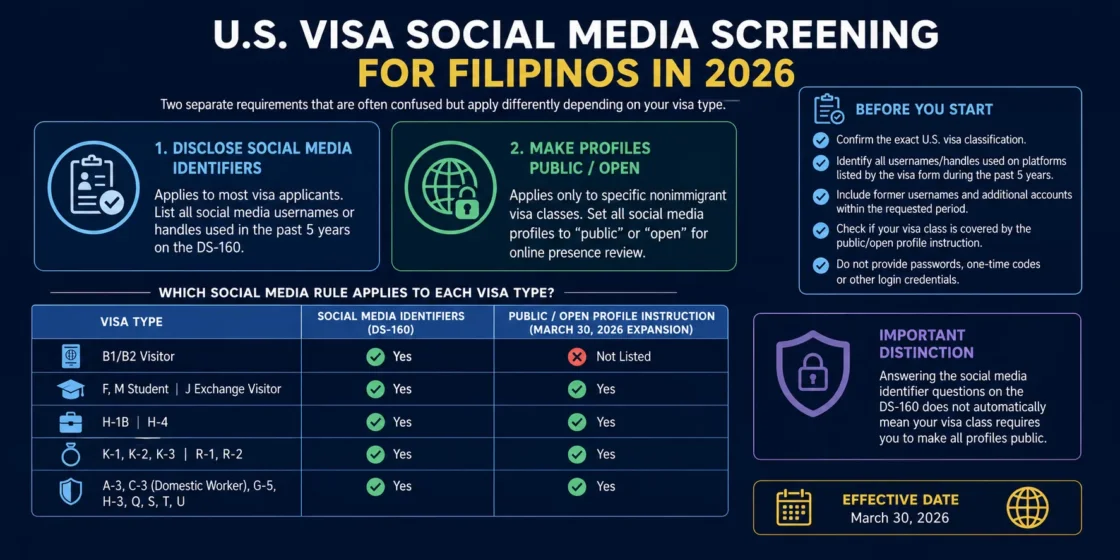
For Filipino applicants, U.S. visa social media screening in 2026 involves two separate requirements that are often confused: disclosing social media identifiers on a visa application and, for certain nonimmigrant visa classes, making social media profiles public or open for online presence review. The disclosure requirement reaches far more applicants. The public-profile instruction applies to visa classes specifically named by the U.S. Department of State, including F, M, J, H-1B, H-4, K, R and, effective October 1, 2026, I, TN and TD applicants.[a]
Why this matters →
A Filipino tourist, student, exchange visitor, professional worker or fiancé(e) applicant can face different social media requirements even when each applicant uses the same DS-160 system.
Before completing the social media portion:
- Confirm the exact U.S. visa classification being requested.
- Identify social media usernames or handles used on platforms listed by the visa form during the preceding five years.
- Include former usernames and additional accounts when they fall within the period requested by the form.
- Check whether the visa class is covered by the Department of State’s public/open profile instruction.
- Do not provide social media passwords, one-time codes or other login credentials.
Which Social Media Rule Applies to Each Visa Type?
The first task is to separate the five-year identifier question from the newer public-profile requirement.
| Visa Situation | Social Media Identifiers on the Visa Application | Public/Open Profile Instruction |
|---|---|---|
| B1/B2 visitor | Yes, the social media questions generally apply to visa applicants subject to the DS-160 collection rules. | Not listed in the Department of State’s current public/open profile categories. |
| F or M student | Yes | Yes |
| J exchange visitor | Yes | Yes |
| H-1B | Yes | Yes |
| H-4 | Yes | Yes, under the Department of State’s published public-profile instruction. |
| K-1, K-2 or K-3 | Yes | Yes, effective March 30, 2026. |
| R-1 or R-2 | Yes | Yes, effective March 30, 2026. |
| A-3, qualifying C-3 domestic worker, G-5, H-3, Q, S, T or U | The visa application’s social media questions apply according to the form and applicable visa rules. | Yes, these classifications are named in the March 2026 expansion. |
| I, TN or TD | The visa application’s social media questions apply according to the form and applicable visa rules. | Yes, effective October 1, 2026. |
March 30, 2026 Expansion: Online presence review expanded to A-3, C-3 when the applicant is a domestic worker, G-5, H-3, H-4 dependents of H-3, K-1, K-2, K-3, Q, R-1, R-2, S, T and U applicants. These classes joined H-1B applicants and their H-4 dependents, along with F, M and J student and exchange visitor applicants already subject to review. Applicants in the covered classes were instructed to set all social media profiles to “public” or “open.”[e]
October 1, 2026 Expansion: The Department of State added I, TN and TD nonimmigrant visa applicants to online presence review. Applicants in these three classifications are also instructed to set the privacy settings on all social media profiles to “public” or “open.”[a]
Important distinction: A social media identifier question on the DS-160 does not, by itself, mean that the applicant’s visa class is covered by the March 2026 instruction to make every profile public or open.
Does the 2026 Public-Profile Rule Apply to Filipino B1/B2 Applicants?
B1/B2 visitor visas are not named in the Department of State’s current list of classifications instructed to make all social media profiles public or open. The March 30 expansion did not add B1/B2, and the October 1 expansion added I, TN and TD instead. A Filipino applying for a B1/B2 visa should therefore not assume that the public/open profile instruction applies merely because the DS-160 asks social media questions.[a]
The older social media identifier collection is broader. The Department of State’s official FAQ explains that the DS-160 and DS-260 were updated to collect social media identifiers and that applicants who used a listed platform during the preceding five years are expected to provide the associated identifier. B1/B2 applicants are not among the diplomatic-type exceptions identified in that FAQ.[c]
Tip: For a B1/B2 case, answer the social media questions on the current DS-160 truthfully, but do not treat the public/open profile instruction as though it automatically includes B1/B2.
Social Media Disclosure and Online Presence Review Are Different
The two rules overlap, but they answer different questions in the visa process.
Social Media Identifier Collection
A social media identifier is the username, handle or other name used by an applicant on a social media platform. The Department of State began collecting these identifiers on updated visa application forms on May 31, 2019. Its FAQ states that applicants must provide all identifiers used for the platforms listed on the form, subject to the applicable exceptions.[c]
This requirement is about identifying accounts. It is not a request for a social media account password.
Online Presence Review
Online presence review is part of visa screening for the classifications named by the Department of State. The current notice says the Department uses available information during screening and vetting to assess visa eligibility and admissibility. The public/open profile instruction applies only to the classifications the Department has named for this review.[a]
The Department does not publish a post-by-post checklist explaining that a particular like, photograph, comment or type of account automatically produces a visa refusal. Applicants should therefore be cautious with online claims that describe a secret scoring system or a fixed list of social media “red flags.”
Which Visa Classes Were Added in 2026?
The 2026 expansions cover several situations relevant to Filipino applicants, including student, exchange, temporary worker, fiancé(e), religious worker, trainee and media cases.
| Visa Class | Typical Purpose | 2026 Public/Open Instruction |
|---|---|---|
| A-3 | Attendant, servant or personal employee of certain A visa holders | Added effective March 30, 2026 |
| C-3 | Covered when the C-3 applicant is a domestic worker | Added effective March 30, 2026 |
| G-5 | Attendant, servant or personal employee of certain G visa holders | Added effective March 30, 2026 |
| H-3 | Trainee or special education exchange visitor | Added effective March 30, 2026 |
| K-1 / K-2 / K-3 | Fiancé(e), qualifying child, or certain spouse cases | Added effective March 30, 2026 |
| Q | International cultural exchange | Added effective March 30, 2026 |
| R-1 / R-2 | Religious worker and qualifying dependent | Added effective March 30, 2026 |
| S / T / U | Special statutory nonimmigrant classifications | Added effective March 30, 2026 |
| I | Foreign media representative | Added effective October 1, 2026 |
| TN / TD | USMCA professional and qualifying dependent | Added effective October 1, 2026 |
H-1B applicants and H-4 dependents were added earlier. The Department of State announced that the online presence review requirement for H-1B applicants and their dependents would take effect on December 15, 2025. That notice also confirmed that F, M and J student and exchange visitor applicants were already subject to online presence review.[b]
What Does the Visa Application Ask Applicants to Disclose?
The official social media FAQ describes the requested item as a handle or identifier: a name used by the individual on a listed social media platform. The current form should always control because the platforms shown in the application can change over time.
For nonimmigrant visa cases, the DS-160 is the electronic application used for temporary travel and for K visa cases. Consular officers use the information entered on that form, together with the rest of the visa process, to determine eligibility.[d]
What an identifier is: A username or handle associated with the applicant’s account on a platform listed by the visa form.
What it is not: A password, authentication code, recovery code or other credential used to sign in to the account.
The Five-Year Social Media History Rule
The Department of State FAQ states that when an applicant has used one of the social media platforms listed on the visa application during the preceding five years, the associated identifier is required. It also says applicants using multiple listed platforms must provide all identifiers used for those platforms.[c]
This makes the requested history broader than a list of accounts that are active today. An applicant who changed a username three years ago should consider both the former and current identifiers if both fall within the period requested by the application.
Changed Usernames
A username change does not erase the fact that the earlier identifier was used. This can matter when an applicant switched from a nickname to a legal-name format, changed a handle after marriage, or renamed an account for work or school.
Multiple Accounts on the Same Platform
If an applicant used more than one identifier on a platform listed by the form, the Department’s instruction is to provide all identifiers used for the listed platforms. A personal account and a separate professional or hobby account should not automatically be treated as one account merely because both are on the same service.
Old, Inactive or Deleted Accounts
The official rule is framed around whether the identifier was used during the requested five-year period. Therefore, an account being inactive or no longer accessible does not automatically mean that its past identifier falls outside the question. When the form asks about a period in which the account was used, the applicant should answer according to that history rather than only what is visible today.
What If an Applicant Has Never Used Social Media?
An applicant who genuinely has never used social media is not expected to invent an account. The Department of State FAQ states that the form allows a response of “None” and that an applicant who has never used social media will not be refused merely for failing to provide a social media identifier. The same FAQ warns applicants to complete the application fully and honestly.[c]
Having no social media is different from having used social media but leaving the identifiers undisclosed. The answer should reflect the applicant’s actual history.
Do Applicants Have to Give the U.S. Embassy Their Passwords?
No. The Department of State’s official FAQ says consular officers will not request user passwords. The 2026 public-profile instruction changes privacy-setting expectations for the listed visa classes, but it does not turn the social media disclosure question into a request for login credentials.[c]
Security warning: A visa applicant should not treat a request for a social media password, one-time authentication code or account recovery code as part of the Department of State’s social media identifier requirement.
How Filipino Applicants Can Prepare the Social Media Portion
Preparation should focus on accurate disclosure and the privacy-setting rule attached to the applicant’s visa class.
Step 1: Confirm the Exact Visa Classification
The applicant should start with the visa class shown in the case. A B1/B2 visitor and an F-1 student may both complete a DS-160, but the March 2026 public/open instruction treats those cases differently.
Step 2: Reconstruct the Previous Five Years of Identifiers
Applicants should think beyond current usernames. Former handles, name changes and additional accounts used on platforms listed in the form can matter when they fall inside the five-year period requested.
Step 3: Match Each Identifier to the Platform Listed on the Form
The application itself determines which platforms are being requested. Applicants should use the current form rather than an old online list of platforms, since a copied list may no longer match the application being submitted.
Step 4: Apply the Public/Open Setting Rule Only When It Covers the Visa Class
F, M, J, H-1B, H-4, the classifications added on March 30, 2026, and I, TN and TD applicants added on October 1, 2026 are instructed to make all social media profiles public or open for the review. Applicants outside the published list should not assume that the same blanket instruction applies solely because social media identifiers are requested.
Step 5: Check for Ordinary Factual Mismatches
A social media profile can be outdated without being deceptive. Even so, an old employer, school, surname or biographical detail can create a question when it differs from the visa application. The appropriate approach is not to manufacture a matching online persona, but to make sure the visa application is accurate and to be prepared to explain legitimate changes truthfully.
Step 6: Keep the Disclosure Consistent Through the Visa Process
If a consular officer asks a follow-up question about an account or identifier, the answer should remain consistent with the application and the applicant’s actual history. Guessing, hiding a known account or inventing a reason for a mismatch can create a larger problem than a normal change in employment, education, surname or account use.
Common Profile Differences That May Need a Simple Explanation
Not every mismatch means there is a visa problem. Social media biographies are often old. The useful question is whether the difference has an ordinary, truthful explanation.
| Visa Application | Online Profile | Possible Explanation |
|---|---|---|
| Current employer is Company B | LinkedIn still lists Company A | The profile may not have been updated after a job change. |
| Uses married surname | Older account uses maiden surname | The account predates the legal name change. |
| Enrolled at a current school | Biography lists a former school | The biography may be old. |
| Current occupation is different from earlier work | Older professional page shows the previous occupation | The account reflects earlier employment. |
The Department of State has not published a rule saying that every stale profile field is a refusal ground. The focus should remain on truthful answers in the visa application and any follow-up questions.
Should Applicants Delete Posts Before a Visa Interview?
The Department of State’s social media instructions do not publish a rule requiring applicants to create a “visa-friendly” profile, nor do they provide a checklist of posts that must be removed. The identifier requirement asks for account identifiers, while the public/open rule for covered visa classes makes profiles accessible for review.
Applicants should not turn preparation into an effort to conceal account history or make false statements. The official FAQ warns that inaccurate or untruthful answers on a visa application or during a visa interview may result in visa denial.[c] Ordinary account management is separate from the duty to answer the visa form truthfully.
Tip: Accuracy is more useful than trying to guess what an officer wants an applicant’s social media presence to look like.
Filipino Applicant Examples
The same social media question can produce different next steps depending on the visa class.
Filipino F-1 Student
An F-1 applicant should provide the social media identifiers requested by the DS-160 and follow the Department of State instruction to make all social media profiles public or open for online presence review.
Filipino J-1 Teacher or Exchange Visitor
A J-1 applicant is in the group already subject to online presence review. The public-profile instruction applies, in addition to truthful completion of the social media identifier fields.
Filipino H-1B Professional
H-1B applicants became subject to the expanded online presence review requirement on December 15, 2025. H-1B applicants are instructed to make social media profiles public for the review.[b]
Filipino K-1 Fiancé(e) Applicant
K-1 applicants were added to the online presence review group effective March 30, 2026. K-2 and K-3 are included as well. K applicants use the DS-160 for the visa application process, so the social media identifier questions and the 2026 public/open instruction can both be relevant to the case.[e]
Filipino R-1 Religious Worker
R-1 and R-2 applicants are among the classifications added in the March 2026 expansion and are included in the public/open profile instruction.
I, TN and TD Applicants
Effective October 1, 2026, I, TN and TD applicants are included in online presence review and are instructed to make all social media profiles public or open. The TN classification itself is limited to qualifying Canadian and Mexican USMCA professionals; Filipino nationality alone does not create TN eligibility.[a]
Filipino B1/B2 Visitor
A B1/B2 applicant should answer the DS-160 social media questions accurately. The Department of State’s current online-presence announcements do not list B1/B2 among the visa classifications instructed to make all profiles public or open.
What About Immigrant Visa Applicants Using the DS-260?
Social media identifier collection is not limited to the DS-160. The Department of State’s official FAQ says the DS-260 immigrant visa application was also updated to collect social media identifiers. It further states that the social media questions apply broadly to immigrant and nonimmigrant visa applicants, subject to specified exceptions.[c]
That does not mean every immigrant visa applicant is covered by the public/open profile instruction. The 2026 announcements identify specific nonimmigrant visa classifications for online presence review. The identifier-disclosure rule and the public-profile instruction should therefore remain separate when evaluating an immigrant visa case.
Does the Rule Affect Someone Who Already Has a U.S. Visa?
The Department of State FAQ that introduced the identifier collection states that the form update applies to new visa applications. It also notes that visa applicants can be screened at the time of application and afterward. Holding an existing visa does not, by itself, create a new DS-160 social media submission.[c]
A person applying for a new visa, renewal or new visa classification should follow the requirements of that application and the current instructions for the visa class involved.
Can Social Media Review Delay Visa Processing?
The Department of State’s public announcements describe online presence review as part of visa screening, but they do not publish a fixed number of hours or days for completing that review. There is therefore no official universal “social media screening time” that can be applied to every Filipino applicant.
A case that requires further review may take longer than a case that can be completed without additional processing, but a delay by itself does not establish why the case is pending. Applicants should avoid relying on unofficial claims that a social media review always takes a specific number of days or automatically means a refusal.
Social Media Screening Claims That Cause Confusion
| Claim | What the Published Rules Support |
|---|---|
| “Every Filipino visa applicant must make Facebook public.” | No. The Department of State’s public/open instruction applies to specific nonimmigrant visa classifications. |
| “B1/B2 applicants are in the 2026 public-profile list.” | B1/B2 is not listed in the Department of State’s March 30 or October 1 expansions. |
| “The Embassy asks for social media passwords.” | The Department of State FAQ says consular officers will not request user passwords. |
| “Only the current username matters.” | The application can require identifiers used during the preceding five years. |
| “No social media account means automatic denial.” | The official FAQ allows “None” for an applicant who has never used social media and says that absence alone is not a refusal basis. |
| “There is an official list of posts that automatically fail the review.” | The Department’s public notices do not provide such a post-by-post checklist. |
Frequently Asked Questions
Does a Filipino Applying for a B1/B2 Visa Have to Make Facebook Public?
No current 2026 Department of State online-presence announcement lists B1/B2 among the visa classes instructed to make all social media profiles public or open. A B1/B2 applicant still needs to answer the social media questions presented on the DS-160 accurately.
Do Old Facebook or Instagram Usernames Have to Be Listed?
If the platform is listed on the visa application and the identifier was used during the preceding five years, the Department of State FAQ says the associated identifier is required.
What If the Username Changed After Marriage?
A former identifier used within the requested five-year period can still be relevant even if the account now uses a married surname or a different handle.
What If an Applicant Has Two Accounts on the Same Platform?
The Department of State says applicants must provide all identifiers used for the platforms listed on the visa form. The applicant should not assume that only the most active account is relevant.
What If an Account Was Deleted Three Years Ago?
The official rule focuses on whether the identifier was used during the preceding five years. Deleting or deactivating an account does not change the period in which the identifier was previously used.
Can an Applicant Select “None” for Social Media?
Yes, when the applicant genuinely has never used social media. The Department of State FAQ states that the form allows “None” and that such an applicant will not be refused merely for failing to provide an identifier.
Does the U.S. Embassy Ask for Social Media Passwords?
No. The Department of State says consular officers will not request user passwords.
Do F-1 Applicants Have to Make Their Profiles Public?
Yes. F applicants are among the student visa classifications subject to online presence review and the Department of State public-profile instruction.
Does the Rule Apply to Filipino J-1 Teachers?
Yes. J applicants, including J-1 applicants, are in the exchange visitor group subject to online presence review and the public-profile instruction.
Are K-1 Fiancé(e) Applicants Included in the 2026 Expansion?
Yes. K-1, K-2 and K-3 applicants were added effective March 30, 2026.
Are I, TN and TD Applicants Included?
Yes. I, TN and TD nonimmigrant visa applicants were added to online presence review effective October 1, 2026, and are instructed to make all social media profiles public or open.
Does the DS-260 Collect Social Media Information?
Yes. The Department of State’s social media FAQ states that the DS-260 immigrant visa application was updated to collect social media identifiers.
Is a Private Account Automatically a Visa Refusal?
The public notices do not state that every private account automatically produces a refusal. Applicants in the named visa classes are, however, instructed to change all social media profile privacy settings to public or open to facilitate the review. Applicants should follow any case-specific instruction issued by the consular post.
Is There a Published List of Social Media Posts That Cause Visa Denial?
No post-by-post automatic denial list is published in the Department of State notices used for these rules. Visa eligibility is determined under U.S. law using the information available in the case.
Verification note: U.S. visa screening procedures and the visa classes covered by online presence review can change. Applicants should recheck the current Department of State instructions for the exact visa classification before submitting an application or attending a visa interview.
Sources
[a] U.S. Department of State — Announcement of Expanded Screening and Vetting for Visa Applicants (September 18, 2026). Covers the October 1, 2026 addition of I, TN and TD applicants and lists the visa classes already subject to online presence review. (U.S. Department of State; official visa-policy notice.)
[b] U.S. Department of State — Announcement of Expanded Screening and Vetting for H-1B and Dependent H-4 Visa Applicants. Explains the December 15, 2025 H-1B/H-4 expansion and confirms that F, M and J applicants were already subject to online presence review. (U.S. Department of State; official visa-policy notice.)
[c] U.S. Department of State — Frequently Asked Questions on Social Media Identifiers in the DS-160 and DS-260. Explains the five-year identifier period, multiple handles, “None,” password policy and truthful disclosure. (U.S. Department of State; official consular FAQ.)
[d] U.S. Department of State — DS-160: Online Nonimmigrant Visa Application. Confirms the role of the DS-160 for temporary travel and K visa applicants. (U.S. Department of State; official visa-form information page.)
[e] U.S. Department of State — Announcement of Expanded Screening and Vetting for Visa Applicants (March 25, 2026). Covers the March 30, 2026 expansion to A-3, qualifying C-3 domestic workers, G-5, H-3, certain H-4 dependents, K, Q, R, S, T and U applicants. (U.S. Department of State; archived official visa-policy notice.)