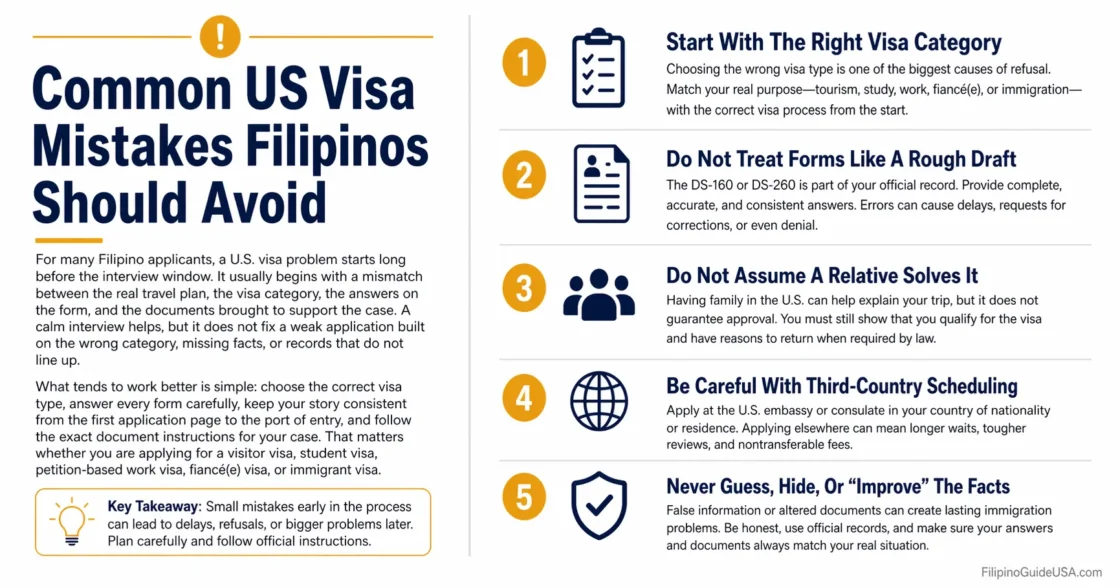
For many Filipino applicants, a U.S. visa problem starts long before the interview window. It usually begins with a mismatch between the real travel plan, the visa category, the answers on the form, and the documents brought to support the case. A calm interview helps, but it does not fix a weak application built on the wrong category, missing facts, or records that do not line up.
What tends to work better is simple: choose the correct visa type, answer every form carefully, keep your story consistent from the first application page to the port of entry, and follow the exact document instructions for your case. That matters whether you are applying for a visitor visa, student visa, petition-based work visa, fiancé(e) visa, or immigrant visa.
Start With The Right Visa Category
One of the most common mistakes is trying to make a real plan fit a visa that was not built for it. That often happens when the applicant wants the fastest appointment, thinks one visa is “easier,” or assumes a relative in the U.S. can solve the category issue later.
For example, a visitor visa is not the right path for ordinary employment, full-time study, or moving permanently to the United States.[e] If your real purpose is study, petition-based work, or immigration through family, the safer move is to prepare for the proper process instead of forcing a temporary visitor explanation that does not match your plans.
- If the trip is for tourism or short business activity, use a visitor visa path.
- If the plan is full-time study, use the student route.
- If a U.S. employer is sponsoring temporary work, make sure the petition and visa type match the job.
- If the goal is marriage-based entry or permanent relocation, do not present it as a normal tourist visit.
This sounds basic, but many refusals and delays start here. Once the category is off, every later answer becomes harder to explain.
Do Not Treat The DS-160 Or DS-260 Like A Rough Draft
Another common mistake is treating the form like a quick online task. The visa application is part of your record. Names, passport details, past travel, work history, school history, prior refusals, social media questions where required, and contact details should be complete and internally consistent. The Department of State warns that inaccurate or incomplete DS-160 answers can lead to correction requests, interview disruption, or problems retrieving the case, and the confirmation page is required at the interview.[a]
Before submitting, slow down and review details that often cause trouble:
- Passport number, full legal name, and date of birth
- Employment titles and dates
- Past U.S. trips and prior visa outcomes
- School names, program dates, and addresses
- The exact embassy or consulate process you are using
If you notice an error after submission, do not assume you can “just explain it later.” Follow the correction instructions given for that form and for the post handling your case.
Do Not Assume A Relative In The U.S. Solves A Weak Nonimmigrant Case
Many Filipinos apply with help from relatives in the United States. That can be useful for planning a trip or explaining where you will stay. But for nonimmigrant visas, especially visitor visas, the officer still needs to see that you fit the category you chose and, where the law requires it, that you have enough ties outside the United States to leave after a temporary stay. A refusal under INA 214(b) means the officer was not satisfied on those points.[b]
That is why it is risky to rely on only one idea: “My aunt will sponsor me,” or “My brother is in America, so the visa should be fine.” Sponsorship can be part of the picture, but it does not replace the need for a believable temporary purpose, stable background details, and answers that make sense for your situation.
- Be clear about why you are traveling now.
- Make sure your work, study, family, or business ties are described honestly.
- Do not inflate income, job rank, or property ownership to look stronger.
- Do not assume a U.S. contact is enough by itself.
Be Careful With Third-Country Scheduling
Some applicants living or working outside the Philippines assume they can simply book in any country with faster slots. Current Department of State guidance says nonimmigrant visa applicants should schedule at the U.S. embassy or consulate in their country of nationality or residence. Applicants who apply outside their country of nationality or residence may face longer waits, tougher practical review, and nontransferable fees.[c]
This matters for Filipinos working in the Gulf, studying abroad, or traveling often. Before paying or booking travel, confirm whether you are applying where the Department of State expects you to apply and whether you can show residence there if that is the basis for the appointment.
Never Guess, Hide, Or “Improve” The Facts
A serious mistake is changing facts to make the case look cleaner. That includes hiding a prior refusal, shortening a period of unemployment, adjusting dates to remove gaps, using fake bank records, submitting altered civil documents, or claiming something you know is not true. USCIS policy explains that fraud or willful misrepresentation in connection with an immigration benefit can create lasting immigration problems.[d]
If something in your record is weak, it is still better to deal with the real fact than to submit a version that can collapse later. Consular processing and later immigration filings often connect back to the same identity, travel, and case history. A short-term “fix” can turn into a long-term problem.
Bring Documents That Match The Visa, Not Just A Thick Folder
A large folder does not help if the contents do not support the actual case. For immigrant visa interviews, the Department of State says applicants must bring the original or certified copy version of required civil documents, and missing documents can delay or block issuance.[f]
For Filipino immigrant and fiancé(e) cases, the State Department’s Philippines reciprocity page points applicants to official records such as documents issued by the Philippine Statistics Authority and the National Bureau of Investigation where required.[g]
Think about documents in a focused way:
- For a visitor visa, bring items that support the stated purpose, funding, and reason to return, if the post asks for them.
- For a student visa, make sure the school record, finances, and study plan all match.
- For petition-based work, the employer, job, petition details, and intended activity should line up.
- For immigrant or fiancé(e) processing, use the exact civil documents the post and reciprocity schedule require, in the format required.
The mistake is not “bringing too few papers” in the abstract. The real mistake is bringing papers that do not fit the category, do not come from the proper issuing authority, or do not match what the form already says.
Do Not Assume You Qualify For An Interview Waiver
Another avoidable mistake is building your plan around the assumption that no interview will be needed. Department of State guidance updated in 2025 keeps interview waivers limited to certain categories and qualifying prior visa holders, with consular discretion still in place.[h]
That means you should not book flights, courier arrangements, hotel stays, or connecting travel based only on social media advice or old forum posts. Waiver rules can change, and local post practice still matters.
After Approval, Do Not Confuse The Visa With Admission
A visa in the passport is not the final step. The Department of State explains that a visa does not guarantee entry, and the Customs and Border Protection officer at the port of entry decides whether to admit you and how long you may stay. The visa expiration date is also not the same thing as your allowed stay in the United States.[i]
This is where some travelers make avoidable mistakes:
- They think visa validity tells them how long they can remain in the U.S.
- They assume they can change the trip purpose after arrival without consequences.
- They overstay because they looked at the visa foil instead of the admission record.
If you are admitted, check the terms of that admission and keep your stay consistent with the category you used to enter.
If You Receive A 221(g) Refusal, Respond Carefully And Early
Many applicants hear “221(g)” and assume the case is finished forever. Others ignore it and wait too long. The Department of State explains that 221(g) can mean the officer still needs more documents or information, or that the case requires administrative processing. Processing time varies by case, and applicants are advised to apply well before planned travel.[j]
If this happens, read the notice closely and answer exactly what was asked for. Do not send unrelated papers just to make the file look fuller. A clean, complete response is usually better than a rushed bundle of extra documents.
Before You Hit Submit
For Filipino applicants, the safest pattern is not fancy. It is disciplined.
- Choose the visa that matches the real purpose of travel.
- Make sure the form, interview answers, and documents tell the same story.
- Use official Philippine civil records when your case requires them.
- Do not rely on sponsorship alone for a weak temporary visa case.
- Do not submit anything false, altered, or guessed.
- Do not confuse visa approval with guaranteed entry or a fixed length of stay.
- Do not assume waiver rules or local procedures stayed the same from last year.
Most visa mistakes are not dramatic. They are small mismatches that add up. Catching them early is often what keeps an ordinary application from turning into a delay, a refusal, or a much bigger problem later.
Questions Many Filipinos Ask
Does A Relative In The U.S. Guarantee Approval?
No. A U.S. relative may explain where you will stay or help with costs, but you still need to qualify for the visa category you chose and present a believable case that matches your own background.
Is A 221(g) Case The Same As A Final Denial?
Not always. It can mean the officer needs more information or that the case is under further review. The best next step is to read the notice carefully and respond exactly as instructed.
Can I Use A Visitor Visa For Work Or Full-Time Study?
That is a common category mistake. Visitor visas are for temporary visitor purposes, not ordinary employment, full-time study, or permanent relocation.
Visa rules, interview practices, document lists, and local post procedures can change. Before you submit forms, pay fees, or travel for an appointment, check the current instructions for your visa type and the embassy or consulate handling your case.
Sources
- [a] DS-160: Frequently Asked Questions — Used for the points about accurate and complete DS-160 answers, correction steps, and the confirmation page requirement. (U.S. Department of State; official visa application instructions.) ↩
- [b] Visa Denials — Used for the explanation of INA 214(b), qualification for the visa category, and the need to overcome immigrant intent where the law requires it. (U.S. Department of State; official visa eligibility and refusal guidance.) ↩
- [c] Adjudicating Nonimmigrant Visa Applicants In Their Country Of Residence — Used for the current rule that nonimmigrant applicants should book in their country of nationality or residence, plus the warning about longer waits and fee issues outside that setting. (U.S. Department of State; current policy update from the agency running visa issuance.) ↩
- [d] USCIS Policy Manual, Volume 8, Part J, Chapter 2: Overview Of Fraud And Willful Misrepresentation — Used for the warning that false statements and deceptive submissions in immigration matters can carry lasting consequences. (USCIS Policy Manual; official legal policy reference.) ↩
- [e] Visitor Visa — Used for the point that visitor visas are not for ordinary employment, study, or permanent residence. (U.S. Department of State; official page for B visitor visa purposes and limits.) ↩
- [f] Interview Preparation — Used for the point that immigrant visa applicants must bring required original or certified civil documents to the interview. (U.S. Department of State; official immigrant visa interview instructions.) ↩
- [g] Philippines: Visa Reciprocity And Civil Documents By Country — Used for the Philippines-specific note on official civil records, including PSA and NBI documents where required. (U.S. Department of State reciprocity schedule; official country-specific document reference.) ↩
- [h] Interview Waiver Update — Used for the point that interview waiver eligibility is limited and tied to current Department rules and consular discretion. (U.S. Department of State; official update on waiver eligibility.) ↩
- [i] What The Visa Expiration Date Means — Used for the distinction between visa validity, admission at the port of entry, and the actual period of authorized stay. (U.S. Department of State; official explanation of admission and stay length.) ↩
- [j] Administrative Processing Information — Used for the explanation of 221(g), case-specific review, and the need to apply well before planned travel. (U.S. Department of State; official page on post-interview processing and refusals.) ↩